Why Every NBFC Needs an Advanced Loan Management Software

The Indian NBFC sector has grown at a remarkable pace over the last decade. With over 10,000 registered NBFCs in the country and billions of dollars in assets under management, these institutions are the backbone of credit access for millions of underserved borrowers — from micro-entrepreneurs in tier-3 cities to salaried professionals seeking instant personal loans.
Yet despite this explosive growth, a large number of NBFCs still rely on fragmented, outdated systems to manage their loan portfolios. Manual spreadsheets, disconnected ERPs, and legacy software that wasn’t built for the digital lending era are quietly costing these institutions money, compliance points, and customer trust.
This is where advanced Loan Management Software (LMS) becomes not just useful — but essential.
Start Free Trial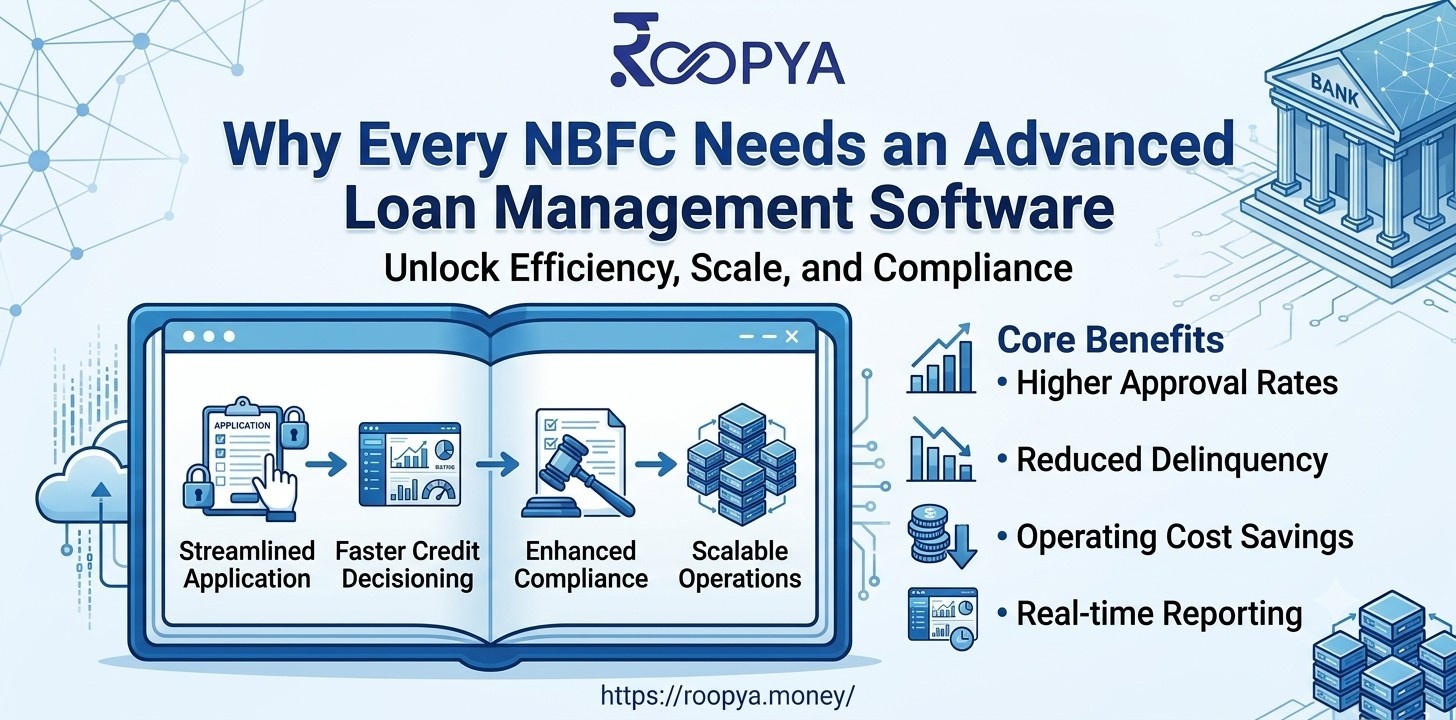
What Is Loan Management Software?
A Loan Management System (LMS) is a technology platform that automates and manages the complete post-disbursement lifecycle of a loan. Once a borrower is approved and funds are released, the LMS takes over — tracking repayments, managing amortization schedules, sending automated payment reminders, handling prepayments and foreclosures, generating regulatory reports, and flagging early warning signs of default.
Think of it as the operational backbone of your lending business: the system of record that knows the exact status of every loan in your portfolio at any given moment.
Modern LMS platforms like Roopya go far beyond basic loan tracking. They combine AI-powered collections, real-time portfolio analytics, compliance automation, and seamless integrations with payment gateways and credit bureaus — all on a single, no-code platform.
The Hidden Cost of Manual Loan Management
Before exploring what an advanced LMS can do, it is worth understanding what happens when NBFCs operate without one — or with an inadequate system.
Operational inefficiency is the most immediate pain point. Loan officers spend hours every week manually updating spreadsheets, reconciling payment data from multiple sources, and generating reports by hand. This is not just time-consuming; it is error-prone. A single miscalculation in an amortization schedule or a missed payment entry can snowball into a customer dispute, an audit finding, or a regulatory penalty.
Rising NPAs are another consequence. Without real-time visibility into borrower repayment behavior, early delinquency signals go unnoticed until accounts have already crossed the 90-day NPA threshold. By that point, recovery becomes exponentially harder and more expensive.
Compliance risk looms large as well. The RBI continuously updates its Fair Practices Code, IRACP norms, and digital lending guidelines. NBFCs without automated compliance tools are perpetually playing catch-up, and a single lapse can result in penalties, restrictions, or reputational damage.
Finally, poor borrower experience damages retention and word-of-mouth. Borrowers today expect instant statements, digital repayment options, and proactive communication. An NBFC that sends paper notices weeks after a missed payment or cannot provide a real-time outstanding balance on demand will quickly lose customers to nimbler competitors.
7 Reasons Every NBFC Needs an Advanced Loan Management Software
1. End-to-End Loan Lifecycle Automation
An advanced LMS automates every stage of the post-disbursement journey. From generating repayment schedules on the day of disbursement to processing final closure and issuing a No-Dues Certificate — every step is handled systematically, with no manual intervention required.
Roopya’s LMS, for example, supports multiple amortization methodologies including flat rate, reducing balance, and bullet repayment structures. It auto-generates EMI schedules, applies prepayment logic, handles part-payments, and recalculates outstanding principal dynamically — all without requiring your operations team to touch a single spreadsheet.
This level of automation reduces operational costs, eliminates human error, and allows your team to focus on higher-value activities like customer relationship management and portfolio strategy.
2. AI-Powered Collections and Recovery
Collections is where many NBFCs bleed most. Traditional collection models are reactive: a borrower misses an EMI, a collector is assigned days later, and by the time meaningful contact is made, the borrower has already slipped further.
Modern LMS platforms flip this model on its head using predictive analytics and AI-driven intervention workflows. By analyzing patterns in repayment history, bank account behavior, and borrower demographics, the system identifies which borrowers are at elevated risk of default before they actually miss a payment.
Roopya’s collections module uses AI to prioritize collection queues, assign the right channel (SMS, WhatsApp, voice call, email) for each borrower segment, and automate escalation workflows based on Days-Past-Due (DPD) buckets. The result is a measurable improvement in collection efficiency — Roopya reports up to 60% better collections for lenders using its AI-driven collection engine.
For NBFCs operating at scale, this translates directly into lower provisioning requirements, stronger balance sheets, and better ROE.
3. Real-Time Portfolio Visibility and Analytics
What you cannot measure, you cannot manage. Yet many NBFC management teams are still looking at portfolio data that is 24 to 48 hours stale — or worse, manually compiled once a week.
An advanced LMS provides a real-time, 360-degree view of your loan portfolio through customizable dashboards and reporting tools. You can drill down by product type, geography, loan officer, vintage, DPD bucket, or any other dimension that matters to your business.
Roopya’s lending analytics layer includes credit risk analytics, portfolio performance metrics, and trend analysis that help leadership make faster, more informed decisions. Whether you need to assess concentration risk in a particular borrower segment or evaluate the effectiveness of a new collection strategy, the data is available instantly.
This visibility is also critical for board reporting, investor updates, and regulatory submissions — all of which demand accurate, up-to-date portfolio data.
4. Automated Regulatory Compliance
The RBI’s digital lending framework has become significantly more stringent in recent years. NBFCs must comply with rules around Key Fact Statements (KFS), cooling-off periods, lending service provider disclosures, and the IRACP (Income Recognition and Asset Classification Prudential) norms — among many others.
Keeping up with these requirements manually is a significant compliance burden. An advanced LMS automates compliance by embedding regulatory rules directly into workflows. Amortization calculations follow RBI-prescribed methodologies. NPA classification happens automatically based on DPD. Regulatory reports — including those required for the RBI’s supervisory portal — are generated with a single click.
Roopya’s platform is continuously updated to reflect the latest regulatory changes, so NBFCs do not need to scramble every time a new circular is issued. This “always compliant” approach is a significant competitive advantage, particularly for smaller NBFCs that lack large compliance teams.
5. Seamless Integration with the Lending Ecosystem
A Loan Management System does not operate in isolation. It needs to connect with payment gateways for EMI collection, credit bureaus for NPA reporting and credit data updates, accounting systems for ledger entries, and customer communication platforms for automated notifications.
Older LMS platforms often require expensive custom integrations to connect with these systems. Roopya’s platform comes with 300+ pre-integrated APIs covering payment processors (UPI, NACH, debit card), major credit bureaus (CIBIL, Experian, CRIF, Equifax), verification services, and communication tools.
This plug-and-play ecosystem means NBFCs can go live quickly, reduce integration costs, and ensure data flows seamlessly across their entire technology stack — without writing a single line of code.
6. Superior Borrower Experience Through Self-Service
Borrower expectations have changed dramatically. The same customer who uses UPI for daily payments and checks their mutual fund portfolio on an app expects a similarly seamless experience from their lender. They want to check their outstanding balance, download a repayment schedule, make a prepayment, or request a statement — all without calling a customer service agent.
An advanced LMS includes a customer-facing portal that delivers exactly this experience. Borrowers can self-serve for routine requests, receive proactive notifications about upcoming EMIs, and get instant digital receipts for every payment. This reduces inbound call volumes for the NBFC while simultaneously improving customer satisfaction scores.
For NBFCs focused on customer lifetime value, a great borrower experience is a direct driver of repeat lending and referral growth.
7. Scalability Without Proportional Cost Growth
One of the most powerful benefits of cloud-native LMS platforms is that they allow NBFCs to scale their loan books without proportionally scaling their operations teams. Traditional models require NBFCs to hire more loan servicing staff as their portfolio grows. With an advanced LMS, automation handles the incremental volume.
Roopya’s platform is built on a pay-as-you-use pricing model with zero upfront costs, making it accessible to both early-stage NBFCs that are building their first loan portfolio and established lenders that are scaling aggressively. The infrastructure scales automatically to handle peak volumes — whether that is a surge in disbursements at month-end or a spike in collections activity during festive season.
This economic model fundamentally changes the unit economics of loan servicing and enables NBFCs to compete with the efficiency of digital-first lenders.
Roopya: Built for the Modern NBFC
Roopya is India’s leading digital lending infrastructure platform, purpose-built for NBFCs, banks, MFIs, and modern financial institutions. Its comprehensive suite includes a Loan Origination System (LOS), Loan Management System (LMS), Collections module, Early Warning System, and Advanced Lending Analytics — all on a single, unified, no-code platform.
Key capabilities that set Roopya apart:
- 1-day go-live — fully operational loan management within 24 hours of onboarding
- No-code configuration — business teams can configure products, workflows, and rules without IT involvement
- AI-powered document analysis with 99%+ accuracy for verification and fraud detection
- Intelligent credit decisioning that processes applications in milliseconds
- 20+ pre-configured loan products including personal loans, MSME loans, gold loans, and more
- 300+ pre-integrated APIs across payments, bureaus, verification, and communication
- Real-time dashboards and regulatory reporting built for RBI compliance
Trusted by modern lenders including IndiaKaLoan, QuickFinShop, Recapita, Findoc, and EazyCredit, Roopya delivers measurable outcomes: 10x faster processing, 40% better credit accuracy, 80% fraud reduction, and 60% improvement in collections.
The NBFC sector is at an inflection point. Regulatory scrutiny is intensifying, borrower expectations are rising, and competition from fintech lenders and digital-first NBFCs is growing. In this environment, operational excellence is no longer a differentiator — it is a prerequisite for survival and growth.
Advanced Loan Management Software is the foundation of that operational excellence. It automates what should be automated, surfaces the insights that drive better decisions, ensures compliance without manual effort, and delivers the borrower experience that drives loyalty.
For NBFCs that want to scale profitably, reduce risk, and serve more borrowers with greater efficiency, the question is no longer whether to invest in an advanced LMS — it is which one to choose, and how quickly you can deploy it.
Roopya helps you answer both questions. With a 1-day setup, zero upfront cost, and a platform built specifically for the Indian lending ecosystem, Roopya is the fastest path to a modern, compliant, and scalable loan management operation.

