Microfinance Software for Loan Management System: The Complete Guide for Modern Lenders

India’s financial ecosystem is changing rapidly. From rural borrowers to urban entrepreneurs, access to small-ticket credit has become an essential driver of economic growth. Microfinance institutions (MFIs), NBFCs, cooperative societies, fintech companies, and digital lenders now manage thousands of loan applications every month.
Traditional paper-based lending processes are no longer sufficient. Manual verification, spreadsheet-based repayment tracking, and disconnected systems create delays, increase operational costs, and expose organizations to compliance risks.
This is where microfinance software for loan management systems becomes a strategic investment.
Start Free Trial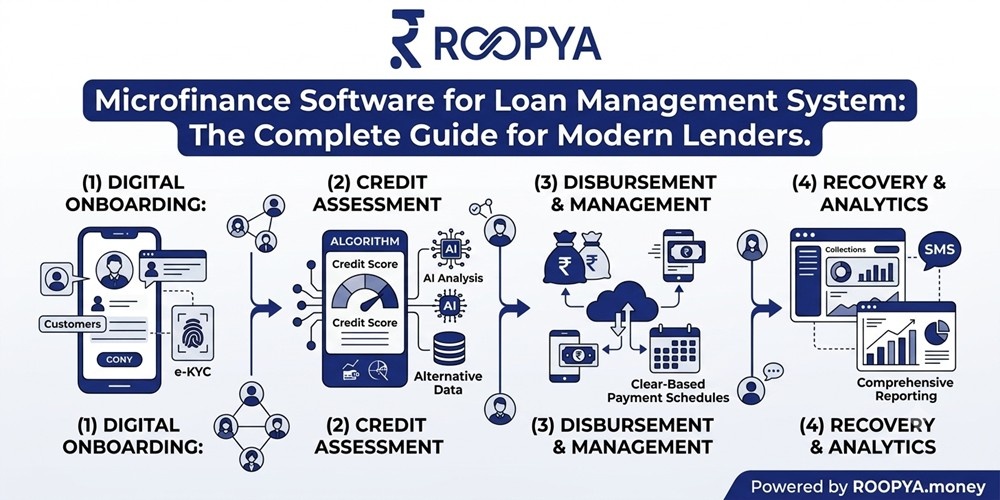
A modern platform automates the complete lending lifecycle—from customer onboarding and KYC verification to credit assessment, loan disbursement, EMI collection, portfolio monitoring, and recovery management.
For organizations aiming to scale efficiently while improving borrower experience, adopting digital microfinance software is no longer optional—it is a competitive necessity.
What is Microfinance Software?
Microfinance software is a specialized digital platform designed to help financial institutions automate and manage lending operations.
It centralizes borrower information, loan applications, underwriting, approvals, disbursements, repayment schedules, collections, reporting, and compliance into a single integrated system.
Instead of relying on manual workflows, lenders can process loans faster while minimizing operational errors.
What is a Loan Management System (LMS)?
A Loan Management System (LMS) is software that manages every activity after loan approval.
It handles:
- EMI scheduling
- Interest calculations
- Repayment tracking
- Penalty computation
- Partial payments
- Foreclosure
- Restructuring
- Customer statements
- Collections
- Reporting
An LMS ensures that lenders maintain complete visibility over every active loan.
Why Microfinance Institutions Need Digital Software
Many MFIs still rely on outdated systems.
Common challenges include:
- Manual paperwork
- Duplicate customer records
- Slow approvals
- Data entry mistakes
- Missed repayments
- Compliance issues
- Poor borrower communication
- Limited reporting
Digital software solves these issues through automation and centralized management.
Core Components of Modern Microfinance Software
1. Customer Onboarding
Digital registration enables borrowers to submit applications online.
Features include:
- Mobile onboarding
- Aadhaar verification
- PAN verification
- OCR document extraction
- eKYC
- Digital signatures
2. Loan Origination
Loan origination covers:
- Application capture
- Eligibility checks
- Document verification
- Credit assessment
- Approval workflows
Automation significantly reduces turnaround time.
3. Credit Decision Engine
Modern platforms evaluate applicants using:
- Credit bureau data
- Banking history
- Income verification
- Employment details
- Alternative data
- Internal risk policies
AI-powered decision engines improve approval quality.
4. Loan Disbursement
Approved loans can be disbursed digitally through integrated banking systems.
Automation reduces delays and improves customer satisfaction.
5. EMI Management
The software automatically generates:
- Repayment schedules
- Due dates
- Outstanding balances
- Payment reminders
- Interest calculations
6. Collections Management
Collection modules include:
- SMS reminders
- WhatsApp notifications
- Email alerts
- Agent assignment
- Recovery tracking
- Delinquency management
7. Portfolio Analytics
Decision-makers receive dashboards showing:
- Collection efficiency
- NPA trends
- Portfolio growth
- Branch performance
- Risk exposure
Benefits of Microfinance Loan Management Software
Faster Loan Processing
Automation eliminates repetitive manual tasks.
Applications that previously took days can often be processed within minutes.
Lower Operational Costs
Reduced paperwork lowers administrative expenses.
Less manual intervention means fewer staffing requirements.
Better Customer Experience
Borrowers receive:
- Instant updates
- Faster approvals
- Digital documentation
- Online repayments
Improved Compliance
Software helps lenders maintain regulatory documentation and audit trails.
Enhanced Data Security
Cloud platforms protect sensitive borrower information using encryption and role-based access controls.
Higher Collection Rates
Automated reminders increase repayment consistency.
Better Decision Making
Real-time analytics help management identify trends quickly.
Features Every Microfinance Software Should Include
- Cloud deployment
- Mobile accessibility
- API integrations
- Automated underwriting
- Credit bureau integration
- KYC automation
- Loan servicing
- EMI management
- Collections automation
- Multi-branch support
- Multi-user roles
- Audit logs
- Analytics dashboards
- RBI-ready reporting
- Data backup
Cloud-Based vs Traditional Software
| Cloud Software | Traditional Software |
|---|---|
| Accessible anywhere | Office-only access |
| Lower infrastructure cost | Expensive servers |
| Automatic updates | Manual upgrades |
| Better scalability | Limited expansion |
| Easier integrations | Complex deployment |
AI in Modern Microfinance Software
Artificial intelligence enables:
- Fraud detection
- Credit scoring
- Risk prediction
- Automated underwriting
- Collection prioritization
- Customer service chatbots
AI reduces human error while increasing efficiency.
Role of Automation in Lending
Automation simplifies:
- Loan applications
- KYC verification
- Rule-based approvals
- Notifications
- EMI reminders
- Payment reconciliation
- Portfolio reporting
Mobile Apps for Field Officers
Field executives can:
- Capture borrower data
- Upload documents
- Verify addresses
- Collect repayments
- Sync records instantly
This improves productivity in rural operations.
Digital Collections Strategy
Modern software supports:
- UPI payments
- NACH mandates
- QR collections
- Payment gateways
- Auto reminders
These features reduce defaults.
Security Features
Enterprise-grade platforms provide:
- End-to-end encryption
- Role-based permissions
- Two-factor authentication
- Secure APIs
- Audit trails
- Backup systems
Compliance Requirements
Microfinance software should support:
- KYC compliance
- AML checks
- Consent management
- Audit logs
- Regulatory reporting
- Data privacy
Choosing the Best Microfinance Software
Before selecting a platform, evaluate:
- Scalability
- Customization
- API ecosystem
- Cloud infrastructure
- Support quality
- AI capabilities
- Pricing
- Compliance readiness
Why Roopya is an Ideal Choice
Roopya provides an integrated lending platform designed for NBFCs, fintechs, and microfinance institutions with features such as:
- AI-powered loan origination
- Loan management
- Collections automation
- No-code configuration
- Cloud-native deployment
- API integrations
- Analytics dashboards
- Compliance-focused workflows
Its unified approach helps lenders streamline operations while supporting business growth.
Future of Microfinance Technology
Emerging trends include:
- AI underwriting
- Embedded finance
- Open banking
- Predictive analytics
- Hyperautomation
- Digital KYC
- Instant disbursement
- API-first ecosystems
Organizations adopting these technologies are likely to gain significant operational advantages.
Microfinance software has evolved from a simple loan tracking application into a complete digital lending ecosystem.
For lenders seeking operational efficiency, regulatory readiness, and scalable growth, investing in a modern loan management system can improve customer experience, reduce costs, and support data-driven decision-making.
As digital lending continues to expand across India, institutions that embrace automation and intelligent workflows will be better positioned to compete in an increasingly technology-driven market.

