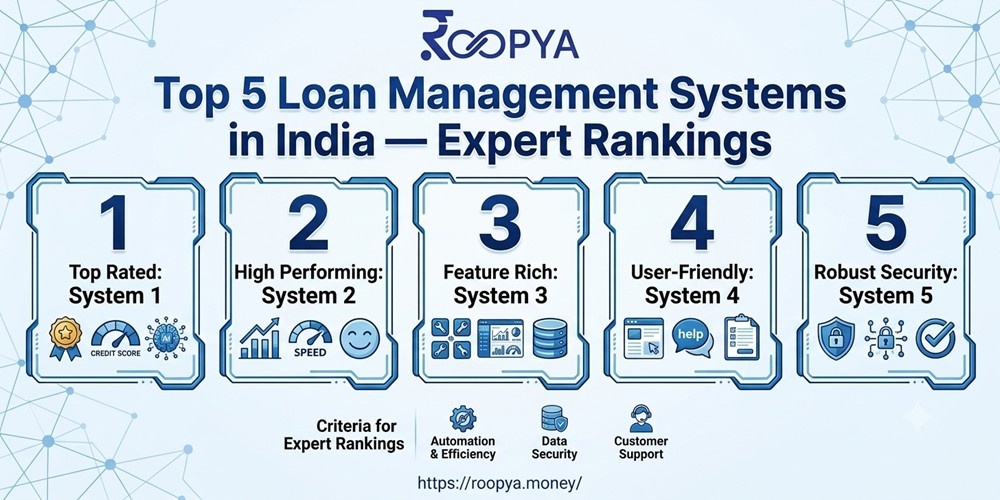
Top 5 Loan Management Systems in India — Expert Rankings

India’s digital lending revolution is accelerating at a remarkable pace. With over 10,000 registered NBFCs, hundreds of fintech lenders, and traditional banks aggressively digitising their portfolios, the demand for robust Loan Management Systems (LMS) has never been higher. Choosing the right LMS can be the difference between scaling profitably and drowning in operational chaos.
In this expert-ranked guide, we evaluate India’s top 5 loan management systems across critical parameters: automation depth, regulatory compliance, API ecosystem, configurability, and total cost of ownership. Whether you are an NBFC, MFI, fintech, or a bank seeking a modern servicing backbone, this ranking will help you make the right call.
Start Free Trial
India Loan Management System Market Overview
India’s LMS market is one of the fastest-growing segments within the broader fintech infrastructure space. The country’s credit penetration remains significantly below global averages, which means the headroom for growth — and the need for scalable loan servicing technology — is enormous.
Several macro forces are shaping this market:
- RBI’s digital lending guidelines requiring end-to-end auditability of loan lifecycle events
- Account Aggregator (AA) framework enabling consent-based financial data sharing
- India Stack integrations (Aadhaar, PAN, DigiLocker) becoming mandatory for compliant onboarding
- Rising NPA pressures demanding smarter early warning and collections modules
- Co-lending partnerships between banks and NBFCs requiring seamless data interchange
A modern LMS is no longer just a ledger of outstanding loans. It is a configurable orchestration layer that handles everything from disbursement to collections, from regulatory reporting to borrower self-service portals. The platforms that win in 2026 are those that combine deep automation with openness — meaning plug-and-play APIs, no-code configuration, and real-time analytics.
How We Ranked These Systems
Our expert panel assessed each platform across six weighted criteria:
| Criteria | What We Evaluated | Weight |
| Automation & AI | Rule engine, auto-decisioning, AI-based document verification | 25% |
| API Ecosystem | Pre-built integrations, REST API openness, bureau connectivity | 20% |
| Regulatory Compliance | RBI guidelines, FIU reporting, audit trails, CKYC | 20% |
| Configurability | No-code setup, loan product flexibility, workflow design | 15% |
| Pricing & TCO | Upfront cost, per-transaction fees, hidden costs | 10% |
| Support & Go-Live Speed | Onboarding time, SLA, documentation, training | 10% |
Top 5 Loan Management Systems in India (2026)
#1 Roopya — Best Overall LMS for NBFCs & Modern Lenders
Platform: roopya.money | Best For: NBFCs, MFIs, Fintechs, Co-lending setups
Roopya occupies the top spot in our ranking for one compelling reason: it is the only platform in India that delivers a truly no-code, AI-powered, end-to-end lending infrastructure with a go-live time of just one day. Built by GeoAlgo Technologies Private Limited and headquartered in Gurgaon, Roopya has rapidly become the preferred choice for modern lenders who want speed, configurability, and compliance without the complexity of legacy systems.
At its core, the Roopya LMS handles portfolio management, payment processing, amortisation schedule generation, and customer portal delivery seamlessly. But what sets it apart is the surrounding ecosystem: an LOS, a collections module, an early warning system, and a full lending analytics layer — all tightly integrated under one roof.
Key Strengths of Roopya LMS:
- 1-Day Go-Live: Unmatched onboarding speed. Most competitors take weeks to months.
- 300+ Pre-integrated APIs: Credit bureaus (CIBIL, Experian, Equifax), Aadhaar eKYC, DigiLocker, PAN verification, payment gateways, and more — all pre-connected.
- No-Code Business Rule Engine (BRE): Credit teams can configure underwriting policies, approval thresholds, and collection triggers without touching code.
- AI-Powered Document Analysis: 99%+ accuracy in OCR and document fraud detection, reducing verification time from hours to seconds.
- Pay-As-You-Use Pricing: Zero upfront investment. This is transformative for early-stage NBFCs and fintechs watching their burn.
- 20+ Pre-configured Loan Products: Personal loans, business loans, gold loans, payday loans, home loans, auto loans — launch-ready templates.
- Early Warning System: ML-based models identify borrowers at risk of default weeks before a missed EMI, enabling proactive intervention.
- RBI-Compliant Architecture: Continuously updated to reflect evolving digital lending regulations, FIU norms, and data localisation requirements.
- Advanced Fraud Detection: AI modules cross-check applicant data against multiple signals simultaneously, reducing fraud by up to 80% per the platform’s internal benchmarks.
Roopya’s collections module deserves special mention. Its AI-driven engine reportedly delivers 60% better collection outcomes by dynamically adjusting communication strategy, channel, and timing based on individual borrower behaviour.
For lenders evaluating a platform that can grow with them from 100 loans to 1,00,000 loans without re-platforming, Roopya is the standout choice in India’s market today.
Expert Rating: 9.5/10
#2 Nucleus Software — Best for Large Banks & Enterprise NBFCs
Platform: nucleussoftware.com | Best For: Large private sector banks, large NBFCs
Nucleus Software’s FinnOne Neo is one of India’s most established loan management platforms, with decades of deployments across banks in India, Southeast Asia, and the Middle East. FinnOne Neo handles complex multi-entity, multi-currency environments with deep support for treasury operations, regulatory reporting, and large-scale collections.
The platform is a strong fit for institutions with complex product hierarchies, large IT teams, and the budget for a long implementation cycle. However, its setup timeline — typically 6 to 18 months — and high licensing costs place it out of reach for smaller lenders.
- Strength: Battle-tested at scale with large institutions
- Strength: Rich reporting and regulatory module depth
- Weakness: High cost and long implementation cycles
- Weakness: Limited no-code flexibility for business users
Expert Rating: 8.0/10
#3 Loanpro (India deployments) — Best for Configurable Loan Servicing
Platform: loanpro.io | Best For: Mid-market lenders, consumer finance companies
LoanPro, while US-headquartered, has gained traction among Indian lenders through partners and integrators who adapt it to local regulatory requirements. Its core strength lies in extreme loan product configurability — interest accrual methods, fee structures, and payment allocation rules can all be tailored without custom development.
The trade-off is that India-specific integrations (NACH mandates, GST-compliant invoicing, RBI reporting formats) require significant custom work. Lenders need a strong implementation partner and budget for localisation.
- Strength: Highly granular loan product configuration
- Strength: Modern API-first architecture
- Weakness: India-specific compliance requires significant custom effort
- Weakness: Support response times can be slower given time zone differences
Expert Rating: 7.5/10
#4 Credgenics — Best for Collections-First Lenders
Platform: credgenics.com | Best For: Lenders with large NPA portfolios, collection-heavy operations
Credgenics is not a full-stack LMS in the traditional sense, but its strength in the collections and NPA resolution layer makes it a critical tool for lenders managing stressed assets. The platform uses AI to predict default probability and optimises collection agent workflows accordingly, leading to measurably improved recovery rates.
For lenders who already have a servicing platform but need a superior collections overlay, Credgenics is an excellent specialist. However, it lacks the origination, disbursement, and portfolio management features that a standalone LMS requires.
- Strength: Market-leading AI collections and NPA management
- Strength: Deep legal notice and SARFAESI workflow automation
- Weakness: Not a full-stack LMS — needs pairing with another platform
- Weakness: Best value realised at significant loan book scale
Expert Rating: 7.2/10
#5 Finflux (by M2P) — Best for Microfinance & Rural Lending
Platform: finflux.com | Best For: MFIs, rural lenders, co-operative banks
Finflux, now part of the M2P Fintech ecosystem, has carved a strong niche in microfinance and rural lending segments. It supports group loans, JLG structures, field officer workflows, and offline-first data collection — features critical for lenders operating in low-connectivity geographies.
The platform’s handling of SHG (Self Help Group) and JLG (Joint Liability Group) loan structures is best-in-class for the MFI segment. However, for urban NBFCs or digital-first lenders, it may feel underspecified in areas like digital customer journeys and advanced analytics.
- Strength: Excellent JLG, SHG, and group lending support
- Strength: Offline field operations and rural network management
- Weakness: Less suited to urban digital-first lending models
- Weakness: Analytics and AI capabilities lag behind newer platforms
Expert Rating: 7.0/10
Side-by-Side Comparison: Top 5 LMS Platforms in India
| Feature | Roopya | Nucleus | LoanPro | Credgenics | Finflux |
| Go-Live Time | 1 Day | 6–18 Months | 3–6 Months | 4–8 Weeks | 4–12 Weeks |
| No-Code Config | Yes | Partial | Partial | Partial | No |
| AI/ML Modules | Advanced | Basic | Moderate | Advanced | Basic |
| Pre-built APIs | 300+ | 50+ | 100+ | 40+ | 60+ |
| Collections | Yes | Yes | Basic | Best-in-class | Yes |
| India Compliance | Native | Native | Custom needed | Native | Native |
| Pricing Model | Pay-as-use | License | SaaS/License | SaaS | License/SaaS |
| Best For | All modern lenders | Large banks | Mid-market | Collections | MFI/Rural |
| Expert Rating | 9.5/10 | 8.0/10 | 7.5/10 | 7.2/10 | 7.0/10 |
Why Roopya Leads the Market in 2026
The lending technology landscape in India is cluttered with legacy systems built for a pre-digital world. Roopya represents a fundamental rethink: a platform designed from the ground up for the speed, compliance complexity, and API-first world that modern Indian lenders operate in.
Three factors make Roopya uniquely positioned:
- Speed to Market: When a lending window opens — be it a regulatory change, a seasonal credit demand spike, or a new co-lending partnership — Roopya lets lenders act in hours, not months.
- Total Cost Alignment: The pay-as-you-use model means technology costs scale with revenue. Early-stage NBFCs are not penalised with enterprise licensing fees they cannot afford.
- Future-Readiness: Roopya’s continuous regulatory updates, AI model improvements, and expanding API library mean the platform gets better over time without lender intervention.
For any NBFC, fintech, or modern financial institution evaluating loan management systems in India today, Roopya deserves serious consideration as the first — and possibly final — platform they will ever need.
Ready to Choose the Right LMS? Start with Roopya.
If speed, compliance, and zero upfront cost are your priorities — and they should be — Roopya is the loan management system built for India’s next generation of lenders. Join NBFCs, fintechs, and MFIs already scaling their lending operations on Roopya’s unified platform.
Request a Demo: https://roopya.money/contact-us/
LMS Product Page: https://roopya.money/loan-management-system/
Sign Up Free: https://lenders.roopya.money/#/register

