Top 10 Loan Management Software (LMS) Provider Companies in India

India’s #1 Loan Management Software (LMS) rovider Companies in India
India’s lending ecosystem is undergoing a profound digital transformation. With the loan management software market projected to reach $29.86 billion by 2031 at a CAGR of 17.8%, financial institutions — from large banks to emerging NBFCs and microfinance institutions — are under increasing pressure to modernize their lending operations.
At the heart of this transformation is the Loan Management System (LMS) — a software platform that automates and manages the complete post-disbursement loan lifecycle, including EMI tracking, collections, repayment posting, NPA management, regulatory reporting, and customer communications.
Choosing the right LMS is one of the most consequential technology decisions a lender can make. The wrong platform leads to operational inefficiencies, compliance gaps, poor borrower experiences, and higher NPAs. The right platform becomes a strategic advantage — enabling faster go-lives, lower costs, and scalable growth.
In this comprehensive guide, we evaluate and rank the Top 10 Loan Management Software Provider Companies in India based on features and functionality, ease of use, implementation speed, compliance and regulatory alignment, pricing model, customer support, and AI and automation capabilities.
Whether you are a fintech startup, an NBFC scaling rapidly, or a traditional MFI going digital, this list will help you find the right LMS partner for your specific needs.
Start Free Trial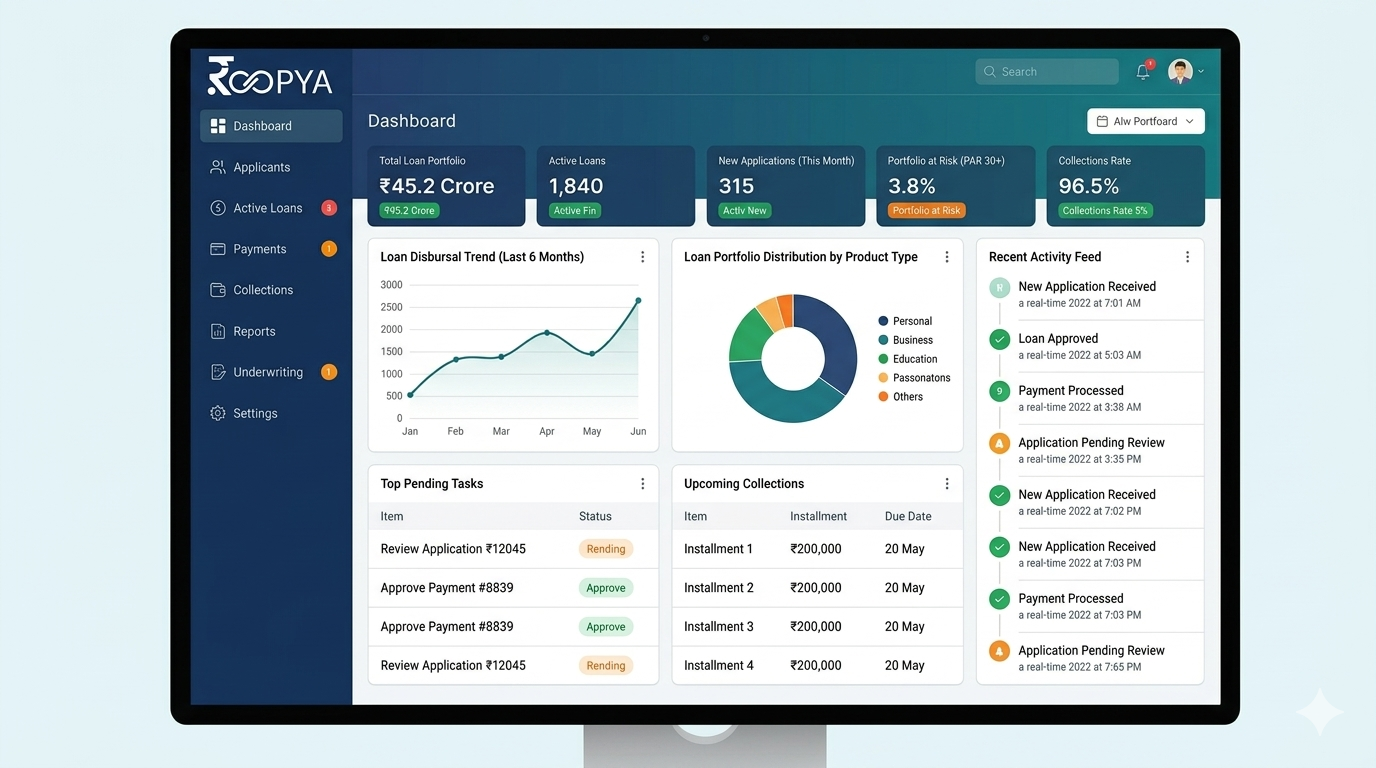
What Is a Loan Management System (LMS)?
A Loan Management System (LMS) is a digital platform that handles everything that happens after a loan is disbursed. It is distinct from a Loan Origination System (LOS), which handles the application and approval process.
Key functions of an LMS include:
- EMI Scheduling & Amortization — Automatically generate repayment schedules based on loan terms
- Payment Processing — Accept and reconcile repayments via UPI, NEFT, NACH, and other payment modes
- Collections Management — Automate dunning, reminders, field agent workflows, and recovery tracking
- NPA Management — Classify accounts, compute provisioning, and manage write-offs per RBI guidelines
- Regulatory Reporting — Generate RBI-compliant reports, audit trails, and CERSAI filings
- Customer Portal — Enable borrowers to view statements, make payments, and raise service requests
- Portfolio Analytics — Track portfolio health, delinquency trends, and collection efficiency
Modern LMS platforms combine all of the above with cloud-native architecture, open API integrations, AI-driven decisioning, and no-code configurability — enabling lenders to launch and manage loan products faster than ever before.
Why Indian Lenders Need a Modern LMS
India’s digital lending environment has become more complex and competitive than ever. Several forces are driving urgency:
Regulatory Pressure: RBI’s digital lending guidelines, DPDPA (Digital Personal Data Protection Act), and account aggregator frameworks require lenders to maintain stringent audit trails, data consent management, and transparent borrower communication — all of which demand a robust LMS.
Rising Digital Borrower Expectations: Modern borrowers expect instant disbursals, real-time account visibility, and frictionless repayment — none of which are possible with manual or legacy systems.
Co-Lending Expansion: The RBI’s 2025 co-lending guidelines have increased the complexity of loan portfolio management, requiring platforms that natively support triple schedule generation, blended rate computation, and escrow automation.
NPA Management: With rising credit risk, lenders need early warning systems, behavioral analytics, and AI-driven collection intelligence built directly into their LMS.
Cost Pressures: As competition intensifies, per-loan operational costs must come down. Automation through a modern LMS is the primary lever to achieve this.
Top 10 Loan Management Software (LMS) Companies in India
1. Roopya — Best Overall LMS for NBFCs & Digital Lenders
Website: roopya.money Headquarters: Gurugram, Haryana Founded: 2023 Best For: NBFCs, Fintechs, MFIs, and Digital-First Lenders of all sizes
Overview:
Roopya, built by GeoAlgo Technologies Private Limited, has rapidly emerged as India’s most complete and innovative digital lending platform. Rated 9.4/10 in independent evaluations across 8 parameters — features, compliance, security, implementation, customer feedback, pricing, ease of use, and support — Roopya consistently outperforms legacy and newer competitors alike.
What sets Roopya apart is its philosophy: enterprise-grade lending infrastructure delivered with consumer-grade simplicity. The platform is truly no-code, meaning business users — not IT teams — can configure loan products, workflows, credit policies, and collection strategies without writing a single line of code.
Key Features:
- Full LOS + LMS + Collections + Early Warning System in a single unified platform
- 300+ pre-integrated APIs — credit bureaus (CIBIL, Experian, CRIF, Equifax), payment gateways, KYC providers, and more
- 20+ pre-configured loan products — personal loans, business loans, gold loans, home loans, vehicle loans, payday/salary advance, MSME credit, and more
- AI-Powered Document Analysis with 99%+ accuracy for OCR, KYC, and fraud detection
- Intelligent Credit Decisioning using alternative data, behavioral analytics, and real-time financial indicators
- No-Code Business Rule Engine (BRE) for configuring credit policies, eligibility rules, and approval workflows visually
- AI-Driven Collections with sentiment scoring, borrower behavior modeling, and automated dunning
- Early Warning System with predictive risk models to identify potential defaults before they occur
- Cloud-Native Architecture with open REST APIs for seamless integration with CRMs, ERPs, and third-party tools
- Pay-As-You-Use Pricing with zero upfront cost — ideal for startups and growing NBFCs
Go-Live Speed: As fast as 1 day — the fastest in the industry. Most organizations go live in 5–7 days including data migration, training, and testing.
Compliance: Continuously updated for RBI digital lending guidelines, DPDPA, and CERSAI requirements.
AI Advantage:
- 10x faster document processing
- 40% better credit scoring accuracy
- 80% reduction in fraud rates
- 60% improvement in collection efficiency
- 95% accuracy in conversational AI borrower interactions
Why Choose Roopya: Roopya is the ideal choice for any lending institution that wants to go live fast, scale efficiently, and leverage the full power of AI — without heavy IT investment or complex implementation timelines. Its transparent pricing, exceptional customer support, and continuous product innovation make it the top-ranked LMS platform in India for 2025–2026.
2. Finflux (by M2P Fintech) — Best for Regional NBFCs Seeking Quick Deployment
Website: m2pfintech.com Headquarters: Chennai, Tamil Nadu Best For: Small to mid-sized NBFCs, Regional Lenders, Microfinance Institutions
Overview:
Finflux, acquired by M2P Fintech in July 2022, brings over 12 years of lending industry experience. It offers an integrated cloud-first lending solution covering LOS, LMS, debt collections, and microfinance platforms. It is a familiar and trusted name among regional NBFCs transitioning from manual to digital systems.
Key Features:
- Integrated LOS and LMS covering origination through collections
- Support for common Indian loan products and RBI-aligned regulatory reporting
- DPD-based tracking with automatic provisioning
- GST and TDS automation for compliance-ready operations
- Co-lending software with end-to-end partnership support
- 12 loan product types supported including microloans, agri loans, and gold loans
Considerations: As portfolios grow and product structures become more complex, Finflux’s customization flexibility can feel limiting for NBFCs planning aggressive scale or unique lending models.
3. Nucleus Software (FinnOne Neo) — Best for Large Banks & Enterprise NBFCs
Website: nucleussoftware.com Headquarters: Noida, Uttar Pradesh Best For: Large banks, housing finance companies, enterprise-scale NBFCs
Overview:
FinnOne Neo is Nucleus Software’s flagship loan management system with over a decade of deployments across banks and housing finance companies in India, Southeast Asia, and the Middle East. It follows an SOA-based architecture, enabling deep integration with core banking systems.
Key Features:
- ML-based risk models for early delinquency detection and NPA prediction
- Predictive analytics supporting provisioning and portfolio monitoring
- Support for 15+ loan products across secured, unsecured, and microfinance segments
- ISO 27001 certified with deep RBI compliance
- Trusted by 300+ lenders and 200+ banks including large institutions like Capri Loans and Moneyview
- Co-lending engine aligned to RBI 2025 guidelines
Considerations: FinnOne Neo is best suited for large, complex institutions. Implementation timelines tend to be longer, and the platform may be over-engineered for small or mid-sized lenders.
4. Synoriq (SynoFin) — Best for Multi-Product Lenders Seeking Unified Architecture
Website: synoriq.com Headquarters: Jaipur, Rajasthan Founded: 2017 Best For: NBFCs and digital lenders managing diverse loan product portfolios
Overview:
Synoriq has emerged as a strong player in India’s lending technology space with its SynoFin platform — a comprehensive single-code SaaS solution. With 35+ clients and managing ₹30,000+ Crore in AUM, Synoriq has built credibility as a serious LMS provider.
Key Features:
- Single-code SaaS platform combining LOS, LMS, collections, and customer service
- Support for 15+ loan products including personal, commercial, vehicle, and housing loans
- Advanced NPA management with automated asset classification
- Mobile-first design with a comprehensive app for field officers, including offline capabilities
- Rich rescheduling capabilities — instalment changes, part payments, rate changes, tenure modifications
- RBI-compliant reporting and audit trail management
Considerations: Synoriq is a solid choice for multi-product NBFCs but may require more technical involvement for customization compared to truly no-code platforms like Roopya.
5. CloudBankIN — Best for Startups & Small Lenders on a Budget
Website: cloudbankIN.com Headquarters: India Best For: Fintech startups, small NBFCs, microfinance institutions
Overview:
CloudBankIN is a seed-funded platform recognized as a Momentum Leader and High Performer by G2.com. It has been widely adopted in the Indian lending sector to digitize loan processes with accessible pricing and quick setup.
Key Features:
- Support for 12 loan product types: personal, business, vehicle, gold, line of credit, payday, microloans, and more
- Co-lending software with end-to-end support for co-lending partnerships
- DPD-based tracking with automatic provisioning
- Configurable product parameters including principal/interest ranges and calculation methods
- GST and TDS automation for built-in tax compliance
Considerations: CloudBankIN is an excellent entry-level option. However, for lenders with more complex lending models or ambitious scale targets, more enterprise-grade platforms would be needed.
6. Finezza — Best for Credit Assessment Depth & Analytics
Website: finezza.in Headquarters: Bengaluru, Karnataka Best For: NBFCs focused on data-driven credit underwriting and analytics
Overview:
Finezza provides an integrated lending platform covering origination, loan management, collections, bureau analysis, and document processing. Its primary differentiation lies in the depth of its credit assessment capabilities, making it particularly valuable for lenders where underwriting precision is critical.
Key Features:
- Bank statement analysis and GST-based cash flow evaluation for comprehensive credit assessment
- Account Aggregator integrations for real-time consented financial data
- Integrated collections and portfolio monitoring
- Bureau analysis with multi-bureau support (CIBIL, Experian, CRIF, Equifax)
- Document processing with intelligent extraction and verification
- Configurable credit policies and underwriting rules
Considerations: Finezza’s strength is in the credit assessment layer. Lenders looking primarily for post-disbursement management and collections automation may want to evaluate broader LMS capabilities.
7. LendFoundry — Best for Tech-Savvy Teams Wanting API-First Architecture
Website: lendfoundry.com Best For: Technology-driven lenders, digital-first NBFCs with strong engineering teams
Overview:
LendFoundry is designed for lenders that prefer modular, API-first architectures. It supports rapid product launches and flexible integrations with third-party services, making it a good fit for teams that want deep technical control over their lending stack.
Key Features:
- Modular, API-first architecture enabling custom workflows and integrations
- Support for rapid product launches across multiple loan types
- Flexible reporting and analytics customization
- Integration with credit bureaus, payment gateways, and AA framework
- Configurable business rules and underwriting logic
Considerations: LendFoundry assumes significant internal technical capability. NBFCs without strong engineering teams may face challenges configuring analytics or adapting workflows. It is better suited as a foundation for technically mature organizations than a plug-and-play LMS.
8. FinBox — Best for MSME Lenders Needing Credit Infrastructure
Website: finbox.in Headquarters: Bengaluru, Karnataka Best For: Banks and NBFCs focused on MSME lending, requiring API-based credit components
Overview:
FinBox operates as credit infrastructure rather than a traditional full-stack LMS. It offers API-based components that lenders can assemble to build and scale lending workflows. It is used by major institutions including HDFC Bank, Kotak, Poonawalla Fincorp, and Tata Capital.
Key Features:
- API-based modular lending infrastructure
- Strong origination-stage intelligence including underwriting enrichment and fraud detection
- Account Aggregator data integration for richer credit assessment
- Designed for MSME lending at scale
- Integration with major banks and enterprise-grade NBFCs
Considerations: FinBox is better positioned as a lending platform layer than a traditional end-to-end LMS. It requires internal engineering capability to assemble complete workflows. Lenders seeking a standalone, ready-to-deploy LMS should look at other options.
9. Jaguar Software India — Best for Customizable On-Premise & Cloud Deployments
Website: jaguarsoftwareindia.com Headquarters: India Best For: NBFCs, MFIs, banks, and co-operatives needing highly customizable platforms
Overview:
Jaguar Software India provides a robust and highly customizable cloud-based loan management software designed for a range of lending institutions. Known for its compliance focus, quick deployment, and strong post-sales support, it serves both Indian and international lenders with flexible deployment options.
Key Features:
- Support for multiple loan product types: personal, vehicle, business, gold loans, and more
- Cloud-based and on-premise deployment options
- Customizable workflows and product parameters
- Strong customer support with dedicated implementation teams
- Compliance-ready reporting for RBI and NBFC regulatory requirements
- Integration capabilities with payment gateways and credit bureaus
Considerations: Jaguar is a reliable choice for lenders who value flexibility and customization. The platform may require more implementation time for complex configurations compared to truly plug-and-play solutions.
10. Nelito Systems — Best for Microfinance Institutions & Cooperative Banks
Website: nelito.com Headquarters: Thane, Maharashtra Best For: Microfinance institutions, cooperative banks, urban and rural co-operative societies
Overview:
Nelito Systems is a veteran in India’s financial software space with decades of experience serving banking and financial institutions. Its LMS is particularly well-regarded in the microfinance and cooperative banking segment, where specialized features like group lending management and field officer tools are essential.
Key Features:
- Group loan management for Self Help Groups (SHGs) and Joint Liability Groups (JLGs)
- Recurring collection tracking for daily, weekly, and monthly repayment cycles
- Mobile app for field officers with offline data collection capability
- Portfolio monitoring with early delinquency identification
- Regulatory reporting for RBI, NBFC, and cooperative society compliance
- Deposit management for institutions handling both loans and deposits
Considerations: Nelito is purpose-built for microfinance and cooperative institutions. Large-scale digital lenders or fintech NBFCs with sophisticated product portfolios may find it less feature-rich compared to modern cloud-native platforms.
Comparison Table: Top 10 LMS Platforms in India
| Platform | Best For | Go-Live Speed | No-Code | AI-Powered | Pricing Model |
|---|---|---|---|---|---|
| Roopya | All lender types | 1–7 days | ✅ True No-Code | ✅ Full AI Suite | Pay-as-you-use |
| Finflux (M2P) | Regional NBFCs | 2–4 weeks | Partial | Basic | SaaS subscription |
| Nucleus FinnOne | Large banks | 3–6 months | ❌ | ✅ ML models | Enterprise license |
| Synoriq SynoFin | Multi-product NBFCs | 4–8 weeks | Partial | Moderate | SaaS |
| CloudBankIN | Startups | 1–2 weeks | Partial | Basic | Affordable SaaS |
| Finezza | Analytics-focused | 3–6 weeks | Partial | Credit AI | SaaS |
| LendFoundry | Tech-savvy teams | Varies | ❌ API-first | Moderate | API/modular |
| FinBox | MSME credit | Varies | ❌ API-first | ✅ Strong | API-based |
| Jaguar Software | Customization-first | 4–8 weeks | ❌ | Basic | License/SaaS |
| Nelito Systems | MFIs & Cooperatives | 4–8 weeks | ❌ | Basic | License |
How to Choose the Right LMS for Your Lending Business
With so many options available, selecting the right LMS requires a structured evaluation framework. Here are the key questions to ask:
1. What is your go-live urgency? If you need to launch lending operations quickly — in days, not months — prioritize platforms like Roopya that offer true plug-and-play deployment with no-code configuration.
2. What loan products do you offer? Ensure the platform natively supports your specific product types — secured, unsecured, microfinance, co-lending — without requiring heavy customization.
3. What is your technical capability? API-first platforms like LendFoundry and FinBox are powerful but demand strong engineering teams. If you lack this, a no-code platform like Roopya is a better fit.
4. What is your scale and growth ambition? Choose a platform that can grow with you — from a small portfolio today to a large book tomorrow — without requiring a platform migration or expensive re-implementation.
5. What is your budget model? Legacy enterprise platforms require significant upfront license fees. Modern SaaS platforms like Roopya offer pay-as-you-use models that align costs with business growth, making them ideal for emerging lenders.
6. How important is RBI compliance? All serious LMS platforms should be RBI-compliant, but verify specifics: DPDPA consent management, co-lending support, Account Aggregator integration, and CERSAI reporting.
7. Do you need AI-powered features? For lenders prioritizing fraud detection, early warning, automated underwriting, and intelligent collections, look for platforms with deeply embedded AI — not just analytics dashboards bolted on after the fact.
Why Roopya Stands Above the Competition
While every platform on this list has its strengths, Roopya consistently leads across the parameters that matter most in 2025–2026.
Here is what makes Roopya the top choice:
Speed: No other platform matches Roopya’s 1-day setup and 5–7 day go-live timeline. In a competitive lending market, speed to launch is a decisive advantage.
True No-Code: Most platforms claim no-code but still require IT involvement for configuration changes. Roopya’s visual workflow builder, no-code BRE, and self-configurable loan products genuinely empower business users — not just developers.
AI Depth: Roopya’s AI is not a feature layer — it is baked into every stage of the lending lifecycle, from document analysis and credit decisioning to collections intelligence and early warning. The results are measurable: 10x faster processing, 80% fraud reduction, 60% better collections.
Transparent Pricing: The pay-as-you-use model means no upfront capital expenditure, no surprises, and costs that scale proportionally with your business growth.
Comprehensive Platform: LOS + LMS + Collections + Early Warning System + Analytics — all in one unified platform, eliminating the cost and complexity of stitching together multiple vendor solutions.
300+ Pre-Integrated APIs: From credit bureaus to payment gateways to KYC providers, Roopya’s pre-built API ecosystem dramatically reduces integration timelines and costs.
Lending institutions that have switched to Roopya report significant reductions in operational costs, faster loan processing times, improved collection efficiency, and higher borrower satisfaction scores.
The Future of Loan Management Software in India
The next generation of LMS platforms in India will be defined by several emerging trends:
AI and Machine Learning at Scale: Beyond credit scoring, AI will power real-time repayment behavior tracking, proactive collections, OTS (One Time Settlement) computation, and automated regulatory reporting.
Account Aggregator Integration: Consented financial data from the AA framework is becoming standard in credit assessment, enabling more accurate risk profiling with less manual documentation.
Co-Lending Complexity: As co-lending becomes mainstream, LMS platforms must natively handle the complexity of dual schedules, blended interest rates, shared collections, and RBI 2025 guideline alignment.
Embedded Finance: Lending as a service — embedded directly into merchant platforms, supply chains, and e-commerce ecosystems — requires LMS platforms with open API architectures and real-time processing capabilities.
Offline-First for MFIs: For microfinance institutions operating in rural India, offline-capable mobile apps for field officers are becoming table stakes, not differentiators.
India’s lending technology market is at an inflection point. Lenders who invest in the right LMS today will be positioned to scale faster, operate more efficiently, maintain stronger compliance, and deliver superior borrower experiences.
Among all the platforms evaluated, Roopya stands out as the clear leader — combining the fastest deployment, the most comprehensive feature set, genuine no-code usability, deeply embedded AI capabilities, and the most flexible pricing model available in the Indian market.
Whether you are an NBFC looking to go digital, a fintech startup ready to launch, or an established lender seeking to modernize legacy infrastructure, Roopya offers everything you need to build, scale, and optimize your lending operations.
Ready to experience the future of lending technology?
👉 Schedule a Free Demo with Roopya Today
Explore our complete platform at roopya.money — including our Loan Management System, Loan Origination Platform, Collections System, and Early Warning System.

