Loan Origination System: The Complete Guide for Modern Lenders in India

The definitive guide to understanding how Loan Origination Software (LOS) is transforming digital lending in India — automating the entire loan lifecycle from application to disbursement for banks, NBFCs, and fintech lenders.
Start Free Trial
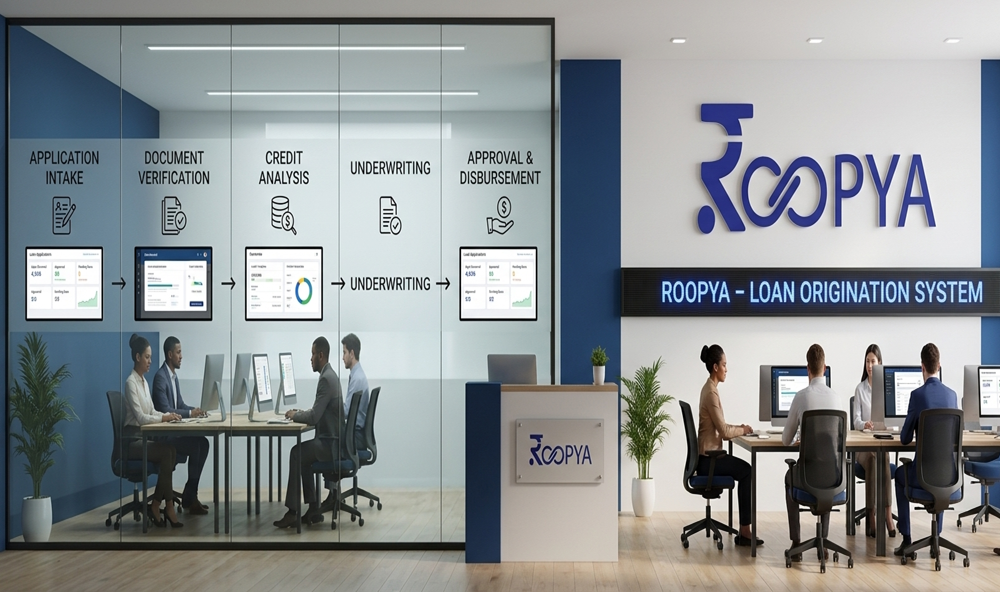
What Is a Loan Origination System? (And Why Every Lender Needs)
The lending business in India is moving faster than ever. NBFCs, banks, microfinance institutions, and fintech lenders are competing fiercely to disburse loans quickly, accurately, and profitably. In this environment, one piece of technology separates the winners from those still drowning in paperwork: a Loan Origination System.
But what exactly is a Loan Origination System, how does it work, and why does your lending institution need one right now? This comprehensive guide answers every question — from the fundamentals to advanced capabilities — so you can make smarter decisions about your lending infrastructure.
What Is a Loan Origination System?
A Loan Origination System (LOS) is a software platform that manages the complete lifecycle of a loan application — from the moment a borrower submits their request to the moment funds are disbursed. It is the operational backbone of any modern lending institution.
Think of it as a digital assembly line for your lending operations. Every step that used to require manual effort — collecting documents, verifying identity, checking credit scores, underwriting risk, generating offer letters, and finally disbursing funds — is handled systematically, with speed and precision, by a well-built Loan Origination System.
In simple terms: a Loan Origination System turns a slow, error-prone, paper-heavy loan process into a fast, automated, compliant digital workflow.
For NBFCs and modern lenders in India, adopting an LOS is no longer optional. It is a competitive necessity.
The Loan Origination Process: Step by Step
To truly understand the value of a Loan Origination System, it helps to walk through exactly what the origination process involves. A complete loan origination cycle typically includes the following stages:
-
Lead Capture and Application Intake
The process begins when a potential borrower expresses interest in a loan. A modern LOS captures this lead digitally — through a mobile app, website form, partner channel, or DSA — and initiates a structured application flow. Smart, adaptive digital forms guide borrowers through the process, collecting only the information relevant to their specific loan product.
-
KYC and Identity Verification
Once an application is submitted, the system triggers KYC verification. This includes Aadhaar-based eKYC, PAN verification, video KYC (VKYC), and identity document cross-checks — all automated through integrated API connections with UIDAI, NSDL, and other government databases.
-
Document Collection and OCR Processing
Borrowers upload their income documents, bank statements, salary slips, ITR filings, and address proofs through a secure digital portal. A good Loan Origination System uses Optical Character Recognition (OCR) and AI-powered data extraction to pull relevant financial information from these documents automatically — eliminating manual data entry and reducing errors dramatically.
-
Credit Bureau Pull and Credit Scoring
The system automatically fetches credit reports from bureaus like CIBIL, Experian, CRIF High Mark, and Equifax. It then applies the lender’s configured credit scorecard to calculate the applicant’s creditworthiness. This entire step, which used to take days, now takes seconds.
-
Automated Underwriting and Decisioning
This is where a Loan Origination System delivers its most powerful value. Using a configurable Business Rule Engine (BRE), the system evaluates dozens of variables — income, obligations, credit history, employment type, geography, loan purpose — and generates an automated decision: Approve, Decline, or Counter-Offer. Lenders can configure their own rules without writing a single line of code.
-
Offer Generation and Loan Structuring
For approved applications, the LOS generates a personalized loan offer — including the approved amount, interest rate, tenure, EMI, and processing fee — and presents it to the borrower digitally. The borrower can review and accept the offer through the self-service portal.
-
Legal, Compliance, and Documentation
The system generates all required loan agreements, sanction letters, and regulatory disclosures automatically. e-Signature capabilities allow borrowers to sign documents digitally, eliminating the need for physical presence or courier-based paperwork.
-
Disbursement
Once all conditions are satisfied and documents are executed, the LOS triggers disbursement instructions to the payment system, and funds reach the borrower’s account — often on the same day.
Why Your Lending Institution Needs a Loan Origination System Right Now
If your team is still processing loan applications through spreadsheets, email chains, and manual document verification, you are losing on three fronts simultaneously: speed, accuracy, and cost.
Here is what a modern Loan Origination System delivers:
Dramatically Faster Loan Processing
The average time-to-disburse for a traditional lender using manual processes is anywhere from 7 to 30 days. With a well-implemented LOS, that number drops to 24–72 hours for standard consumer loans and same-day for pre-approved or small-ticket products. Faster processing means happier borrowers, lower dropout rates, and more loans per month from the same team.
Reduced Operational Cost
Every manual step in the loan process has a cost attached to it — staff time, printing, physical verification, courier fees, rework caused by errors. A Loan Origination System automates the majority of these steps. Lenders using automated origination platforms typically report a 40–60% reduction in per-loan processing costs within the first year.
Better Credit Decisions
Manual underwriting is inconsistent. Two underwriters looking at the same file will sometimes reach different conclusions. A rules-based and AI-augmented LOS applies the same credit policy every time, consistently, without fatigue or bias. This reduces both bad loans (by catching risks humans miss) and false rejections (by recognizing creditworthy borrowers that simplistic scorecards would decline).
Regulatory Compliance Without the Headache
For NBFCs and banks operating under RBI guidelines, compliance is non-negotiable. A modern Loan Origination System maintains complete, tamper-proof audit trails for every decision made during the loan journey. It generates all required regulatory disclosures, ensures data privacy compliance, and can be updated instantly when regulations change — without requiring custom development.
Borrower Experience That Drives Referrals
Today’s borrowers are digital natives. They expect to apply for a loan on their phone, upload documents with a camera click, receive a decision within minutes, and sign agreements online. A Loan Origination System with a borrower-facing portal delivers exactly this experience — and lenders who offer it see significantly higher application completion rates and Net Promoter Scores.
Scalability Without Proportional Headcount Growth
Growing from processing 100 loans per month to 1,000 loans per month should not require hiring ten times more staff. A cloud-based Loan Origination System scales horizontally — handling increased volume through additional compute resources, not people. This gives NBFCs and digital lenders a fundamentally more sustainable growth model.
Key Features to Look for in a Loan Origination System
Not all Loan Origination Systems are built equal. When evaluating platforms for your lending institution, look for these critical capabilities:
No-Code Configuration: Your credit team should be able to modify credit policies, add new loan products, and change workflow steps without depending on IT or external developers. A truly no-code BRE (Business Rule Engine) is essential.
Pre-Integrated API Ecosystem: The best LOS platforms come with 200+ pre-integrated APIs covering credit bureaus, KYC providers, bank statement analyzers, GST verification, e-signature platforms, and payment gateways. Building these integrations from scratch is expensive and slow.
Multi-Product Support: Your platform should support the full spectrum of loan products — personal loans, business loans, MSME loans, home loans, auto loans, gold loans, microfinance, and more — through configurable product templates rather than hard-coded logic.
AI-Powered Decisioning: Modern loan origination is increasingly powered by machine learning models that go beyond traditional credit scores. Look for platforms that incorporate alternative data — bank statement analysis, GST data, digital footprint scoring — to accurately assess borrowers who may be thin-file or new-to-credit.
Real-Time Analytics and Reporting: A good LOS gives your leadership team live visibility into pipeline volumes, approval rates, turnaround times, and portfolio quality. Regulatory reporting — including CRILC submissions and NPA classification — should be automated.
Seamless Integration with LMS: The Loan Origination System should connect natively with a Loan Management System (LMS) so that once a loan is disbursed, all the account, EMI, and customer data flows automatically — without manual re-entry.
Cloud-Native, Bank-Grade Security: Your LOS should run on secure cloud infrastructure, with role-based access controls, end-to-end encryption, and comprehensive activity logs. SOC 2 compliance and ISO 27001 certification are strong signals.
Loan Origination System vs. Loan Management System: Understanding the Difference
A common source of confusion for lenders new to lending technology is the distinction between a Loan Origination System and a Loan Management System (LMS).
The distinction is straightforward:
A Loan Origination System handles everything that happens before a loan is disbursed — application intake, underwriting, approval, documentation, and disbursement trigger.
A Loan Management System handles everything that happens after disbursement — EMI scheduling, payment collection, arrears management, NOC generation, prepayment processing, and account closure.
The most powerful lending platforms today combine both into a unified architecture, with seamless data flow between origination and servicing. This eliminates the risk of data loss, reduces reconciliation errors, and gives relationship managers a single 360-degree view of every borrower.
Loan Origination System for NBFCs in India: Special Considerations
India’s NBFC sector operates under a unique regulatory environment shaped by the Reserve Bank of India’s Master Directions on digital lending, the Account Aggregator framework, and evolving guidelines on data privacy and fair lending practices.
A Loan Origination System built for Indian NBFCs must account for several India-specific requirements:
Account Aggregator Integration: The RBI’s Account Aggregator framework allows borrowers to consent-based share their financial data — bank statements, tax returns, insurance data — directly with lenders. A modern LOS should integrate with the AA network to enable frictionless data access without borrowers having to manually upload documents.
Video KYC (VKYC) Compliance: RBI mandates specific standards for video-based KYC for digital lending. The LOS must support compliant VKYC workflows with face-match, liveness detection, and document capture within the video session.
Digital Lending Guidelines Compliance: RBI’s digital lending guidelines require specific disclosures at application, sanction, and disbursement stages. They also mandate that funds flow directly to borrower accounts — not through intermediary accounts. A compliant LOS enforces these rules automatically.
Multilingual Borrower Journeys: India’s borrower base spans 22+ official languages and hundreds of dialects. An LOS serving tier-2 and tier-3 markets should support vernacular language interfaces to maximize application completion rates.
GST and ITR Data Integration: For business and MSME loan origination, integrating with GSTN (GST Network) and the Income Tax department’s APIs to fetch verified financial data directly dramatically improves underwriting accuracy and reduces fraud.
How Roopya’s Loan Origination System Is Built Differently
Roopya is India’s leading unified digital lending platform, purpose-built for modern NBFCs, banks, and fintech lenders. Its Loan Origination System is not an afterthought or a retrofitted legacy system — it was designed from the ground up to solve the specific challenges that Indian lenders face every day.
Here is what makes Roopya’s LOS stand apart:
Go Live in 1 Day: Roopya’s plug-and-play infrastructure and pre-configured loan product templates allow lenders to launch their digital origination pipeline in as little as 24 hours — not weeks or months. For NBFCs looking to move fast and capture market share, this speed-to-market advantage is decisive.
Truly No-Code: Roopya’s Business Rule Engine allows credit managers to configure complex multi-variable decisioning rules through an intuitive visual interface. Changing a credit policy, adding a new bureau, or modifying a loan product takes minutes — not a development sprint.
300+ Pre-Integrated APIs: The Roopya platform comes with a comprehensive ecosystem of pre-integrated lending APIs — credit bureaus, KYC providers, bank statement analyzers, e-signature platforms, payment gateways, and more. Lenders get years of integration work on day one.
AI-Powered Document Processing: Roopya’s intelligent OCR and NLP engine extracts data from bank statements, income tax returns, salary slips, and GST filings with 99%+ accuracy — in seconds. Fraud pattern detection runs automatically on every application.
Pay-As-You-Use Pricing: Unlike traditional LOS vendors that charge heavy upfront license fees, Roopya operates on a usage-based pricing model. NBFCs pay for what they actually process — making it accessible for lenders at every stage of growth, from startups to large-scale institutions.
20+ Pre-Configured Loan Products: From personal loans and salary advances to gold loans, business loans, and microfinance — Roopya’s platform comes with ready-to-deploy product templates that cover the full spectrum of lending in India.
Unified LOS + LMS: Roopya’s origination system connects natively with its Loan Management System, giving lenders a single platform that covers the entire loan lifecycle — from first application click to final account closure — with no data gaps, no reconciliation errors, and no integration headaches.
The Business Case: ROI of Implementing a Loan Origination System
Decision-makers at NBFCs often ask: what is the actual return on investment of implementing a Loan Origination System? The numbers are compelling.
Consider a mid-sized NBFC processing 500 loans per month. At an average operational cost of ₹3,000 per loan using manual processes, that is ₹15 lakh in monthly processing costs. A modern LOS typically reduces per-loan processing cost by 50% — saving ₹7.5 lakh per month, or ₹90 lakh annually.
Faster processing also directly increases loan volume. If time-to-disburse drops from 10 days to 2 days, the same team and capital can support significantly higher disbursement velocity — directly increasing interest income.
Fraud detection improvements prevent losses that are difficult to quantify until they occur. AI-powered fraud modules in modern LOS platforms typically reduce fraudulent disbursements by 70–80%.
And borrower satisfaction improvements — measurable through application completion rates, referral volumes, and repeat loan rates — create compounding revenue growth that more than justifies the investment in a high-quality Loan Origination System.
Getting Started: Questions to Ask Before Choosing a Loan Origination System
Before selecting an LOS for your institution, get clear answers to these questions from any vendor you evaluate:
- How long will implementation take, and what support is provided during go-live?
- Is the platform truly no-code, or will configuration changes require developer involvement?
- Which credit bureaus, KYC providers, and payment gateways are pre-integrated?
- Does the platform support the specific loan products and borrower segments we serve?
- How is regulatory compliance maintained, and how quickly are updates deployed when RBI guidelines change?
- What does the pricing model look like — upfront license, subscription, or usage-based?
- Is there a native Loan Management System, or will we need a separate integration?
- What security certifications does the platform hold?
The answers to these questions will quickly reveal which platforms are genuinely built for modern lenders and which are simply repackaged legacy systems with a fresh coat of digital paint.
The Future of Lending Runs on a Loan Origination System
The Indian lending market is at an inflection point. Digital penetration is accelerating. RBI’s regulatory framework is evolving to support responsible digital lending. Borrower expectations are rising. And competition — from large banks, new-age NBFCs, and embedded finance players — is intensifying.
In this environment, the lenders who win will be those who can originate loans faster, with better accuracy, at lower cost, and with a borrower experience that earns trust and referrals.
A modern Loan Origination System is not just a software investment. It is the operational foundation on which scalable, profitable, compliant lending is built.
If you are an NBFC, bank, microfinance institution, or fintech lender in India looking to modernize your loan origination process, Roopya offers one of the most advanced, India-specific, no-code Loan Origination Systems available today — with the speed, depth, and flexibility that modern lenders demand.
Explore Roopya’s Loan Origination Platform →
Roopya (Geoalgo Technologies Private Limited) is India’s #1 digital lending infrastructure platform, helping NBFCs, banks, and modern lenders go live with full-stack LOS and LMS solutions. Headquartered in Gurgaon, Haryana.

