Credit Risk Management Software in India: The Complete Guide for NBFCs, Banks & Fintech Companies

The Indian lending ecosystem is undergoing a massive digital transformation. With the rapid rise of fintech companies, digital banks, NBFCs, microfinance institutions, and embedded finance platforms, lenders are processing thousands of loan applications every day. While digital lending has improved customer experience and accelerated approvals, it has also introduced new challenges in assessing borrower risk and preventing loan defaults.
This is where Credit Risk Management Software plays a crucial role.
Modern lenders can no longer rely solely on traditional credit scores or manual underwriting processes. They require intelligent systems capable of analyzing multiple data sources, automating risk assessment, identifying fraudulent applications, predicting repayment behavior, and ensuring compliance with regulatory requirements.
Start Free Trial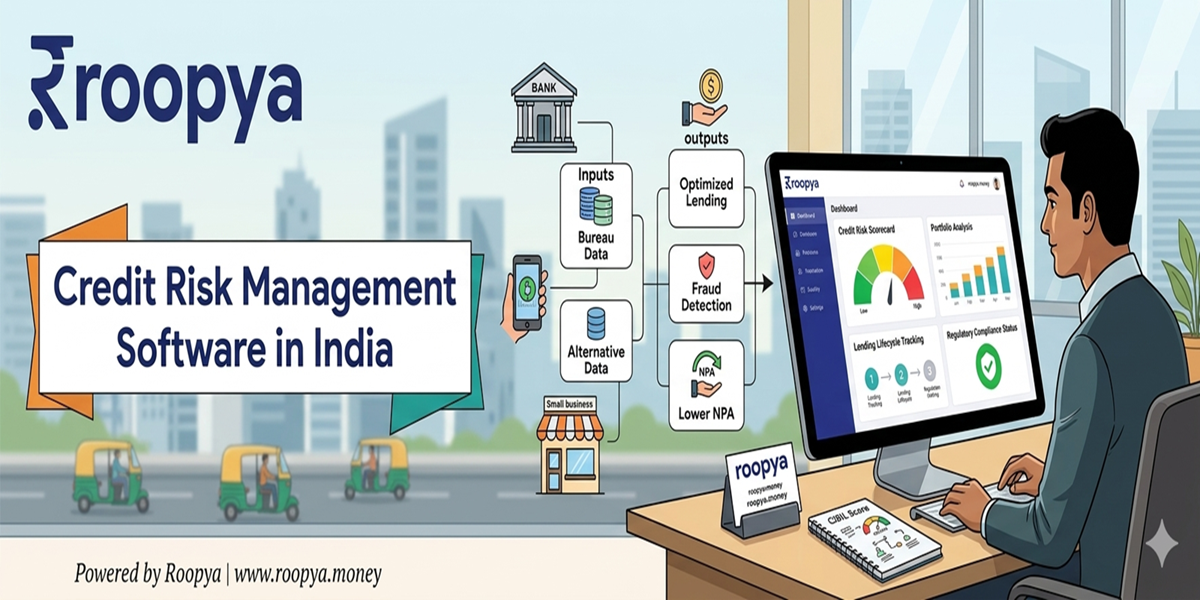
Credit Risk Management Software enables financial institutions to make faster, more accurate lending decisions while reducing non-performing assets (NPAs), improving portfolio quality, and enhancing profitability.
Platforms like Roopya combine AI-powered analytics, automated underwriting, business rule engines, bureau integrations, and early warning systems into a unified lending infrastructure that supports smarter credit decisions.
What is Credit Risk Management Software?
Credit Risk Management Software is a technology platform designed to evaluate, monitor, and manage the risk associated with lending money to borrowers.
It automates the complete risk assessment process by collecting borrower information, verifying identity, analyzing financial behavior, checking credit bureau reports, calculating risk scores, and recommending approval or rejection based on predefined lending policies.
The software supports:
- Credit assessment
- Borrower profiling
- Risk scoring
- AI underwriting
- Policy automation
- Fraud detection
- Portfolio monitoring
- Early warning signals
- Regulatory reporting
Instead of depending on manual evaluations, lenders can automate decisions while maintaining consistency and reducing operational costs.
Why Credit Risk Management Matters in India
India has witnessed exponential growth in:
- Digital lending
- BNPL services
- MSME financing
- Personal loans
- Consumer durable financing
- Gold loans
- Education loans
- Co-lending models
As loan volumes increase, lenders face risks including:
- Identity fraud
- Fake documentation
- Income manipulation
- Multiple borrowing
- Delayed repayments
- Portfolio deterioration
An intelligent credit risk management platform minimizes these risks through data-driven decision-making.
Challenges of Traditional Credit Risk Assessment
Many organizations still rely on spreadsheets and manual underwriting.
Common issues include:
Slow decision-making
Manual verification delays loan approvals.
Human errors
Different underwriters may reach different conclusions.
Limited data analysis
Traditional systems often evaluate only bureau scores.
Fraud exposure
Fake KYC documents and manipulated income statements may go undetected.
High operating costs
Manual processes require larger teams and increase overhead.
Poor scalability
Growing loan volumes become difficult to manage efficiently.
How Credit Risk Management Software Works
A modern platform follows a structured workflow.
Step 1: Digital Customer Onboarding
Applicants submit:
- PAN
- Aadhaar
- Mobile number
- Income details
- Employment information
- Bank statements
Step 2: Identity Verification
Automated KYC validation checks:
- PAN
- Aadhaar
- OTP verification
- Document authenticity
Step 3: Credit Bureau Integration
The system retrieves information from credit bureaus to evaluate:
- Credit history
- Existing loans
- Outstanding balances
- Delinquencies
- Credit utilization
Step 4: Alternative Data Collection
Advanced platforms analyze:
- Banking transactions
- Salary credits
- GST records
- UPI behavior
- Device intelligence
- Digital footprints
Step 5: AI-Based Risk Scoring
Machine learning algorithms evaluate hundreds of variables and assign a dynamic risk score.
Step 6: Automated Underwriting
Business Rule Engines automatically approve, reject, or refer applications for manual review.
Step 7: Early Warning Monitoring
Post-disbursement analytics monitor repayment behavior and predict default risks before they occur.
Key Features of Credit Risk Management Software
AI-Powered Credit Scoring
Artificial intelligence evaluates multiple borrower characteristics beyond traditional bureau scores.
Benefits include:
- Higher accuracy
- Reduced defaults
- Faster approvals
Automated Underwriting
Policy-based decision engines eliminate manual bottlenecks.
Examples:
- Minimum income threshold
- Age validation
- Employment verification
- Existing EMI limits
- DTI calculations
Multi-Bureau Connectivity
Integration with multiple bureaus provides a comprehensive borrower profile.
Business Rule Engine (BRE)
No-code policy management enables lenders to modify lending rules without software development.
Fraud Detection
Advanced fraud engines identify:
- Duplicate applications
- Synthetic identities
- Device anomalies
- Suspicious behavior
- Forged documents
Early Warning System
Predictive monitoring helps identify accounts likely to become delinquent.
Portfolio Risk Analytics
Dashboards provide insights into:
- Risk concentration
- Delinquency trends
- Product performance
- Geographic exposure
- Vintage analysis
Compliance Management
Automated compliance workflows help organizations follow RBI guidelines and internal governance requirements.
Benefits of Credit Risk Management Software
Faster Loan Approvals
Automation reduces approval times from days to minutes.
Lower NPAs
Better borrower evaluation reduces default probability.
Improved Customer Experience
Instant approvals increase borrower satisfaction.
Operational Efficiency
Automation minimizes manual intervention.
Better Decision-Making
AI models analyze significantly more variables than humans.
Scalability
Cloud platforms handle high loan volumes without infrastructure expansion.
AI in Credit Risk Management
Artificial intelligence is transforming lending by enabling:
- Predictive default modeling
- Behavioral scoring
- Dynamic credit limits
- Fraud prediction
- Portfolio optimization
- Automated decision-making
AI continuously improves as more lending data becomes available.
Role of Alternative Data in Credit Risk
Traditional bureau scores do not always reflect borrower potential.
Alternative data sources include:
- Mobile usage
- Utility payments
- GST filings
- Salary patterns
- UPI transactions
- Bank statements
- Digital commerce activity
These signals help lenders assess thin-file customers.
Credit Risk Management for NBFCs
NBFCs require flexible systems that support multiple loan products.
Key capabilities include:
- Personal loans
- Business loans
- Gold loans
- MSME financing
- Consumer finance
- Education loans
Automation improves underwriting consistency while reducing operational costs.
Credit Risk Management for Fintech Companies
Fintech lenders operate at scale.
They require:
- API-first architecture
- Instant underwriting
- AI scoring
- Digital onboarding
- Fraud prevention
- Real-time decision engines
Modern software enables approvals within minutes.
Credit Risk Management for Banks
Banks benefit from:
- Enterprise workflow automation
- Branch integration
- Risk dashboards
- Centralized policy control
- Portfolio monitoring
Essential Modules in a Modern Credit Risk Platform
- Customer onboarding
- KYC verification
- OCR document extraction
- Credit bureau integration
- AI scoring
- Business Rule Engine
- Loan origination
- Underwriting
- Fraud detection
- Portfolio analytics
- Collections monitoring
- Early warning system
- Reporting dashboards
How Roopya Supports Credit Risk Management
Roopya provides a comprehensive lending infrastructure that combines automated origination, underwriting, analytics, bureau connectivity, Business Rule Engine functionality, and early warning capabilities to help lenders make faster and more informed credit decisions. The platform is designed for NBFCs, fintech companies, and financial institutions seeking scalable digital lending operations.
Its capabilities include:
- AI-powered credit assessment
- Automated underwriting
- Multi-bureau integration
- No-code Business Rule Engine
- Digital KYC workflows
- Risk analytics dashboards
- Early warning monitoring
- Loan origination automation
- Cloud-native deployment
Future Trends in Credit Risk Management in India
The future will be driven by:
- Generative AI underwriting
- Real-time analytics
- Open banking integrations
- Embedded finance
- Behavioral risk models
- Hyper-personalized lending
- Explainable AI
- Predictive collections
Organizations adopting intelligent risk management platforms will gain a competitive advantage.
Credit Risk Management Software has become a strategic necessity for banks, NBFCs, fintech companies, and digital lenders operating in India.
By automating underwriting, integrating multiple data sources, leveraging AI-driven analytics, and monitoring portfolios proactively, lenders can significantly reduce risk while accelerating growth.
As lending volumes continue to rise, institutions investing in intelligent credit risk technology will be better positioned to improve approval quality, lower NPAs, strengthen compliance, and deliver superior borrower experiences.

