Loan Management Software for Microfinance Institutions: Complete Guide to Digital Lending Success

Microfinance Institutions (MFIs) have become one of the strongest pillars of financial inclusion by providing small-ticket loans to underserved communities, rural borrowers, women entrepreneurs, self-help groups, and micro-businesses. However, as lending volumes grow, managing applications, repayments, collections, compliance, and customer records manually becomes increasingly difficult.
This is where Loan Management Software for Microfinance Institutions plays a transformative role.
Modern loan management software automates the complete lending lifecycle—from borrower onboarding and credit assessment to loan disbursement, EMI tracking, collections, reporting, and portfolio analytics. It reduces operational costs, minimizes errors, improves customer experience, and enables institutions to scale efficiently.
Start Free Trial
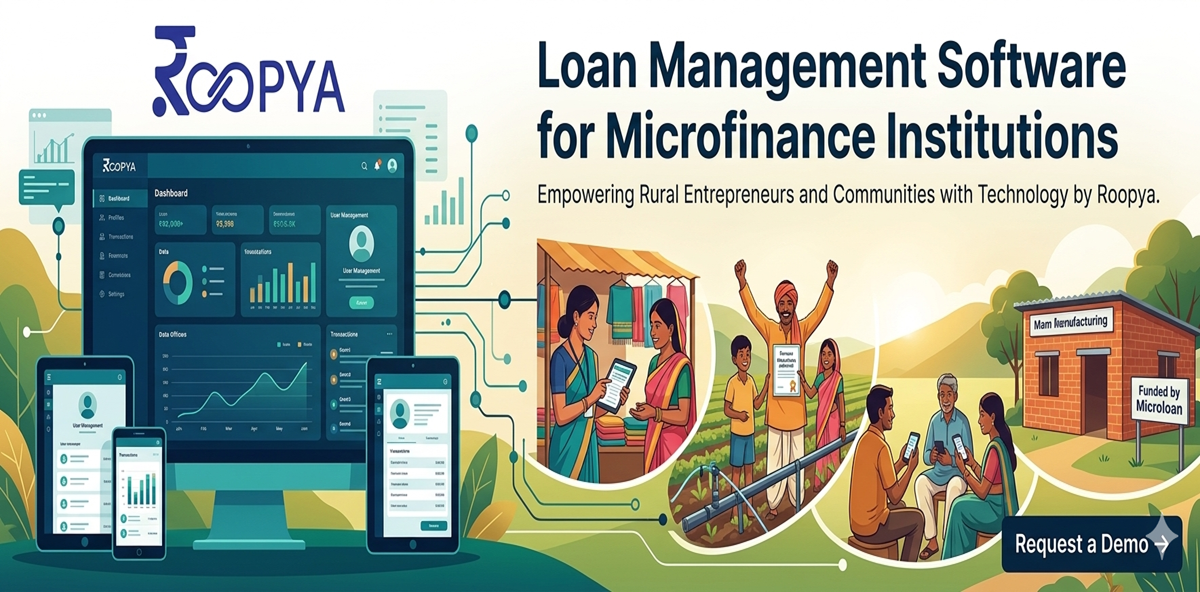
Solutions such as Roopya’s AI-powered Microfinance Loan Management Software are designed to help MFIs, NBFCs, fintech companies, and digital lenders streamline operations with cloud-native technology, automation, and intelligent decision-making. Roopya positions its platform as a no-code, AI-first lending solution supporting end-to-end loan management for Indian lenders.
What is Loan Management Software for Microfinance Institutions?
Loan Management Software (LMS) is a centralized digital platform that automates every stage of the lending process.
Instead of maintaining spreadsheets, physical files, and disconnected systems, the software stores all borrower information in one secure location while automating workflows.
It helps institutions manage:
- Customer onboarding
- Digital KYC
- Loan origination
- Credit assessment
- Loan approval
- Disbursement
- EMI scheduling
- Repayment tracking
- Collection management
- NPA monitoring
- Regulatory reporting
- Customer servicing
- Analytics and dashboards
The result is a faster, smarter, and more scalable lending operation.
Why Microfinance Institutions Need Modern Loan Management Software
Traditional loan management methods create multiple operational bottlenecks.
Manual Documentation
Paper files are difficult to maintain, prone to loss, and increase processing time.
Slow Loan Approvals
Without automation, approvals may take several days, reducing customer satisfaction.
Collection Challenges
Tracking thousands of borrowers manually often results in missed payments and increased delinquencies.
Compliance Risks
Meeting RBI regulations and maintaining audit trails becomes difficult with fragmented systems.
Human Errors
Manual calculations can create mistakes in EMI schedules, interest computation, and repayment tracking.
Digital loan management software eliminates these issues by introducing automation and centralized data management.
Key Features of Loan Management Software for MFIs
1. Digital Customer Onboarding
Borrowers can submit applications online using mobile or web platforms.
Features include:
- Paperless applications
- Aadhaar and PAN verification
- Digital document upload
- OCR document reading
- eSign integration
- Instant profile creation
This reduces onboarding time significantly.
2. Loan Origination Automation
Loan origination includes:
- Application processing
- Eligibility verification
- Credit bureau checks
- Internal scoring
- Risk assessment
- Approval workflows
Automation reduces dependency on manual underwriting.
3. AI-Based Credit Decision Engine
Artificial Intelligence enables:
- Alternative credit scoring
- Fraud detection
- Predictive risk analysis
- Automated approvals
- Better portfolio quality
AI also helps lenders serve first-time borrowers more efficiently.
4. Loan Disbursement Management
After approval, the system automates:
- Agreement generation
- Digital signatures
- Bank integration
- Fund transfer
- Customer notification
Disbursement happens much faster compared to manual workflows.
5. EMI Scheduling
Software automatically generates:
- Repayment schedules
- Interest calculations
- Amortization tables
- Due dates
- Payment reminders
Borrowers receive automated SMS and email alerts.
6. Collection Management
Collections become more organized through:
- DPD tracking
- Automated reminders
- Collection buckets
- Agent allocation
- Promise-to-pay tracking
- Settlement management
This improves recovery rates.
7. Portfolio Monitoring
Management dashboards display:
- Active loans
- Closed loans
- Default rates
- Portfolio at Risk (PAR)
- NPA trends
- Branch performance
- Collection efficiency
Executives can make faster decisions using real-time insights.
8. Compliance & Audit Trail
Loan software maintains:
- User activity logs
- Regulatory reports
- RBI-ready documentation
- KYC records
- AML checks
- Data encryption
Compliance becomes significantly easier.
Benefits of Loan Management Software for Microfinance Institutions
Faster Loan Processing
Applications that previously required several days can now be processed within minutes.
Lower Operational Costs
Automation reduces manpower requirements and paperwork.
Better Customer Experience
Borrowers enjoy:
- Quick approvals
- Digital applications
- Online repayment
- Transparent communication
Reduced NPAs
AI-driven risk assessment improves lending decisions.
Higher Collection Efficiency
Automated reminders increase repayment rates.
Scalability
Institutions can manage thousands or even millions of loans without proportionally increasing staff.
Complete Loan Lifecycle Managed Through One Platform
A robust loan management solution typically supports:
Step 1: Customer Registration
Borrower details captured digitally.
Step 2: KYC Verification
Identity documents validated automatically.
Step 3: Loan Application
Digital submission with document upload.
Step 4: Credit Evaluation
Internal and bureau checks performed.
Step 5: Approval
Automated or manual approval workflow.
Step 6: Disbursement
Funds transferred electronically.
Step 7: EMI Tracking
Repayment schedule monitored continuously.
Step 8: Collections
Reminders and follow-ups initiated automatically.
Step 9: Closure
Loan closed after full repayment.
How AI is Revolutionizing Microfinance Lending
Artificial Intelligence introduces smarter lending decisions.
AI can:
- Predict repayment behavior
- Detect fraud
- Recommend approval policies
- Analyze alternative data
- Optimize collections
- Forecast defaults
This results in better portfolio quality and reduced credit losses.
Roopya highlights AI-powered underwriting, fraud detection, and collections optimization as core capabilities within its lending platform.
Cloud-Based Loan Management vs Traditional Software
| Cloud LMS | Traditional LMS |
|---|---|
| Remote access | Office-only access |
| Automatic updates | Manual upgrades |
| Lower infrastructure cost | Expensive servers |
| High scalability | Limited scalability |
| Faster implementation | Months of deployment |
| Better security | Depends on local infrastructure |
Cloud-native platforms offer flexibility for growing institutions.
Mobile-First Lending Experience
Modern MFIs increasingly rely on mobile applications.
Field officers can:
- Capture customer data
- Upload documents
- Collect repayments
- Update loan status
- Verify locations
Customers can:
- Check loan status
- Download statements
- Pay EMIs
- Receive notifications
Essential Integrations
A modern loan management platform should integrate with:
- Credit bureaus
- Aadhaar verification
- PAN verification
- Payment gateways
- eNACH systems
- SMS gateways
- WhatsApp APIs
- Email services
- Accounting software
- Banking APIs
Pre-built integrations reduce implementation time.
Security Features
Financial institutions require enterprise-grade security.
Key capabilities include:
- Data encryption
- Multi-factor authentication
- Role-based access
- Audit logs
- Secure APIs
- Cloud backup
- Disaster recovery
These measures protect borrower information and institutional data.
Reporting and Analytics
Comprehensive dashboards provide:
- Loan growth
- Branch-wise performance
- Collection ratios
- Delinquency reports
- Portfolio analysis
- Revenue tracking
- NPA reports
- Executive summaries
Real-time reporting supports informed decision-making.
Why Choose Roopya for Microfinance Loan Management?
Roopya offers an AI-powered, cloud-native lending platform built for NBFCs, MFIs, fintechs, and banks with features such as:
- End-to-end loan lifecycle management
- No-code configuration
- AI-powered underwriting
- Loan origination system (LOS)
- Loan management system (LMS)
- Automated collections
- Digital onboarding
- Compliance-ready workflows
- 300+ pre-integrated APIs
- Cloud deployment
According to its published platform information, Roopyya also emphasizes rapid implementation and support for multiple lending products.
The future of microfinance depends on speed, automation, intelligence, and compliance. Institutions relying on manual processes risk higher operational costs, slower approvals, and reduced competitiveness.
A modern Loan Management Software for Microfinance Institutions empowers lenders to automate workflows, improve borrower experiences, strengthen risk management, and scale operations efficiently.
By combining AI-driven decision-making, cloud infrastructure, automated collections, and end-to-end loan lifecycle management, platforms like Roopya can help MFIs build a more efficient and future-ready lending ecosystem.

