Complete Guide to Loan Origination Software: Features, Workflow & Benefits

Why Loan Origination Software Is No Longer Optional
In today’s hyper-competitive lending landscape, speed and accuracy define winners. Whether you are a Non-Banking Financial Company (NBFC), a microfinance institution (MFI), or a modern digital bank, your ability to process loan applications quickly — without sacrificing compliance or credit quality — determines your growth trajectory.
This is exactly where Loan Origination Software (LOS) becomes your most powerful asset.
A Loan Origination System is a digital platform that automates and manages the entire lifecycle of a loan application — from the moment a borrower submits their details to the point when a credit decision is made and funds are disbursed. It replaces fragmented, manual processes with intelligent, rules-driven workflows that reduce processing time from days to minutes.
Start Free Trial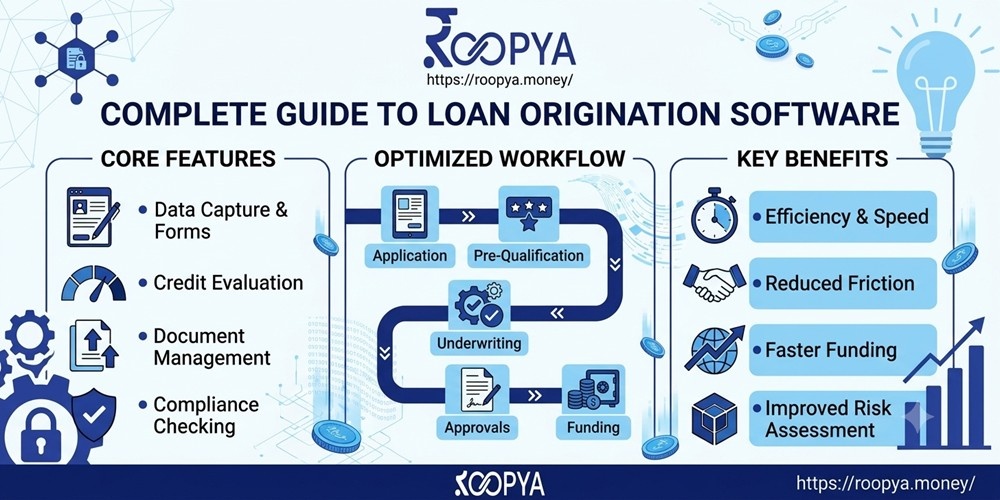
This guide covers everything you need to know about LOS — what it is, how it works, its core features, the workflow it enables, and the tangible business benefits it delivers.
What Is Loan Origination Software?
Loan Origination Software is a technology platform designed to automate the process of receiving, evaluating, and approving (or rejecting) loan applications. It serves as the operational backbone for lending institutions, orchestrating every step between a borrower’s initial inquiry and the final credit decision.
Modern LOS platforms — like Roopya’s Loan Origination Platform — are no-code, API-integrated, and AI-powered. They allow lenders to configure complex workflows, credit policies, and product parameters without writing a single line of code. This means business teams can directly own lending operations without depending on IT for every change.
Key components of a Loan Origination System include:
- Digital application intake
- Automated document collection and verification
- Credit bureau integration and scoring
- Business Rule Engine (BRE) for policy automation
- Underwriting support and risk assessment
- Approval or rejection decisioning
- Disbursement triggering
The End-to-End Loan Origination Workflow
Understanding the LOS workflow helps you appreciate the value it delivers at each stage. Here is how a modern loan origination process flows:
Stage 1: Lead Capture & Application Submission
The borrower completes a digital application form — on a web portal, mobile app, or embedded finance interface. The LOS captures structured data including personal details, employment information, income, loan amount required, and tenure. Pre-fill capabilities using Aadhaar, PAN, or mobile number significantly reduce form abandonment rates.
Stage 2: Document Collection & eKYC
Once the application is submitted, the LOS triggers automated document requests. The borrower uploads identity proofs, income statements, bank statements, and other required documents through a secure digital interface. Platforms like Roopya integrate with eKYC providers to verify identity instantly using facial recognition, Aadhaar OTP, and video KYC — eliminating the need for physical branch visits.
Stage 3: Data Extraction & Verification
AI-powered Optical Character Recognition (OCR) and Natural Language Processing (NLP) extract relevant data from uploaded documents with 99%+ accuracy. The system cross-checks extracted data with bureau records, income tax filings, and bank transaction history to validate the borrower’s profile.
Stage 4: Credit Bureau Pull & Scoring
The LOS automatically fetches credit reports from CIBIL, Experian, CRIF, or Equifax — or multiple bureaus simultaneously. It analyses credit scores, repayment history, outstanding obligations, and derogatory marks. Advanced platforms supplement bureau data with alternative data sources such as GST filings, utility payments, and digital transaction history to score thin-file or new-to-credit borrowers.
Stage 5: Business Rule Engine (BRE) Processing
The Business Rule Engine is the policy heart of any LOS. Lenders configure rules based on their credit policies — minimum CIBIL score thresholds, debt-to-income ratios, geography restrictions, loan-to-value norms, and more. The BRE evaluates every application against these rules in real time and routes applications to the appropriate decision path: auto-approval, manual review, or auto-rejection.
Stage 6: Underwriting & Risk Assessment
For applications that require human review, the LOS presents underwriters with a structured dashboard showing all verified data, credit scores, risk flags, and system recommendations. Underwriters can add notes, request additional documents, or override system decisions within defined authority limits. This hybrid human-machine model ensures consistency while retaining human judgment where needed.
Stage 7: Credit Decision & Offer Generation
Based on BRE outcomes and underwriter input, the LOS generates a credit decision — approved, declined, or counter-offered. If approved, it automatically generates a loan offer with customized interest rate, tenure, EMI, and terms based on the borrower’s risk profile. The offer is shared digitally for e-signature acceptance.
Stage 8: Agreement Execution & Disbursement
Post acceptance, the LOS triggers loan agreement generation with pre-filled terms. Digital signature integration (via e-Sign or Aadhaar-based signing) completes the legal process. The system then triggers disbursement to the borrower’s verified bank account via NEFT, IMPS, or UPI — often within minutes.
Core Features of Modern Loan Origination Software
Not all LOS platforms are created equal. The best platforms combine flexibility, automation, and intelligence. Here are the features that define a best-in-class LOS:
1. No-Code Configuration
Business teams can design and modify loan products, workflows, eligibility rules, and document checklists without IT intervention. This agility is critical in a fast-changing regulatory and market environment.
2. 300+ Pre-Integrated APIs
A robust LOS connects natively with credit bureaus, eKYC providers, bank statement analyzers, GST APIs, e-Sign platforms, payment gateways, and fraud detection services. Roopya, for instance, offers 300+ pre-integrated APIs — dramatically reducing integration timelines.
3. AI-Powered Document Analysis
Intelligent document processing uses AI to extract, validate, and cross-reference data from identity documents, income proofs, bank statements, and property papers — in seconds, with minimal human intervention.
4. Configurable Business Rule Engine
The BRE allows lenders to codify their credit policy into automated decision logic. Rules can be layered — combining score bands, income filters, product eligibility, and fraud signals — to produce nuanced decisions.
5. Multi-Product & Multi-Channel Support
A modern LOS handles personal loans, business loans, gold loans, home loans, payday loans, BNPL, and more — across web, mobile, DSA, branch, and embedded finance channels — all within a single platform.
6. Real-Time Decisioning
Millisecond-level decisions on creditworthiness are now possible. Automated pipelines process applications 24/7 without human queuing, enabling lenders to offer instant approvals to pre-qualified borrowers.
7. Advanced Fraud Detection
AI-powered fraud modules flag anomalies in documents, detect identity mismatches, recognize synthetic identities, and cross-reference applications against internal negative lists — before any credit decision is made.
8. Compliance & Regulatory Reporting
The LOS maintains audit trails for every decision, document, and communication. It generates regulatory reports required by RBI, SEBI, and other bodies — and updates automatically as regulations evolve.
9. Customizable Dashboards & Analytics
Loan officers, credit managers, and executives each get role-specific dashboards showing pipeline health, approval rates, TAT metrics, and portfolio quality indicators in real time.
10. Seamless LMS Integration
Post-disbursement, the loan data flows automatically into the Loan Management System (LMS) for repayment scheduling, collections, and servicing — eliminating data re-entry and reducing errors.
Business Benefits of Implementing a Loan Origination System
The ROI on a well-implemented LOS is significant and measurable across multiple dimensions:
Dramatically Reduced Turnaround Time
Manual loan processing can take 3–7 days. A modern LOS can compress this to under 15 minutes for eligible borrowers. Speed is a competitive differentiator — especially in the consumer lending and MSME lending markets where borrowers compare multiple lenders simultaneously.
Lower Operational Costs
Automation reduces the need for large credit operations teams. Lenders can handle 5x–10x more applications with the same or fewer staff. Roopya’s infrastructure enables lenders to process loans with up to 10x faster throughput.
Better Credit Quality
Consistent, rules-driven decisioning eliminates human subjectivity and individual bias. All applications are evaluated against the same policy framework, resulting in a more predictable and stable loan book.
Improved Borrower Experience
A seamless, digital-first journey — from application to disbursement — builds borrower trust and loyalty. Faster approvals and transparent status updates reduce borrower anxiety and improve satisfaction scores.
Scalability Without Proportional Cost
Cloud-based LOS platforms scale elastically. Whether you process 100 or 1,00,000 applications per month, the platform handles the load without requiring capital investment in infrastructure.
Regulatory Compliance Built-In
The LOS maintains complete audit trails, enforces policy compliance at every decision point, and generates RBI-compliant reports automatically — reducing compliance risk significantly.
Faster Product Launch
With no-code configurability, lenders can design and launch new loan products in days rather than months. Roopya customers have gone live with fully functional loan products in as little as 1 day.
Roopya: India’s Leading Loan Origination Platform
Roopya (by Geoalgo Technologies Pvt. Ltd.) is a next-generation, no-code digital lending platform purpose-built for NBFCs, banks, MFIs, and modern lenders in India. The Loan Origination Platform is designed for institutions that want to:
- Launch lending operations without a large technology team
- Go live in 1 day with 20+ pre-configured loan products
- Connect with 300+ pre-integrated APIs covering bureaus, eKYC, payments, and fraud detection
- Configure their entire credit policy through a self-service, visual Business Rule Engine
- Operate with zero upfront infrastructure cost — paying only for what they use
From personal loan software to business loan software, gold loan platforms, and payday loan systems, Roopya powers the full spectrum of lending products with a single unified infrastructure.

