Switching to Roopya: A Complete Migration Guide for NBFCs

Every NBFC reaches a crossroads at some point. Maybe your current lending software is slowing down your team. Maybe it cannot keep up with your portfolio growth, does not support the new loan products you want to launch, or is costing you more in maintenance and customisation fees than it is worth. Maybe it simply was not built for the speed and automation that modern lending demands.
Whatever the reason, switching your core lending platform is a significant decision — and a common source of anxiety for operations heads, CTOs, and founders alike. The fear is understandable: What happens to your historical loan data? How long will the switchover take? Will your team need extensive retraining? Will there be downtime? Will your borrowers notice?
Start Free Trial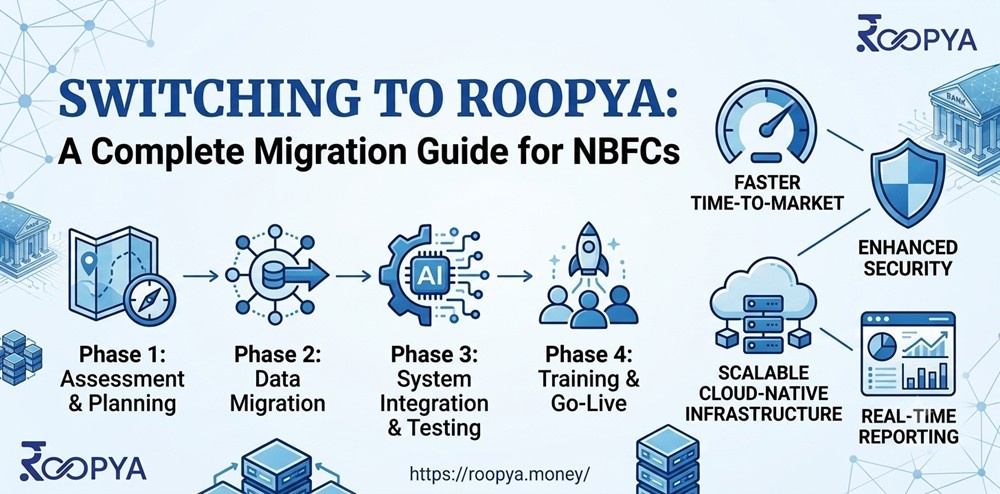
This guide exists to answer every one of those questions. It is the definitive resource for NBFCs, MFIs, and digital lenders who are evaluating a move to Roopya — covering everything from the reasons organisations make this switch, to the step-by-step migration process, to what life looks like on the other side. If you have been thinking about moving to a better lending platform but have been held back by uncertainty, read this first.
1. Why NBFCs Switch Their Lending Software
Before we get into the how, it helps to understand the why. In our experience onboarding dozens of NBFCs and fintech lenders onto Roopya, the decision to switch almost always comes from one or more of the following pain points:
1.1 The Current System Cannot Scale
Many NBFCs started with legacy software or even spreadsheet-based processes that worked fine when they were doing 200 loans a month. At 2,000 or 20,000 loans a month, the same system becomes a liability. Servers crash during peak periods. Manual steps that were manageable at small scale become operational bottlenecks. Reports that used to take an hour now take a day. The system was simply not built to grow with you.
Roopya is a cloud-native, API-first platform designed to scale elastically. Whether you process 500 applications a month or 500,000, the infrastructure adjusts automatically — with no performance degradation and no additional infrastructure investment from your side.
1.2 Too Much Dependence on IT and Developers
Legacy lending platforms are notoriously rigid. Changing a credit policy rule, adding a new data field to an application form, or onboarding a new loan product often requires opening a change request with the vendor, waiting weeks for development, and paying a customisation fee. This creates a dangerous dependency: your business agility is held hostage by your software vendor’s development roadmap.
Roopya’s no-code architecture changes this equation entirely. Credit managers, risk officers, and operations teams can configure credit rules, modify application workflows, add new product types, and set up new DSA channels entirely through a visual interface — no developer required. When the RBI issues new guidelines, your compliance team can update the platform the same day.
1.3 Poor Integration Ecosystem
Modern NBFC operations require a dense web of integrations: credit bureaus, KYC providers, eSign platforms, payment gateways, accounting software, bank statement analyzers, GST API, and more. Many legacy platforms were built before this ecosystem matured and require expensive, custom-built connectors for each integration. When a new service provider offers better rates or features, switching is painful because the integration has to be rebuilt from scratch.
Roopya comes with 300+ pre-built API integrations covering every service category an NBFC needs. Switching between bureau providers, adding a new KYC service, or connecting a new payment gateway is a configuration change — not a development project.
1.4 High Total Cost of Ownership
The upfront licence cost of legacy lending software is often just the beginning. Add in annual maintenance fees, customisation charges, server hosting costs, IT support staff, and vendor-dependency premiums, and the true cost of running an old system can be staggering. Many NBFCs switching to Roopya discover they were spending 3–5x more on their old system than they realised when all costs are accounted for.
Roopya’s pay-as-you-use model eliminates upfront licence fees, reduces IT overhead dramatically, and aligns cost directly with the value you receive — you pay based on the loans you process, not the size of the contract you signed.
1.5 Inability to Support Digital and Embedded Lending
The future of NBFC lending is digital-first and increasingly embedded — lending products delivered inside partner apps, e-commerce platforms, payroll tools, and HR systems via APIs. Most legacy platforms were architected for branch-based, agent-led origination and simply cannot support modern digital journeys or API-first embedded lending.
Roopya is built API-first from the ground up. Any lending journey — whether initiated via your own mobile app, a partner’s platform, a DSA’s tablet, or a conversational AI interface — runs on the same Roopya backend, with full visibility and control from a single dashboard.
2. What Migration to Roopya Actually Involves
The word ‘migration’ tends to conjure images of months of disruption, data loss risks, and parallel-running systems that drive up costs. The reality of migrating to Roopya is very different — and significantly simpler than most NBFCs expect.
A Roopya migration involves four core workstreams: data migration, integration setup, workflow configuration, and team onboarding. Let us walk through each in detail.
3. Step-by-Step: The Roopya Migration Process
Step 1: Discovery and Current State Assessment (Week 1)
Every successful migration starts with a clear picture of where you are today. Roopya’s implementation team conducts a structured discovery exercise with your operations, technology, and compliance stakeholders covering:
- Current system architecture: What software are you running today? What modules are in use? What is the data model?
- Active portfolio snapshot: How many active loans are on the current system? What is the distribution across product types and stages?
- Integration inventory: What third-party services are currently connected (bureaus, KYC, payment, accounting)?
- Workflow documentation: What are the current credit policy rules, approval workflows, and document checklists?
- Compliance requirements: What regulatory reports are currently generated? What audit trail requirements apply?
- Team structure: Who are the users of the current system? What roles and permissions need to be replicated?
This discovery produces a Migration Blueprint — a detailed plan that maps your current state to the Roopya configuration, identifies any gaps, and sets out a realistic timeline for each workstream. For most NBFCs, this takes three to five working days.
Step 2: Roopya Configuration and Parallel Setup (Week 1–2)
While the discovery is underway, Roopya’s implementation team begins configuring your dedicated Roopya environment. Because Roopya is no-code, this configuration process is dramatically faster than a traditional software implementation:
- Loan product setup: Your active loan products are configured in Roopya — application forms, eligibility criteria, document checklists, and offer parameters.
- Credit policy configuration: Your credit rules are translated into Roopya’s Business Rule Engine — score cutoffs, income filters, geographic restrictions, and manual review triggers.
- Integration activation: Required third-party integrations (bureaus, KYC, eSign, payments) are activated from Roopya’s pre-built connector library.
- User accounts and roles: Your team’s accounts are created with appropriate role-based access controls — underwriters, credit managers, operations, compliance, and admin.
- Compliance settings: Audit trail configuration, consent management, and regulatory reporting templates are set up.
Because most of this is pre-built and pre-integrated in Roopya, configuration rather than development is what this step involves — meaning it takes days, not months.
Step 3: Historical Data Migration (Week 2–3)
This is the step most NBFCs worry about most — and it is where Roopya’s migration team has the deepest expertise. Historical data migration involves transferring your existing loan portfolio data from your current system into Roopya’s data model. Here is how it works:
- Data extraction: Your current vendor or IT team exports data from the existing system in a structured format (SQL dump, CSV, or via API where available).
- Data mapping: Roopya’s team maps fields from your current data model to the Roopya schema — handling field name differences, data type conversions, and any data normalisation required.
- Data cleansing: During mapping, data quality issues in the existing dataset — duplicate records, missing fields, inconsistent formats — are identified and resolved.
- Staged import: Data is imported into Roopya in stages — typically starting with closed loans for historical records, then active loans, then pipeline applications.
- Reconciliation and validation: Once imported, data is reconciled against the source system at the record level. Any discrepancies are identified and corrected before the old system is decommissioned.
Roopya has successfully migrated data from a wide range of legacy platforms including Nucleus Software, Finflux, LoanTap, Mambu, custom-built in-house systems, and even Excel-based operations. Our team has seen and resolved virtually every data quality challenge that NBFC migrations produce.
An important note on data security: all data migration activities are conducted over encrypted channels, with full access logging and no data ever leaving India’s boundaries. Roopya is fully compliant with India’s data protection requirements throughout the migration process.
Step 4: User Acceptance Testing (Week 3–4)
Before go-live, your team runs a structured User Acceptance Testing (UAT) exercise on the configured Roopya environment. UAT involves:
- End-to-end application processing: Submitting test loan applications through every channel and product type, from initial submission through KYC, credit decisioning, offer generation, and eSign.
- Credit policy validation: Verifying that the BRE configuration correctly applies your credit policy across a range of test scenarios — approvals, rejections, referrals, and edge cases.
- Integration testing: Confirming that all third-party integrations are functioning correctly — bureau pulls returning accurate data, KYC completing successfully, eSign working end-to-end.
- Historical data validation: Spot-checking migrated loan records against the source system for accuracy.
- Reporting and compliance: Running regulatory reports and confirming that output formats meet RBI and internal requirements.
- Role-based access verification: Confirming that each user role has appropriate access and that data visibility controls are correctly applied.
UAT typically takes five to seven working days and involves your operations, credit, compliance, and IT teams. Any issues identified during UAT are resolved before go-live is scheduled.
Step 5: Team Training and Change Management (Week 3–4)
Technology migration is as much a people challenge as a technical one. Roopya’s onboarding includes structured training programmes for every user group:
- Operations team training: Hands-on training in application processing, document verification, communication workflows, and the Roopya borrower portal.
- Credit and underwriting team training: Deep-dive training on the Business Rule Engine, manual review workflows, credit decision overrides, and portfolio analytics.
- Compliance team training: Training on audit trail access, regulatory report generation, consent management, and bureau dispute management.
- Admin and IT team training: Platform administration, user management, integration monitoring, and API documentation walkthrough.
Roopya also provides a comprehensive Knowledge Base with step-by-step guides, video tutorials, and workflow templates that your team can reference after go-live. Dedicated customer success support is available for the first 90 days post-migration.
Step 6: Phased Go-Live (Week 4)
Roopya recommends a phased go-live approach for NBFCs migrating from a running system — rather than a single hard cutover that creates operational risk. The typical phased approach looks like this:
- Phase 1 – New applications only: New loan applications are processed exclusively through Roopya. The old system remains in read-only mode for reference and for managing the existing active portfolio.
- Phase 2 – Active portfolio migration: Active loans from the old system are progressively migrated to Roopya as they reach milestones (next EMI due date, next renewal, etc.) or in batches.
- Phase 3 – Full decommission: Once the active portfolio is fully migrated and the team is confident in Roopya, the old system is decommissioned. Historical records remain accessible in Roopya.
This phased approach ensures that there is zero disruption to your active portfolio during the transition. Borrowers experience no service interruption. EMI collections, disbursements, and communications continue without interruption throughout the migration.
Step 7: Post-Go-Live Optimisation (Month 2–3)
The migration does not end at go-live. Roopya’s customer success team works with you through the first 90 days post-migration to:
- Monitor platform performance and resolve any issues that emerge in production.
- Refine credit policy rules based on early portfolio data from Roopya’s analytics.
- Optimise application conversion rates using funnel analysis from Roopya’s dashboards.
- Identify and activate additional integrations or features that can further improve operations.
- Provide additional training for new team members and for features not used in the initial rollout.
By the end of the first 90 days, most NBFCs on Roopya are operating at significantly higher efficiency than they were on their old platform — and are actively exploring new product types and channels that were simply not possible before.
4. How Long Does Migration to Roopya Take?
The honest answer is: it depends on the complexity of your current setup. But here is a realistic timeline framework for different NBFC profiles:
- Early-stage NBFC (under 1,000 active loans, 1–2 product types, no complex legacy integrations): Full migration in 5–7 business days. In many cases, these lenders can go live on Roopya in a single day for new applications, with historical data migration completed in parallel.
- Mid-size NBFC (1,000–20,000 active loans, 3–5 product types, existing legacy platform): Full migration in 3–6 weeks. Discovery and UAT account for most of the timeline; technical migration is typically faster than expected.
- Large NBFC or multi-product lender (20,000+ active loans, 6+ product types, complex integration stack, multiple geographic regions): Full migration in 6–12 weeks with a dedicated implementation team.
These timelines include UAT and team training. The Roopya implementation team has consistently delivered within these windows — and often ahead of schedule — because the no-code architecture eliminates the development bottlenecks that inflate timelines in traditional software migrations.
5. What Happens to Your Data During Migration?
Data is the most precious asset in any lending organisation, and protecting it during migration is Roopya’s highest implementation priority. Here is exactly how data is handled:
- No data is ever deleted from your current system during migration. The migration process reads and copies data — it never modifies the source system.
- All data transfers are conducted over encrypted connections (TLS 1.2+). No data is transmitted via email or unencrypted channels.
- Data is stored exclusively on servers located in India, compliant with RBI data localisation requirements.
- Access to migration data is restricted to named members of the Roopya implementation team and your designated internal team. Access logs are maintained throughout.
- A full data reconciliation report is produced post-migration, confirming record-level accuracy between the source system and Roopya.
- Your historical data in Roopya is fully exportable at any time in standard formats. You are never locked in.
Roopya has completed migrations involving hundreds of thousands of loan records without a single data loss incident. Our implementation team follows a documented, auditable migration protocol for every engagement.
6. Will There Be Any Downtime?
This is one of the most frequently asked questions — and the answer, for most NBFCs, is no. The phased migration approach ensures that:
- New loan applications are processed on Roopya from go-live day without interruption.
- Existing active loans continue to be managed on the old system during the transition period, with no service disruption for existing borrowers.
- EMI collections, disbursements, and borrower communications continue without interruption on the appropriate system for each loan throughout the migration.
- The transition from old system to Roopya for the active portfolio happens in planned, controlled batches — not in a single high-risk cutover event.
The only scenario in which downtime can occur is if an NBFC chooses a hard cutover approach — transitioning the entire portfolio simultaneously. Roopya’s team actively discourages this approach and recommends phased migration for all but the simplest setups.
7. Roopya vs. Your Current Platform: An Honest Comparison
Migrating platforms is a significant decision, and it is worth being clear-eyed about what you are gaining — and what, if anything, you might be giving up.
What You Gain
- Speed: Real-time credit decisioning, instant KYC, and automated document processing that dramatically reduce turnaround time.
- Agility: No-code configuration means your team can implement policy changes, launch new products, and onboard new channels in hours — not months.
- Integration breadth: 300+ pre-built integrations versus the handful your current system likely supports natively.
- Cost efficiency: Pay-as-you-use pricing eliminates large fixed costs. Total cost of ownership typically drops by 40–60%.
- AI capabilities: Native document analysis, fraud detection, and ML-based credit scoring that most legacy systems lack entirely.
- Compliance confidence: Continuous RBI compliance updates built in, versus the lengthy update cycles of legacy vendors.
- Scalability: Cloud-native infrastructure that grows with you without performance issues or infrastructure investment.
What to Consider
- Learning curve: Any new platform requires a period of adjustment. Roopya’s interface is designed to be intuitive, and structured training is included — but your team will need a few weeks to reach full fluency.
- Process redesign: Migration is an excellent opportunity to redesign processes — but it does require your team to document and review existing workflows, which takes time and internal attention.
- Integration re-verification: Even with pre-built connectors, integrations need to be tested and verified in your specific environment. Roopya’s team handles this, but your team needs to participate in UAT.
The overwhelming verdict from NBFCs that have completed the migration: the transition period is a small price to pay for the operational improvement that follows.
8. Migrating from Specific Platforms to Roopya
Migrating from Nucleus Software / FinnOne
FinnOne is one of the most widely deployed lending platforms among established NBFCs and banks. Data export from FinnOne is well-documented and Roopya’s team has mapped the FinnOne data model thoroughly. Key considerations include handling FinnOne’s complex product hierarchy, migrating custom fields that may have been added during implementation, and ensuring that in-progress workflow states are correctly mapped to Roopya’s equivalent stages.
Migrating from Finflux
Finflux is a popular choice among mid-size NBFCs and MFIs. Roopya has completed multiple migrations from Finflux and has established data mapping templates that significantly accelerate the process. The primary complexity is typically around group lending and JLG structures for MFIs, which Roopya handles natively.
Migrating from In-House or Custom-Built Systems
Many fast-growing NBFCs built their own lending platforms in their early stages, only to find that maintaining and extending custom software becomes unsustainable as the business scales. These migrations require the most careful discovery work, since documentation is often incomplete and the data model may be idiosyncratic. Roopya’s team has extensive experience navigating these challenges and works closely with your internal technical team throughout the process.
Migrating from Excel or Manual Processes
Surprisingly common — and not just among small NBFCs. Even organisations with substantial portfolios sometimes rely on Excel-based tracking for parts of their workflow. These migrations are actually the fastest to complete in terms of technical complexity, but require the most attention to data standardisation and process redesign, since Roopya’s structured workflows may be quite different from the freeform flexibility of spreadsheets.
9. What Your Team Will Experience After Migration
The best way to understand what migrating to Roopya feels like is to hear from the NBFCs that have already done it. Across the lenders who have made this transition, certain themes come up consistently:
- Faster loan processing: Teams report average processing times dropping from days to hours — or from hours to minutes — for clean applications. Underwriters spend their time on genuinely complex decisions, not data entry and document chasing.
- Less firefighting: System crashes, performance issues, and integration failures that were routine on legacy platforms become rare events on Roopya’s cloud infrastructure.
- More business agility: Product and credit teams report being able to respond to market opportunities much faster — launching a new product in a day, adjusting interest rate bands without an IT ticket, onboarding a new DSA channel in hours.
- Better data and insights: Roopya’s analytics dashboards give leadership teams real-time visibility into application volumes, approval rates, TAT, and portfolio performance — replacing the weekly spreadsheet-based reports that were common on legacy platforms.
- Happier borrowers: Faster decisions, digital communication, and a smoother application experience translate directly into higher borrower satisfaction and better completion rates.
10. Is Now the Right Time to Switch?
There is rarely a ‘perfect’ time to migrate your core lending platform. There will always be a busy season coming up, a regulatory submission due, or a product launch in progress. The question is not whether there will ever be a convenient time — there usually will not be. The question is how much longer you can afford to operate on a platform that is holding you back.
Consider switching to Roopya now if any of the following apply:
- Your current platform cannot support a new loan product or channel you want to launch in the next six months.
- Your team is spending more time working around system limitations than actually processing loans.
- Your IT or vendor maintenance costs have grown faster than your portfolio.
- A competitor has launched a digital lending product faster than you can — and you know your current system is the reason.
- You are preparing for a fundraise or regulatory review and want to demonstrate that your technology infrastructure is fit for scale.
- You are about to hire significantly more staff to handle volume growth that a better platform would handle automatically.
If two or more of these apply, the cost of staying on your current platform is almost certainly higher than the cost of migrating. Roopya’s implementation team is happy to walk you through a business case analysis — mapping your current operational costs against a projected Roopya scenario — before you commit to anything.
11. Getting Started: Your First Conversation with Roopya
Starting the migration process does not require you to commit to anything. The first step is a discovery call with Roopya’s solutions team — a 60-minute conversation in which you describe your current setup, your pain points, and what you are hoping to achieve. From that conversation, Roopya will produce a personalised Migration Readiness Assessment that gives you a clear picture of:
- How long a migration would take for your specific setup.
- What the phased go-live plan would look like.
- Which integrations are immediately available and which (if any) need additional configuration.
- A projected total cost of ownership comparison between your current platform and Roopya.
- References from NBFCs that have migrated from a similar setup.
There is no obligation and no sales pressure. Roopya’s business model is pay-as-you-use — we grow when you grow, which means our incentive is always to make sure you succeed on the platform, not just to close a deal.
If you are an NBFC that has been thinking about switching your lending software — whether because your current platform is too slow, too expensive, too rigid, or simply not built for where you are going — this is a good time to start the conversation. Book a free demo at roopya.money and see what the other side of this migration looks like.

