Autonomous Lending Software for Banks and NBFCs: The Future of Credit Delivery in India

Lending has always been about trust — the confidence that a borrower will repay, and the efficiency with which a lender can assess that confidence and act on it. For decades, the mechanics of that trust assessment involved armies of credit analysts, mountains of paper documents, and weeks of back-and-forth between branches and underwriting desks. It was slow, expensive, and inconsistent.
That model is being rapidly replaced. The catalyst is autonomous lending software — a new generation of lending technology that does not merely assist human decision-makers but executes the entire loan lifecycle independently, from the moment a borrower initiates an application to the moment funds are disbursed, with no human hand touching the process.
Start Free Trial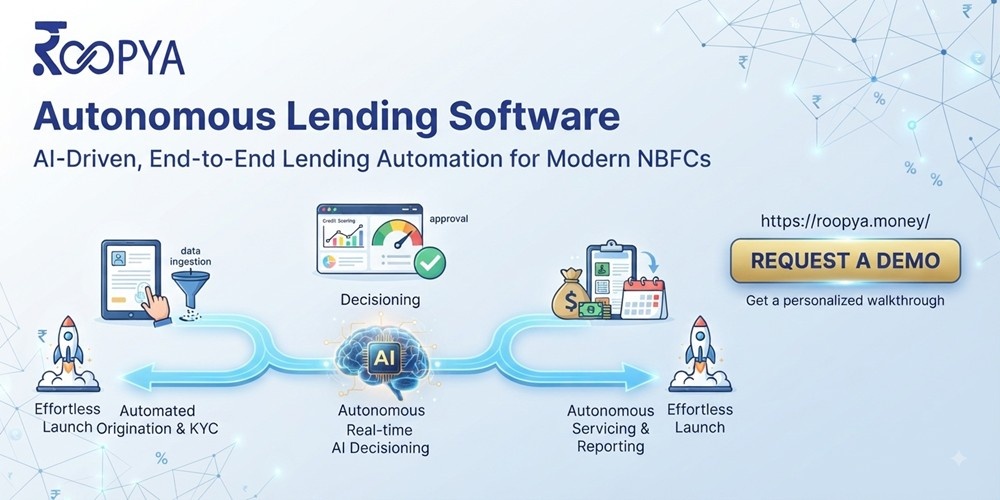
For banks and NBFCs in India, autonomous lending software is no longer a futuristic concept. It is the architecture that separates the market leaders from the laggards. In this guide, we explore what autonomous lending software is, how it works, why it matters, what to look for in a platform, and how Roopya is delivering fully autonomous lending infrastructure to Indian financial institutions today.
1. What Is Autonomous Lending Software?
Autonomous lending software is a technology platform that executes every stage of the loan origination and management process automatically — without requiring human intervention at any step. It combines artificial intelligence, machine learning, robotic process automation, pre-integrated data APIs, and configurable decisioning engines to create a seamless, end-to-end lending pipeline that runs 24 hours a day, 7 days a week, at any scale.
The term ‘autonomous’ is deliberate and precise. Traditional loan processing software digitises manual steps — it replaces a paper form with a digital form, or a phone call with an online document upload. But humans still review, decide, and approve. Autonomous lending software eliminates that human layer entirely for the majority of loan applications, reserving human attention only for genuinely complex or high-risk edge cases that require judgement beyond what data alone can provide.
Think of autonomous lending software the way you think of autonomous vehicles. A conventional car requires a driver to make every decision. An advanced driver-assistance system (ADAS) assists and alerts. A fully autonomous vehicle perceives the environment, makes decisions, and acts — without human involvement. Autonomous lending software operates at that final tier: perceiving borrower data, making credit decisions, and disbursing funds — autonomously.
Roopya’s autonomous lending platform brings this capability to Indian banks and NBFCs through a no-code infrastructure that combines AI-powered data processing with a fully configurable decision engine and 300+ pre-integrated data sources.
2. Why Autonomous Lending Is Now Essential for Indian Lenders
The Scale Problem
India’s formal credit gap is enormous. Hundreds of millions of individuals and tens of millions of MSMEs are either underserved or entirely excluded from formal credit. Serving this population through human-driven underwriting is simply not economically viable — the cost per loan is too high relative to the ticket size. Autonomous lending software makes it possible to profitably underwrite a ₹20,000 personal loan or a ₹75,000 MSME working capital line, because the marginal cost of processing each additional application approaches zero.
Borrower Expectations Have Transformed
Digital-native borrowers — increasingly the majority of applicants — expect an experience comparable to booking a cab or ordering food online. Instant confirmation, transparent status updates, and same-day outcomes. A lending process that takes three to five business days is not just inconvenient; it actively pushes potential borrowers toward competitors who can deliver in minutes. Autonomous lending software is the only way to meet this expectation at scale.
Consistency and Compliance
Human underwriters, no matter how well trained, introduce variability. Two analysts reviewing the same application may reach different conclusions. Mood, fatigue, unconscious bias — all affect manual decisioning. Autonomous lending software applies the exact same credit policy to every single application, every single time, creating a consistency that improves both portfolio quality and regulatory defensibility.
Competitive Pressure from Fintech
Fintech lenders have built their entire businesses on autonomous lending infrastructure. They process thousands of applications a day with tiny teams. Traditional banks and NBFCs that continue to rely on manual workflows face an existential competitive disadvantage in speed, cost, and customer experience. Adopting autonomous lending software is not an upgrade — it is a survival strategy.
3. Core Components of Autonomous Lending Software
3.1 Intelligent Application Intake
The autonomous lending journey begins the moment a borrower initiates an application. Smart, adaptive digital forms — configurable by loan product, borrower segment, and channel — collect structured data with real-time field validation. AI-powered form logic adjusts the application flow dynamically based on borrower responses, reducing form abandonment and improving data completeness. Roopya’s pre-configured product journeys support 20+ loan types out of the box, meaning lenders can launch new products without any form-building effort.
3.2 Fully Automated KYC
Identity verification is the first gate in any loan process. Autonomous lending software integrates directly with Aadhaar eKYC, NSDL PAN verification, Digilocker, CKYC registry, and video KYC (VKYC) platforms, completing the full KYC process in seconds — triggered automatically when the borrower submits their application and provides digital consent. No branch visit. No manual review. No delay. Roopya’s platform executes multi-source KYC simultaneously, cross-validating identity signals across providers to flag discrepancies without human review.
3.3 Real-Time Bureau & Alternate Data Pulls
The moment KYC is cleared, autonomous lending software triggers simultaneous pulls from credit bureaus — CIBIL, Experian, CRIF, Equifax — along with alternate data sources: GST returns, bank account aggregator data, telecom data, e-commerce transaction history, and social utility signals. In Roopya’s platform, these 300+ data integrations are pre-built and execute in parallel, delivering a complete data picture in seconds rather than the hours required by sequential manual sourcing.
3.4 AI-Powered Document Processing
Borrowers upload income documents, bank statements, salary slips, ITR filings, and GST returns. Autonomous lending software processes these documents through AI-powered optical character recognition (OCR) and natural language processing (NLP) engines that extract, validate, and analyse data with greater than 99% accuracy. Bank statement analysis — income computation, expense categorisation, EMI obligation detection, cash flow pattern analysis — is completed automatically, with fraud anomaly detection running in parallel. Documents that would take a human analyst 30 minutes to review are processed in under 10 seconds.
3.5 No-Code AI Credit Decisioning Engine
The credit decision is the heart of the autonomous lending process. A sophisticated, no-code Business Rule Engine (BRE) translates the lender’s credit policy into automated decisioning logic — income thresholds, bureau score floors, EMI-to-income ratio limits, employment type eligibility, geographic restrictions, negative list checks, and hundreds of other variables. Overlaid on the BRE is a machine learning credit scoring model that evaluates the full data picture — bureau, banking, income, alternate data — to generate a risk score and recommended decision.
In Roopya’s autonomous lending platform, the BRE is configurable by non-technical business users through an intuitive visual interface. Credit policy changes that previously required weeks of IT development can be implemented by a risk analyst in hours, with no code written. The ML models continuously learn from portfolio outcomes, improving decisioning accuracy over time.
3.6 Dynamic Offer Generation
For applications that pass the decisioning engine, autonomous lending software automatically generates a personalised loan offer — configured for the specific borrower’s risk profile, the lender’s product parameters, and any applicable promotional pricing. The offer — including sanctioned amount, interest rate, tenure, processing fee, and EMI schedule — is presented to the borrower through the digital interface and delivered via SMS, WhatsApp, and email simultaneously. The borrower accepts digitally, triggering the next stage automatically.
3.7 Automated Legal Documentation & eSign
Accepted offers trigger automatic generation of the loan agreement, sanction letter, and all required disclosure documents, populated with the specific terms of the approved loan. The borrower executes the agreement digitally through Aadhaar OTP-based eSign or Digilocker eSign — legally valid under the IT Act and RBI guidelines. No physical documents. No courier delays. No branch visit. The entire documentation and signing process completes within the same session as the application, typically in under five minutes.
3.8 Automated Disbursement
Once documentation is executed, autonomous lending software triggers disbursement automatically — through IMPS, NEFT, UPI, or direct account credit — verified against bank account details confirmed during the KYC process. End-to-end, from application initiation to funds in the borrower’s account, can be completed in under 15 minutes for clean profiles, with zero human intervention at any point. Roopya’s integration with leading payment processors ensures disbursement reliability across all bank accounts.
3.9 Continuous Monitoring and Early Warning
Autonomous lending does not stop at disbursement. Leading platforms continuously monitor the live portfolio — tracking repayment behaviour, bureau updates, and early delinquency signals — and trigger automated actions: payment reminders, restructuring offers for stressed accounts, collections escalation, or reporting to credit bureaus. This post-disbursement autonomy is what separates a true autonomous lending platform from a sophisticated origination tool.
4. Types of Lending Products That Autonomous Software Can Process
Modern autonomous lending software is not limited to simple consumer loans. Roopya’s platform supports the full spectrum of lending products with autonomous or semi-autonomous processing:
- Personal Loans (Salaried & Self-Employed): Bureau-led, income-verified, fully automated decisioning in under 60 seconds.
- MSME and Business Loans: GST surrogate underwriting, banking analysis via Account Aggregator, and CIBIL MSME integration — all automated.
- Microfinance (JLG Loans): Group lending workflows with automated bureau checks, repayment capacity assessment, and digital documentation.
- Payday and Salary Advance: Ultra-fast processing with employer verification, attendance data integration, and same-session disbursement.
- Gold Loans: Automated collateral valuation triggers, LTV computation, and digital pledge documentation.
- Auto Loans: RC verification, insurance check integration, and hypothecation documentation automation.
- Buy Now Pay Later (BNPL): Real-time decisioning embedded directly in merchant checkout flows via API.
5. Autonomous vs. Automated Lending: An Important Distinction
These terms are frequently conflated, but the difference is significant. Automated lending software digitises individual steps in the loan process — an automated email notification, an online form, a digital document upload. Humans remain in the decisioning and approval loop throughout.
Autonomous lending software eliminates the human loop entirely for qualifying applications. It does not just send an automated email asking for documents — it processes those documents, makes the credit decision, generates the offer, executes the agreement, and disburses the funds, all without a human reviewing any step. The distinction is the difference between a calculator (which automates arithmetic) and a financial modelling AI (which builds the entire model independently).
Roopya is designed for true autonomy — not just automation. The platform handles complete loan journeys from start to finish with zero human touchpoints for clean, standard applications. Human intervention is reserved for genuinely complex cases that require contextual judgement — a policy the platform’s smart referral engine handles automatically.
6. How Roopya’s Autonomous Lending Platform Works in Practice
Here is a step-by-step view of how a personal loan is processed on Roopya’s autonomous lending platform, from first click to disbursement:
- T+0:00 — Application Initiated: Borrower opens the lender’s branded mobile app or web portal. The Roopya-powered application form adapts dynamically to the borrower’s profile as they type.
- T+0:02 — KYC Completed: Borrower provides Aadhaar consent. Roopya simultaneously triggers eKYC, PAN verification, and CKYC check. Identity confirmed in seconds.
- T+0:03 — Bureau & Data Pulls: Credit bureau reports from CIBIL and Experian retrieved. Bank statement pulled via Account Aggregator (if consented). Alternate data scores computed.
- T+0:05 — Documents Uploaded: Borrower uploads salary slip and bank statement. AI engine processes both: income extracted, obligations identified, fraud signals checked. All in under 10 seconds.
- T+0:06 — Credit Decision: BRE and ML credit model evaluate the full data picture. Decision generated: Approved for ₹3,00,000 at 14.5% for 36 months.
- T+0:07 — Offer Presented: Personalised loan offer displayed in app. Borrower reviews EMI schedule and accepts with a single tap.
- T+0:10 — Documents Generated & Signed: Loan agreement auto-generated and presented. Borrower signs via Aadhaar OTP eSign.
- T+0:14 — Funds Disbursed: IMPS transfer initiated and confirmed. Borrower receives SMS confirmation.
Total elapsed time: 14 minutes. Human interventions: zero. This is autonomous lending in action.
7. Key Benefits of Autonomous Lending Software for Banks and NBFCs
Dramatic Cost Reduction
The cost of processing a loan application manually — factoring in staff time, document handling, physical infrastructure, and error remediation — can range from ₹1,500 to ₹5,000 per application depending on product complexity. Autonomous lending software reduces this to a fraction of that cost, making profitable lending viable at ticket sizes and volumes that were previously uneconomical. Roopya clients report processing cost reductions of 50–70% after moving to the autonomous platform.
Speed as Competitive Advantage
When disbursement time drops from days to minutes, conversion rates increase dramatically. Borrowers who might have abandoned an application out of impatience — or accepted a competitor’s offer — become customers. Roopya lenders consistently report 30–50% improvement in application-to-disbursement conversion after deployment.
Portfolio Quality Improvement
Counterintuitively, autonomous decisioning often produces better credit outcomes than manual underwriting. This is because the BRE and ML models apply the credit policy consistently, without the variability introduced by individual analyst judgement. Early data from Roopya clients shows meaningful reductions in 90+ day delinquency rates after deployment — a direct result of consistent, data-driven underwriting replacing inconsistent human review.
24/7 Operations Without Incremental Cost
Autonomous lending software runs continuously — processing applications submitted at 2 AM on a Sunday with exactly the same speed and accuracy as a Tuesday morning submission. This 24/7 capability, available at no incremental cost, dramatically expands the effective operating hours of a lending business.
Regulatory Compliance at Scale
Every action taken by Roopya’s autonomous lending platform is logged, timestamped, and stored in a tamper-evident audit trail. Consent management, bureau pull authorisation, KYC documentation, credit decisioning rationale, and agreement execution are all captured automatically. Regulatory examinations that previously required weeks of manual file preparation can be satisfied with a few report exports.
8. Choosing Autonomous Lending Software: What to Evaluate
- True autonomy vs. assisted automation: Does the platform make decisions and act independently, or does it just move information between human reviewers faster?
- Breadth of pre-built integrations: The more data sources connected out of the box, the richer the autonomous decisioning. 300+ integrations (like Roopya offers) is the benchmark.
- No-code configurability: Can your risk and credit teams update policies without IT involvement? Autonomy without agility is a liability.
- AI and ML maturity: Are the models pre-trained on Indian lending data? Do they improve with your portfolio performance? Are they explainable for regulatory purposes?
- Implementation speed: A platform that takes 12 months to go live is not delivering competitive advantage. Roopya’s 1-day go-live is the standard to demand.
- Pricing model: Pay-as-you-use models align the vendor’s incentives with yours. Avoid large upfront licences for early-stage or growth-stage lenders.
- Post-disbursement autonomy: Does the platform manage the live portfolio autonomously, or does automation stop at disbursement?
9. The Future of Autonomous Lending in India
The autonomous lending software category in India is in its early growth phase, but the trajectory is clear and steep. Several powerful forces are accelerating adoption:
The Account Aggregator (AA) framework, now operational across major banks, provides autonomous lending platforms with instant access to consented financial data — bank statements, investments, insurance — in a machine-readable format, dramatically improving underwriting depth for thin-file borrowers without any manual document collection.
The OCEN (Open Credit Enablement Network) protocol is creating a new layer of embedded, autonomous credit delivery — allowing borrowers to access credit directly within the applications they already use for business, without ever interacting with a lender’s interface. Autonomous lending software that speaks OCEN will originate loans invisibly, at the point of need.
Generative AI is beginning to enter the autonomous lending stack — enabling intelligent, conversational application journeys that dramatically reduce abandonment in Tier 2 and Tier 3 markets where literacy or tech familiarity may be a barrier. Roopya’s conversational AI interface already serves this segment with high satisfaction scores.
The combination of AA, OCEN, and AI will produce a lending environment where the best lenders are those who can deploy capital the fastest, most accurately, and most economically. Autonomous lending software is the infrastructure layer that makes all of this possible.
10. Why Roopya Is India’s Leading Autonomous Lending Platform
Roopya was architected from the ground up as an autonomous lending infrastructure — not a traditional lending software that had automation layered on top. Every component of the platform is designed for zero-touch operation, and every integration is pre-built so there is no custom development required to achieve full autonomy.
- 1-Day Go-Live: The only autonomous lending platform in India where you can go from sign-up to processing live loans in 24 hours.
- 300+ Pre-Integrated APIs: Every bureau, KYC provider, AA connector, eSign platform, banking API, and data source you need — already connected.
- True No-Code: Risk teams configure credit policies, decisioning rules, and product parameters independently — no IT dependency.
- AI-Native: Not AI bolted on, but AI at the core — document processing, credit scoring, fraud detection, and portfolio monitoring are all AI-powered.
- Pay-As-You-Use: Zero upfront investment. Pay only for what you process, with pricing that scales with your volume.
- RBI-Compliant by Design: Continuous regulatory updates, built-in audit trails, consent management, and regulatory reporting built in.
- Proven at Scale: IndiaKaLoan, EazyCredit, Recapita, QuickFinShop, Findoc and others run fully autonomous lending operations on Roopya today.
If your lending operation still relies on manual reviews, branch-based workflows, or disconnected technology tools, Roopya offers a free consultation and live platform demo. See what autonomous lending looks like in practice — and understand why leading Indian NBFCs and banks are making the transition now.

