Best NBFC Software for Loan Management in India: The Definitive Guide

Non-Banking Financial Companies (NBFCs) are the unsung heroes of India’s credit story. They reach borrowers that traditional banks cannot — the micro-entrepreneur in a Tier 3 town, the self-employed professional with an irregular income, the first-time borrower with a thin credit file. In FY 2024-25, NBFCs collectively disbursed over ₹35 lakh crore in credit, making them one of the most consequential pillars of India’s financial system.
Yet running an NBFC profitably and compliantly is harder than ever. The Reserve Bank of India has tightened its regulatory framework considerably — from the Scale-Based Regulation (SBR) framework to more stringent KYC and fair practice guidelines. At the same time, borrower expectations have shifted dramatically: faster processing, digital-first journeys, and personalised offers are now baseline expectations, not differentiators.
Start Free Trial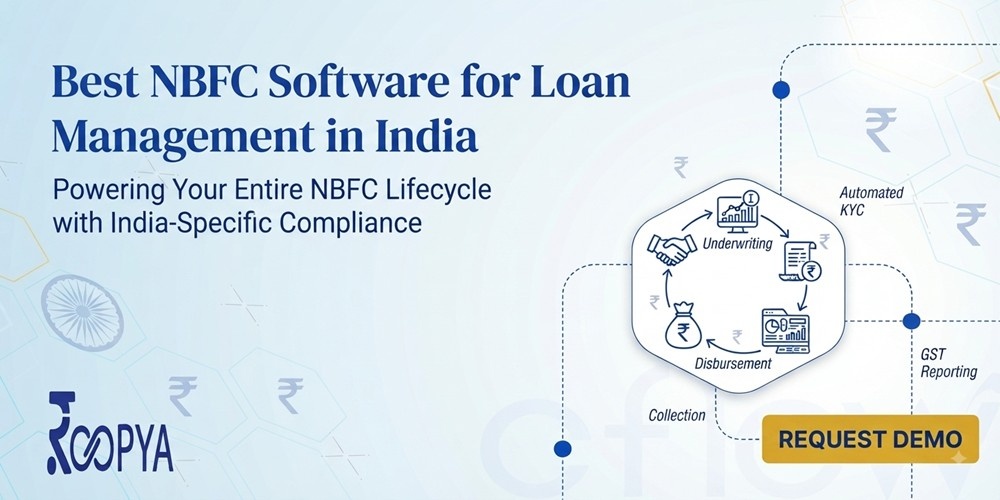
The solution to both challenges — operational efficiency and regulatory compliance — is the right NBFC software for loan management. In this guide, we explore what NBFC loan management software is, what features define the best platforms, how to evaluate your options, and why Roopya has emerged as the leading choice for NBFCs across India.
1. What Is NBFC Software for Loan Management?
NBFC loan management software is a comprehensive digital platform that automates and manages the complete lending lifecycle — from borrower acquisition and application processing, through credit underwriting and disbursement, to repayment collection, portfolio monitoring, and regulatory reporting.
Unlike generic CRM or ERP tools adapted for lending, purpose-built NBFC software is designed around the specific workflows, regulatory requirements, and data integrations that define non-banking financial company operations in India. It understands CIBIL bureau data structures, Aadhaar eKYC flows, RBI reporting formats, and the nuances of NBFC-specific product types — from microfinance JLG loans to MSME term credit to gold-backed lending.
The best NBFC software platforms integrate multiple functional modules — Loan Origination System (LOS), Loan Management System (LMS), Business Rule Engine (BRE), collections management, and compliance reporting — into a single, unified interface that eliminates data silos and manual handoffs between teams.
2. Why Indian NBFCs Need Specialised Loan Management Software
2.1 The Regulatory Pressure Is Intensifying
The RBI’s Scale-Based Regulation framework, introduced in 2021 and progressively tightened since, has created differentiated compliance requirements for Base Layer, Middle Layer, Upper Layer, and Top Layer NBFCs. Fair Practices Code guidelines, digital lending norms (particularly the September 2022 guidelines), FLDG restrictions, and AML/KYC requirements have all added layers of compliance complexity that manual processes simply cannot manage reliably.
Purpose-built NBFC software automates compliance at every stage — from consent capture at the application stage to regulatory report generation at month-end — ensuring that your NBFC is always audit-ready without the manual effort that compliance typically demands.
2.2 Manual Processes Are a Competitive Liability
In a market where leading fintech lenders are approving personal loans in under 60 seconds and disbursing within the hour, an NBFC that relies on manual underwriting, physical document collection, and spreadsheet-based portfolio tracking is operating with a severe competitive disadvantage. The best talent gravitates to organisations that give them modern tools; the best borrowers gravitate to lenders that offer fast, friction-free experiences.
Loan management software eliminates the bottlenecks that make NBFC operations slow — automating document verification, bureau score retrieval, credit decisioning, and collection follow-ups so that your team can focus on exceptions, relationships, and growth rather than data entry and paperwork.
2.3 Portfolio Risk Is Increasingly Data-Driven
In an environment of rising retail credit stress, NBFCs that rely on intuition-based credit decisions are exposed to outsized risk. Modern NBFC software integrates AI-powered credit scoring, bureau analytics, bank statement analysis, and early warning indicators to give credit teams a 360-degree view of borrower risk — enabling smarter decisions at origination and earlier intervention when portfolio accounts show stress signals.
2.4 Scalability Requires Automation
An NBFC that wants to grow from 500 loans a month to 5,000 cannot simply hire ten times the staff. The unit economics break down, quality control becomes impossible, and regulatory risk multiplies. NBFC loan management software enables scale without proportional cost growth — the same platform that processes 500 applications handles 50,000 with the same accuracy and compliance.
3. Core Modules of the Best NBFC Loan Management Software
3.1 Loan Origination System (LOS)
The Loan Origination System is the front door of your lending operation. It manages everything from the initial borrower inquiry through application submission, document collection, KYC verification, credit bureau pulls, and the initial credit decision. The best LOS modules for NBFCs offer:
- Configurable digital application forms for multiple loan product types — personal loans, business loans, gold loans, microfinance, vehicle loans, and more.
- Automated Aadhaar eKYC, PAN verification, VKYC, and Digilocker integration for paperless identity verification.
- Real-time credit bureau integration with CIBIL, Experian, CRIF, and Equifax — with automated score retrieval and report parsing.
- AI-powered document OCR for instant extraction and verification of income proof, bank statements, ITR, GST returns, and salary slips.
- Multi-channel support: direct borrower portal, DSA/agent-assisted applications, and embedded API-based origination for partner platforms.
3.2 Business Rule Engine (BRE) and Credit Decisioning
The Business Rule Engine is where your credit policy lives in digital form. A no-code BRE allows credit and risk teams to configure complex, multi-variable decisioning rules — bureau score thresholds, income requirements, employment type filters, geographic eligibility, LTV ratios for secured products — through an intuitive interface, without any coding required.
The best NBFC software BREs support:
- Multi-product rule sets with product-specific eligibility criteria and pricing logic.
- Bureau data parsing and scorecard integration — translating raw bureau data into actionable decisioning inputs.
- AI-assisted rule optimisation — learning from historical application outcomes to suggest improvements to credit policy.
- Real-time decisioning — approving, rejecting, or referring applications for manual review in seconds.
- Waterfall logic for multi-bureau pulls and alternative data integration.
3.3 Loan Management System (LMS)
Once a loan is disbursed, the Loan Management System takes over — tracking repayment schedules, managing EMI collections, handling prepayments and foreclosures, and maintaining the complete account ledger. A robust LMS for NBFCs includes:
- Automated EMI schedule generation with flexible repayment structures — monthly, weekly, bi-weekly, or daily for microfinance products.
- Real-time account balance tracking with complete transaction history.
- Prepayment and foreclosure processing with automated penalty and rebate calculations.
- NACH/eNACH mandate management for automated EMI debit.
- Interest calculation engine supporting flat rate, reducing balance, and IRR-based pricing models.
- Accounting integration for seamless journal entry generation and financial reporting.
3.4 Collections Management
Collections is where NBFC profitability is won or lost. A dedicated collections module within your NBFC loan management software enables systematic, data-driven recovery operations:
- Automated DPD (Days Past Due) tracking with real-time bucket movement — SMA 0, SMA 1, SMA 2, NPA classification.
- Configurable collection workflows with automated IVR calls, SMS, WhatsApp, and email follow-up sequences.
- Field agent assignment and geo-tagged visit tracking for physical collection activities.
- Promise-to-pay (PTP) tracking and follow-up automation.
- Settlement and write-off workflow management with appropriate approval hierarchies.
- Portfolio stress analytics and early warning indicators for proactive intervention.
3.5 Compliance and Regulatory Reporting
Regulatory compliance is an operational imperative for NBFCs — not a nice-to-have. The best NBFC software includes comprehensive compliance automation:
- Automated credit bureau reporting to CIBIL, Experian, CRIF, and Equifax — with CIC data format generation.
- CERSAI integration for secured loan charge creation and satisfaction filing.
- RBI regulatory returns generation — ALM reports, NPA reports, and portfolio quality disclosures.
- AML and KYC compliance workflows with complete audit trails.
- Digital consent management — capturing, storing, and auditing borrower consent at every stage.
- Automated Fair Practice Code compliance checks built into every origination workflow.
3.6 Analytics and Portfolio Intelligence
Data is only valuable if it is accessible and actionable. Modern NBFC loan management software provides real-time dashboards and deep portfolio analytics:
- Origination analytics — application funnel tracking, bureau score distribution, approval and rejection rate trends.
- Portfolio quality dashboards — PAR (Portfolio at Risk) tracking, vintage analysis, geographic concentration.
- Collections performance analytics — recovery rate trends, bucket-wise DPD movement, collector productivity.
- Profitability analytics — yield, NIM, cost of credit, and RORWA tracking at portfolio and product level.
- AI-driven early warning signals for borrowers at risk of delinquency.
4. Types of NBFCs and How Software Needs Differ
Not all NBFCs are the same, and the best loan management software recognises this. Here is how software needs vary across NBFC types:
4.1 NBFC-ICC (Investment and Credit Companies)
The largest NBFC category, including most consumer and MSME lenders. Need comprehensive LOS and LMS with strong bureau integration, multi-product configurability, and robust analytics. Digital lending guidelines compliance is critical, particularly around LSP (Lending Service Provider) management.
4.2 NBFC-MFI (Microfinance Institutions)
Specialised needs including JLG (Joint Liability Group) and SHG (Self-Help Group) lending models, weekly or bi-weekly repayment schedules, field officer management, and rural-compatible offline-capable interfaces. MFIN code of conduct compliance and income assessment tools for low-income borrowers are important requirements.
4.3 NBFC-HFC (Housing Finance Companies)
Long-tenor product management, property valuation integration, legal and technical report workflow management, disbursement tranche handling, RERA compliance, and complex amortisation schedules define the software needs of HFCs.
4.4 Gold Loan NBFCs
Collateral valuation and tracking, LTV management, auction workflow management, and gold inventory reconciliation are critical features. Fast disbursal capabilities — gold loan processing in under 30 minutes — are a key competitive differentiator.
4.5 Vehicle and Auto Finance NBFCs
RC and insurance verification, hypothecation creation and satisfaction filing, GPS tracker integration, and vehicle recovery workflow management define vehicle finance software requirements.
Roopya’s platform supports all of these NBFC types with configurable, product-specific workflows — providing a single infrastructure layer that adapts to the lending model, not the other way around.
5. How Roopya’s NBFC Software Works: End-to-End
Roopya is a no-code digital lending infrastructure platform built specifically for the Indian market. Here is how it powers an NBFC’s complete loan management operation:
- Borrower Application: The borrower accesses a branded digital portal (web or mobile) and completes a smart, product-specific application form. Real-time field validation ensures data quality from the first entry.
- Automated KYC: On consent, Roopya simultaneously triggers Aadhaar eKYC, PAN verification, and VKYC — completing identity verification in under two minutes without any manual intervention.
- Bureau Pull and Document Analysis: Credit bureau reports are retrieved instantly from CIBIL, Experian, CRIF, or Equifax. Uploaded documents are analysed by Roopya’s AI engine — extracting income data, detecting anomalies, and flagging fraud signals in seconds.
- Credit Decisioning: The no-code BRE evaluates the application against the NBFC’s configured credit policy and generates an instant decision — approve, reject, or manual review — with full decision documentation for audit purposes.
- Offer and eSign: Approved borrowers receive a personalised loan offer and complete digital agreement signing via Aadhaar OTP-based eSign — all within the same session.
- Disbursement: The completed application triggers automated disbursement workflows — NACH mandate registration, banker approval queues, and fund transfer initiation — reducing time-to-disbursal to hours, not days.
- Loan Lifecycle Management: The LMS tracks every EMI, manages collections workflows, processes prepayments, and generates regulatory reports automatically — giving the NBFC complete visibility and control throughout the loan’s life.
6. Key Benefits of Choosing the Right NBFC Software
Drastic Reduction in Processing Time
Manual NBFC loan processing typically takes three to seven days from application to disbursal. With Roopya’s automated workflows, clean-file loans can be processed in under four hours — from application submission to disbursement trigger. This speed advantage directly translates to higher conversion rates, better borrower satisfaction, and competitive differentiation.
Significant Cost Reduction
Automating document processing, KYC, credit decisioning, and collection follow-ups eliminates much of the manual effort in NBFC operations. Roopya customers report cost-per-loan reductions of 40–65% compared to their previous manual or semi-automated processes. At scale, these savings are transformative.
Superior Credit Quality
AI-powered underwriting, bureau analytics, and bank statement analysis produce more consistent, data-driven credit decisions. The BRE applies your credit policy uniformly across every single application — eliminating the inconsistency and bias that creep into manual underwriting. The result is a healthier portfolio with lower NPA rates.
Regulatory Confidence
With built-in compliance automation, digital audit trails, and automated regulatory reporting, Roopya ensures that your NBFC is always prepared for an RBI inspection or audit. Compliance is a system property, not a manual activity — reducing the risk of regulatory penalties and reputational damage.
Faster Time-to-Market for New Products
In a no-code environment, launching a new loan product — a new EMI structure, a new customer segment, a new interest rate waterfall — takes hours, not months. Business teams can make changes independently without raising development tickets or waiting for IT delivery cycles. This agility is a critical competitive advantage in a fast-moving market.
Scalability That Matches Ambition
Roopya’s cloud-native infrastructure scales automatically with your business. Whether you are processing 200 applications a month or 20,000, the platform maintains the same response times, accuracy levels, and compliance standards. There is no infrastructure ceiling on your growth ambitions.
7. Evaluating NBFC Software: A Practical Checklist
When selecting NBFC loan management software, use this checklist to evaluate your options objectively:
- Is it purpose-built for NBFCs? Generic software adapted for lending rarely meets the specific regulatory and operational requirements of Indian NBFCs.
- How quickly can you go live? Implementation timelines of six to twelve months are common with traditional software — look for platforms that offer pre-configured product templates and rapid deployment.
- Is it truly no-code? If business users need to raise IT tickets for every policy change, the platform is not truly no-code. Test the BRE configuration interface yourself.
- How many integrations are pre-built? Count the bureau integrations, KYC providers, eSign platforms, payment gateways, and accounting tools that are available without custom development.
- What is the pricing model? Upfront licence fees create capital risk. Pay-as-you-use models align the vendor’s success with yours.
- Is the compliance module current? RBI guidelines change frequently. Ask specifically which guidelines have been implemented and when the last compliance update was released.
- What AI capabilities are native? Document analysis, fraud detection, and credit scoring should be built in — not available as expensive add-ons.
- What is the track record with similar NBFCs? Ask for references from NBFCs of a similar size, product mix, and geography to yours.
- What does the SLA look like? Uptime guarantees, support response times, and disaster recovery commitments are critical for a mission-critical platform.
8. Common Mistakes NBFCs Make When Choosing Software
Choosing Price Over Fit
The cheapest NBFC software is rarely the best value. A platform that cannot scale, lacks key integrations, or requires expensive customisation will cost far more in the long run than a slightly more expensive, purpose-built solution. Evaluate total cost of ownership — including implementation, customisation, maintenance, and opportunity cost — not just the monthly licence fee.
Underestimating Implementation Complexity
Traditional software implementations routinely run over time and over budget. Before committing, understand exactly what the implementation process involves — data migration, staff training, integration testing, and user acceptance testing. Platforms like Roopya offer pre-configured templates that compress this timeline dramatically.
Ignoring the Compliance Roadmap
Regulatory requirements for NBFCs are evolving continuously. Before choosing a platform, ask specifically about the vendor’s compliance update process — how quickly are new RBI guidelines implemented, who pays for compliance updates, and what happens to your existing workflows when regulations change.
Neglecting Change Management
Even the best NBFC software fails if staff do not adopt it. Plan for training, change management, and a transition period. Platforms with intuitive, consumer-grade interfaces and dedicated onboarding support see significantly higher adoption rates and faster time-to-value.
9. Why Roopya Is India’s Best NBFC Software for Loan Management
Roopya was designed from day one for the Indian NBFC market — not adapted from a global platform, not repurposed from a banking system, but purpose-built for India’s regulatory environment, technology landscape, and borrower demographics.
- 1-Day Go-Live: 20+ pre-configured loan product journeys, plug-and-play API integrations, and a no-code setup interface mean most NBFCs can begin processing live loans within 24 hours of onboarding — not six months.
- 300+ Pre-Integrated APIs: All four major credit bureaus, all major KYC and eKYC providers, leading eSign platforms, payment gateways, accounting software, banking APIs, GST data, and more — all available out of the box.
- Truly No-Code: Credit managers, risk officers, and operations teams configure credit policies, workflows, and product parameters without writing code or waiting for IT resources.
- AI at Every Stage: Document OCR with 99%+ accuracy, ML-based credit scoring, intelligent fraud detection, and a self-learning Business Rule Engine — all built in as standard features.
- Complete Loan Lifecycle: LOS + BRE + LMS + Collections + Compliance in a single, unified platform. No integration headaches between separate systems.
- Pay-As-You-Use Pricing: Zero upfront licence fees. Pay based on actual loan processing volume — making Roopya equally accessible for a newly licensed NBFC and a large-scale lender.
- RBI-Compliant by Design: Always updated for the latest RBI guidelines, digital lending norms, KYC requirements, and bureau reporting standards. Compliance is a platform property, not a manual checklist.
- Proven Track Record: IndiaKaLoan, QuickFinShop, Recapita, Findoc, EazyCredit and other leading NBFCs run their complete lending operations on Roopya.
If you are ready to transform your NBFC’s loan management operations, Roopya offers a free demo with no commitment required. Go live in a day. Grow without limits.

