MSME Loan Origination System: Everything You Need to Know

India’s 63 million Micro, Small and Medium Enterprises (MSMEs) are the backbone of the national economy — contributing nearly 30% of GDP, employing over 110 million people, and accounting for roughly 45% of the country’s exports. Yet for decades, the majority of these businesses have remained severely underserved by formal credit. Traditional banks and NBFCs found it expensive, risky, and operationally impractical to lend to small businesses at scale. Manual underwriting, paper-heavy documentation, and outdated risk models made MSME lending a costly proposition for lenders and a frustrating experience for borrowers.
That reality is changing — rapidly. The combination of GST data, digital banking records, Account Aggregator infrastructure, and advanced AI is fundamentally transforming how MSME credit is assessed and delivered. At the heart of this transformation is the MSME Loan Origination System (LOS) — a purpose-built technology platform that automates and digitises every stage of the MSME lending journey, from initial application to final disbursement.
Start Free Trial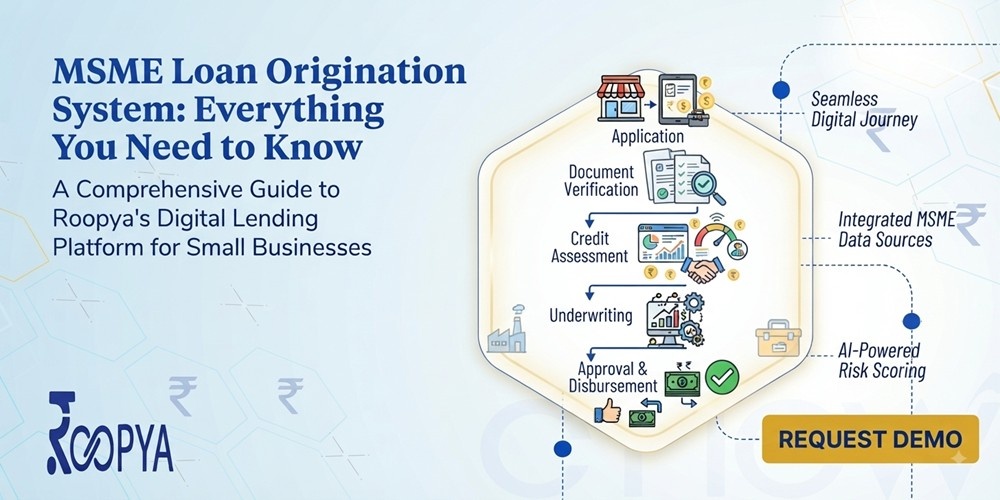
In this comprehensive guide, we cover everything you need to know about MSME loan origination systems — what they are, how they work, what features to look for, and how the right platform can help your lending institution capture the enormous MSME credit opportunity without taking on unsustainable risk.
1. What Is an MSME Loan Origination System?
An MSME Loan Origination System is a specialised digital platform designed to manage the end-to-end process of originating loans for micro, small, and medium enterprises. It is the technology layer that sits between a potential borrower applying for business credit and the lender’s decision to approve, decline, or modify that application.
Unlike a generic loan origination system built for personal or home loans, an MSME-specific platform is engineered to handle the unique complexities of business lending — variable income streams, multiple data sources (GST, banking, ITR, trade references), diverse collateral types, and the wide spectrum of business sizes and structures that fall under the MSME umbrella.
A mature MSME LOS handles:
- Digital application capture with business-specific data fields
- Automated KYC for directors, proprietors, and business entities
- GST data retrieval and automated revenue analysis
- Bank statement analysis using AI-powered pattern recognition
- Credit bureau checks for both the business and personal guarantors
- ITR and financial statement analysis
- Multi-variable credit scoring with business-specific risk parameters
- Collateral assessment and property documentation workflows
- Automated sanction letter and digital agreement execution
- Seamless handoff to the Loan Management System for disbursement
Platforms like Roopya deliver all of this within a single, unified, no-code environment — enabling lenders to originate MSME loans faster, cheaper, and with far greater accuracy than manual processes allow.
2. The MSME Credit Gap: Why Technology Is the Answer
The numbers tell a stark story. Despite the enormous size of the MSME sector, formal credit penetration remains deeply inadequate. Industry estimates place the MSME credit gap in India at over ₹20–25 lakh crore — the difference between what MSMEs need and what the formal financial system currently provides. The reasons are well understood:
- Thin financial footprints: Many MSMEs have limited formal financial records, making traditional credit assessment unreliable or impossible.
- High processing costs: Manual underwriting of small-ticket business loans is expensive relative to the revenue they generate. The economics only work at scale, which manual processes cannot deliver.
- Collateral requirements: Traditional lenders have relied heavily on property collateral, excluding the vast majority of asset-light MSMEs from formal credit.
- Slow turnaround: MSMEs often need credit quickly — for working capital, for a large order, for equipment. A 30-day loan processing cycle is commercially useless.
- Geography: Many MSMEs operate in semi-urban or rural areas, far from bank branches with the expertise to assess business loan applications.
A well-built MSME Loan Origination System addresses every one of these barriers. It makes thin-file borrowers assessable through alternative data. It makes per-loan economics viable through automation. It enables cash-flow-based underwriting that removes the collateral dependency. It cuts turnaround from days to minutes. And it operates digitally, reaching borrowers in every geography through web and mobile interfaces.
The MSME LOS is not merely a convenience — it is the foundational infrastructure that makes profitable, responsible MSME lending at scale possible.
3. Key Components of a Modern MSME Loan Origination System
3.1 Digital Application Journey for Businesses
The borrower experience begins with the application form, and for MSMEs, this means collecting a fundamentally different set of information compared to a personal loan. A well-designed MSME LOS captures business registration details (GSTIN, Udyam registration, CIN or LLP number), promoter and director information, the nature of business and industry classification, banking relationships, existing credit facilities, and preliminary financial details — all through a structured, guided digital journey.
Roopya’s platform offers pre-configured MSME loan journeys that guide business owners step by step, with intelligent field validation, real-time data prefill from government databases, and mobile-friendly design that works on entry-level smartphones. Smart branching logic adapts the application flow based on business type — a sole proprietor sees a different journey from a private limited company — eliminating irrelevant fields and reducing drop-off.
3.2 Business and Promoter KYC
MSME lending involves layered KYC — not just for the borrowing entity but for promoters, directors, and personal guarantors. A capable MSME LOS automates all of these simultaneously: GSTIN verification, Udyam/MSME registration validation, company master data pull from MCA21, Aadhaar eKYC for promoters, PAN verification, and Digilocker-based document fetching for certificates of incorporation, partnership deeds, and other business documents.
Roopya’s 300+ pre-integrated APIs enable this entire multi-layer KYC process to complete in under three minutes, without any manual document handling or branch intervention. The result is a fully verified application ready for credit assessment the moment the borrower completes onboarding.
3.3 GST Data Analysis and Revenue Underwriting
The introduction of GST has been transformational for MSME lending. A business that files GST returns regularly is providing a quarterly self-reported revenue declaration to the government — and this data is now accessible to lenders (with borrower consent) through GSTN APIs.
An MSME Loan Origination System that integrates with GSTN can retrieve a business’s GST returns history — monthly and quarterly filings — and run automated analysis to determine revenue trends, seasonality patterns, filing consistency, and effective tax rate. This creates a surrogate income assessment for businesses that may not have audited financials, opening formal credit access to millions of previously unassessable MSMEs.
Roopya’s GST analytics module extracts, normalises, and models GST data to produce a reliable revenue underwriting input in real time. Credit teams can configure the weight given to GST-derived income relative to other sources, giving lenders full control over how this powerful data source is incorporated into their credit policy.
3.4 Bank Statement Analysis with AI
Bank statements remain one of the richest sources of financial intelligence for MSME underwriting. They reveal actual cash inflows and outflows, average monthly balances, EMI obligations, bounce history, and behavioural patterns that are invisible in official financial statements.
Manual bank statement analysis is one of the biggest operational bottlenecks in MSME lending — a 12-month statement for a business with multiple accounts can run to hundreds of pages. AI-powered bank statement analysis within Roopya’s MSME LOS processes multi-bank, multi-account statements in seconds, extracting and categorising transactions, computing net cash flow, identifying EMI obligations, flagging adverse patterns such as cheque returns or unusual transfers, and delivering a structured financial summary ready for credit use.
Accuracy exceeds 99%, and the system supports statements from all major Indian banks in both PDF and Excel formats, including password-protected files.
3.5 ITR and Financial Statement Integration
For MSMEs with audited financials — particularly in the small and medium categories — ITR data and CA-certified financial statements are essential credit inputs. A mature MSME LOS integrates with TRACES and the Income Tax portal to pull ITR data directly (with consent), eliminating the need for borrowers to submit physical documents.
Automated financial spreading — extracting key financial ratios (DSCR, current ratio, debt-to-equity, operating profit margin) from uploaded balance sheets and P&L statements — is another core feature of Roopya’s platform. This analysis, which traditionally takes a credit analyst hours, is completed in seconds with consistent methodology across every application.
3.6 Credit Bureau Checks: Business and Personal
MSME credit assessment requires bureau checks at multiple levels. The business entity must be checked against CIBIL MSME Rank, Experian Business, and CRIF Business. Key promoters and personal guarantors require individual bureau checks from CIBIL, Experian, Equifax, or CRIF. An effective MSME LOS triggers all these checks simultaneously at the point of application consent, returning consolidated bureau data to the underwriting engine in seconds.
Roopya pre-integrates with all four major Indian credit bureaus at both the individual and commercial bureau level, with configurable rules determining which bureaus to pull for different product types, ticket sizes, or borrower segments.
3.7 No-Code Credit Policy Engine for MSME Lending
MSME credit policy is inherently more complex than retail credit policy. Variables include: business vintage, industry type and sector risk, GST revenue versus declared income, banking behaviour scores, bureau grades, promoter personal credit history, collateral coverage, and geographic risk factors — among many others.
Roopya’s no-code Business Rule Engine (BRE) enables credit and risk teams to configure and modify this entire multi-variable policy through a visual interface, without any developer involvement. Rules can be layered, sequenced, and weighted to reflect the lender’s specific risk appetite. Product-level policies — different rules for working capital loans versus term loans versus equipment finance — can be maintained in parallel within the same platform.
The BRE also supports champion-challenger configurations, allowing risk teams to test new credit policies against existing ones on live traffic before fully replacing them — a critical capability for continuous credit model improvement.
3.8 Cash-Flow-Based Credit Scoring
The most significant innovation in modern MSME lending is the shift from collateral-based to cash-flow-based underwriting. Rather than asking ‘does this business owner have property to pledge?’, a cash-flow model asks ‘can this business generate sufficient cash to service this loan?’
Roopya’s MSME LOS supports configurable cash-flow-based credit scorecards that synthesise inputs from GST data, bank statement analysis, ITR, and bureau data to generate a composite creditworthiness score. This score, combined with the BRE, drives automated decisioning — making previously unassessable MSME borrowers accessible to formal credit for the first time.
3.9 Collateral and Property Assessment Workflow
When collateral is involved — as it often is for larger MSME loans and LAP (Loan Against Property) products — the MSME LOS must manage property assessment workflows. This includes integration with valuation agencies, legal search vendors, and CERSAI for encumbrance checking. Roopya supports configurable collateral workflows with multi-vendor assignment, progress tracking, and automated LTV calculation tied to credit decisioning.
3.10 Digital Sanction and eSign
An approved MSME loan application should flow directly into digital sanction letter generation and agreement execution — without reverting to paper. Roopya’s platform generates sanction letters with all relevant terms pre-populated from the approved application, delivers them digitally, and captures borrower acceptance through Aadhaar OTP-based or Digilocker-based eSign — legally valid under the IT Act and fully paperless.
4. Types of MSME Loans an LOS Can Originate
A well-designed MSME Loan Origination System should be versatile enough to handle the full range of business credit products:
- Working Capital Term Loans: Short-to-medium tenor loans for operational funding needs, underwritten primarily on cash-flow and banking behaviour.
- Business Term Loans: Medium-to-long tenor loans for business expansion, capital investment, or equipment purchase.
- Machinery and Equipment Finance: Asset-backed lending with equipment as primary collateral; includes invoice-based lending for new equipment.
- Loan Against Property (Business LAP): Property-backed business loans for larger ticket sizes, with property valuation and CERSAI workflows.
- Overdraft and Cash Credit Facilities: Revolving credit products with dynamic limit management.
- Supply Chain Finance and Invoice Discounting: Receivable-based lending products for manufacturers and distributors.
- Government Scheme Loans (CGTMSE, MUDRA): Subsidised and guarantee-backed loans requiring specific documentation and reporting.
Roopya’s platform comes pre-configured for all major MSME loan product types, with product-specific application journeys, underwriting workflows, and credit policies that can be activated and customised in hours — not months.
5. How the MSME Loan Origination Process Works on Roopya
Here is a step-by-step walkthrough of how an MSME loan application moves through Roopya’s origination system:
- Step 1 – Business Applies: The MSME owner accesses your branded digital interface (web or mobile) and begins the pre-configured business loan application. GSTIN and PAN prefill business details automatically.
- Step 2 – Instant Multi-Layer KYC: On consent, Roopya simultaneously triggers GSTIN verification, business entity checks, promoter Aadhaar eKYC, and PAN validation. Completed in under 3 minutes.
- Step 3 – Data Aggregation: GST return data, bank statements (via AA or upload), and ITR data are fetched and processed automatically. AI analyses all inputs and generates structured financial summaries.
- Step 4 – Bureau Checks: Business and personal bureau reports are pulled simultaneously from configured bureaus. Results are parsed and fed into the underwriting engine.
- Step 5 – Automated Underwriting: The BRE and credit scorecard evaluate all inputs — GST revenue, bank cash flow, bureau grades, financial ratios, and policy rules — and generate a credit decision in real time.
- Step 6 – Offer Generation: For approved applications, a personalised loan offer is generated with amount, tenor, rate, and EMI details. The borrower receives this digitally.
- Step 7 – eSign and Documentation: The borrower accepts the offer and executes the loan agreement digitally. Sanction letter, term sheet, and repayment schedule are delivered in the same session.
- Step 8 – Disbursement Trigger: The completed, signed application moves automatically to the Loan Management System, initiating disbursement workflows.
From application to sanction, the entire process can be completed in under 20 minutes for digitally compliant businesses — a transformation from the days or weeks that traditional MSME lending required.
6. Benefits of Implementing an MSME Loan Origination System
Dramatically Faster Turnaround Time
Reducing MSME loan processing from weeks to hours — or minutes for clean applications — is not just operationally efficient. It is commercially transformational. MSMEs often need credit at specific, time-sensitive moments: a large purchase order, a seasonal working capital requirement, equipment failure. A lender that can respond in hours wins; one that responds in weeks is irrelevant.
Lower Cost Per Loan Originated
The unit economics of MSME lending become viable only when the cost of origination is brought under control. Roopya lenders report 40–65% reductions in per-loan processing costs after implementing the platform, driven by automation of KYC, document analysis, bureau pulls, and credit decisioning that previously required significant manual effort.
Better Credit Decisions Through Richer Data
Automated analysis of GST data, bank statements, bureau reports, and financial statements gives lenders a more complete and accurate picture of a borrower’s creditworthiness than manual review ever could. Consistent, data-driven decisioning reduces both Type I errors (rejecting creditworthy borrowers) and Type II errors (approving unqualified borrowers), improving portfolio quality over time.
Scale Without Proportional Cost Growth
A manual origination process requires hiring more staff as application volumes grow. Roopya’s cloud-native platform scales automatically — handling 100 applications a month or 100,000 with the same infrastructure and the same consistency of output. This is the enabling condition for NBFCs and banks that want to grow their MSME portfolio aggressively.
Regulatory Compliance Built In
MSME lending is subject to a growing body of RBI regulation — from KYC norms and Fair Practice Code to CERSAI reporting and credit bureau data standards. Roopya’s platform is continuously updated for compliance, with built-in audit trails, digital consent management, and regulatory reporting that ensures every origination meets current requirements without additional compliance overhead.
Improved Borrower Experience
An MSME owner who can apply for a loan from their phone, receive a decision in minutes, and execute the agreement digitally is a borrower who will return for future credit needs and recommend the lender to peers. Superior borrower experience is both a growth driver and a retention mechanism in a highly competitive MSME lending market.
7. What to Look for When Choosing an MSME Loan Origination System
- MSME-specific data integrations: Does the platform connect natively with GSTN, TRACES, MCA21, CIBIL MSME Rank, and Experian Business — or will you need to build these?
- AI-powered financial analysis: Can the system analyse bank statements and financial documents automatically, with proven accuracy?
- No-code policy configuration: Can your credit team modify underwriting rules without developer involvement?
- Multi-product support: Does the platform handle working capital, term loans, LAP, and supply chain finance — or just one product type?
- Implementation speed: Can you go live in days, not months? Time-to-market is a real competitive cost.
- Scalability: Is the infrastructure cloud-native and genuinely elastic, or will you hit capacity constraints as you grow?
- Regulatory compliance: Is the platform continuously updated for RBI norms, or will compliance be your responsibility to manage?
- Pricing model: Is pricing usage-based, or does the vendor require large upfront licence fees that create financial risk?
8. Roopya: Purpose-Built MSME Loan Origination for Indian Lenders
Roopya is not a generic loan platform that has been adapted for MSME use. It was designed from its foundations with the complexities and opportunities of Indian MSME lending in mind. Every feature, every integration, and every workflow has been built to serve the specific needs of NBFCs, banks, and MFIs originating business credit in the Indian context.
- 1-Day Go-Live: Pre-configured MSME product journeys, pre-integrated data sources, and no-code setup mean you can begin originating loans within 24 hours of onboarding.
- 300+ Pre-Integrated APIs: GSTN, all four credit bureaus (business and individual), all major banks, KYC providers, eSign platforms, Aadhaar eKYC, CERSAI, MCA21, TRACES, and more — all connected out of the box.
- AI-Native: Document OCR, bank statement analysis, GST analytics, and fraud detection are all AI-powered, built in as standard features, not expensive add-ons.
- Truly No-Code BRE: Business and risk teams configure, test, and deploy credit policy changes independently — no developer queue, no implementation lag.
- Pay-As-You-Use: Zero upfront licence costs. You pay based on actual origination volume, making the economics work whether you are processing 50 loans a month or 50,000.
- Account Aggregator Ready: Full AA integration for consent-based financial data sharing — the most powerful and borrower-friendly route to MSME financial data.
- Trusted by Leading Lenders: IndiaKaLoan, QuickFinShop, Recapita, Findoc, EazyCredit and others power their MSME origination on Roopya.
If you are an NBFC, bank, or MFI looking to capture the MSME credit opportunity — profitably, at scale, and with full regulatory compliance — Roopya offers a free platform demo and a no-obligation trial. Go live in a day. Grow without limits.

