Loan Management Software

Loan Management Software
Everything a growing NBFC, bank, or MFI needs to know about loan management software — what it actually does after disbursement, which modules matter, and how to go live without a six-month IT project.
What loan management software actually does
The term gets used loosely. Here’s where it starts and where the two halves of a lending stack split.
Loan Management Software (LMS) is the system of record for a loan after money has moved. It tracks the outstanding principal, generates the amortisation schedule, applies interest and penal charges, reconciles repayments, and keeps every account’s status current — current, overdue, restructured, or closed.
It’s easy to confuse with the system that comes before it. A Loan Origination Software (LOS) handles the application, the KYC, the credit decision, and the disbursement approval. The LMS picks up the moment funds leave the account and stays with that loan until it’s repaid, written off, or foreclosed.
Most lenders don’t actually need to choose between the two — they need both, talking to each other without a manual handoff in between. That’s the gap a unified platform like Roopya is built to close.
Before disbursementLoan Origination System
Application capture, document collection, credit bureau pulls, underwriting rules, approval workflow.
After disbursementLoan Management System
Repayment schedules, EMI collection, statements, restructuring, collections, closure and NOC.
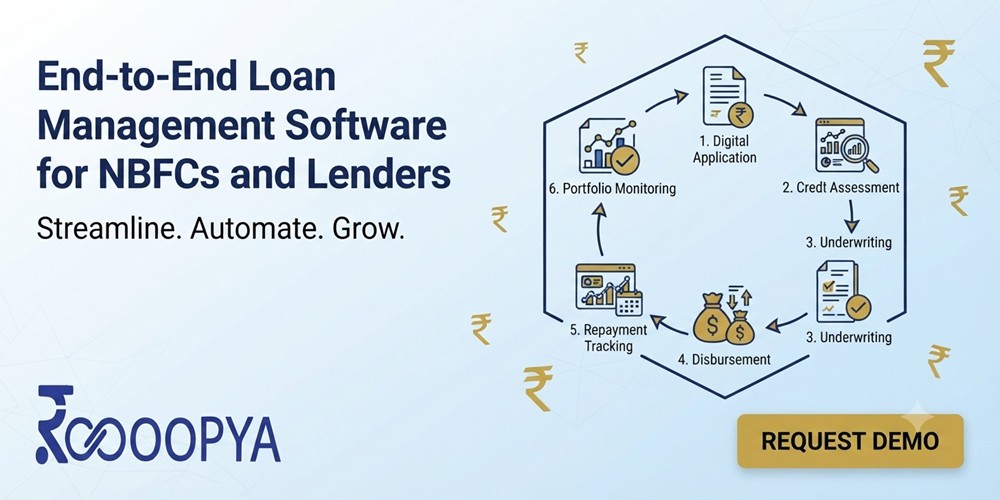
Six stages, one platform
Each capability below maps to a stage in the loan lifecycle shown in the passbook above — mapped here so nothing falls into the gap between systems.
Digital application intake
Borrower-facing forms across web, mobile, and API, with documents and e-signatures collected in the same flow instead of chased over email.
Business rule engine
Credit policy, eligibility, and pricing rules configured visually — a policy change ships the same day, not after the next sprint.
Portfolio & schedule management
Amortisation schedules, interest accrual, restructuring, and statements generated automatically for every loan on the book.
Recovery workflows
Reminder cadences, agent assignment, and payment plans that adjust automatically as an account moves between buckets.
Early warning signals
Behavioural and repayment signals flagged before an account slips, so intervention happens ahead of default, not after.
Analytics & regulatory reports
Portfolio performance, vintage analysis, and compliance-ready reports available on demand instead of assembled by hand each month.
What changes when the ledger stops being a spreadsheet
| Operation | Spreadsheets & legacy tools | Modern Loan Management Software |
|---|---|---|
| Launching a new loan product | Weeks of developer work per product variant | Configured in hours through a no-code product builder |
| Repayment tracking | Manual reconciliation, error-prone at scale | Automated schedules, accruals, and reconciliation |
| Identifying at-risk accounts | Noticed after an account is already overdue | Flagged by early-warning models before default |
| Regulatory reporting | Assembled manually each cycle | Generated on demand, audit-ready |
| Integrating a new bureau or payment partner | A fresh integration project each time | Selected from a pre-built API library |
Built so the loan ledger and the origination flow are the same platform
Roopya runs origination and loan management on one data model, so an approved application becomes a servicable loan without a migration step in between.
Go live in a day
Pre-configured loan products and a plug-and-play environment mean a new lender can process a real application on day one, not after a multi-month rollout.
300+ pre-built APIs
Credit bureaus, KYC verification, payment gateways, and core banking connectors are already wired in — nothing to build from scratch.
AI-assisted fraud checks
Document and identity verification run automatically during origination, catching inconsistencies before a loan is ever disbursed.
No-code business rules
Credit policy, pricing, and approval workflow are set by the business team through a visual rule builder — no engineering ticket required.
Common questions from lending teams
Is loan management software the same as a loan origination system?
No, though they’re often bundled together. Origination covers everything before disbursement — application, credit decision, approval. Loan management software takes over after money moves, handling repayment schedules, servicing, and collections through to closure.
Can loan management software handle multiple loan types on one platform?
Yes, on a modern no-code platform. Personal loans, gold loans, business loans, and top-up products can each be configured as separate product variants — with their own eligibility rules, pricing, and tenure — without separate implementations.
How long does implementation typically take?
Legacy systems can take months because every workflow is custom-built. A no-code platform with pre-configured products, like Roopya, can have a lender processing live applications within a day, with the implementation team handling deeper configuration in parallel.
Does it help with regulatory compliance?
A good LMS keeps audit trails, generates regulatory reports, and updates policy logic as rules change — reducing the manual work of staying compliant, though the lender’s compliance team remains responsible for interpreting requirements.
What size of lender is this built for?
The same core system typically scales from an early-stage NBFC issuing its first loan product to an established bank digitising a large existing portfolio — the difference is usually configuration and volume, not the underlying platform.
See your loan lifecycle on one ledger.
Walk through how origination, servicing, and collections work together in a live instance of Roopya — tailored to your loan products.