Account Aggregator in NBFC Lending: Complete Integration Guide for 2026

Why Account Aggregator Is the Biggest Shift in NBFC Lending Since UPI
India’s lending landscape is undergoing its most significant transformation since the introduction of UPI payments. The Account Aggregator (AA) framework, regulated by the Reserve Bank of India under the NBFC-AA license category, has quietly become the backbone of next-generation credit decisioning for NBFCs, banks, and fintech lenders across the country.
If you run or operate an NBFC, you have almost certainly heard the term “Account Aggregator” thrown around in boardroom conversations. But there remains a wide gap between understanding the concept and actually implementing it into your lending stack. This guide closes that gap entirely.
By the end of this blog, you will understand exactly how the AA framework works, why it is a mandatory upgrade for any NBFC lending software stack in 2026, and how to integrate it end-to-end into your Loan Origination System (LOS) and Loan Management System (LMS) — with zero manual data handling, full RBI compliance, and faster credit decisions than ever before.
Whether you are a startup NBFC processing ₹2 crore monthly or a mid-market lender handling ₹500 crore in disbursements, this guide is your definitive reference.
Start Free Trial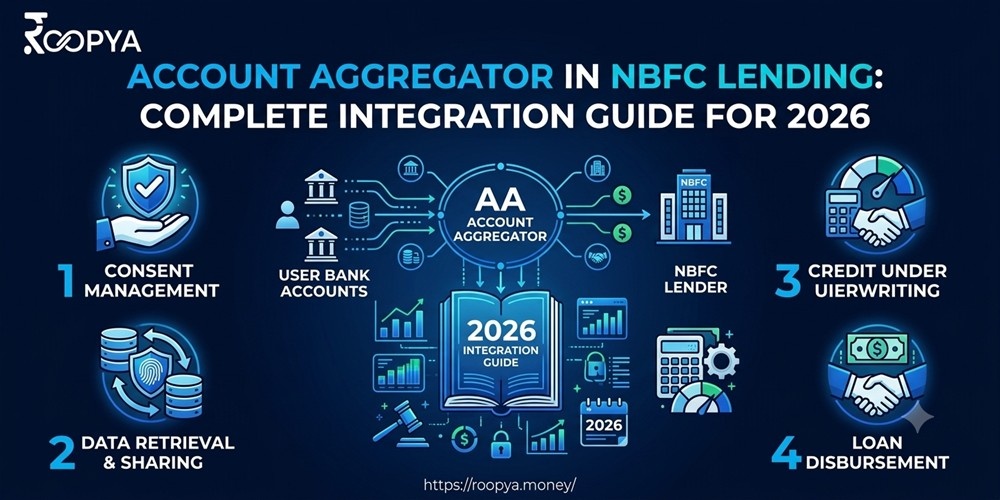
What Is the Account Aggregator Framework? A Clear Definition for NBFC Lenders
The Account Aggregator (AA) framework is a consent-based financial data-sharing ecosystem launched under RBI’s regulatory sandbox. It enables individuals and businesses (called Financial Information Users or FIUs) to access a borrower’s financial data from Financial Information Providers (FIPs) — such as banks, insurance companies, mutual fund houses, and pension funds — with explicit, time-bound, revocable consent from the borrower.
In plain language: Account Aggregators act as a secure data highway between a borrower’s bank accounts and your NBFC’s lending platform. No manual document collection. No PDF bank statements that can be doctored. No friction-filled physical verification. Just clean, structured, real-time financial data — shared with the borrower’s full consent.
Key Players in the AA Ecosystem:
- AA (Account Aggregator): Licensed NBFC-AA entities like Finvu, OneMoney, CAMS Finserv, Perfios AA, and Sahamati
- FIP (Financial Information Provider): Banks, AMCs, insurance providers, NPS, GST network
- FIU (Financial Information User): Your NBFC — the lender requesting data
- Customer: The borrower whose consent drives the entire flow
Data types available via AA framework in 2026:
- Bank account statements (savings, current, OD)
- Mutual fund holdings and transaction history
- Insurance policy data
- Equity and demat account holdings
- GST returns (via GSTN integration)
- National Pension System (NPS) data
- Income Tax Returns (ITR via CBDT) — being rolled out progressively
The Problem With Traditional NBFC Lending Data Collection (And Why It’s Killing Your Conversions)
Before we deep-dive into integration, let’s acknowledge why the old model is broken.
Traditional NBFC lending workflows rely on:
- Physical or PDF bank statements — easily manipulated, slow to verify, and time-consuming to analyse
- Salary slips and ITR copies — collected manually, leading to document fraud risks
- Credit bureau data alone — misses the unbanked or thin-file borrowers entirely
- Manual underwriting — creates bottlenecks, inconsistent decisions, and high operating costs
- Long TAT (Turnaround Time) — industry average still stands at 5–7 business days for SME loans
The result? High abandonment rates, significant fraud exposure, and poor borrower experience — all of which directly impact your portfolio quality and growth.
The Account Aggregator framework eliminates every single one of these pain points when properly integrated into your NBFC lending software.
How the Account Aggregator Consent Flow Works: Step-by-Step
Understanding the technical consent flow is essential before integration. Here is exactly how it works inside an AA-enabled NBFC lending software platform:
Step 1: Borrower Initiates Loan Application
The borrower applies for a loan via your digital lending app, NBFC website, or partner channel. They enter their mobile number linked to their bank account.
Step 2: AA Consent Request is Generated
Your LOS (Loan Origination System) sends a consent artefact request to the chosen AA via API. This request specifies:
- The type of financial data required (e.g., 12 months of bank statement)
- The purpose of data use (credit assessment)
- Data fetch frequency (one-time or recurring)
- Consent expiry duration
Step 3: Borrower Receives Consent Notification
The borrower gets a push notification or SMS from their AA app (e.g., Finvu, OneMoney). They review exactly what data is being shared, with whom, for how long, and for what purpose.
Step 4: Borrower Approves or Rejects
With a single tap, the borrower approves consent. This is their explicit, informed consent — fully RBI compliant and legally binding. They can revoke it any time.
Step 5: AA Fetches Data from FIP
The AA securely retrieves encrypted financial data from the borrower’s bank (FIP) using a standardised API protocol (based on the ReBIT AA API specification).
Step 6: Data Delivered to Your NBFC (FIU)
The structured, encrypted data arrives in your NBFC lending software’s FIU module. Your credit underwriting engine then automatically parses and analyses this data for:
- Average monthly balance
- Income regularity
- EMI obligations (existing loan repayments)
- Spending patterns and cash flow
- Credit card repayment behaviour
Step 7: Credit Decision in Minutes, Not Days
Your automated Business Rule Engine (BRE) or AI credit model processes the AA data and returns a credit decision within minutes — approve, reject, or refer for manual review.
This entire flow, from consent request to credit decision, can be completed in under 10 minutes with the right NBFC lending software infrastructure.
Account Aggregator vs. Traditional Data Sources: The Head-to-Head Comparison
| Parameter | AA Framework | PDF Bank Statement | Net Banking Scraping |
|---|---|---|---|
| Data Authenticity | Cryptographically verified | Easily tampered | Platform ToS violation |
| RBI Compliance | Fully compliant | Grey area | Non-compliant |
| Borrower Consent | Explicit & auditable | Implicit | Implicit |
| Processing Speed | Real-time | 24–48 hours | 1–6 hours |
| Data Richness | Structured JSON | Unstructured PDF | Semi-structured |
| Fraud Risk | Very Low | High | Medium |
| Recurring Data Access | Supported natively | Manual re-upload | Requires re-login |
| Cost per Fetch | ₹5–₹25 | ₹0 but high ops cost | ₹10–₹40 |
The verdict is unambiguous. For any NBFC serious about scaling digital lending in 2026, AA integration is not optional — it is the foundation of a compliant, efficient lending stack.
Technical Integration Guide: Connecting Account Aggregator to Your NBFC Lending Software
This section is specifically written for product managers, CTOs, and technology heads at NBFCs evaluating or executing AA integration.
Prerequisites for AA Integration
Before your NBFC can go live as an FIU, you need:
- FIU Registration on Sahamati Network — The Central Registry for AA ecosystem participants. Your NBFC registers as a Financial Information User.
- Technical Certification — Your lending software must pass the ReBIT API compatibility test for AA interactions.
- Consent Template Configuration — Define your consent templates: data type, frequency, expiry, and purpose codes.
- AA Partner Selection — Choose one or more AA partners (Finvu, OneMoney, CAMS, Perfios, PhonePe AA). Multi-AA support is recommended for maximum borrower coverage.
- Encryption & Key Management — AA data is end-to-end encrypted. You need a proper key management system within your lending platform.
Core API Modules for AA Integration
A production-ready AA integration inside your NBFC lending software typically covers these API modules:
1. Consent APIs
POST /Consent— Raise a consent requestGET /Consent/{consentHandle}— Check consent statusPOST /Consent/Notification— Receive consent status callbacks
2. Data Session APIs
POST /FI/request— Initiate financial information fetch after consent approvalGET /FI/fetch/{sessionId}— Fetch the financial dataPOST /FI/Notification— Receive data fetch status callbacks
3. Account Discovery APIs (Optional but Recommended)
POST /Accounts/discover— Discover linked accounts for a mobile numberPOST /Accounts/link— Link specific accounts to the consent flow
Integration Architecture in a Typical NBFC LOS
Here is the recommended technical architecture for integrating AA into a modern NBFC lending software platform:
[Borrower App / Web]
→ [NBFC LOS Frontend]
→ [AA Consent Orchestration Module]
→ [AA Gateway (Finvu / OneMoney / CAMS)]
→ [FIP: Bank / MF / Insurance]
← [Encrypted Financial Data]
← [FI Data Parser & Normaliser]
→ [Credit Rule Engine (BRE) / AI Scoring Model]
→ [Loan Decision Output]
→ [NBFC LMS for Disbursement & Servicing]
The AA Consent Orchestration Module is the heart of the integration. It manages:
- Multi-AA routing based on borrower’s bank
- Consent lifecycle management
- Data retry logic
- Webhook handling for async data delivery
Data Parsing and Normalisation
Raw AA data arrives as encrypted JSON following the Financial Information (FI) schema defined by ReBIT. Your platform must parse this into structured underwriting parameters:
From Bank Account Data, extract:
- Monthly credits (average, minimum, maximum, last 3/6/12 months)
- Monthly debits (pattern analysis)
- Closing balance trend
- Inward EMI obligations (identify existing loan repayments)
- Salary credit pattern (regularity and amount)
- Utility bill payments (positive behaviour signal)
- Cash withdrawal ratio (fraud signal)
- Return/bounce ratio (creditworthiness signal)
From Mutual Fund / Investment Data, extract:
- Net asset value of holdings
- Redemption history
- SIP regularity
This parsed data feeds directly into your credit scorecard and BRE (Business Rule Engine) for automated credit decisioning.
Business Rule Engine Configuration for AA-Powered NBFC Lending
The real power of AA integration is unlocked only when your BRE is configured to leverage AA-derived insights. Here is a practical framework for NBFC credit teams:
Rule Category 1: Income Verification Rules
- Minimum average monthly salary credit ≥ ₹X for product category
- Salary credit consistency: present in ≥ 10 of last 12 months
- Employer credit pattern: same source, similar amounts (reduces moonlighting risk)
Rule Category 2: Obligation Assessment Rules
- Fixed Obligation to Income Ratio (FOIR) ≤ 50% after new EMI
- Detect undisclosed EMIs via debit analysis
- Credit card minimum payment vs. full payment ratio
Rule Category 3: Cash Flow Health Rules
- Minimum average closing balance ≥ 3× proposed EMI
- No salary account overdraft in last 6 months
- Cheque return/bounce rate ≤ 2% of total transactions
Rule Category 4: Fraud Detection Rules
- Round-trip transactions within 72 hours (cash cycling flag)
- Sudden spike in credits month-of-application (income inflation flag)
- Multiple salary-like credits from different sources (fraud flag)
- Dormant account suddenly active (identity fraud flag)
Rule Category 5: Positive Behaviour Signals
- Consistent utility/insurance premium payment
- Regular SIP investments (financial discipline indicator)
- Growing balance trend over 12 months
When configured on a no-code BRE platform like Roopya, these rules can be set up and modified by credit risk analysts without any developer dependency — dramatically reducing the time to respond to portfolio quality signals.
Compliance and Regulatory Framework for AA-Enabled NBFC Lending in 2026
NBFCs operating as FIUs in the AA ecosystem must comply with a layered regulatory framework:
RBI Master Directions on NBFC-AA (2016, Updated 2021)
- AA entities must be RBI-licensed
- Data cannot be stored beyond the defined consent period
- FIUs cannot use AA data for any purpose beyond what is stated in the consent artefact
Digital Personal Data Protection Act (DPDP Act), 2023
- Explicit, informed consent is mandatory — AA framework already enforces this
- Data minimisation principle: fetch only what you need
- Right to withdrawal: borrowers can revoke consent at any time — your platform must handle this gracefully
RBI Digital Lending Guidelines (2022)
- No data scraping from borrower devices or accounts without explicit consent
- Loan sanctioning must be done by the NBFC directly, not a third party
- All data used in credit assessment must be from regulated, consented sources
Key Compliance Checklist for NBFC FIUs
- Registered on Sahamati FIU registry
- Consent templates approved and version-controlled
- Data retention policy aligned with consent expiry
- Audit trail for all consent events
- Grievance mechanism for consent-related complaints
- DPDP Act compliance documentation
- Annual technical audit of AA integration
AA Integration for Different NBFC Lending Products
The application of AA data varies significantly across loan products. Here is how to tailor your integration for each:
Personal Loans (Salaried)
Key AA Data Used: Bank statements (salary account), 6–12 months
Critical Parameters: Salary regularity, FOIR, balance trend
AA Benefit: Eliminate manual salary slip collection; real-time income verification reduces TAT from 3 days to 30 minutes
Personal Loans (Self-Employed)
Key AA Data Used: Current account statements, savings account, GST returns
Critical Parameters: Business revenue pattern, GST turnover consistency, cash flow volatility
AA Benefit: Self-employed lending, historically the riskiest segment, becomes dramatically more precise with 12–24 months of business account data
MSME / Business Loans
Key AA Data Used: Business current account, GST returns, trade receivables
Critical Parameters: Revenue regularity, supplier payment patterns, outstanding obligations
AA Benefit: For MSME loans under ₹50 lakhs, AA-powered underwriting can replace the need for audited financials in most cases, opening up credit to a massively underserved segment
Consumer Durable / Buy Now Pay Later
Key AA Data Used: Savings account (last 3 months)
Critical Parameters: Average balance, recurring payment history, existing EMI burden
AA Benefit: Near-instant underwriting decisions (under 60 seconds) that are essential for point-of-sale lending use cases
Gold Loans
Key AA Data Used: Savings/current account statements
Critical Parameters: Cash flow adequacy, existing obligations
AA Benefit: Even collateral-backed loans benefit from AA data for accurate LTV setting and repayment capacity assessment
Choosing the Right NBFC Lending Software for Account Aggregator Integration
Not all NBFC lending software platforms are created equal when it comes to AA integration. Here is what to look for:
1. Pre-built AA Connector
Your LOS should have a native, pre-integrated AA module — not a custom build that will take 6 months and ₹50 lakhs in development costs. Look for platforms that support multiple AA entities (Finvu, OneMoney, CAMS, Perfios) out of the box.
2. No-Code Consent Template Management
Credit risk analysts, not just developers, should be able to configure and modify consent templates — adjusting data fetch period, type, and frequency without engineering support.
3. Built-in FI Data Parser
Raw AA data in ReBIT schema format is not directly usable. Your platform should automatically parse and normalise the financial information into structured credit parameters that feed directly into your BRE and scorecard.
4. Multi-AA Routing Logic
Different borrowers’ accounts may be accessible through different AAs. Your platform should automatically route consent requests to the most appropriate AA, with fallback logic if the first choice fails.
5. Real-time Webhook & Async Data Handling
AA data delivery is asynchronous. Your lending platform must handle webhook callbacks gracefully, with retry logic and proper queue management, so borrowers don’t experience delays or errors.
6. End-to-End Audit Trail
Every consent event — creation, approval, rejection, revocation, data fetch — must be logged with timestamps for regulatory compliance. This is non-negotiable.
7. Integration with Credit Bureau APIs
AA data works best when combined with bureau data (CIBIL, Experian, Equifax, CRIF). Your lending software should orchestrate both data sources in a single underwriting workflow.
Roopya’s NBFC lending software platform delivers all seven of these capabilities out of the box, with pre-integrated connections to all major AA entities, a no-code BRE, and a complete audit infrastructure — enabling NBFCs to go live with AA-powered lending in days, not months.
ROI Calculator: What AA Integration Actually Delivers for Your NBFC
Let’s make the business case concrete. Here is what NBFCs typically report after implementing AA-enabled lending:
| Metric | Before AA | After AA | Improvement |
|---|---|---|---|
| Loan TAT (Personal Loan) | 5–7 days | 15–45 minutes | 95%+ reduction |
| Document Fraud Rate | 3–8% | <0.5% | 85% reduction |
| Underwriting Cost per Case | ₹800–₹1,500 | ₹150–₹300 | 75–80% reduction |
| Borrower Dropout (Application Abandonment) | 45–60% | 15–25% | 50% improvement |
| NPA Rate (12-month cohort) | Baseline | 20–35% lower | Significant reduction |
| Credit Operations Headcount | 10 analysts per ₹100Cr | 3–4 analysts per ₹100Cr | 60% efficiency gain |
These numbers are directional averages across AA-enabled NBFCs in India. Actual results vary based on product mix, borrower profile, and implementation quality — but the direction is consistent: AA integration fundamentally improves every key lending metric.
Common AA Integration Challenges and How to Solve Them
Challenge 1: Low AA Consent Approval Rates
Problem: Borrowers don’t complete the AA consent flow, leading to high drop-offs
Solution:
- Educate borrowers within the loan journey (short explainer screen before consent request)
- Pre-select the most relevant AA for the borrower’s bank
- Offer alternative data paths (upload) as fallback with conversion nudges back to AA
- Send consent reminder notifications via WhatsApp/SMS
Challenge 2: Data Fetch Failures
Problem: AA fetch returns errors or incomplete data
Solution:
- Implement multi-AA redundancy — if Finvu fails, route to OneMoney
- Build retry logic with exponential backoff
- Create a graceful fallback to alternative data sources (bureau + ITR upload) without breaking the borrower journey
Challenge 3: Parsing Inconsistencies Across Banks
Problem: Different banks format transaction descriptions differently, making categorisation hard
Solution:
- Use an AI/ML-powered transaction categorisation engine
- Maintain a continuously updated merchant and transaction category dictionary
- Flag unclassified transactions for analyst review rather than ignoring them
Challenge 4: Consent Template Configuration Errors
Problem: Wrong data period or data type in consent request leads to useless fetches
Solution:
- Standardise consent templates by product type in your NBFC lending software’s CMS
- Implement pre-flight validation before sending consent requests
- Maintain version history of consent templates for audit purposes
Challenge 5: Integration with Legacy Core Banking
Problem: Your core banking or LMS doesn’t speak to the AA module
Solution:
- Use a middleware API layer (provided by modern NBFC lending software like Roopya)
- Implement event-driven architecture: AA data fetch triggers downstream workflows via webhooks
- Avoid point-to-point integrations; build a centralised data orchestration layer
The Future of Account Aggregator in NBFC Lending: 2026 and Beyond
The AA ecosystem in India is accelerating. Here are the developments reshaping NBFC lending in 2026 and beyond:
1. GST Data Integration Going Mainstream
GSTN is now a full FIP in the AA ecosystem. For MSME lenders, GST turnover data from AA is becoming the primary income signal, replacing audited financials for loans under ₹25 lakhs. This is opening up formal credit for millions of small businesses for the first time.
2. ITR Integration via CBDT
Income Tax Return data is progressively becoming available through the AA framework via CBDT. This will give lenders direct, government-verified income data — eliminating one of the last remaining document collection friction points.
3. Insurance and Investment Data for Wealth-Based Lending
Loan Against Mutual Funds (LAMF) and Insurance Premium Financing are seeing explosive growth powered by AA data from AMCs and insurance companies. NBFCs with AA integration can underwrite these products in minutes.
4. Recurring Data Consent for Dynamic Monitoring
The AA framework’s recurring consent capability is enabling real-time portfolio monitoring. NBFCs can now set up monthly re-fetches of borrower bank data — identifying early warning signals of financial stress before EMI bounces begin, dramatically improving collections efficiency.
5. OCEN 4.0 and Embedded Lending
The Open Credit Enablement Network (OCEN) is evolving alongside AA. Together, they are enabling embedded lending — where credit is offered contextually within e-commerce platforms, B2B marketplaces, and gig economy platforms, with AA providing instant underwriting data.
6. AA for Bharat: Vernacular and Voice Consent
Recognising that a significant borrower population is not comfortable with app-based consent flows, AA partners are building vernacular and voice-based consent interfaces. This will unlock AA-powered lending in Tier 3, 4, and rural markets — a massive untapped opportunity for NBFCs.
Roopya’s Account Aggregator Integration: Built for NBFCs Ready to Scale
Roopya’s digital lending software platform was built ground-up for the modern AA era. Our NBFC lending software stack includes:
- Native AA Integration with Finvu, OneMoney, CAMS Finserv, and Perfios — no custom development required
- No-Code BRE pre-loaded with AA-powered credit rules that your credit team can configure without engineering support
- AI-Powered FI Data Parser that transforms raw AA JSON into structured underwriting parameters in seconds
- Multi-AA Routing Engine with automatic fallback for maximum consent success rates
- Complete Compliance Infrastructure — consent audit trail, DPDP Act aligned data handling, RBI reporting modules
- Pre-built Loan Products for personal loans, MSME loans, consumer durables, and more — all AA-ready on Day 1
- 300+ Pre-integrated APIs including credit bureaus, GST verification, ITR fetch, and e-Sign — orchestrated in a single underwriting workflow alongside AA data
Most importantly, Roopya can get your NBFC live with full AA-powered lending in as little as 1 day — not 6 months. Our plug-and-play infrastructure means you are not building; you are configuring.
Whether you are launching your first digital lending product or upgrading a legacy system, Roopya’s NBFC lending software is the fastest, most compliant path to AA-powered credit in India.
Ready to see it in action? Request a demo at roopya.money and our lending technology team will walk you through a live AA-powered loan journey — from borrower application to credit decision in under 10 minutes.

