Advanced Loan Management Software for Digital Lending: The Definitive Guide for NBFCs, Banks & Fintechs

India’s digital lending market is at an inflection point. With over 1.5 billion connected citizens, an increasingly creditworthy middle class, and a regulatory environment that is actively enabling innovation, the opportunity for lenders has never been greater. But opportunity and execution are two very different things. The lenders who will capture the next decade of growth are not simply those with the most capital — they are those with the most intelligent, automated, and scalable operational infrastructure.
At the centre of that infrastructure is advanced loan management software. This is not the rigid, legacy core banking software of the previous generation. Modern loan management software is a living, breathing operational platform — one that handles every stage of the lending lifecycle, from origination and disbursement through repayment, collections, and closure, with AI-powered automation, real-time analytics, and seamless integrations woven throughout.
Start Free Trial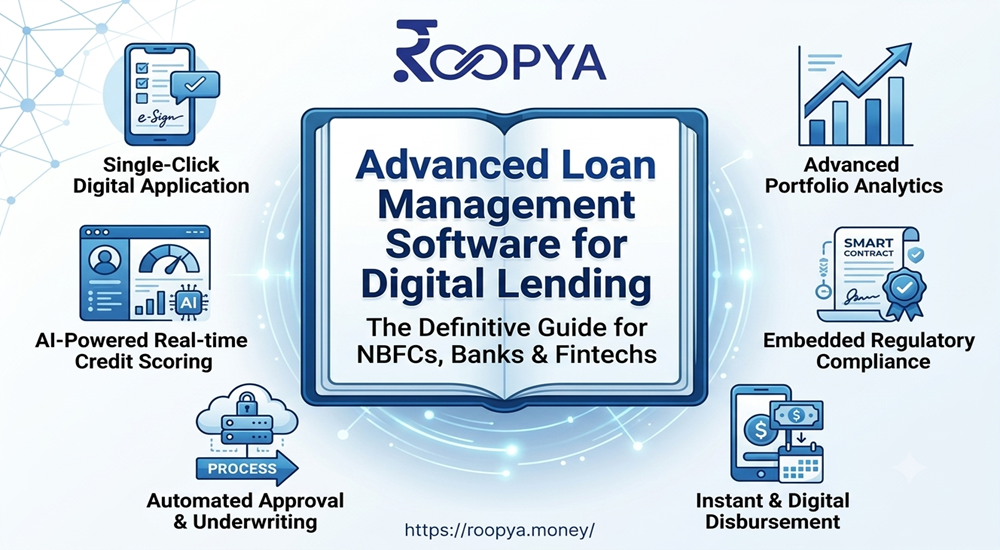
This comprehensive guide explains what advanced loan management software is, why it is fundamentally different from basic or legacy alternatives, what features define a best-in-class platform, and how Roopya is redefining what is possible for digital lenders in India.
1. Understanding Advanced Loan Management Software
1.1 What Is Loan Management Software?
Loan management software (LMS) is the core operational system that lenders use to manage their loan portfolios throughout the entire credit lifecycle. It handles everything that happens after a loan is originated — disbursement, EMI scheduling, repayment tracking, interest computation, prepayment and foreclosure processing, delinquency management, collections, regulatory reporting, and account closure.
In its most basic form, an LMS is a ledger — a system of record for loan accounts. But advanced loan management software is dramatically more than a ledger. It is an intelligent, automated operational platform that proactively manages risk, enforces credit policy, optimises collections outcomes, enables compliance, and delivers real-time insight into portfolio health — all without requiring armies of manual operators.
1.2 What Makes Loan Management Software ‘Advanced’?
The word ‘advanced’ is overused in software marketing, but in the context of loan management it has specific, meaningful attributes. Advanced loan management software is distinguished from basic alternatives by five core characteristics:
- Intelligence: AI and machine learning are embedded throughout — in collections prioritisation, delinquency prediction, fraud detection, and portfolio analytics — rather than being add-on modules or afterthoughts.
- Automation: Every routine operational task — EMI generation, payment reconciliation, overdue notices, regulatory filings, report generation — is handled automatically without human intervention.
- Configurability: Business users — not developers — can configure loan products, interest computation methods, repayment schedules, fee structures, and collection workflows through no-code interfaces.
- Integration depth: The platform connects natively and in real time with payment gateways, bureau systems, accounting software, banking APIs, and regulatory infrastructure — not through fragile point-to-point custom integrations.
- Scalability: Cloud-native architecture handles volume spikes — month-end EMI processing, seasonal disbursement peaks — without performance degradation or manual infrastructure management.
Roopya’s advanced loan management software embodies all five of these characteristics. It was designed from the ground up for Indian digital lenders, with India’s regulatory complexity, payment infrastructure, and borrower diversity built into its DNA.
2. The Digital Lending Imperative: Why Advanced LMS Is No Longer Optional
Ten years ago, a mid-sized NBFC could operate profitably with an Excel-based loan register and a basic accounting system. That era is definitively over. Several converging forces have made advanced loan management software a strategic necessity rather than a discretionary investment.
2.1 Regulatory Complexity Has Increased Dramatically
The Reserve Bank of India’s regulatory framework for digital lending has evolved significantly, particularly since the Digital Lending Guidelines of 2022 and subsequent circulars. Lenders must now maintain detailed digital audit trails, implement specific disclosure norms, manage FLDG arrangements within prescribed limits, report to multiple credit bureaus in standardised formats, and adhere to strict data localisation requirements. Manual systems cannot reliably meet these obligations at scale. Advanced loan management software enforces compliance programmatically — ensuring every account action is logged, every communication is archived, and every regulatory report is generated accurately and on time.
2.2 Borrower Expectations Have Shifted Permanently
Digital-native borrowers — who now represent the majority of new-to-credit applicants in India — expect a fully digital experience from the first loan inquiry through the final repayment. They expect instant disbursement confirmation, real-time EMI alerts, digital payment options via UPI and NACH, self-service account management through apps and portals, and instant foreclosure statements. Delivering this experience requires an advanced loan management system that can surface real-time data and trigger automated communications across every borrower touchpoint.
2.3 Portfolio Complexity Has Grown
Modern lenders rarely offer a single loan product. A typical growth-stage NBFC might manage personal loans, business loans, two-wheeler loans, and an embedded BNPL product — each with distinct interest computation methods, repayment frequencies, fee structures, and collection workflows. Managing this diversity with basic software or, worse, spreadsheets is an operational and risk management disaster waiting to happen. Advanced loan management software handles unlimited product complexity through configurable, rule-based frameworks.
2.4 Collections Efficiency Is the Difference Between Profit and Loss
With gross NPAs in the NBFC sector averaging 4–6% and net NPAs representing the difference between a profitable and loss-making portfolio, collections performance is arguably the most critical operational capability for any lender. AI-powered collections — prioritisation based on delinquency risk scores, personalised communication via WhatsApp and IVR, predictive escalation models, and real-time agent dashboards — is only possible with advanced loan management software. Lenders running manual or basic collections processes leave significant recovery value on the table every single month.
3. Core Modules of Advanced Loan Management Software
3.1 Loan Account Management
The foundation of any LMS is accurate, real-time loan account management. Advanced loan management software maintains a complete, auditable record of every loan account — outstanding principal, accrued interest, fees charged, payments received, overdue amounts, and account status — updated in real time with every transaction. Roopya’s account management module supports unlimited concurrent accounts with millisecond-level update latency, ensuring every stakeholder — borrower, branch, relationship manager, risk officer — sees a consistent, current picture of account status at all times.
3.2 Flexible Repayment Schedule Engine
Loan products vary enormously in their repayment structures. A home loan amortises monthly over 20 years. A business loan may have a moratorium period followed by quarterly payments. A payday loan has a bullet repayment. A microfinance loan uses a weekly group collection model. Advanced loan management software accommodates all of these through a configurable repayment schedule engine that supports:
- EMI-based amortisation (reducing balance and flat rate)
- Bullet and balloon repayment structures
- Step-up and step-down EMI schedules
- Moratorium and grace period configuration
- Weekly, fortnightly, monthly, and quarterly repayment frequencies
- Irregular repayment schedules for agricultural and seasonal lending
Roopya’s repayment engine is fully configurable without code, allowing product managers to launch new repayment structures in hours rather than months.
3.3 Automated Payment Collection and Reconciliation
Payment collection is where operational efficiency is most visibly won or lost. Advanced loan management software integrates natively with all major payment rails — NACH (both physical and e-NACH), UPI AutoPay, payment gateways, and NEFT/RTGS — to automate the collection of scheduled EMIs. When payments arrive, they are automatically reconciled against the correct loan account, applied in the correct order (fees, interest, principal), and reflected in the borrower’s account in real time.
Roopya’s payment reconciliation engine handles millions of transactions per day with 99.99% accuracy, eliminating the manual reconciliation work that consumes hours of operations team time in lenders using basic systems. Failed payment events automatically trigger retry workflows and borrower communication — without any manual intervention.
3.4 Interest, Fee, and Penalty Computation Engine
Interest computation sounds simple but is extraordinarily complex in practice. A single lender may need to support daily reducing balance interest, monthly reducing balance, flat rate, and floating rate structures — often simultaneously across different products. On top of interest, there are processing fees, prepayment charges, late payment penalties, GST on fees, and various other charges that must be computed, applied, and reported accurately. Advanced loan management software handles all of this through a configurable computation engine that enforces consistency across every account, every month, without error.
3.5 Prepayment, Foreclosure, and Restructuring
Borrower life events — windfalls, distress, refinancing opportunities — generate requests for partial prepayment, full foreclosure, or loan restructuring. Processing these requests manually is slow, error-prone, and a source of borrower dissatisfaction. Advanced loan management software automates the entire workflow: calculates the foreclosure amount in real time (with applicable charges per the loan agreement), generates the foreclosure statement digitally, processes the payment, closes the account, and triggers the NOC issuance — often without any human involvement. Roopya’s foreclosure module delivers NOCs digitally within minutes of final payment receipt.
3.6 Collections and Delinquency Management
Collections is where the most significant advances in AI-powered loan management software have occurred. Roopya’s collections module replaces the traditional, manual collections process with an intelligent, automated system that:
- Predicts delinquency risk at the account level 30-60 days before default, using ML models trained on repayment behaviour, bureau data, and macroeconomic signals.
- Automatically segments overdue accounts by risk bucket, days past due, and recovery probability to prioritise collection agent effort.
- Triggers multi-channel borrower communication — WhatsApp, SMS, IVR, email — on a configurable escalation schedule, with personalised messaging based on account context.
- Manages field agent assignments, visit scheduling, and outcome recording through a mobile collections app that syncs in real time with the central LMS.
- Tracks settlement offers, repayment commitments, and legal actions within the system, maintaining a complete collections history for every delinquent account.
Lenders using Roopya’s AI-powered collections module report 15–25% improvement in early-stage delinquency resolution compared to manual collections processes.
3.7 Real-Time Portfolio Analytics and Dashboards
You cannot manage what you cannot measure. Advanced loan management software provides real-time visibility into every dimension of portfolio performance — disbursement volumes, outstanding AUM, product-wise NPA rates, geographic concentration, vintage analysis, collection efficiency ratios, and cash flow projections. Roopya’s analytics dashboards are configurable for different roles — a CEO sees portfolio-level metrics, a collections manager sees delinquency buckets, a product manager sees product performance trends — all in real time, without needing to run manual reports.
3.8 Regulatory Reporting and Compliance Automation
Regulatory reporting is one of the most time-consuming operational burdens for Indian lenders. Monthly credit bureau submissions, quarterly RBI returns, annual CERSAI filings, and various ad-hoc regulatory disclosures require accurate, complete data from the loan management system. Roopya automates all standard regulatory reports — generating bureau reporting files in the required CIBIL, Experian, and CRIF formats, producing RBI NPA classification reports, and maintaining CERSAI security interest records — with a single click, saving compliance teams dozens of hours every month.
3.9 Accounting and GL Integration
Every loan transaction has accounting implications — disbursements hit loan asset accounts, interest accruals generate income entries, provisions are created for overdue accounts, and fee income is recognised on receipt or accrual basis per applicable accounting standards. Advanced loan management software maintains a shadow accounting ledger that automatically generates journal entries for every loan event and syncs them with the lender’s core accounting system — whether that is Tally, SAP, Oracle Financials, or a custom ERP. Roopya’s accounting integration eliminates the manual journal entry process entirely.
3.10 Document Management and Digital Record-Keeping
A complete loan account generates dozens of documents over its lifecycle — sanction letters, loan agreements, repayment schedules, payment receipts, overdue notices, settlement letters, and NOCs. Advanced loan management software stores all of these digitally, linked to the relevant loan account, with version control and access logging. Borrowers can retrieve their documents through self-service portals or apps. Auditors and regulators can access complete account histories instantly. The era of retrieving physical loan files from storage rooms is definitively over.
4. AI and Machine Learning in Advanced Loan Management Software
Artificial intelligence is not a future capability in leading loan management software — it is a present reality that is delivering measurable performance improvements today. Here is how AI is embedded throughout Roopya’s platform:
4.1 Predictive Delinquency Scoring
Roopya’s ML models analyse hundreds of signals from repayment history, bureau data, payment behaviour patterns, and macroeconomic indicators to generate a daily delinquency risk score for every active loan account. Accounts with rising risk scores are flagged for proactive intervention — a pre-delinquency call or WhatsApp message — before they miss an EMI. This proactive approach dramatically reduces early-bucket delinquency rates and improves overall portfolio quality.
4.2 Intelligent Collections Prioritisation
Not all delinquent accounts are equal. Some borrowers have the intent to pay but face temporary liquidity issues — they respond to a gentle reminder. Others are chronic defaulters who require escalated legal action. AI-powered collections prioritisation identifies these segments automatically, directing collection agent effort and automated communication resources to where they will have the greatest impact on recovery.
4.3 Fraud Detection and Anomaly Monitoring
Loan fraud does not stop at origination. Post-disbursement fraud — account takeover, early delinquency linked to first-payment default patterns, and coordinated fraud rings — is a significant risk for digital lenders. Roopya’s AI monitoring layer continuously analyses account behaviour, payment patterns, and device signals to detect anomalies that suggest fraud, triggering alerts and automated account holds before losses escalate.
4.4 Portfolio Risk Forecasting
Advanced loan management software provides forward-looking risk intelligence — not just historical reporting. Roopya’s portfolio forecasting models project NPA trajectories, cash flow expectations, and provision requirements based on current portfolio composition and predicted macroeconomic conditions. This gives risk managers and CFOs the intelligence to make proactive decisions — tightening credit policy, increasing collections intensity, or adjusting provisioning — before portfolio deterioration becomes visible in lagging indicators.
5. Integration Ecosystem: The Connected Loan Management Platform
Loan management does not happen in isolation. A loan account interacts with payment systems, credit bureaus, banking infrastructure, accounting systems, regulatory portals, and customer communication channels throughout its lifecycle. Advanced loan management software must connect seamlessly with all of these systems to deliver the automation and real-time accuracy that modern lending operations demand.
Roopya comes pre-integrated with 300+ APIs and services across every category relevant to loan management:
- Payment collection: NACH (physical and e-NACH), UPI AutoPay, Razorpay, PayU, Cashfree, BillDesk, and all major payment aggregators.
- Credit bureaus: CIBIL TransUnion, Experian, Equifax, and CRIF — for bureau reporting and mid-tenure credit monitoring.
- Banking APIs: Account statement fetch via Account Aggregator, penny drop for account validation, IMPS/NEFT/RTGS for disbursements.
- Communication: SMS, WhatsApp Business API, IVR, and email — for automated borrower communications at every stage.
- Accounting: Tally, SAP, QuickBooks, Zoho Books, and custom ERP systems via API or file-based integration.
- Document management: Digilocker for document fetch, eSign providers for digital signatures, and cloud storage for document archival.
- Regulatory: CERSAI for security interest filing, credit bureau reporting in standard formats, and RBI return generation.
6. Cloud-Native Architecture: The Foundation of Scalable Loan Management
Architecture matters. The difference between a loan management system that struggles with month-end EMI processing and one that handles it effortlessly is almost always an architectural one. Legacy LMS platforms were built for on-premise deployment — they scale vertically (bigger servers) and struggle with the horizontal scaling demands of modern, high-volume digital lending.
Roopya is built on cloud-native architecture from the ground up. This means:
- Horizontal scalability: The platform automatically provisions additional compute capacity during peak processing periods — such as month-end EMI runs — and scales back during low-demand periods, ensuring consistent performance without over-provisioning.
- 99% uptime SLA: Cloud-native redundancy, automatic failover, and multi-zone deployment ensure that your loan management operations are never interrupted by infrastructure failures.
- Data security: Bank-grade encryption at rest and in transit, role-based access controls, complete audit logging, and regular security audits protect your portfolio data and borrower information.
- Regular automatic updates: Regulatory changes, new integrations, and platform improvements are deployed automatically without downtime or manual upgrade projects.
7. Multi-Product, Multi-Entity, Multi-Geography Support
As lenders grow, their operational complexity multiplies. A single NBFC may operate multiple lending products across multiple states, with different regulatory registrations, interest rate structures, and collection approaches in each geography. Advanced loan management software must accommodate this complexity without requiring separate systems or manual data reconciliation.
Roopya’s platform supports:
- Unlimited loan products: Configure any number of products with distinct interest rates, repayment structures, fee schedules, and collection workflows — all managed within a single system.
- Multi-entity support: For lenders operating multiple legal entities or co-lending arrangements, Roopya provides separate entity-level accounting and reporting while maintaining a unified operational view.
- Geographic configuration: State-specific stamp duty rates, GST registration management, and geography-specific collection rules are all configurable within the platform.
- Co-lending and FLDG management: Roopya’s co-lending module manages the complex accounting and operational requirements of co-lending arrangements — portfolio splitting, risk sharing, and separate P&L tracking — within the core LMS.
8. Borrower-Facing Capabilities: The Self-Service Experience
Advanced loan management software is not just an internal operations tool — it is also the engine that powers the borrower-facing digital experience. Roopya’s platform includes a configurable borrower portal and mobile app that gives borrowers 24/7 self-service access to:
- Real-time account balance, outstanding principal, and interest accrual information.
- Digital repayment schedule with upcoming EMI dates and amounts.
- Payment history and digital receipts for every payment made.
- Prepayment calculator showing the impact of additional payments on tenure and total interest.
- Foreclosure statement generation on demand.
- Document retrieval — sanction letters, loan agreements, NOCs.
- Repayment via UPI, NACH mandate management, and payment gateway.
Providing borrowers with self-service access to their loan information reduces inbound customer service calls, improves borrower satisfaction, and builds the trust that drives repeat lending relationships.
9. Why Legacy Loan Management Systems Are Holding Lenders Back
Many NBFCs and smaller banks are still operating on legacy loan management systems — software that was built a decade or more ago, often as on-premise installations, with monolithic architectures, limited integration capabilities, and no AI functionality. The operational tax these systems impose is significant and growing.
- Integration costs: Every new payment method, regulatory requirement, or data source requires expensive custom development work that takes months and costs lakhs.
- Manual workarounds: Operations teams build elaborate Excel-based workarounds for capabilities the legacy system lacks — creating data integrity risks and operational fragility.
- Slow product launches: Launching a new loan product or changing an interest computation method requires developer intervention and testing cycles that take weeks.
- Regulatory risk: Legacy systems often cannot generate required regulatory reports accurately, creating compliance gaps that expose lenders to regulatory action.
- Talent costs: Maintaining and operating complex legacy systems requires expensive, specialised technical talent that is increasingly scarce.
Migrating to Roopya’s advanced loan management software eliminates all of these costs. The migration process is structured, supported, and designed to be completed without operational disruption — with Roopya’s implementation team managing data migration, integration setup, and staff training throughout.
10. Roopya: The Advanced Loan Management Software Built for Indian Digital Lenders
Roopya is not a global software platform that has been localised for India. It is an Indian platform, built by a team with deep roots in Indian financial services, designed specifically for the complexity of India’s lending market, regulatory environment, and payment infrastructure. Every feature, every integration, and every compliance requirement is built for India first.
What Sets Roopya Apart
- No-code configuration: Product managers configure loan products, interest structures, fee schedules, and collection workflows through an intuitive visual interface — no developer required. Changes that would take weeks in a legacy system take hours in Roopya.
- 1-day go-live: Pre-built product templates, plug-and-play integrations, and a structured onboarding process allow new lenders to go live in a single day. Existing lenders migrating from legacy systems typically complete migration within two to four weeks.
- 300+ pre-integrated APIs: Every payment rail, bureau, KYC provider, eSign platform, and accounting system relevant to Indian lending is already integrated — no custom development required.
- Pay-as-you-use pricing: Zero upfront costs or capital expenditure. Roopya’s pricing scales with your portfolio, making enterprise-grade loan management software accessible to lenders at every stage of growth.
- AI throughout: Predictive delinquency scoring, intelligent collections prioritisation, fraud detection, and portfolio risk forecasting are all included as standard features — not expensive add-ons.
- RBI-compliant by design: The platform is continuously updated for regulatory compliance. Bureau reporting, audit trails, CERSAI integration, and Fair Practice Code requirements are all handled automatically.
- Dedicated support: Roopya’s implementation and customer success teams provide hands-on support throughout onboarding, migration, and ongoing operations — not just a ticketing system.
Who Uses Roopya
Roopya powers the loan management operations of NBFCs, MFIs, fintech lenders, and banking partners across India. Customers include IndiaKaLoan, QuickFinShop, Recapita, Findoc, and EazyCredit — lenders spanning personal loans, business lending, microfinance, and embedded finance. What they have in common is a commitment to operational excellence and a recognition that advanced loan management software is not a cost centre — it is a competitive advantage.
The Roopya Commitment
Roopya’s mission is straightforward: to give every lender in India — from a newly licensed NBFC to a large-scale digital lending platform — access to the same quality of loan management infrastructure that the largest banks in the world use. To make enterprise-grade technology accessible without enterprise-grade costs or timelines. To let lenders focus on what they do best — making credit decisions and serving borrowers — while Roopya handles the operational complexity.
If you are ready to move beyond the limitations of your current loan management system and build a digital lending operation that can compete at scale, Roopya offers a free, no-obligation demonstration. See the platform in action. Bring your most complex product configuration challenge. We will show you how Roopya handles it — in real time, without code.

