AI-Based Autonomous Loan Origination System

AI-Based Autonomous Loan Origination System: How Roopya Is Redefining Lending in India
Artificial intelligence is no longer a futuristic concept in financial services — it is the present reality that separates market leaders from those struggling to keep up. Nowhere is this more visible than in loan origination. The traditional loan origination process — manual document review, subjective credit assessment, weeks of back-and-forth communication — is being replaced by AI-based autonomous loan origination systems that can process, evaluate, and approve a loan application in minutes with zero human intervention.
Start Free Trial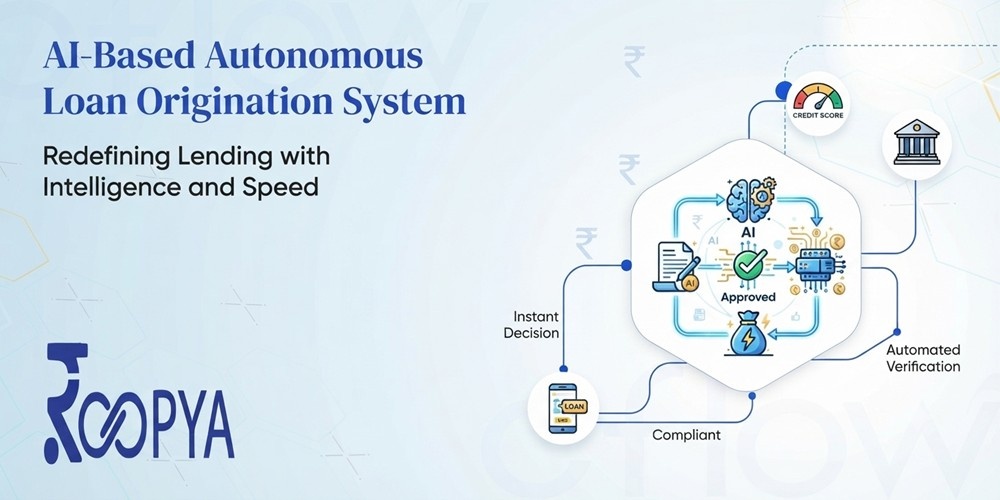
For NBFCs, banks, and microfinance institutions operating in India’s hyper-competitive, digitally-driven lending market, adopting an AI-based loan origination system is not an option — it is an existential necessity. This guide explores what an autonomous loan origination system is, how AI transforms every stage of the origination process, and how Roopya’s purpose-built platform is giving Indian lenders an unbeatable edge.
1. What Is an AI-Based Autonomous Loan Origination System?
A loan origination system (LOS) is the technology platform that manages the complete journey of a loan application — from the moment a borrower expresses interest to the point of disbursement. Traditionally, this process involved significant manual effort: loan officers collecting documents, credit analysts reviewing bureau reports, risk managers applying judgement-based decisioning, and operations teams coordinating between departments.
An AI-based autonomous loan origination system replaces this manual effort with intelligent automation. Machine learning models evaluate creditworthiness. Computer vision and NLP extract and verify data from documents. Natural language interfaces guide borrowers through the application. Predictive analytics flag fraud before it reaches a human reviewer. Rules engines apply complex credit policy in microseconds. The result is a system that can originate loans end-to-end — autonomously — with speed, accuracy, and consistency that no human team can match.
Roopya’s platform is built on this philosophy: every stage of the loan origination lifecycle, from digital KYC and document collection to credit scoring, offer generation, and eSign, is powered by AI-native infrastructure. The human is removed from routine decisioning and repositioned as an exception handler — overseeing the small percentage of complex cases that genuinely require judgement.
2. Why Autonomous Loan Origination Is the Future of Lending
2.1 Borrower Expectations Have Changed Permanently
Today’s borrowers — particularly millennials and Gen Z — have been conditioned by instant gratification in every digital experience. They compare loan applications to ordering food on Swiggy: fast, frictionless, and resolved on their phone. A process that takes three days and requires physical document submission is not just inconvenient — it drives the borrower to a competitor who can decide in three minutes. AI-based autonomous origination directly addresses this expectation gap.
2.2 Manual Processes Cannot Scale
India’s credit demand is growing at an extraordinary pace, driven by the formalisation of the MSME sector, rising consumer credit appetite, and expanding financial inclusion into Tier 2 and Tier 3 geographies. Manual origination processes simply cannot scale to meet this demand without proportional cost increases. AI-powered automation decouples volume from headcount — processing 10x the applications without 10x the team.
2.3 Data Availability Has Made AI Decisioning Superior
The explosion of alternative data sources — GST returns, bank account aggregation via Account Aggregator, telecom data, UPI transaction history, e-commerce behaviour — has given AI models a far richer picture of a borrower’s creditworthiness than a single bureau score ever could. An AI-based loan origination system can synthesise hundreds of data variables in real time to produce credit decisions that are more accurate, less biased, and more inclusive than traditional underwriting.
2.4 Fraud Is Outpacing Human Detection
Loan fraud is evolving faster than manual detection methods can keep up. Sophisticated identity fraud, synthetic identities, document fabrication, and coordinated bust-out schemes require pattern recognition at scale — something only AI can deliver. An autonomous loan origination system with embedded AI fraud detection catches anomalies that human reviewers routinely miss, reducing fraud losses significantly.
3. Core AI Capabilities in Roopya’s Autonomous Loan Origination System
3.1 AI-Powered Document Intelligence
Document collection and verification is one of the most labour-intensive stages of traditional loan origination. Roopya’s AI-based LOS deploys advanced Optical Character Recognition (OCR) combined with Natural Language Processing (NLP) to automatically extract, classify, and verify data from every document type in the lending ecosystem — PAN cards, Aadhaar, salary slips, bank statements, ITR documents, GST returns, property papers, and more.
The system does not merely read documents — it understands them. It cross-validates extracted data against application-declared information, identifies internal inconsistencies (mismatched account numbers, salary discrepancies, altered dates), and flags high-risk documents for review — all in seconds. Roopya’s document intelligence achieves accuracy rates exceeding 99%, outperforming even experienced human reviewers while processing thousands of documents simultaneously.
3.2 Machine Learning-Based Credit Scoring
Traditional credit scoring relies almost entirely on bureau data — CIBIL score, repayment history, credit utilisation. While valuable, this approach excludes a large segment of creditworthy borrowers who are new to credit or have thin bureau files. Roopya’s ML-based credit scoring models are trained on multi-dimensional datasets that include alternative data sources — bank statement cash flows, GST revenue trends, UPI behaviour, Account Aggregator financial data, and more.
These models continuously learn from portfolio performance, improving their predictive accuracy over time. The result is credit decisions that are not only more accurate but also more inclusive — able to responsibly extend credit to MSME owners, gig economy workers, and first-time borrowers who would be declined under conventional bureau-only models.
3.3 No-Code AI-Driven Business Rule Engine (BRE)
Credit policy is dynamic — it changes with market conditions, portfolio performance, regulatory guidance, and competitive pressures. Roopya’s AI-driven Business Rule Engine (BRE) allows credit and risk teams to configure, test, and deploy complex multi-variable decisioning rules through an intuitive no-code visual interface — without writing a single line of code and without engaging IT teams.
What makes Roopya’s BRE truly autonomous is its AI layer: the system analyses portfolio outcomes and proactively recommends rule adjustments — flagging underperforming segments, identifying credit policy gaps, and suggesting approval rate optimisations. This creates a feedback loop between origination decisions and portfolio performance that continuously sharpens your credit policy.
3.4 Real-Time Fraud Detection and Prevention
Roopya’s autonomous loan origination system embeds multi-layer AI fraud detection throughout the application journey. At the identity layer, AI models verify that the applicant’s face matches their identity documents using liveness detection — preventing both impersonation and synthetic identity fraud. At the document layer, computer vision identifies signs of document manipulation, template fraud, and metadata inconsistencies. At the behavioural layer, machine learning analyses application behaviour patterns — typing speed, device fingerprint, navigation patterns — to detect bot-driven applications and account takeover attempts.
At the portfolio layer, network analysis algorithms identify connected fraud rings — applications that share addresses, phone numbers, bank accounts, or employer details in suspicious patterns. This multi-layer approach catches fraud that single-point detection systems routinely miss.
3.5 Intelligent KYC and Identity Verification
Roopya’s AI-based LOS automates the complete KYC process — Aadhaar eKYC, PAN verification, video KYC (VKYC), Digilocker document retrieval, and face match — through pre-integrated APIs that trigger simultaneously in the background the moment a borrower submits their application. AI-powered VKYC enables remote, real-time verification with liveness checks, dramatically reducing the time and cost associated with traditional KYC.
The system intelligently handles KYC exceptions — routing unusual cases to human reviewers with a pre-populated summary of the anomaly detected, rather than abandoning the application entirely. This ensures that edge cases are handled efficiently without slowing the mainstream origination flow.
3.6 Automated Bank Statement Analysis
Bank statement analysis is one of the most powerful underwriting inputs available — revealing actual income, spending behaviour, EMI obligations, and financial discipline in ways that declared information and bureau scores cannot. Traditionally, this analysis required trained analysts to manually review months of transactions.
Roopya’s AI bank statement analyser processes up to 24 months of bank statements in seconds — categorising transactions, computing net cash flows, identifying salary credits, detecting existing EMI debits, flagging unusual patterns, and generating a structured financial summary for the credit decisioning engine. Account Aggregator integration allows borrowers to share this data digitally in seconds, with consent, eliminating the need to upload physical statements.
3.7 AI-Powered Loan Offer Personalisation
Not every approved borrower should receive the same loan offer. Roopya’s autonomous LOS uses AI to dynamically personalise loan offers based on the individual borrower’s risk profile, income stability, credit history, and product type — configuring the optimal combination of loan amount, tenor, interest rate, and EMI that maximises both affordability for the borrower and risk-adjusted returns for the lender.
This personalisation drives higher acceptance rates, lower defaults, and better portfolio outcomes — a win-win that manual, template-based offer generation cannot achieve.
4. The Autonomous Loan Origination Journey on Roopya
Here is how a complete autonomous loan origination cycle works on the Roopya platform — from initial application to disbursement-ready sanction:
- Stage 1 – Smart Digital Application: The borrower completes a mobile-responsive, AI-assisted application form. Smart fields auto-populate using eKYC data. Intelligent prompts guide the borrower through complex sections. Real-time validation prevents errors before submission.
- Stage 2 – Parallel KYC & Bureau Triggers: On submission and consent, Roopya simultaneously triggers Aadhaar eKYC, PAN verification, bureau pulls (CIBIL/Experian/CRIF), and Account Aggregator data requests — all in parallel, completing in under 30 seconds.
- Stage 3 – AI Document Processing: Uploaded documents are instantly processed by Roopya’s document intelligence engine — data extracted, cross-validated, and fraud-checked. Bank statements are auto-analysed for income and cash flow patterns.
- Stage 4 – ML Credit Scoring: The ML-based credit scoring model synthesises bureau data, AA financial data, document-extracted income, and behavioural signals to compute a multi-dimensional credit score tailored to the specific loan product.
- Stage 5 – BRE Decisioning: The credit score and all application data flow through the configured Business Rule Engine, which applies your credit policy to produce an instant decision — approve, decline, or conditional approval with specific requirements.
- Stage 6 – AI Fraud Assessment: Simultaneously, the fraud detection layer analyses all available signals — identity, document, behaviour, network — and generates a fraud risk score. High-risk applications are quarantined; clean applications proceed automatically.
- Stage 7 – Personalised Offer Generation: For approved applications, the AI offer engine generates a personalised loan offer — optimal amount, tenor, rate, and EMI — and delivers it to the borrower instantly via the application interface, WhatsApp, or SMS.
- Stage 8 – Digital eSign and Agreement: The borrower reviews and accepts the offer, completes digital agreement execution via Aadhaar OTP-based eSign — legally valid, paperless, and instant.
- Stage 9 – Sanction and Disbursement Trigger: The completed, signed application package is automatically routed to the loan management system, triggering disbursement workflow without manual handoff.
For clean-profile applications, this entire journey — from application to sanction-ready status — takes under 10 minutes. For the vast majority of borrowers, no human ever touches the file.
5. Business Impact: What Autonomous AI Loan Origination Delivers
Dramatic Cost Reduction
Industry benchmarks suggest that AI-based autonomous loan origination reduces the cost per origination by 50–70% compared to manual processes. The elimination of manual document review, credit analysis, and underwriting labour — combined with higher straight-through processing (STP) rates — transforms the economics of retail and MSME lending.
Exponentially Faster Turnaround
Where traditional origination takes days or weeks, autonomous AI-based origination delivers decisions in minutes. This speed advantage directly translates to higher conversion rates — capturing borrowers at the moment of intent rather than losing them to competitors during extended processing delays.
Better Credit Quality
Counterintuitively, AI-based decisioning produces better credit quality than human underwriting. ML models eliminate the cognitive biases, fatigue effects, and inconsistencies that affect human decision-makers. Credit policy is applied uniformly and rigorously to every single application, resulting in lower NPAs and more predictable portfolio performance.
Expanded Financial Inclusion
By incorporating alternative data and building models that assess creditworthiness beyond bureau scores, AI-based autonomous loan origination enables responsible lending to thin-file borrowers — MSMEs, gig workers, first-time credit users — who would otherwise be excluded from formal credit. This both expands the addressable market and serves a genuine social purpose.
Continuous Self-Improvement
Unlike static rule-based systems, Roopya’s ML models continuously learn from portfolio outcomes — updating their understanding of credit risk as real-world performance data accumulates. The system gets smarter with every loan originated, creating a compounding competitive advantage over time.
6. Why Roopya Is India’s Leading AI-Based Autonomous Loan Origination Platform
Roopya was architected from the ground up as an AI-native lending infrastructure platform — not a legacy system retrofitted with AI features. This distinction matters profoundly in practice:
- AI at Every Layer: From the application form (smart validation) to KYC (AI-powered VKYC), document processing (99%+ accuracy OCR/NLP), credit scoring (ML models), fraud detection (multi-layer AI), and offer generation (personalisation engine) — AI is the operating system, not an add-on.
- 300+ Pre-Integrated APIs: Every data source an AI model needs — bureaus, KYC providers, AA frameworks, GST portals, bank APIs, telecom data — is pre-integrated and ready to use. No custom development. No integration delays.
- No-Code Configuration: Credit and risk teams configure the AI decisioning engine, BRE rules, and product parameters through a visual, no-code interface. Changes deploy instantly without IT involvement.
- 1-Day Go-Live: Roopya’s pre-configured product journeys and plug-and-play infrastructure mean lenders can launch a fully autonomous AI-powered origination operation in 24 hours.
- RBI-Compliant by Design: Every AI decision is explainable, auditable, and documented — meeting RBI’s requirements for transparency in algorithmic lending. Fair lending principles are built into the model architecture.
- Pay-As-You-Use: Zero upfront licence costs. Scale from 100 to 100,000 applications without infrastructure investment or renegotiation.
- Proven at Scale: Trusted by IndiaKaLoan, QuickFinShop, Recapita, Findoc, EazyCredit, and growing — lenders who have moved from manual processes to fully autonomous AI origination on Roopya.
The lending market rewards speed, accuracy, and scale. Roopya’s AI-based autonomous loan origination system delivers all three — simultaneously and sustainably. The question is not whether your institution needs autonomous AI origination. The question is how quickly you can get there.
Book a free demo with Roopya today and see autonomous loan origination in action. Go live in a day. Scale without limits.

