AI in Lending Technology

A comprehensive look at how AI is reshaping every stage of the lending lifecycle — and how Roopya puts these capabilities in the hands of any NBFC, instantly.How Artificial Intelligence is Transforming Loan Origination, Loan Management, and Collections
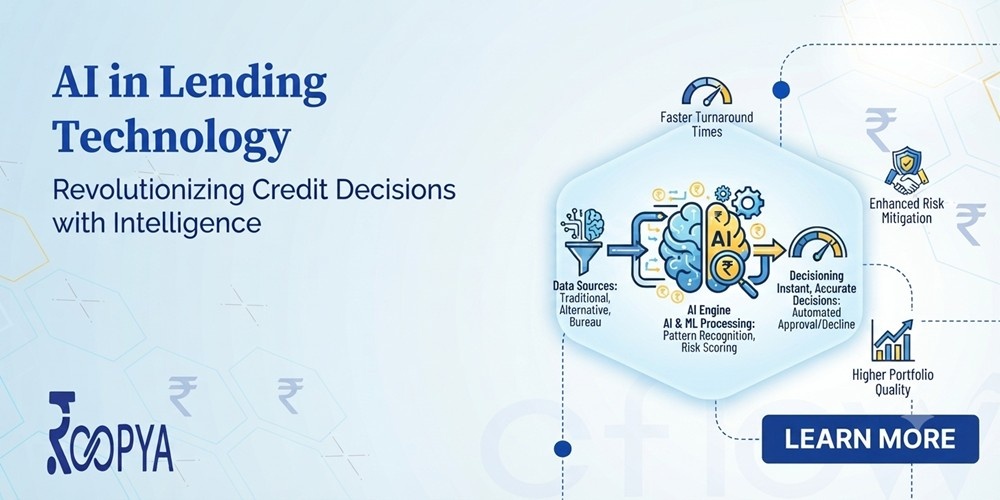
The Indian lending ecosystem is at an inflection point. With over 10,000 registered NBFCs, a rapidly growing fintech sector, and a massive underserved credit market, the institutions that win will be those that can assess credit faster, manage portfolios smarter, and recover more efficiently. Artificial Intelligence is not a future aspiration for Indian lenders — it is a competitive necessity today. This article breaks down exactly how AI is being applied across three critical pillars of lending: Loan Origination (LOS), Loan Management (LMS), and Collections — and how Roopya makes all of it accessible without building a data science team.
Overview
Why AI Has Become Non-Negotiable for Lenders
Traditional lending relied on fixed credit bureau scores, manual document checks, and rule-of-thumb underwriting. This model worked when borrower profiles were simple and competition was limited. Today, neither condition holds. Borrowers expect decisions in minutes, not days. The best borrowers have multiple options. And the risks of manual error in credit assessment translate directly into NPAs that erode profitability.
AI addresses the core limitations of traditional lending in three ways: speed (decisions in seconds, not days), accuracy (multi-variable models outperform human judgment on large datasets), and coverage (AI can assess borrowers with thin or no credit bureau history using alternate data).
The Roopya Advantage Most AI capabilities for lending require months of data science work and significant investment. Roopya builds all of it into the platform so any lender — from a 50-person NBFC to a large institution — gets access to production-ready AI models from day one of their subscription.
Loan Origination System
AI in Loan Origination (LOS): Smarter Credit Decisions, Faster
Loan origination is where the lending relationship begins — and where the most consequential decisions are made. Every approval decision carries risk. Every rejection is lost revenue. AI fundamentally improves the quality and speed of these decisions by bringing more data, better models, and automated workflows to the table.
1. AI-Powered Credit Underwriting
Traditional credit underwriting relies primarily on bureau scores (CIBIL, Experian) and income documentation. This creates a significant problem: a large portion of creditworthy borrowers — MSMEs, gig workers, rural customers, young professionals — have thin bureau files or no formal income documentation. They get rejected not because they are bad credit risks, but because the data used to assess them is insufficient.
AI-based underwriting engines solve this by incorporating a much wider set of variables:
GST & Business Data
Turnover trends, GST filing consistency, business age, and industry segment from GSTN records provide a real picture of MSME revenue.
Bank Statement Analysis
AI reads 12–24 months of bank statements to identify salary credits, regular outflows, EMI obligations, and cash flow patterns in seconds.
UPI Transaction History
Regular income through UPI, payment behavioural patterns, and merchant transactions reveal earning consistency for gig workers and traders.
Bureau + Alternate Data Fusion
AI combines bureau scores with alternate signals to generate a composite credit score that is more predictive than bureau data alone.
Roopya LOS: Alternate Data Scoring Built InRoopya’s LOS natively integrates with the Account Aggregator (AA) framework, GSTN, and bank statement analysis APIs. Lenders get a unified borrower risk profile combining bureau data, AA-fetched financial data, and GST records — without any custom integration work.
2. Intelligent Document Processing
Manual document verification is one of the biggest bottlenecks in loan origination. A loan officer reviewing KYC documents, income proof, and property papers for each application cannot scale beyond a certain volume. AI-based OCR and document intelligence changes this completely.
- Automated KYC extraction: Aadhaar, PAN, and passport details are read, extracted, and cross-verified against bureau records in under 5 seconds.
- Income document parsing: Salary slips, ITR, and Form 16 are read and structured automatically. AI flags inconsistencies between stated income and documents.
- Fraud signal detection: AI identifies tampered documents, mismatched fonts, metadata anomalies, and photo substitution attempts that human reviewers routinely miss.
- NACH and eMandate pre-verification: AI validates bank account details and NACH mandate status before disbursement, reducing bounce rates.
3. No-Code AI Rule Engine
Beyond machine learning models, AI in LOS also means sophisticated rule-based decisioning that non-technical credit teams can configure and modify without developer support. Roopya’s no-code credit rule engine allows lenders to define complex, multi-variable credit policies using a visual interface.
⚡
How Roopya LOS Uses AI in Credit Underwriting
- ✓ Account Aggregator (AA) integration for consent-based financial data
- ✓ GST data pull and automated business cashflow scoring
- ✓ AI bank statement analyser with income trend detection
- ✓ Bureau integration with all 4 credit bureaus (CIBIL, Experian, Equifax, CRIF)
- ✓ AI-powered OCR for KYC document processing
- ✓ Fraud signal detection on submitted documents
- ✓ No-code credit policy rule engine
- ✓ Composite AI credit score combining bureau + alternate data
- ✓ Configurable auto-approval thresholds
- ✓ Video KYC with liveness detection built in
4. AI-Driven Loan Product Matching
Beyond approving or rejecting a single loan, AI can recommend the right product for each applicant. Based on the borrower’s credit profile, income pattern, and repayment capacity, AI can suggest the appropriate loan amount, tenure, and interest rate — maximising approval rates while staying within the lender’s risk appetite. This results in fewer dropoffs, higher conversion, and better portfolio quality from the outset.
“With Roopya’s AI-enabled LOS, our credit team went from reviewing 50 applications per day to processing 300+ — with better decision quality and lower early delinquency rates.”
| Underwriting Task | Traditional LOS | Roopya AI LOS |
|---|---|---|
| Bureau Score Pull | Manual / 1 bureau | All 4 bureaus, automated |
| Bank Statement Analysis | Manual, 30–60 min | AI, under 30 seconds |
| GST / Business Cashflow | Not available | Automated via GSTN |
| Document Verification | Manual, error-prone | AI OCR + fraud check |
| Credit Decision Time | 2–5 business days | Under 5 minutes |
| Thin-File Borrower Assessment | Rejected by default | Alternate data scoring |
Loan Management System
AI in Loan Management (LMS): Intelligent Portfolio Oversight
Once a loan is disbursed, the work of managing it begins — and this is where most lenders still operate on largely manual, reactive processes. AI transforms loan management from a reactive record-keeping function into a proactive, predictive, and highly automated operation.
1. Predictive Early Warning System
One of the most powerful applications of AI in LMS is identifying at-risk accounts before they become NPAs. Traditional systems flag an account as delinquent only after a payment is missed. AI-based early warning systems identify stress signals weeks earlier — giving lenders time to intervene.
The signals AI monitors continuously include:
- Payment pattern changes: A borrower who has been paying on the 1st of every month but recently paid on the 8th, then 12th, is showing stress.
- NACH bounce frequency: A single NACH bounce can be a technical issue; two in a row is an early warning signal.
- Bank account balance drops: Via Account Aggregator consent, AI can monitor whether the borrower’s primary account balance is declining.
- Bureau enquiry spikes: A sudden increase in credit enquiries from a borrower suggests they are searching for funds — a stress indicator.
- Business cashflow changes: For business loans, AI monitors GST filing trends and business transaction patterns for deterioration.
Roopya LMS: Continuous AI Portfolio MonitoringRoopya’s LMS runs continuous AI surveillance across the entire loan portfolio. Each account receives a dynamic risk score that updates in real time. Portfolio managers get a single dashboard view of their highest-risk accounts, segmented by product, geography, and risk category — no manual data pulls required.
2. Automated Repayment Management
Managing repayments across thousands of loans involves tracking due dates, processing payments, handling NACH mandates, reconciling returns, and updating accounts — all in real time. AI automates the entire repayment workflow:
-
1
Pre-Due Reminders
AI sends personalised reminders via SMS, WhatsApp, and email at optimised intervals before due dates. Timing is calibrated based on each borrower’s historical response pattern.
-
2
NACH Presentation
NACH mandates are presented automatically on due dates. In case of insufficient funds, AI schedules re-presentation at the optimal time based on account credit patterns.
-
3
Payment Reconciliation
Payments received via NACH, UPI, NEFT, or over-the-counter are automatically reconciled against the correct loan accounts, eliminating manual matching errors.
-
4
Account Update & Reporting
Loan ledgers, interest accruals, and outstanding balances update in real time post-payment, ensuring accurate portfolio reporting at all times.
3. Dynamic Interest and Fee Calculations
AI enables lenders to move beyond fixed EMI structures to more nuanced, borrower-responsive loan management. For instance, AI can calculate interest on a daily reducing balance based on actual payment dates, automatically apply penal charges for late payments, process prepayments and foreclosures with accurate interest rebates, and handle moratorium periods and restructuring without manual recalculation.
4. AI-Powered Portfolio Analytics
Raw data becomes insight through AI-driven analytics. Roopya’s LMS provides lenders with a live intelligence layer over their portfolio — not just static reports.
NPA Trend Prediction
AI projects NPA trajectory 30, 60, and 90 days forward, enabling proactive provisioning and early intervention.
Geographic Risk Heatmaps
Identify pockets of portfolio stress by geography, enabling targeted field intervention and tightened origination in high-risk areas.
Product Profitability Analysis
AI breaks down yield, cost of funds, and credit losses by product to identify your most and least profitable loan segments.
Compliance Reporting
RBI returns, Ind AS ECL provisioning, and board MIS reports are auto-generated from live portfolio data — no manual compilation.
⚡
How Roopya LMS Uses AI in Portfolio Management
- ✓ Real-time dynamic risk scoring per account
- ✓ AI early warning system with configurable alert thresholds
- ✓ Automated NACH presentation and re-presentation logic
- ✓ Intelligent repayment reminder scheduling per borrower
- ✓ Automated prepayment and foreclosure calculations
- ✓ Real-time payment reconciliation across all channels
- ✓ AI portfolio analytics with NPA projection
- ✓ Ind AS ECL provisioning engine
- ✓ Auto-generated RBI and board reporting
- ✓ Drag-and-drop custom report builder
Collections
AI in Collections: Recover More, Spend Less
Collections is the most operationally intensive phase of the lending lifecycle and often the most emotionally fraught — for both borrowers and lenders. It is also the area where AI delivers some of its most dramatic ROI improvements. The core challenge in collections is resource allocation: a collections team cannot contact every overdue borrower with equal intensity. AI tells them exactly where to focus.
1. Predictive Default Scoring
Not all overdue borrowers are equal. Some have missed a payment due to a technical glitch and will self-cure within 24 hours. Others are genuinely in financial distress. AI builds a predictive default score for each delinquent account that estimates the probability of recovery, the likely recovery amount, and the optimal intervention method. This determines how collections resources are deployed.
The AI model analyses dozens of variables per account:
- Number of days past due (DPD) and historical DPD pattern
- Previous payment behaviour — has this borrower been consistently late before?
- Response to previous reminder communications
- Current bank account balance (via Account Aggregator consent)
- External credit bureau updates on new delinquencies
- Loan vintage, product type, and original credit score at origination
- Geographic and sectoral economic conditions
Why Traditional Collections Approaches FailCalling every overdue customer in DPD order — 1 DPD, then 2 DPD, then 3 DPD — wastes agent time on accounts that will self-cure while ignoring high-risk accounts that are about to skip. AI-driven prioritisation flips this, identifying which accounts need immediate human attention versus automated reminders.
2. Intelligent Communication Automation
AI determines not just who to contact, but when and how. Research shows that the same borrower responds differently to SMS, WhatsApp, email, or a phone call — and that the optimal contact time varies significantly by individual. Roopya’s AI collections module automates this intelligence at scale.
WhatsApp & SMS Automation
Personalised messages with payment links, outstanding amount, and due date sent at AI-optimised times for each borrower’s engagement pattern.
Email Communication
Formal notice emails with loan account statements, regulatory disclosures, and payment instructions auto-generated and tracked for opens and clicks.
IVR & Outbound Call Scheduling
AI prioritises and schedules outbound calls for human agents, ensuring they spend time only on accounts where a call is the highest-value intervention.
Field Agent Routing
For high-risk accounts requiring physical visits, AI clusters accounts geographically and assigns routes to field agents to maximise visits per day.
3. Settlement Intelligence
AI can also assist in determining the right settlement offer for long-overdue accounts. Based on the account’s profile, AI models the probability of recovery under different settlement scenarios — a waiver of penal interest, a partial principal write-down, or a restructuring into smaller EMIs — and recommends the settlement structure most likely to maximise net recovery. This prevents both under-discounting (losing accounts that could have been recovered) and over-discounting (giving away too much on accounts that would have paid anyway).
4. Legal Action Propensity Scoring
For severely delinquent accounts, AI helps lenders decide when to escalate to legal action versus continuing collections efforts. By modelling asset quality, borrower response patterns, and recovery probability, AI flags accounts where legal action has a positive expected recovery value — and those where continued collections effort is more cost-effective.
⚡
How Roopya Collections Module Uses AI
- ✓ Predictive default scoring per delinquent account
- ✓ AI-prioritised daily collections worklist for agents
- ✓ Automated WhatsApp, SMS, and email communications
- ✓ Optimal contact time prediction per borrower
- ✓ Field agent route optimisation by geography
- ✓ AI-assisted settlement offer recommendation
- ✓ Legal action propensity scoring
- ✓ NACH bounce analysis and smart re-presentation
- ✓ Real-time collections dashboard with bucket-wise DPD tracking
- ✓ Automated FOS (Feet on Street) app for field teams
Business Impact
What Roopya’s AI Capabilities Mean for Your Business
The value of AI in lending is ultimately measured in business outcomes — not in the sophistication of the underlying technology. Here is what lenders using Roopya’s AI-first platform report across LOS, LMS, and Collections:
From application to disbursement in under 24 hours for eligible digital applicants, compared to 3–7 days on traditional platforms.
AI-driven underwriting using alternate data identifies risk patterns that bureau scores alone miss, improving portfolio quality from origination.
Collections agents using AI-prioritised worklists close significantly more accounts per day than teams working from DPD-sorted spreadsheets.
Automation of document processing, repayment management, and report generation reduces the need for back-office headcount as loan volumes grow.
Expanding Credit Access for Underserved Borrowers
Perhaps the most significant business impact of AI in lending is the expansion of the addressable market. India has an estimated 50 million+ MSMEs with limited or no formal credit history. With AI-based alternate data scoring, lenders using Roopya can assess these borrowers accurately — unlocking a market that simply does not exist for platforms relying solely on bureau data.
This is not just a social good argument. It is a competitive opportunity. The NBFCs that build the capability to serve thin-file borrowers responsibly will capture a disproportionate share of India’s next wave of credit growth.
Compliance Without Additional Effort
AI in loan management also dramatically simplifies regulatory compliance. Roopya’s platform automatically generates all required RBI returns, maintains audit-ready transaction logs, calculates Ind AS ECL provisioning, and tracks regulatory deadlines — all from live portfolio data with no manual data compilation. As RBI adds new reporting requirements, Roopya pushes updates to all customers simultaneously, ensuring compliance without lenders having to track every circular.
Getting Started
How to Access AI-Driven Lending Capabilities with Roopya
The barrier to deploying AI in lending has traditionally been high: it required a data science team, months of model development, API integrations with data providers, and ongoing model maintenance. Roopya eliminates this entirely.
-
1
Sign Up and Go Live in 3–5 Days
The Roopya platform is fully cloud-native. There is nothing to install. Sign up, complete your KYC verification, and configure your loan products through the no-code interface. You are ready to originate in under a week.
-
2
Connect Your Data Sources
Roopya’s pre-built integrations with bureaus, AA, GSTN, and banking partners are activated as part of onboarding. No custom API development is required for the standard Indian lending data stack.
-
3
Configure Your AI Credit Policy
Use the no-code rule engine to define your credit policy — minimum bureau score, income thresholds, DTI ratios, and alternate data criteria. The AI engine combines these rules with its predictive models automatically.
-
4
Start Originating, Managing, and Collecting with AI
From the first application onwards, Roopya’s AI is at work — scoring every applicant, monitoring every account, and optimising every collections action in real time.
-
5
Monitor and Improve Continuously
As your portfolio grows, Roopya’s AI models are continuously updated with your own data, improving scoring accuracy over time. You get a progressively smarter platform — without any data science overhead.
No Data Science Team RequiredRoopya’s AI models are trained on aggregated industry data and continuously updated. Lenders benefit from portfolio-wide intelligence from day one — even before they have enough of their own data to build proprietary models. As they grow, the models adapt to their specific portfolio characteristics automatically.
Conclusion
The Future of Lending is AI — and It Is Available Today
AI in lending is no longer a competitive differentiator reserved for large banks and well-funded fintechs. It is becoming a baseline capability that every NBFC will need to compete effectively. The lenders who act now build compounding advantages: better portfolio quality means lower cost of funds, which means better pricing, which means more borrowers, which means more data, which means even better AI models.
The good news is that accessing this capability no longer requires a technology build project. Roopya delivers production-ready AI across loan origination, loan management, and collections as a fully integrated platform — available from the day you sign up, on a pay-per-usage model that scales with your business.
The question for Indian lenders is no longer whether to use AI — it is how quickly you can get started.
See Roopya’s AI Capabilities in Action
Request a personalised demo and we will walk you through exactly how AI-driven LOS, LMS, and Collections work for your specific loan product and borrower profile.
Ready to Add AI to Your Lending Operations?
Join 100+ NBFCs and lenders already using Roopya’s AI-first platform to originate faster, manage smarter, and collect better.

