Best Autonomous Lending Software in India: The Complete Guide for NBFCs, Banks & Modern Lenders

India’s lending sector is at a historic inflection point. A decade ago, the dominant image of credit in India was the branch — a physical space where loan officers manually reviewed paper applications, called references, and made credit decisions based on instinct as much as data. Today, that image is giving way to something entirely different: lending systems that think, decide, and act — automatically, accurately, and at scale.
Start Free Trial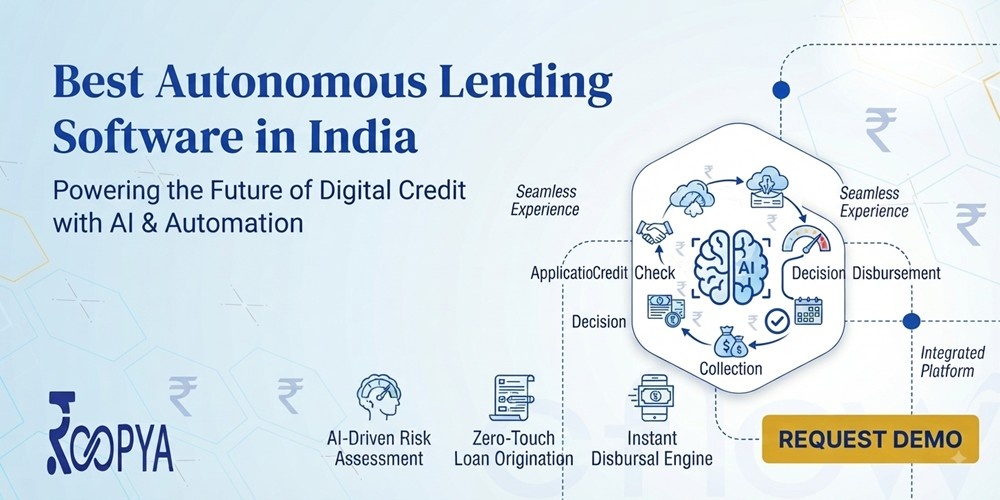
This is the era of autonomous lending software. And for NBFCs, banks, microfinance institutions, and fintech lenders operating in India’s fast-evolving credit market, choosing the right autonomous lending platform is no longer a technology decision — it is a strategic one.
This guide explains what autonomous lending software is, how it works, what the best platforms offer, and why Roopya has emerged as India’s leading autonomous lending infrastructure for modern lenders.
1. What Is Autonomous Lending Software?
Autonomous lending software refers to a category of lending technology that uses artificial intelligence, machine learning, automated workflows, and pre-integrated data sources to manage the entire lending lifecycle — from loan application and underwriting to disbursement, servicing, collections, and reporting — with minimal or zero human intervention.
The word ‘autonomous’ is intentional. Unlike traditional loan management software, which automates individual tasks but still relies heavily on human decision-makers at critical junctures, autonomous lending software is designed to make end-to-end decisions based on real-time data, configured credit policies, and continuously learning AI models.
In practical terms, this means a borrower can apply for a loan, have their identity verified, their creditworthiness assessed, a loan offer generated, an agreement signed, and funds disbursed — all without a single human being involved in the process. For the lender, this translates into dramatically lower operating costs, faster turnaround times, higher throughput, and more consistent credit decisions.
Autonomous lending software is not a single product — it is a stack of interconnected capabilities: a Loan Origination System (LOS), a Loan Management System (LMS), a Business Rule Engine (BRE), an AI-powered document analysis layer, credit bureau integrations, collections automation, analytics, and reporting — all unified on a single platform.
2. Why Autonomous Lending Is the Future of Credit in India
India’s lending market has several structural characteristics that make autonomous lending software not just advantageous, but essential for lenders who want to compete:
The Scale Challenge
India has over 500 million potential credit consumers who are underserved or entirely outside the formal credit system. Traditional, manually-driven lending processes cannot scale to serve this population profitably. Autonomous lending software can process thousands of applications per day with the same infrastructure that handles hundreds — enabling lenders to reach new markets without proportionally increasing headcount.
The Speed Imperative
Digital-native borrowers in India increasingly apply for credit through smartphones and expect near-instant decisions. Studies consistently show that loan conversion rates drop sharply when approval times exceed a few hours. An autonomous lending platform delivers decisions in seconds — not days — capturing borrower intent at the peak moment of motivation.
The Data Abundance Opportunity
India’s digital infrastructure — Aadhaar, UPI, Account Aggregator, GST Network, credit bureaus — has created an unprecedented volume of borrower data that can inform better credit decisions. But processing this data manually is impossible. Autonomous lending software is built to ingest, process, and act on this data in real time, enabling more accurate underwriting than any human underwriter could achieve alone.
The Compliance Complexity
The regulatory environment for lenders in India — RBI guidelines, PMLA requirements, Fair Practice Code, data localisation — is complex and constantly evolving. Autonomous lending platforms with built-in compliance automation ensure lenders remain compliant continuously, without manual monitoring or periodic reviews.
The Cost Pressure
Rising interest rate environments, thinning NIMs, and competitive pressure from fintech lenders are squeezing traditional lenders’ margins. Autonomous lending software dramatically reduces cost per loan — by eliminating manual processing, reducing errors, and optimising collection strategies — giving lenders a structural cost advantage.
3. Core Components of the Best Autonomous Lending Software
Not all lending software that claims to be ‘autonomous’ delivers on the promise. Here are the core components that define a truly autonomous lending platform:
3.1 No-Code Loan Origination System (LOS)
The origination system is the entry point for every loan. A truly autonomous LOS goes beyond digital application forms — it automates the entire journey from first touch to sanction. This includes smart, multi-step digital application forms with real-time validation; automatic triggering of KYC checks, bureau pulls, and document analysis; configurable eligibility screening; automated underwriting; and personalised offer generation. The best autonomous lending software — like Roopya — ships with 20+ pre-configured loan product journeys, so lenders can go live without building a single workflow from scratch.
3.2 AI-Powered Document Analysis
Document collection and verification is one of the most labour-intensive stages of traditional lending. Autonomous lending software replaces this manual effort with AI-powered Optical Character Recognition (OCR) and Natural Language Processing (NLP) that can extract data from any document — PAN cards, Aadhaar, salary slips, bank statements, ITRs, GST returns, property documents — in seconds, with accuracy exceeding 99%. More importantly, the AI detects inconsistencies and fraud signals that human reviewers routinely miss — inflated income figures, manipulated bank statements, mismatched identity information.
3.3 Automated KYC and Identity Verification
Know Your Customer compliance in India requires verification of identity, address, and PAN — at minimum. The best autonomous lending platforms integrate directly with Aadhaar eKYC, NSDL PAN verification, Digilocker, and video KYC (VKYC) providers, automating the entire KYC process. Borrowers complete full KYC from their smartphones in under two minutes, with no branch visit or manual review required.
3.4 Credit Bureau Integration and Automated Scoring
Real-time credit bureau integration is non-negotiable for autonomous lending. Autonomous lending software automatically pulls bureau reports from CIBIL, Experian, CRIF, and Equifax upon application submission, parses the reports, and feeds the data into the credit decisioning engine. This ensures every decision is based on current, accurate bureau data — not stale information or manual lookups. Roopya’s platform integrates with all four major Indian credit bureaus out of the box.
3.5 No-Code Business Rule Engine (BRE)
The BRE is the brain of an autonomous lending platform. It translates your credit policy — income thresholds, bureau score cutoffs, employment type filters, geographic restrictions, product-level eligibility criteria, debt-to-income ratios — into automated decisioning logic. The critical differentiator for truly autonomous software is that the BRE must be configurable by business users, without requiring developer involvement. Roopya’s no-code BRE goes further: it uses machine learning to learn from historical approval and rejection data, continuously suggesting rule improvements and adapting to changing market conditions — while keeping human oversight at the centre.
3.6 Intelligent Credit Decisioning
The credit decision — approve, reject, or manual review — is the moment of truth in any loan application. Autonomous lending software makes this decision in milliseconds, synthesising bureau data, document analysis outputs, BRE rule results, and ML-based credit scores. The best platforms go beyond traditional credit scores to evaluate alternative data: transaction patterns, GST filing history, account aggregator data, and behavioural signals. Roopya’s intelligent credit decisioning analyses thousands of data points to deliver risk assessments that are more accurate than traditional methods — with 40% better accuracy than bureau score-only models.
3.7 Digital Agreement Execution and eSign
For an autonomous lending platform to deliver a truly end-to-end automated experience, it must include legally valid digital agreement execution. Roopya integrates with Aadhaar OTP-based and Digilocker-based eSign providers, enabling borrowers to sign loan agreements digitally — from their device, in seconds — with no courier, no branch visit, and no wet signature required. The executed agreement is stored with a complete audit trail for regulatory compliance.
3.8 Automated Loan Management System (LMS)
Post-disbursement, autonomous lending software continues to manage the loan lifecycle without manual intervention. An automated LMS handles repayment scheduling, EMI collection, pre-payment and foreclosure processing, amortisation schedules, NOC generation, and portfolio reporting — all automatically. Roopya’s LMS integrates with payment gateways and NACH/e-NACH for automated EMI collection, reducing delinquencies and collection costs simultaneously.
3.9 AI-Driven Collections Automation
Collections is where many lending businesses lose money — through inefficient agent allocation, generic communication strategies, and poor timing. Autonomous lending software uses AI to predict which borrowers are at risk of delinquency before it happens, and to optimise collection strategies based on individual borrower behaviour profiles. Roopya’s AI-driven collections engine delivers 60% better collections performance by automatically triggering the right communication, at the right time, through the right channel — for every borrower in the portfolio.
3.10 Early Warning System (EWS)
A proactive Early Warning System is a hallmark of truly autonomous lending software. Rather than waiting for a borrower to miss an EMI, an EWS monitors behavioural signals, transaction patterns, and external data in real time to identify borrowers who are at elevated risk of default — weeks or months in advance. Roopya’s EWS uses predictive analytics and behavioural modelling to flag at-risk accounts automatically, enabling lenders to intervene early and prevent losses before they crystallise.
3.11 Lending Analytics and Reporting
Autonomous lending software generates data at every stage of the lending lifecycle. The best platforms turn this data into actionable intelligence through built-in lending analytics: portfolio performance dashboards, vintage analysis, segment-level risk metrics, collection effectiveness scores, and regulatory reports. Roopya’s AI-driven analytics module uses Natural Language Processing to let business users ask questions in plain English and receive instant, detailed analytical responses — eliminating the need for dedicated data analysts for routine reporting.
4. How Roopya’s Autonomous Lending Software Works: End-to-End
Roopya is India’s leading autonomous lending infrastructure platform, built specifically for NBFCs, banks, MFIs, and fintech lenders. Here is how the end-to-end autonomous lending journey works on Roopya:
- Stage 1 – Borrower Applies: The borrower initiates an application on your branded digital interface. Smart forms with real-time validation guide them through the process in minutes. Multi-channel support covers direct digital, agent-assisted, and embedded finance journeys.
- Stage 2 – Instant KYC & Identity Verification: Upon consent, Roopya simultaneously triggers Aadhaar eKYC, PAN verification, and Digilocker checks. KYC is completed in under 120 seconds, automatically, with full regulatory compliance.
- Stage 3 – Credit Bureau Pull & Scoring: Bureau reports are automatically pulled from CIBIL, Experian, CRIF, or Equifax. AI parses and scores the reports in real time, feeding results into the credit decisioning engine.
- Stage 4 – Document Upload & AI Analysis: The borrower uploads required documents. Roopya’s AI extracts data, validates fields, cross-checks for consistency, and flags fraud signals — all within seconds.
- Stage 5 – Autonomous Credit Decision: The BRE evaluates all inputs against your configured credit policy. AI credit scoring models supplement with alternative data analysis. A decision — approve, reject, or refer — is generated automatically in milliseconds.
- Stage 6 – Personalised Offer & eSign: Approved borrowers receive a personalised loan offer and complete digital agreement signing. The entire approval-to-eSign journey can take under five minutes.
- Stage 7 – Disbursement: The completed loan file triggers automated disbursement workflows. Funds are transferred directly to the borrower’s verified bank account.
- Stage 8 – Autonomous Loan Servicing: The LMS takes over — managing EMI schedules, processing repayments, sending automated reminders, and generating statements. Human intervention is only required for exception cases.
- Stage 9 – AI-Driven Collections (if needed): For delinquent accounts, the AI collections engine automatically segments borrowers, selects optimal communication strategies, and manages recovery workflows — maximising collection efficiency.
The entire lifecycle, from application to closure, is managed on a single unified platform — with complete visibility through real-time dashboards and automated reports.
5. What Makes Roopya the Best Autonomous Lending Software in India?
1-Day Go-Live
Traditional lending software implementations require six to twelve months of technical work, customisation, and testing. Roopya’s no-code platform eliminates this entirely. Pre-built integrations, pre-configured loan product journeys, and an intuitive no-code configuration interface allow lenders to go live and process real loan applications within a single business day of onboarding.
Truly No-Code — Business Users in Control
On most lending software platforms, changing a credit policy rule or adding a new document requirement requires a developer and a change management cycle. On Roopya, business users — credit managers, operations heads, product managers — configure everything themselves through a visual, no-code interface. Credit policies, approval workflows, loan product parameters, communication templates, and collection strategies are all under business user control.
300+ Pre-Integrated APIs
Roopya comes with 300+ pre-integrated APIs covering every major data source and service a modern lender needs: all four credit bureaus, Aadhaar eKYC, PAN and GST verification, Digilocker, VKYC providers, eSign platforms, NACH and UPI payment gateways, accounting software, CRMs, and banking APIs. No custom integration development is required — every connection is already built and tested.
AI at Every Layer
Roopya’s AI is not a marketing claim — it is embedded at every stage of the lending lifecycle. Document analysis with 99%+ accuracy. Machine learning-based credit scoring with 40% better accuracy than traditional methods. AI-driven fraud detection that reduces fraudulent approvals by 80%. A self-learning Business Rule Engine that continuously optimises credit policy. NLP-powered analytics that let business users query portfolio data in plain English. And a conversational AI layer that achieves 95% satisfaction rates in borrower interactions.
Pay-As-You-Use Pricing
Roopya’s pricing model is built for lenders at every stage of growth. There are no large upfront licence fees, no capital expenditure requirements, and no minimum commitment volumes for early-stage lenders. You pay based on actual usage — meaning the platform’s cost scales proportionally with your revenue, making it equally accessible for a newly-licensed NBFC processing 50 applications a month and a large lender processing 50,000.
Full Regulatory Compliance
Roopya’s platform is continuously updated for RBI compliance, covering KYC norms under PMLA, Fair Practice Code requirements, data localisation regulations, credit bureau reporting obligations, CERSAI filings, and audit trail requirements. Compliance is built into the platform’s architecture — not a manual checklist that your team has to maintain.
Embedded Finance Ready
Autonomous lending software must be deliverable through APIs as lending moves into embedded contexts — buy-now-pay-later, payroll-integrated credit, supply chain financing. Roopya’s open API architecture allows any partner platform to originate and manage loans through Roopya’s infrastructure programmatically, without redirecting borrowers to a separate lender portal. This positions Roopya customers to capture the growing embedded finance opportunity without additional development investment.
Trusted by India’s Modern Lenders
Roopya is trusted by a growing community of forward-thinking Indian lenders — including IndiaKaLoan, QuickFinShop, Recapita, Findoc, EazyCredit, and Lona Seva — who have chosen Roopya as the infrastructure backbone of their lending operations. Their growth is Roopya’s strongest validation.
6. Autonomous Lending Software vs. Traditional Lending Software: The Comparison
The differences between autonomous lending software and traditional lending software are not incremental — they are structural:
- Decision Speed: Traditional software requires hours or days of human review. Autonomous software delivers decisions in milliseconds.
- Accuracy: Human underwriters are inconsistent and subject to bias. AI-driven autonomous platforms apply credit policy uniformly across every application, every time.
- Scalability: Traditional systems require proportionally more staff as volume grows. Autonomous systems scale infinitely without headcount increases.
- Cost per Loan: Manual processing costs are high and fixed. Autonomous processing costs drop as volume increases, creating powerful operating leverage.
- Fraud Detection: Human reviewers miss sophisticated fraud patterns. AI-powered autonomous platforms detect anomalies in documents, identity, and behaviour that no human would catch.
- Compliance: Manual compliance processes are reactive and error-prone. Autonomous platforms enforce compliance rules automatically on every transaction.
- Learning: Traditional systems are static — they do the same thing until someone changes the code. Autonomous platforms continuously learn and improve from every transaction processed.
7. Use Cases: Who Benefits Most from Autonomous Lending Software?
New and Growing NBFCs
For newly licensed NBFCs and rapidly growing non-banking lenders, autonomous lending software is the foundation that allows lean teams to build large loan books. With Roopya, a five-person founding team can process thousands of applications a month without hiring a proportional operations workforce. The 1-day go-live means new NBFCs can launch their lending operations before their competitors have finished customising their legacy software.
Microfinance Institutions (MFIs)
MFIs face unique challenges: large numbers of small-ticket loans, rural and semi-urban borrowers with limited formal credit histories, and the logistical complexity of JLG (Joint Liability Group) lending. Autonomous lending software with mobile-first interfaces, alternative data underwriting, and offline-capable agent apps makes MFI operations dramatically more efficient and allows responsible lending to underserved populations at scale.
Fintech Lenders and Embedded Finance Providers
Fintech lenders and platforms that offer embedded credit products need lending infrastructure that is API-first, infinitely scalable, and configurable without developer involvement. Roopya’s open API architecture and embedded finance capabilities make it the natural choice for companies building credit products into non-financial platforms — from e-commerce to agri-tech to gig economy payroll apps.
Banks Modernising Their Retail Lending
Legacy core banking systems were not designed for the speed and automation requirements of modern retail lending. Banks looking to build or rebuild their digital lending capabilities — without replacing their entire core banking infrastructure — can use Roopya as a modern lending layer that integrates with existing systems through APIs, delivering autonomous lending capabilities without a multi-year core banking transformation programme.
8. Selecting the Best Autonomous Lending Software: What to Look For
- True end-to-end coverage: Does the platform cover origination, underwriting, servicing, collections, and reporting — or just parts of the lifecycle?
- No-code configurability: Can business users change credit policies, workflows, and product parameters without developer involvement?
- Pre-integrated data ecosystem: How many bureau, KYC, and document provider integrations are already built? What is the integration effort for anything not on the list?
- AI maturity: Is AI embedded throughout the platform, or limited to a specific module? Does the platform’s AI improve over time?
- Go-live timeline: How long from contract signature to processing live loans? Hours and days are better than months.
- Pricing model: Are costs aligned with your growth? Pay-as-you-use models are far better for most lenders than large upfront licence fees.
- Regulatory track record: Is the platform continuously updated for Indian regulatory requirements? Who is responsible for compliance updates?
- Reference customers: What lenders — similar in size and product mix to you — are running on this platform? What do they say about it?
9. The Future of Autonomous Lending in India
Autonomous lending is still in its early stages in India, and the next phase of evolution will be driven by three powerful forces. First, the Account Aggregator (AA) ecosystem will make financial data portability a reality for hundreds of millions of borrowers, dramatically improving underwriting accuracy for thin-file and new-to-credit segments. Autonomous lending software that is integrated with the AA framework will be able to underwrite borrowers who are currently invisible to traditional credit assessment.
Second, conversational AI will transform how borrowers interact with the lending process. Voice and chatbot-driven loan application journeys will reach rural, low-literacy populations in a way that digital forms never can — expanding the addressable market for formal credit further into India’s heartland.
Third, real-time credit using UPI and banking data will enable instant, contextual credit decisions at the point of need — embedded directly into payment flows, commerce platforms, and everyday financial interactions. Autonomous lending infrastructure that is open, API-first, and AI-native — like Roopya — is built precisely for this future.
The lenders who invest in autonomous lending software today will not just operate more efficiently — they will be architecturally positioned to lead India’s next credit cycle.
10. Conclusion: Why Roopya Is India’s Best Autonomous Lending Software
Choosing autonomous lending software is one of the most consequential technology decisions a lender makes. It determines how fast you can grow, how efficiently you can operate, how accurately you can assess risk, and how effectively you can serve borrowers. The wrong choice can mean months of wasted implementation time, an inflexible platform that cannot adapt to your credit policy, and a system that requires constant technical intervention to keep running.
Roopya is different. It is the only autonomous lending platform in India that combines a no-code, 1-day go-live, pay-as-you-use infrastructure with 300+ pre-integrated APIs, end-to-end AI across the lending lifecycle, full RBI compliance, and a proven track record with India’s most forward-thinking lenders.
Whether you are launching a new NBFC, scaling an existing lending business, modernising a bank’s retail lending operations, or building an embedded credit product, Roopya gives you the autonomous lending infrastructure to do it faster, smarter, and at lower cost than any alternative.
Request a free demo today. Go live in a day. Lend at scale. Grow without limits.

