Complete Loan Management System for Digital Lending: The Definitive Guide for NBFCs, Banks & Fintech Lenders

India’s digital lending ecosystem is one of the most dynamic and fastest-growing in the world. Driven by a combination of smartphone penetration, UPI infrastructure, AA (Account Aggregator) frameworks, and progressive NBFC licensing, the country now has thousands of active lenders competing for a market that is projected to exceed $1.3 trillion in outstanding credit by 2030. Yet, for all the opportunity, many lenders — from newly licensed NBFCs to mid-sized banks — remain constrained by one critical gap: the absence of a modern, end-to-end Loan Management System.
A Loan Management System (LMS) is not simply a database of loan accounts. It is the operational nervous system of a lending business — managing everything from disbursement and EMI scheduling to collections, NPA classification, regulatory reporting, and customer service. When this system is outdated, fragmented, or manual, the costs are enormous: higher delinquency rates, operational errors, compliance failures, and an inability to scale efficiently.
Start Free Trial
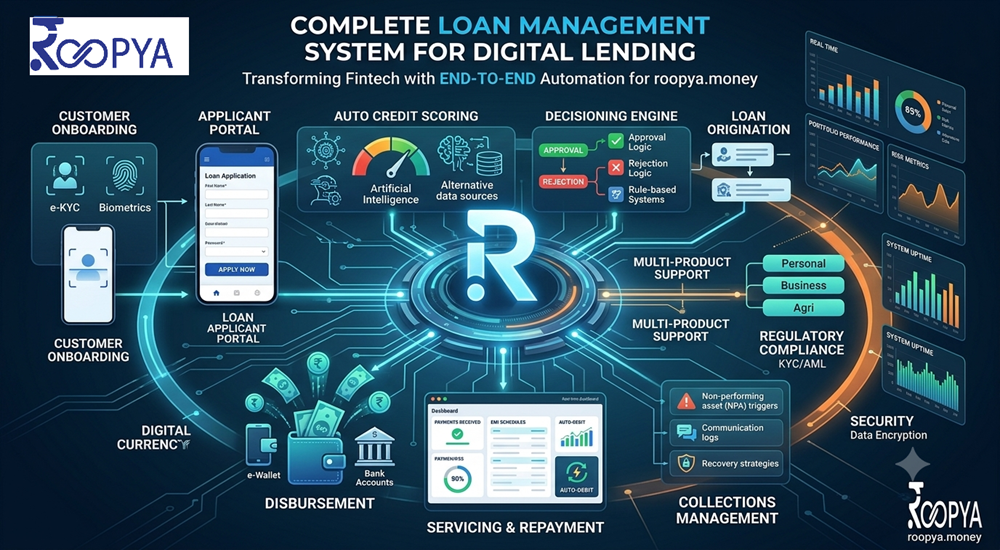
This guide is a comprehensive resource for lending institutions evaluating, upgrading, or implementing a Loan Management System for digital lending. We cover what an LMS does, why it matters, the features that differentiate world-class systems from mediocre ones, and why Roopya has emerged as the most trusted LMS platform for modern Indian lenders.
1. What Is a Loan Management System?
A Loan Management System (LMS) is a software platform that automates and manages the post-disbursement lifecycle of a loan — from the moment funds are released to a borrower through to final repayment or closure. It is the engine that keeps a lending business running day after day, processing millions of data points across thousands of active loan accounts.
In a traditional lending institution, the functions now handled by an LMS were managed by a combination of spreadsheets, manual ledgers, disparate software tools, and human teams. This approach was not only slow and expensive — it was fundamentally incompatible with the speed and scale demands of digital lending.
A modern LMS consolidates all of these functions into a single, unified platform. It tracks every rupee disbursed and every EMI received. It classifies assets according to RBI norms. It generates statutory reports automatically. It triggers automated collections workflows. And it does all of this in real time, across thousands of concurrent loan accounts, without manual intervention.
The best loan management systems — like Roopya — go further still. They integrate seamlessly with the full lending lifecycle, connecting the LMS with the Loan Origination System (LOS) at the front end and with treasury, accounting, and credit risk systems at the back end. The result is a single source of truth for the entire lending operation.
2. The Digital Lending Revolution and Why Your LMS Must Keep Pace
The Reserve Bank of India’s Digital Lending Guidelines (2022) fundamentally changed the compliance requirements for every lender operating in the digital space. Lenders are now required to maintain real-time audit trails, ensure funds flow directly to borrower accounts, report to credit bureaus on a defined schedule, and provide borrowers with digital Key Fact Statements (KFS). Meeting these requirements with legacy or manual systems is essentially impossible.
Simultaneously, borrower expectations have shifted irrevocably. Digital-native borrowers — particularly in the 25-40 age bracket that now represents the largest segment of credit demand — expect self-service access to their loan accounts, instant payment confirmations, automated EMI reminders, and instant NOC generation at closure. These are not optional features; they are table-stakes for customer retention in competitive digital lending.
Meanwhile, the economics of lending have become more demanding. Interest rate margins have compressed in many product categories, making operational efficiency a survival imperative. A lender that processes loan repayments, handles customer queries, and manages delinquency through manual teams cannot compete on economics with one running an automated LMS. The latter can scale its portfolio 10x without adding headcount.
For all of these reasons, the choice of Loan Management System has become one of the most consequential technology decisions a lending institution can make.
3. Core Modules of a Complete Loan Management System
3.1 Loan Account Management
At the heart of every LMS is the loan account management module — the system of record for every active loan in the portfolio. This module maintains the complete financial history of each loan account: disbursement date and amount, applicable interest rate and type (fixed, floating, reducing balance), repayment schedule, all payments received, outstanding principal and interest, and any fees or charges applied. Roopya’s LMS maintains a real-time, immutable ledger for every loan account, with a complete transaction history that serves both operational and audit purposes.
3.2 EMI Scheduling and Repayment Management
Generating accurate repayment schedules is a foundational capability of any LMS. The system must correctly compute EMI amounts for a wide range of loan structures — flat rate, reducing balance, bullet repayment, step-up EMI, moratorium periods, and custom repayment calendars. Roopya’s LMS handles all of these structures with built-in financial computation engines that are tested and verified for accuracy across millions of loan accounts. Repayment schedules are generated automatically at disbursement and updated dynamically if the loan terms change — for example, in a prepayment or restructuring scenario.
3.3 Automated Collections and Repayment Processing
Collecting repayments — and managing the exceptions when they don’t arrive on time — is arguably the most operationally intensive function in any lending business. A complete LMS automates the entire collections cycle. E-NACH mandates are registered at the time of loan origination and triggered automatically on each due date. Payment confirmations are received, reconciled, and posted to loan accounts in real time through payment gateway integrations. For failed payments, the LMS triggers a structured escalation — automated borrower communications, retry logic, field collection assignment, and legal escalation — based on days past due (DPD) and configured collections policies.
Roopya’s collections module supports multi-channel communication (SMS, WhatsApp, IVR, email), payment links, and a dedicated collections agent portal with borrower-level information, making each collection touchpoint as efficient as possible.
3.4 NPA Classification and Asset Quality Management
RBI prudential norms require NBFCs and banks to classify loan assets into Standard, Sub-Standard, Doubtful, and Loss categories based on days past due. Manual NPA classification is error-prone, time-consuming, and — critically — carries regulatory risk if classification is incorrect or delayed. Roopya’s LMS performs automatic, rule-based NPA classification on a daily basis across the entire portfolio, applying the correct provisioning requirements for each NPA bucket and generating the provisions data needed for financial reporting. NPA trends are surfaced in real-time dashboards, giving risk management teams early visibility into portfolio quality movements.
3.5 Prepayment, Foreclosure, and Restructuring
Borrower circumstances change throughout the life of a loan. A complete LMS must handle a full range of loan lifecycle events beyond routine repayments: full and partial prepayments (with correct interest rebate computation), foreclosure processing, restructuring of repayment terms, conversion between loan products, and write-off processing for irrecoverable accounts. Each of these workflows must be fully automated, correctly computed, and accompanied by the appropriate documentation and customer communication. Roopya’s LMS handles all of these scenarios natively, with configurable business rules governing how prepayment penalties, rebates, and restructuring charges are applied.
3.6 Interest Accrual and Fee Management
Interest accrual must occur daily, accurately, and across every active loan account in the portfolio. The LMS must also manage the full spectrum of fees that lenders charge: processing fees, late payment charges, bounced ECS charges, prepayment penalties, and annual maintenance fees. Roopya’s LMS supports configurable fee structures at the product level, with automated fee application triggered by the relevant event — a missed payment, a prepayment request, or a scheduled annual review. All accrued interest and fees flow automatically into the financial reporting module.
3.7 Regulatory Reporting and Compliance
Regulatory compliance is a continuous, never-ending obligation for any lending institution. An LMS must generate accurate, timely reports across multiple regulatory frameworks: RBI returns (including the NPA schedule and provisioning coverage ratio), credit bureau reporting (CIBIL, Experian, CRIF data furnishing), CERSAI security interest filing, GST on fee income, and — for co-lending arrangements — the co-lending partner’s share reporting. Roopya’s LMS automates the generation of all major regulatory reports, ensuring that compliance teams can meet deadlines without weeks of manual data extraction and reconciliation.
3.8 Customer Self-Service Portal and Communication
Borrowers who can serve themselves — viewing their loan account, downloading statements, making payments, and requesting NOCs — cost far less to serve than those who must call or visit a branch. A complete LMS includes a borrower-facing self-service portal, accessible via web and mobile, that provides real-time access to account information, repayment history, upcoming due dates, and document downloads. Roopya’s borrower portal is fully branded to the lender’s identity, mobile-optimised, and integrated with payment gateways for instant EMI payment.
3.9 Co-Lending and Partnership Management
Co-lending — where an NBFC and a bank jointly originate a loan under RBI’s co-lending model — has become a major growth driver for the sector. Managing co-lending relationships requires the LMS to accurately track and report each partner’s share of every loan account: principal outstanding, interest income, NPA status, and recovery. Roopya’s LMS has native co-lending support, with automated partner reporting, waterfall payment distribution, and reconciliation built in.
3.10 Analytics, Dashboards, and Portfolio Intelligence
Real-time visibility into portfolio performance is essential for risk management, collections strategy, and business planning. A modern LMS goes beyond static reports to provide interactive dashboards and analytics: portfolio breakdown by product, geography, vintage, and risk bucket; delinquency roll-rate analysis; recovery rate by collections channel; and NPA movement trends. Roopya’s analytics module includes pre-built dashboards for CEOs, CFOs, risk heads, and collections managers — each surfacing the metrics most relevant to their function.
4. Why a Unified LOS + LMS Platform Is the Future of Lending Technology
Historically, lenders used separate systems for loan origination (LOS) and loan management (LMS), connected by periodic batch data transfers. This architecture created data silos, reconciliation headaches, and delays — a customer’s status in the origination system might not be reflected in the management system for hours or days.
The modern approach — pioneered by platforms like Roopya — is a unified infrastructure layer where LOS and LMS are a single, integrated system sharing a common data model and operating in real time. The moment a loan is disbursed in the LOS, it is live in the LMS. The moment an NPA is identified in the LMS, it is visible to the credit team in the LOS. Collections data informs future origination decisions. Risk models trained on management data improve origination quality.
This integration delivers compounding benefits over time. Lenders on a unified platform make better decisions at every stage of the loan lifecycle — from the initial credit decision through to final recovery — because all relevant data is available to every function, in real time, from a single source of truth.
5. Key Benefits of Roopya’s Loan Management System
End-to-End Automation
From disbursement to closure, every step in the loan servicing lifecycle is automated on Roopya’s LMS. E-NACH mandates, payment reconciliation, NPA classification, regulatory reporting, borrower communications — all run automatically, based on configurable business rules, without human intervention. This automation does not just reduce costs; it eliminates entire categories of operational risk.
No-Code Configuration
Every lending institution has a unique credit policy, fee structure, and operational workflow. Roopya’s no-code configuration engine allows business users — not software developers — to define and modify loan product parameters, collections escalation rules, fee structures, and reporting formats. Changes to business rules that previously required weeks of developer time can now be implemented in minutes, with no code required.
300+ Pre-Built Integrations
A Loan Management System does not operate in isolation. It must connect with payment gateways, banking APIs, credit bureaus, accounting software, GST platforms, and a hundred other tools. Roopya ships with 300+ pre-built integrations, eliminating the custom development work that typically adds months to an LMS implementation. From RazorPay to Zoho Books to CIBIL to NACH — if you need it, it is almost certainly already connected.
Real-Time Portfolio Visibility
Roopya’s LMS provides real-time dashboards and analytics across every dimension of the portfolio. DPD buckets, NPA trends, collection efficiency, product-level performance, geographic distribution, vintage curves — all updated in real time, accessible from any device. Lending leaders who have moved to Roopya consistently describe the shift from lagging reports to real-time visibility as transformative for decision-making quality.
1-Day Go-Live
Traditional LMS implementations take six to eighteen months and cost crores in consulting and development fees. Roopya’s no-code platform, pre-built integrations, and pre-configured product templates enable a go-live in a single day. For early-stage NBFCs and lenders launching new products, this speed-to-market advantage is decisive.
Pay-As-You-Use Pricing
Large upfront licensing costs are one of the biggest barriers to LMS adoption for smaller lenders. Roopya’s pay-as-you-use model eliminates this barrier entirely. There are no capital expenditure requirements, no per-seat licensing fees, and no minimum volume commitments. You pay for what you use, starting from your very first loan.
RBI Compliance by Design
Every feature in Roopya’s LMS is designed with RBI compliance in mind. NPA classification follows current prudential norms. Digital Lending Guidelines requirements — KFS generation, direct fund flows, audit trails — are built in as standard features. Regulatory report formats are updated as guidelines change. Your compliance function can focus on oversight rather than data collection.
6. Loan Management System for Different Types of Lenders
NBFCs
For Non-Banking Financial Companies, the LMS is the system that determines whether you can scale your portfolio without proportionally scaling your team. Roopya’s LMS is purpose-built for NBFC operations: it handles the full range of NBFC-specific compliance requirements (RBI NPA norms, CERSAI filing, credit bureau data furnishing), supports the product diversity typical of NBFCs (personal, business, gold, vehicle, MSME), and integrates with the accounting and treasury systems that NBFCs rely on.
Microfinance Institutions (MFIs)
MFI lending operates under unique constraints — group lending models, weekly repayment cycles, rural connectivity challenges, and a borrower population that may have limited digital literacy. Roopya’s LMS accommodates all of these: JLG (Joint Liability Group) loan account structures, weekly and bi-weekly EMI schedules, field collection workflows with offline capability, and simplified borrower communication in regional languages.
Fintech Lenders
Fintech lenders typically have the highest expectations for system performance and integration capability. Roopya’s open API architecture makes it the natural choice: every LMS function is accessible via API, enabling fintechs to build custom borrower experiences on top of Roopya’s infrastructure without being constrained by the platform’s default interfaces.
Co-Lending Partnerships
For NBFCs operating in the co-lending space — either as originating partners to banks, or as liquidity providers to smaller originating NBFCs — Roopya’s co-lending module provides the partner-level tracking, reporting, and reconciliation that these arrangements require. Managing co-lending without dedicated system support is one of the most common sources of operational error in the sector; Roopya eliminates this risk.
7. Loan Management System vs. Loan Origination System: What You Need and When
New lending institutions frequently ask whether they need both an LOS and an LMS, or whether one can substitute for the other. The answer depends on where you are in your lending journey — but almost always, you need both.
The Loan Origination System (LOS) manages the front-end of lending: capturing applications, verifying identities, assessing creditworthiness, generating offers, and processing disbursements. The Loan Management System (LMS) takes over from the moment the loan is disbursed: managing repayments, collections, compliance, and customer service through to final closure.
Trying to run your LMS functions in your LOS, or vice versa, leads to data quality problems, compliance gaps, and operational breakdowns. The right answer is a unified platform — like Roopya — where LOS and LMS are fully integrated but distinct modules, each optimised for its specific function while sharing a common data layer.
8. The Technology Behind a Modern Loan Management System
Understanding the technology that powers a modern LMS helps lenders make more informed platform choices. Key technical capabilities to look for include:
- Cloud-Native Architecture: A cloud-native LMS — built on modern cloud infrastructure rather than traditional on-premise servers — delivers the scalability, reliability, and data security that digital lending requires. Roopya is fully cloud-native, with 99.9% uptime SLAs and automatic horizontal scaling.
- API-First Design: Every function in the LMS should be accessible via well-documented APIs. This enables integration with existing systems, custom interface development, and embedded finance use cases. Roopya’s API-first architecture makes it the infrastructure choice for fintech builders.
- Real-Time Event Processing: Loan management is an event-driven domain. A payment arrives, an NPA threshold is breached, a collections escalation is triggered — all of these events must be processed in real time, not in overnight batches. Roopya’s event-driven architecture ensures that every event is processed immediately and reflected across all modules.
- Data Security and Encryption: Loan account data is among the most sensitive personal financial data in existence. An LMS must implement end-to-end encryption, strict access controls, and comprehensive audit logging. Roopya is ISO 27001-aligned and implements bank-grade security across all data at rest and in transit.
- AI and Machine Learning Integration: Modern LMS platforms are increasingly AI-enhanced — using machine learning to predict default risk, optimise collections strategies, identify fraud signals, and surface portfolio anomalies. Roopya integrates AI at multiple points in the management lifecycle, delivering intelligence that static rule-based systems cannot provide.
9. Implementing a Loan Management System: What to Expect
For lenders considering an LMS implementation or migration, understanding the typical process helps set realistic expectations and avoid common pitfalls.
The first step is data migration — moving existing loan account data from the legacy system into the new LMS. This is often the most complex part of an implementation, requiring careful data mapping, validation, and reconciliation. Roopya’s implementation team has a proven data migration methodology built on hundreds of successful migrations.
The second step is product configuration — setting up the loan product parameters, interest computation methods, fee structures, and repayment schedule templates in the new system. On Roopya’s no-code platform, this step is completed by business users, not developers, and typically takes hours rather than weeks.
The third step is integration — connecting the LMS to payment gateways, banking APIs, accounting software, credit bureaus, and communication platforms. With 300+ pre-built integrations, this step on Roopya is largely a configuration exercise rather than a development project.
The fourth step is testing and parallel running — operating the new LMS alongside the old system temporarily to validate that all computations, workflows, and reports match expectations. Roopya’s testing environment mirrors production exactly, enabling comprehensive testing before go-live.
The fifth step is go-live and training — launching the new system for live operations and training all relevant teams. Roopya provides dedicated onboarding support and training materials for every user role.
10. How Roopya Compares to Other Loan Management Systems in India
The Indian market has several LMS options, ranging from decades-old on-premise systems to newer cloud-based platforms. Here is how Roopya differentiates:
- Implementation Speed: Legacy systems take 6-18 months to implement. Roopya goes live in 1 day.
- No-Code Configuration: Older systems require developer involvement for every configuration change. Roopya’s business users manage their own workflows.
- Pre-Built Integrations: Many systems require expensive custom development to connect payment gateways and bureau APIs. Roopya ships with 300+ integrations ready.
- Pricing Model: Traditional vendors charge large upfront licence fees. Roopya is pay-as-you-use with zero upfront cost.
- AI Capabilities: Most legacy systems have no AI features. Roopya has AI embedded in collections prediction, fraud detection, and portfolio analytics.
- Compliance Updates: Legacy vendors release compliance updates annually. Roopya updates continuously as RBI guidelines evolve.
- Unified LOS + LMS: Most vendors offer LOS and LMS as entirely separate products. Roopya provides both as a single, integrated platform.
11. The Future of Loan Management Systems in India
The evolution of loan management technology in India over the next five years will be shaped by several converging forces.
The Account Aggregator (AA) ecosystem will transform collections and risk management. Real-time access to a borrower’s financial data — with their consent — will enable early warning systems for default prediction that are far more accurate than current bureau-based models. LMS platforms that integrate with the AA framework will have a significant risk management advantage.
Embedded finance will change how loan repayments are collected. As UPI becomes ubiquitous and wallets proliferate, borrowers will expect to repay loans through whatever payment interface they use — not just through dedicated EMI channels. LMS platforms with broad payment integration will capture repayments more efficiently and reduce bounce rates.
AI-powered collections will replace static escalation trees. Rather than applying the same collections sequence to every delinquent borrower, AI-driven LMS platforms will personalise the collections approach based on predicted borrower behaviour — choosing the right channel, timing, and message to maximise recovery probability while minimising collections cost.
Regulatory technology (RegTech) integration will automate compliance further. As regulatory reporting becomes more granular and real-time, LMS platforms will need to function as RegTech hubs — aggregating, processing, and transmitting regulatory data automatically to multiple recipients.
Roopya is actively investing across all of these areas, ensuring that lenders on the platform are positioned at the leading edge of each technological shift.
12. Why Roopya Is the Complete Loan Management System for Digital Lending
Roopya is not a product built by engineers who have never worked in a lending institution. It is a platform built by a team that understands the day-to-day operational realities of running an NBFC, managing a collections team, and navigating RBI compliance — because they have done all of these things.
That domain expertise shows in every aspect of the platform. The NPA classification engine follows RBI norms precisely. The collections workflow reflects how effective collections teams actually operate. The regulatory reports are formatted exactly as regulators expect to receive them. The borrower communication templates are designed to improve payment compliance, not just tick a notification box.
Trusted by IndiaKaLoan, QuickFinShop, Recapita, Findoc, EazyCredit, and dozens of other modern lenders, Roopya has proven at scale that its loan management system delivers the performance, reliability, and compliance that digital lending demands.
If you are ready to replace your legacy LMS, implement a new system for a growing portfolio, or launch a digital lending operation from scratch — Roopya offers a free demo and a no-obligation trial. Start managing your loans the way they deserve to be managed.

