Digital Lending Software for NBFCs and Fintech Companies: The Complete 2026 Guide

India’s credit market is at an inflection point. After decades of being dominated by branch-heavy, paper-intensive processes, the country’s lending infrastructure is going through a profound digital reimagining. The driving forces — a mobile-first borrower population, regulatory push toward digital KYC and account aggregation, and the explosive growth of fintech challengers — have converged to make digital lending software not just desirable but essential for any NBFC or fintech company that wants to compete and grow in today’s market.
Start Free Trial
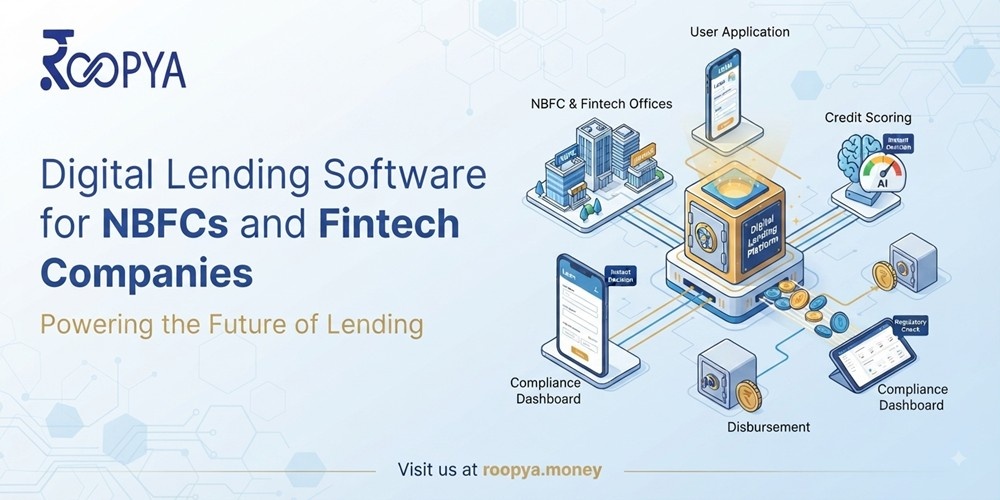
Yet for many lenders, the path to digitisation is unclear. Technology vendors offer a bewildering array of products — loan origination systems, loan management platforms, credit decisioning engines, KYC middleware — with varying levels of integration, configurability, and readiness for the Indian regulatory environment. Understanding what digital lending software actually is, what it should do, and what to look for when selecting a platform is the first step toward making a smart investment.
This guide cuts through the noise. It explains the anatomy of a modern digital lending platform, explores the specific features that matter most for NBFCs and fintech companies, and shows how Roopya’s purpose-built technology is helping Indian lenders go from zero to live in a single day — while maintaining the compliance, scalability, and intelligence required to build a sustainable lending business.
1. What Is Digital Lending Software?
Digital lending software is a technology platform that automates and digitises the complete lifecycle of a loan — from the moment a borrower expresses interest to the final repayment and loan closure. It replaces the manual, document-heavy, branch-dependent processes of traditional lending with automated, data-driven workflows that are faster, cheaper, and more accurate.
At the broadest level, digital lending software encompasses several functional modules that work together:
- Loan Origination: Digital application capture, automated KYC, credit bureau integration, document processing, underwriting, and offer generation.
- Loan Management: EMI scheduling, repayment tracking, prepayment handling, delinquency management, and account statements.
- Collections: Automated reminder workflows, payment gateway integration, NACH mandate management, and recovery tracking.
- Credit Decisioning: Business rule engines, credit scoring models, and AI/ML-based risk assessment.
- Analytics and Reporting: Portfolio dashboards, regulatory reports, collections analytics, and performance monitoring.
For NBFCs and fintech companies specifically, digital lending software must also navigate India’s regulatory framework — RBI guidelines, PMLA KYC norms, credit bureau reporting obligations, and fair practice code requirements — while delivering the speed and simplicity that borrowers now demand. Platforms like Roopya are designed from the ground up to meet this precise set of requirements.
2. Why NBFCs and Fintech Companies Need Purpose-Built Digital Lending Software
NBFCs and fintech lenders face a different set of challenges than large public sector banks. They typically operate with smaller teams, tighter budgets, and a higher imperative to move quickly. At the same time, they face the same regulatory obligations as larger institutions, and they often serve borrower segments — MSMEs, gig workers, rural households, new-to-credit individuals — that require more sophisticated underwriting than a simple bureau score can provide.
Purpose-built digital lending software addresses these realities in ways that generic enterprise software or custom-built solutions cannot:
Speed to Market
A fintech startup or newly-registered NBFC cannot wait nine months for a technology implementation. Every month without a live lending product is revenue lost and market share ceded to competitors. Digital lending platforms designed for rapid deployment — with pre-built integrations, no-code configuration, and pre-configured product templates — allow lenders to go live in days, not quarters. Roopya, for instance, enables a 1-day go-live across its full lending infrastructure stack.
Cost Efficiency
Traditional lending software requires large upfront licence fees, custom development work, and ongoing IT support. For an early-stage NBFC or fintech company, this capital expenditure is often prohibitive. Modern digital lending software typically operates on a SaaS or pay-as-you-use model, eliminating upfront costs and aligning the vendor’s commercial interests with the lender’s growth. Roopya’s pricing follows this model — zero upfront cost, with fees tied to actual usage volume.
Regulatory Compliance
The RBI’s digital lending guidelines, updated in 2022 and continuously evolving, impose specific requirements around KYC, data localisation, fair practice codes, grievance redressal, and transparency in lending. A purpose-built platform for the Indian market handles these requirements natively — updating automatically as regulations change, maintaining complete digital audit trails, and providing the reporting infrastructure needed for bureau submissions and regulatory filings.
Flexibility for Niche Products
Many NBFCs and fintech companies serve specific, well-defined borrower segments — MSME supply chain finance, rural microfinance, buy-now-pay-later for specific sectors, or salary advance products for blue-collar workers. Their lending products often have unusual structures, unconventional data sources, or bespoke underwriting logic. A configurable digital lending platform accommodates this diversity without requiring custom development for every new product or market segment.
3. Core Modules of a Complete Digital Lending Software Platform
3.1 Borrower Onboarding and Digital Application
The borrower’s journey begins with the application experience. In digital lending, this means a mobile-responsive, guided application flow that collects the necessary information with minimal friction. Smart forms with real-time field validation — PAN format checks, Aadhaar digit verification, IFSC lookup, pincode-level geographic validation — reduce errors and incomplete applications that waste underwriting resources.
Roopya provides 20+ pre-configured lending product journeys, covering personal loans, business loans, MSME credit lines, gold loans, microfinance, and more. Each journey can be branded and configured to match the lender’s identity and credit policy without any custom coding.
3.2 Digital KYC and Identity Verification
KYC compliance is the gateway through which every Indian borrower must pass. Manual KYC — photocopied documents, physical presence, branch stamps — is the single biggest source of friction in traditional lending. Digital lending software eliminates this friction entirely through automated, API-driven identity verification.
A comprehensive digital KYC module includes Aadhaar eKYC (OTP-based and biometric), PAN verification through NSDL and UIDAI integration, Digilocker-based document retrieval, video KYC (VKYC) for face-to-face remote verification, and liveness detection to prevent spoofing. Roopya’s platform integrates all these methods through a unified KYC workflow, automatically selecting the appropriate verification path based on the product type, borrower profile, and regulatory requirements.
3.3 Credit Bureau Integration
Credit bureau data is the foundation of modern underwriting. A digital lending platform must integrate seamlessly with all four RBI-licensed credit bureaus — CIBIL TransUnion, Experian, Equifax, and CRIF High Mark — to provide comprehensive coverage across different borrower segments. The platform should automatically trigger bureau pulls on application submission (with appropriate consent mechanisms), parse the bureau report, and feed the structured data into the credit decisioning engine without any manual intervention.
Beyond personal credit reports, sophisticated platforms also support CIBIL MSME Rank for business lending, commercial bureau data for corporate borrowers, and negative list integrations to identify defaulters and fraudsters at the point of application.
3.4 AI-Powered Document Processing
Income documentation — bank statements, salary slips, ITR filings, GST returns, audited financials — is the richest source of underwriting information available for many borrower segments. Yet manually reviewing and extracting data from these documents is extremely time-consuming and error-prone.
AI-powered OCR and NLP technology within digital lending software automates this extraction. Bank statement analyser tools parse months of transaction history in seconds — computing average monthly balances, identifying salary credits, flagging EMI obligations, detecting unusual transactions, and calculating net cash flow. Salary slip analysis extracts gross pay, net take-home, deductions, and employer details. GST return analysis computes turnover trends and seasonality for business borrowers. Roopya’s document AI operates at over 99% accuracy and includes built-in fraud detection — identifying tampered documents, mismatched data, and synthetic identity markers that human reviewers regularly miss.
3.5 No-Code Business Rule Engine and Credit Decisioning
The Business Rule Engine (BRE) is the mechanism through which a lender’s credit policy is operationalised in the digital environment. A well-designed BRE allows credit and risk teams to define eligibility criteria, scorecard cutoffs, exception handling rules, and product-level pricing parameters — all through an intuitive, visual interface that requires no programming knowledge.
This is critically important for NBFCs and fintech companies because credit policy needs to evolve quickly. As portfolio data accumulates, as regulatory requirements shift, or as new market segments are targeted, the ability to modify credit rules in real time — without raising a development ticket and waiting weeks for a release — is a genuine competitive advantage. Roopya’s no-code BRE supports complex, multi-variable rule trees with AND/OR logic, score-based routing, manual review queues, and automated exception escalation.
3.6 Loan Offer Engine and Digital Agreement Execution
Once a credit decision is reached, the platform must generate a personalised loan offer — showing the approved amount, applicable interest rate, tenure options, processing fees, and EMI schedule — and communicate it to the borrower through digital channels. The offer engine must be able to apply product-level and segment-level pricing rules, account for bureau scores and income levels in rate determination, and produce compliant Key Fact Statements (KFS) as required by RBI guidelines.
Digital agreement execution — through Aadhaar OTP-based eSign or Digilocker eSign — completes the loan booking without any physical documentation. eSign integration is fully compliant with the IT Act and produces legally valid agreements that can be stored in the platform’s document management system and retrieved at any time for audit or dispute resolution.
3.7 Loan Management System (LMS)
Once a loan is disbursed, the lending software must track its complete lifecycle. A comprehensive Loan Management System handles EMI scheduling and amortisation, prepayment and part-payment processing, interest accrual and accounting entries, overdue tracking and NPA classification, loan restructuring and moratorium management, and NOC and foreclosure processing. The LMS must also generate customer-facing statements and provide the data infrastructure for regulatory reporting to credit bureaus and internal risk management teams.
3.8 Collections and NACH Management
Repayment management is where loan quality is either preserved or destroyed. Digital lending software automates the entire collections workflow — NACH mandate registration and execution, automated payment reminders via SMS, WhatsApp, and email at configured intervals before and after due dates, failed payment tracking and retry logic, and escalation workflows for delinquent accounts. Roopya’s collections module integrates with all major payment gateways and NACH service providers, enabling fully automated repayment workflows that dramatically reduce the manual collections burden.
3.9 Embedded Finance and API-First Architecture
For fintech companies in particular, the ability to originate loans through partner ecosystems — e-commerce platforms, payroll systems, accounting software, marketplace apps — is a critical growth channel. Digital lending software built on an API-first architecture enables embedded lending: partners can integrate loan origination directly into their user experience through simple API calls, without redirecting users to a separate lender interface. Roopya’s open API layer supports full embedded finance use cases, with partner-specific product configurations, co-branded application journeys, and real-time origination status webhooks.
3.10 Regulatory Compliance and Audit Infrastructure
Every interaction, decision, and data access event in the lending lifecycle must be logged and auditable. RBI’s digital lending guidelines require lenders to maintain comprehensive records of consent, data processing, credit decisions, and customer communications. Roopya’s platform maintains a complete, immutable audit trail across all modules — KYC events, bureau pulls, document accesses, credit decisions, eSign events, disbursement triggers, and repayment records — accessible to authorised users and exportable for regulatory inspections.
4. Account Aggregator Integration: The Next Frontier
The Reserve Bank of India’s Account Aggregator (AA) framework is arguably the most significant development in Indian lending technology in the past decade. AA enables borrowers to share their financial data — bank account statements, investment portfolios, insurance policies, GST data, pension records — with lenders in a consent-based, RBI-regulated, cryptographically secure manner. This eliminates the need for borrowers to share login credentials or upload statement PDFs, and gives lenders access to richer, more reliable financial data than has ever been available before.
For NBFCs and fintech companies serving thin-file borrowers — those with limited or no credit bureau history — AA-enabled underwriting is transformative. By analysing live bank statement data, recurring income patterns, savings behaviour, and investment portfolios, lenders can make accurate credit decisions for borrowers who would previously have been declined on bureau criteria alone. Roopya’s digital lending platform is fully AA-integrated, allowing lenders to leverage the AA ecosystem from day one without building the integration themselves.
5. AI and Machine Learning in Digital Lending
Artificial intelligence is no longer a differentiating feature in digital lending software — it is a baseline expectation. The question is not whether a platform uses AI, but how deeply and intelligently it is integrated.
- Predictive Credit Scoring: ML models trained on historical portfolio data predict default probability with greater accuracy than traditional scorecard models — particularly for borrower segments where bureau data is thin or absent.
- Fraud Detection: AI models identify fraudulent applications by detecting anomalies in application data, document metadata, device fingerprints, and behavioural signals that rules-based systems cannot catch.
- Document Intelligence: Computer vision and NLP models extract, validate, and interpret complex financial documents — bank statements, ITRs, GST returns — at speed and accuracy that no human team can match at scale.
- Portfolio Analytics: Predictive models identify early warning signals of portfolio deterioration, allowing risk managers to intervene before accounts become non-performing.
- Conversational AI: Chatbot and voice-driven application journeys allow borrowers in Tier 2 and Tier 3 markets — and those with limited literacy — to complete loan applications through natural conversation rather than form-filling.
Roopya embeds AI and ML throughout its platform — not as an add-on layer but as a native capability at every stage of the lending workflow.
6. Multi-Product and Multi-Channel Capabilities
The most successful NBFCs and fintech companies do not serve a single product to a single channel. They manage portfolios of loan products — personal credit, MSME working capital, supply chain finance, home loans, or sector-specific credit — across multiple origination channels: direct digital, DSA networks, co-lending partnerships, and embedded finance integrations.
Digital lending software must support this complexity without requiring separate systems for each product or channel. A unified platform with product-level configurability — separate credit policies, document requirements, pricing rules, and workflow configurations for each product — dramatically reduces operational complexity and total cost of ownership. Roopya’s platform supports unlimited product configurations within a single deployment, with channel-specific application journeys, pricing rules, and performance reporting accessible through one integrated dashboard.
7. Co-Lending and BC/DSA Network Management
Co-lending — the RBI-approved model where a bank and an NBFC jointly originate and fund a loan — has emerged as a major growth channel for NBFCs. In a co-lending arrangement, the NBFC handles origination and customer relationship management while the partner bank provides the majority of the funding at lower cost. This requires tight technology integration between the two institutions — shared application flows, credit decision transparency, data exchange protocols, and joint reporting.
Similarly, many NBFCs and fintech companies rely on business correspondent (BC) and DSA networks to reach borrowers in geographies and segments they cannot serve directly. Managing these networks — agent onboarding, performance tracking, commission calculation, lead attribution, and compliance monitoring — requires dedicated technology capabilities that go beyond a simple loan origination system. Roopya’s platform includes full BC/DSA network management functionality, enabling lenders to scale their origination footprint without proportional increases in operational overhead.
8. Security, Data Privacy, and Cloud Infrastructure
Digital lending software handles some of the most sensitive personal and financial data in existence — Aadhaar numbers, PAN details, bank account information, income records, and credit histories. The security architecture of the platform must reflect this sensitivity. Key requirements include end-to-end encryption of data in transit and at rest, role-based access controls with comprehensive activity logging, multi-factor authentication for platform users, data localisation compliance with RBI’s requirements for financial data storage within India, and regular penetration testing and vulnerability assessments.
Roopya operates on a multi-tenant, cloud-native architecture hosted within India, with bank-grade security controls, SOC 2 aligned operational practices, and automated disaster recovery capabilities. Data residency compliance is built into the platform architecture — not bolted on as an afterthought.
9. Choosing the Right Digital Lending Software: A Decision Framework
With dozens of technology vendors competing for the attention of NBFCs and fintech companies, selecting the right digital lending platform requires a structured evaluation approach. Here are the dimensions that matter most:
- Implementation Speed: Can the vendor demonstrate a live deployment within days? Platforms that require six-plus months of implementation work impose enormous opportunity costs.
- No-Code Configurability: Can business users — not just developers — configure credit policies, product parameters, and workflow rules? This determines how quickly the platform can adapt to market changes.
- Integration Depth: How many bureau, KYC, eSign, payment, and accounting integrations are pre-built and production-ready? Every custom integration adds time and cost.
- Regulatory Currency: How quickly does the vendor update the platform when RBI issues new guidelines? Ask for specific examples of recent compliance updates.
- AI Maturity: Is AI genuinely embedded in the platform, or is it a marketing label applied to basic automation? Ask to see document analysis accuracy rates, fraud detection case studies, and ML model performance metrics.
- Pricing Transparency: Is pricing clearly tied to usage metrics, with no hidden setup or annual minimum fees? Pay-as-you-use pricing is the most equitable model for growing lenders.
- Customer References: Can the vendor provide references from NBFCs or fintech companies of similar size, product mix, and regulatory profile? The experience of comparable customers is the most reliable signal of platform fit.
10. Why Roopya Is the Right Digital Lending Software for NBFCs and Fintech Companies
Roopya was built with one mission: to give every Indian NBFC and fintech company access to the same quality of lending technology that the largest banks in the world use — without the enterprise price tag, the twelve-month implementation timeline, or the army of IT consultants.
Here is what makes Roopya different:
- 1-Day Go-Live: 20+ pre-built product journeys, 300+ pre-integrated APIs, and a no-code configuration interface mean you can go from contract signature to processing live applications in 24 hours.
- Truly No-Code: Every credit policy rule, product parameter, workflow step, and pricing configuration can be set and changed by business users without writing code or raising a development ticket.
- AI-Native Platform: Document AI, predictive credit scoring, fraud detection, and conversational loan origination are built into the core platform — not sold as expensive add-ons.
- 300+ Pre-Integrated APIs: All four credit bureaus, all major KYC providers, all leading eSign platforms, NACH service providers, payment gateways, accounting software, and banking APIs are already connected.
- Full Account Aggregator Support: Roopya is a licensed AA ecosystem participant, enabling lenders to leverage consent-based financial data from day one.
- Pay-As-You-Use Pricing: Zero upfront investment. No annual minimum. You pay only for what you process, making enterprise-grade lending technology accessible at every stage of growth.
- Built for India’s Regulatory Reality: PMLA KYC compliance, RBI digital lending guidelines, credit bureau reporting, CERSAI integration, and Fair Practice Code implementation are all built in and continuously updated.
- Trusted by Modern Lenders: IndiaKaLoan, QuickFinShop, Recapita, Findoc, and EazyCredit — among others — run their complete lending operations on Roopya.
If your NBFC or fintech company is ready to move from manual processes to a fully digital, AI-powered lending operation — or if you are building a new lending business from scratch — Roopya provides everything you need to go live fast and scale without limits. Request a free demo today.

