Digital Loan Management System for Banks & NBFCs: The Definitive Guide

The Indian lending sector has never moved faster — or carried more complexity. Banks are expanding into new retail segments. NBFCs are digitising their operations at pace. Microfinance institutions are reaching into geographies that were unbanked just five years ago. At the centre of every successful lending operation, regardless of size or structure, sits one critical piece of technology: a digital loan management system.
A digital loan management system (LMS) is not merely a software upgrade. It is the operational backbone of a modern lending business — managing every loan from the moment it is disbursed until the final repayment is received, and everything in between. Collections, repayment schedules, interest computations, co-lender reconciliations, regulatory reporting, borrower communications, and portfolio analytics — all of it flows through the LMS.
Start Free Trial
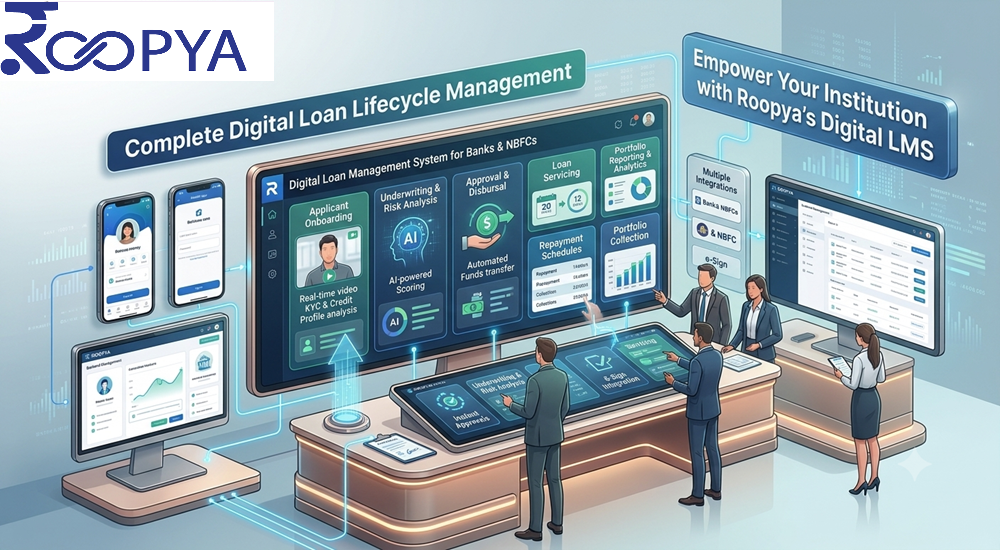
This guide is written for lenders — banks, NBFCs, MFIs, housing finance companies, and fintech lenders — who want to understand what a digital loan management system does, what features separate a world-class platform from a mediocre one, and how Roopya’s next-generation LMS is helping modern lenders manage portfolios of any size with unprecedented efficiency and control.
1. What Is a Digital Loan Management System?
A digital loan management system is a software platform that manages the post-disbursement lifecycle of a loan. Once a borrower has been approved and funds have been released, the LMS takes over — tracking every repayment, calculating interest and penalties, managing escrow and co-lending arrangements, handling prepayments, restructuring, and ultimately closing the loan account when the final payment is received.
The scope of a modern digital LMS goes well beyond simple ledger-keeping. It encompasses borrower-facing self-service portals, automated repayment reminders via SMS and WhatsApp, intelligent collections workflows for delinquent accounts, regulatory reporting for RBI submissions, CERSAI filings, GST calculations, and deep analytics dashboards that give portfolio managers real-time visibility into risk, performance, and profitability.
In the Indian context, a digital loan management system must also handle the unique complexity of the domestic market — multiple repayment instruments (NACH mandates, UPI AutoPay, NEFT, cheques), co-lending partnerships with banks, priority sector lending tracking, bureau reporting to all four credit bureaus, and a regulatory environment that is continuously evolving.
Roopya’s LMS is built for exactly this complexity. It is a cloud-native, no-code platform designed specifically for the Indian market — handling everything from microfinance group loans to large-ticket commercial credit on a single, unified system.
2. Why Banks and NBFCs Need a Digital Loan Management System Now
The case for digitising loan management has never been stronger. Consider the challenges facing lenders who still rely on manual or semi-manual processes:
- Repayment tracking errors: Manual tracking of thousands of EMIs across multiple products introduces reconciliation errors that are costly to identify and fix, and that create regulatory risk when accounts are incorrectly categorised as NPA or standard.
- Collections inefficiency: Without an automated collections system, follow-up on overdue accounts is inconsistent, resource-intensive, and often too slow to prevent accounts from slipping into deeper delinquency buckets.
- Co-lending complexity: Co-lending arrangements between NBFCs and banks require precise, real-time reconciliation of disbursements, repayments, and interest splits. Manual processes are simply not equipped to handle this at scale.
- Regulatory pressure: RBI’s evolving guidelines on NPA recognition, restructuring norms, and fair lending practices demand digital audit trails and real-time reporting that manual systems cannot provide.
- Borrower experience: Digital-native borrowers expect self-service repayment portals, instant receipts, WhatsApp-based reminders, and 24/7 access to their loan account information. Legacy systems cannot deliver this.
- Portfolio growth bottleneck: As a portfolio grows — from hundreds of loans to thousands to lakhs — manual management becomes mathematically impossible. A digital LMS scales automatically with your portfolio without requiring proportional growth in headcount.
The lenders who invest in a robust digital loan management system today are building an operational foundation that allows them to grow without friction, serve borrowers better, and maintain regulatory compliance without a compliance team that grows in lockstep with their portfolio.
3. Core Modules of a World-Class Digital Loan Management System
3.1 Loan Account Setup and Disbursement Management
The LMS life cycle begins the moment a loan is approved and ready for disbursement. A well-designed digital loan management system automatically creates the loan account — pulling borrower details, loan terms, interest rates, and tenure from the origination system — and generates a complete, legally compliant repayment schedule before a single rupee is disbursed.
Disbursement management within the LMS handles single or tranche-based disbursements, integrates with payment gateways and banking APIs for real-time fund transfers, and generates disbursement vouchers and receipts automatically. For co-lending arrangements, the system splits disbursement amounts between the NBFC and bank partner according to the agreed ratio and records both legs of the transaction with complete audit trails.
Roopya’s LMS integrates with all major Indian payment infrastructure — NEFT, RTGS, IMPS, and UPI — for seamless, real-time disbursements, with automatic reconciliation against bank statements.
3.2 Repayment Schedule Management and EMI Tracking
At the heart of any loan management system is its ability to accurately compute and track repayment schedules. Modern LMS platforms support multiple amortisation methods — flat rate, reducing balance (monthly and daily), bullet repayments, step-up and step-down EMI structures, and balloon payment arrangements — with the ability to recompute schedules dynamically when prepayments, restructurings, or interest rate changes occur.
Roopya’s LMS handles all standard amortisation methods as well as complex structures common in MSME and agricultural lending — moratorium periods, seasonal repayment schedules, and bullet principal repayments with periodic interest servicing. Every schedule change is versioned and logged, providing a complete audit trail for regulatory scrutiny.
3.3 Multi-Channel Payment Collection
A digital loan management system must accept repayments through every channel a borrower might use. Roopya’s LMS is pre-integrated with NACH (National Automated Clearing House) for mandate-based auto-debits, UPI AutoPay for recurring digital payments, NEFT/RTGS for large-ticket repayments, payment gateways for online payments via the borrower portal, and cheque clearing through MICR and CTS systems.
When a payment is received through any channel, the LMS automatically allocates it — first to overdue interest and penalties, then to principal, then to future interest according to the agreed allocation logic — and generates an instant payment receipt delivered to the borrower via SMS, email, or WhatsApp.
3.4 Interest, Fee, and Penalty Computation
Accurate computation of interest, processing fees, prepayment charges, late payment penalties, and GST is one of the most technically demanding aspects of loan management. Errors in computation expose lenders to borrower disputes, regulatory sanctions, and financial losses. A robust digital loan management system handles all these calculations automatically — applying the correct rate logic for each product, each payment event, and each borrower scenario.
Roopya’s computation engine handles daily accrual accounting, multiple interest rate types (fixed, floating, hybrid), penal interest on overdue amounts, foreclosure charges with GST, and GST on processing fees — all configurable through a no-code interface without developer intervention.
3.5 NPA Management and Provisioning
RBI’s asset classification norms require lenders to continuously monitor loan accounts and classify them into Standard, Special Mention Account (SMA-0, SMA-1, SMA-2), Sub-Standard, Doubtful, and Loss categories based on days past due (DPD). A digital loan management system automates this classification — updating asset quality buckets daily, calculating provisioning requirements, and alerting risk managers when accounts move between buckets.
Roopya’s LMS generates daily NPA reports, automated SMA flag alerts, and provisioning schedules that are directly exportable for RBI reporting. When RBI guidelines change — as they have multiple times in recent years — Roopya’s platform is updated centrally, ensuring every lender on the platform is always operating under the current regulatory framework.
3.6 Collections and Recovery Management
An intelligent collections module is what separates a truly powerful digital loan management system from a basic loan accounting tool. Roopya’s collections engine uses AI-driven segmentation to categorise delinquent borrowers based on their risk profile, payment history, and behavioural data — then automatically assigns the optimal collection strategy for each segment.
For early-stage delinquency (SMA-0), automated reminders via SMS, WhatsApp, and IVR are triggered at configured intervals. For deeper delinquency, collection cases are assigned to field agents through the LMS’s agent management module, complete with geo-tagged visit records and digital payment collection receipts. For severe delinquency, legal action workflows, SARFAESI notice generation, and arbitration case management are all available within the system.
The result is a collections operation that is faster, more consistent, and significantly more effective than manual processes — typically improving recovery rates by 40–60% compared to manual collections.
3.7 Foreclosure and Prepayment Management
Borrowers who wish to close their loans early or make part-prepayments create a complex computation challenge — especially when prepayments affect the EMI structure, outstanding principal, and accrued interest in different ways depending on the lender’s policy. A digital loan management system handles foreclosure and prepayment requests automatically — computing the exact payoff amount including outstanding principal, accrued interest to date, prepayment charges, and applicable GST — and generating a no-dues certificate immediately upon receipt of the final payment.
3.8 Co-Lending and Partnership Management
Co-lending — where a bank and NBFC jointly originate and fund a loan — has become one of the most important structural trends in Indian lending since RBI’s Co-Lending Model (CLM) framework was introduced. Managing co-lending relationships requires precise tracking of each partner’s share of the outstanding principal, interest income, repayments, and NPA provisions.
Roopya’s LMS has a dedicated co-lending module that automatically splits every financial event — disbursements, repayments, interest accruals, prepayments, and defaults — between lending partners according to the agreed ratio, with complete partner-level reporting and reconciliation tools built in.
3.9 Loan Restructuring and Moratorium Management
Economic stress — whether from a global pandemic, a natural disaster, or individual borrower circumstances — sometimes requires lenders to modify the terms of an existing loan. A digital loan management system must handle restructuring efficiently: extending tenure, reducing EMIs, granting moratoriums, capitalising interest, or changing repayment dates — all while maintaining complete records of the original terms and every subsequent modification.
Roopya’s LMS supports all standard restructuring workflows, generates regulatory-compliant modification letters, and automatically recomputes amortisation schedules post-restructuring with full version history retained for audit purposes.
3.10 Regulatory Reporting and Compliance
Regulatory reporting is one of the most time-consuming and high-stakes functions in lending operations. Monthly RBI reporting, quarterly CERSAI filings, daily NPA recognition, credit bureau reporting across CIBIL, Experian, CRIF, and Equifax, GST returns, TDS deductions and filings, and priority sector lending tracking — all of these require accurate, timely data that is directly derived from loan account records.
Roopya’s LMS generates all regulatory reports automatically — formatted to the exact specifications required by each regulator and bureau. Lenders no longer need a large compliance team manually extracting data from disparate sources; the LMS does it automatically, on schedule, with zero manual intervention.
4. Advanced Features That Set Leading Digital LMS Platforms Apart
Portfolio Analytics and Business Intelligence
A digital loan management system that only tracks individual loan accounts is leaving enormous value on the table. Portfolio-level analytics — which products are performing, which geographies carry the highest delinquency, which borrower segments are most profitable, what the portfolio’s expected credit loss (ECL) exposure is — are essential for strategic decision-making. Roopya’s LMS includes a comprehensive analytics layer with real-time dashboards, drill-down portfolio reports, vintage analysis, and predictive delinquency models that alert portfolio managers to emerging risk before it becomes a problem.
Borrower Self-Service Portal
Modern borrowers expect to manage their loan accounts digitally — checking outstanding balances, downloading statements, making payments, requesting foreclosure quotes, and raising service requests — without calling a customer service line. Roopya’s LMS includes a branded borrower self-service portal that delivers all of these capabilities, reducing inbound call volumes by up to 70% and dramatically improving borrower satisfaction scores.
Automated Communication Engine
Timely, relevant communication is one of the most powerful tools a lender has for maintaining repayment discipline and building borrower loyalty. Roopya’s LMS includes an automated communication engine that sends pre-configured messages — EMI reminders, payment confirmations, overdue notices, restructuring updates, foreclosure quotes, and account statements — across SMS, email, WhatsApp, and push notification channels, triggered automatically by account events.
Early Warning System Integration
An early warning system (EWS) monitors real-time signals — payment behaviour changes, credit bureau enquiry spikes, GST filing gaps, utility payment irregularities — to flag accounts showing early signs of stress before they become formally delinquent. Roopya’s digital loan management system integrates natively with its EWS module, triggering proactive intervention workflows the moment a risk signal is detected.
5. Digital Loan Management System for Banks vs. NBFCs: Key Differences
While banks and NBFCs share many LMS requirements, there are important differences that a digital loan management system must accommodate:
- Regulatory Framework: Banks operate under the Banking Regulation Act and full RBI prudential norms; NBFCs are regulated under a separate NBFC Master Direction framework with different provisioning and reporting requirements. The LMS must handle both.
- Priority Sector Lending (PSL): Banks must meet PSL targets. The LMS must tag loans by PSL category and generate quarterly PSL achievement reports.
- Co-Lending: NBFCs are the primary co-lending partners for banks. The LMS must handle both the NBFC’s and the bank’s view of co-lent portfolio.
- Funding Instruments: Banks fund loans from deposits; NBFCs fund from NCDs, bank borrowings, and securitisation. The LMS must track the liability side as well as the asset side for ALM reporting.
- Product Complexity: Banks typically have more complex product sets — home loans with linked savings accounts, overdraft facilities, and multi-purpose credit lines — that require more sophisticated LMS capabilities.
Roopya’s platform is designed to handle all of these nuances — configurable by the lender through a no-code interface without requiring custom development for each entity type.
6. How Roopya’s Digital Loan Management System Works
Roopya’s LMS is a cloud-native, no-code platform deployed on a secure, RBI-compliant Indian cloud infrastructure. Here is how the end-to-end flow works for a typical lender:
- Loan Handoff from LOS: When a loan is approved and disbursed in Roopya’s Loan Origination System, the loan account is automatically created in the LMS with all terms, borrower details, and disbursement records transferred in real time — no manual data entry required.
- Amortisation Schedule Generation: The LMS computes the complete repayment schedule immediately, factoring in the loan amount, interest rate, tenure, moratorium (if any), and applicable fees. The schedule is available to both the lender and the borrower instantly.
- NACH Mandate Setup: For EMI-based products, the LMS automatically triggers the NACH mandate registration process, sending the mandate form to the borrower digitally for e-signature and submitting it to the bank electronically.
- Automated Repayment Processing: On each due date, the LMS presents the mandate for debit, processes the incoming payment, allocates it correctly across interest, principal, and fees, and updates the loan account in real time.
- Dynamic Account Monitoring: The LMS continuously monitors each account’s DPD status, updating SMA and NPA classifications daily and triggering the appropriate collections workflow for any account that moves into delinquency.
- Regulatory Reporting: At the end of each month, quarter, and year, the LMS automatically generates all required regulatory reports — RBI, CERSAI, credit bureaus, GST — formatted and ready for submission.
- Portfolio Dashboards: Real-time portfolio dashboards give management a live view of AUM, collection efficiency, NPA levels, vintage performance, and product-level profitability at all times.
7. Benefits of Implementing a Digital Loan Management System
Operational Efficiency at Scale
The most immediate benefit of a digital loan management system is the dramatic reduction in manual effort required to manage a growing portfolio. Tasks that once required a team of operations staff — repayment tracking, interest computation, payment allocation, NPA classification, report generation — are fully automated. Lenders on Roopya’s platform consistently report 60–70% reductions in loan operations headcount requirements as their portfolios scale.
Reduced Credit Losses
Early warning signals, automated collections workflows, and intelligent borrower segmentation all contribute to lower credit losses. Roopya’s platform consistently delivers 40–60% better collection efficiency compared to manual operations, directly improving the lender’s NPA ratio and profitability.
Regulatory Compliance Without Risk
Manual compliance processes are inherently prone to error and delay. An automated digital loan management system eliminates this risk — every regulatory obligation is met on time, every time, with complete audit trails that satisfy even the most rigorous regulatory scrutiny. When RBI guidelines change, Roopya’s central update mechanism ensures all lenders on the platform are compliant without any action required on their part.
Superior Borrower Experience
Digital-first borrowers — which now constitute the majority of new loan applications — expect a seamless, self-service experience throughout their loan tenure. Roopya’s borrower portal and automated communication engine deliver this experience at zero marginal cost, improving customer satisfaction scores and reducing voluntary prepayments from borrowers who choose competitors offering better digital experiences.
Real-Time Visibility and Control
Portfolio managers who previously waited for month-end reports to understand their portfolio’s health now have real-time visibility into every dimension of performance. Instant dashboards, drill-down analytics, and predictive risk models give management the information they need to make better decisions faster — whether that means tightening underwriting criteria in a deteriorating geography or accelerating collections efforts for a specific product.
Faster and Cheaper Audits
Regulatory and internal audits of a lender’s loan portfolio are dramatically simpler when all loan account records, payment histories, communications, and policy decisions are stored in a centralised, searchable digital system. What once took audit teams weeks of manual document gathering can be completed in hours with Roopya’s LMS.
8. What to Look for When Choosing a Digital Loan Management System
- Cloud-Native Architecture: Avoid on-premise solutions that require expensive hardware, IT teams, and upgrade cycles. A cloud-native LMS scales automatically and is always on the latest version.
- No-Code Configuration: Business users — not developers — should be able to configure loan products, interest types, fee structures, and collections workflows. No-code platforms dramatically reduce time-to-market for new products.
- Pre-Built Regulatory Compliance: The LMS should come with RBI-compliant NPA classification, credit bureau reporting, CERSAI integration, and GST computation built in — not as expensive add-ons.
- Multi-Product Support: A single LMS that handles personal loans, business loans, MFI loans, co-lent portfolios, and home loans is far simpler to manage than multiple specialised systems.
- Integration Ecosystem: The LMS must integrate seamlessly with your LOS, core banking system, payment gateways, accounting software, and bureaus. Pre-built integrations dramatically reduce implementation time.
- Scalability: Ensure the platform can handle your portfolio at 10x its current size without degradation in performance or cost structure.
- Analytics and Reporting: Portfolio analytics, vintage analysis, ECL modelling, and automated regulatory reporting should be built in — not licensed separately.
- Vendor Track Record: Choose a vendor with demonstrated experience in the Indian lending market, with reference customers you can speak to.
9. The Future of Digital Loan Management: What’s Coming Next
The digital loan management system of tomorrow will be significantly more intelligent and interconnected than today’s best platforms. Several converging trends are shaping the future:
Account Aggregator-Powered Monitoring: The Account Aggregator framework will enable LMS platforms to continuously monitor a borrower’s financial health — bank balances, investment values, insurance policies — in real time, with the borrower’s consent. This will transform early warning systems from reactive to truly predictive.
Embedded Collections: Rather than chasing borrowers through calls and notices, next-generation LMS platforms will embed repayment directly into the borrower’s financial ecosystem — auto-debiting from salary accounts, integrating with UPI payment flows, and enabling one-tap repayments from WhatsApp.
AI-Driven Restructuring: Machine learning models will assess each distressed borrower’s individual circumstances — income shocks, seasonal patterns, sector trends — and automatically recommend the optimal restructuring solution, improving recovery rates while maintaining borrower relationships.
Real-Time Regulatory Reporting: As regulators move toward real-time data submissions (the RBI’s DAKSH supervisory system is an early example), LMS platforms will need to submit data continuously rather than in monthly batches. Roopya’s API-first architecture is already built for this future.
10. Why Roopya Is the Best Digital Loan Management System for Indian Lenders
Roopya’s digital loan management system was built from the ground up for the Indian lending market. It is not a global platform retrofitted for Indian compliance; it is an Indian-first platform that understands the unique requirements of lending in India — its regulations, its payment infrastructure, its borrower demographics, and its co-lending ecosystem.
- 1-Day Go-Live: Pre-built loan product templates and a no-code configuration interface mean most lenders are live within 24 hours of onboarding — not six months.
- 300+ Pre-Integrated APIs: NACH, UPI AutoPay, NEFT, RTGS, all four credit bureaus, CERSAI, GST APIs, and 290+ more are pre-connected — no custom integration work required.
- Truly No-Code: Credit managers configure loan products, interest structures, collections workflows, and regulatory reports through an intuitive visual interface — no developers needed.
- Pay-As-You-Use: Zero upfront licence fee. You pay based on portfolio size and usage, making Roopya equally accessible for a startup NBFC and a large bank.
- AI-Powered Collections: Intelligent borrower segmentation, optimal contact timing, and multi-channel collection automation consistently deliver 40–60% better recovery rates.
- Full RBI Compliance: NPA classification, provisioning, credit bureau reporting, CERSAI, and all regulatory reports are automated and always current.
- Proven at Scale: IndiaKaLoan, QuickFinShop, Recapita, Findoc, EazyCredit, and Loan Seva manage their portfolios on Roopya — and they chose Roopya for its reliability, speed, and depth of functionality.
If you are ready to replace manual processes, spreadsheets, or legacy systems with a modern digital loan management system that scales with your ambition, Roopya offers a free demo and a live portfolio walkthrough. See exactly how your loan management would look on the platform — with no obligation and no upfront cost.

