Free Loan Management System / Software Download: The Complete Guide for Smart Lenders

Every lender—from a newly licensed NBFC to an established microfinance institution—reaches the same crossroads early in their journey: how do I manage loans professionally without spending a fortune on enterprise software? The search for a free loan management software download is one of the most common queries in the Indian lending technology space, and for good reason. Managing loan portfolios manually—in spreadsheets, WhatsApp threads, or paper registers—is not just inefficient; it is a compliance risk, a growth bottleneck, and a borrower experience disaster waiting to happen.
This guide is written for decision-makers who want honest, practical answers. We will explain what loan management software does, why ‘free download’ is often a misleading promise, what to look for in a zero-cost or low-cost LMS, and how Roopya’s cloud-based platform delivers everything a modern lender needs — completely free to start, with no downloads, no hidden fees, and no long-term lock-in.
Start Free Trial
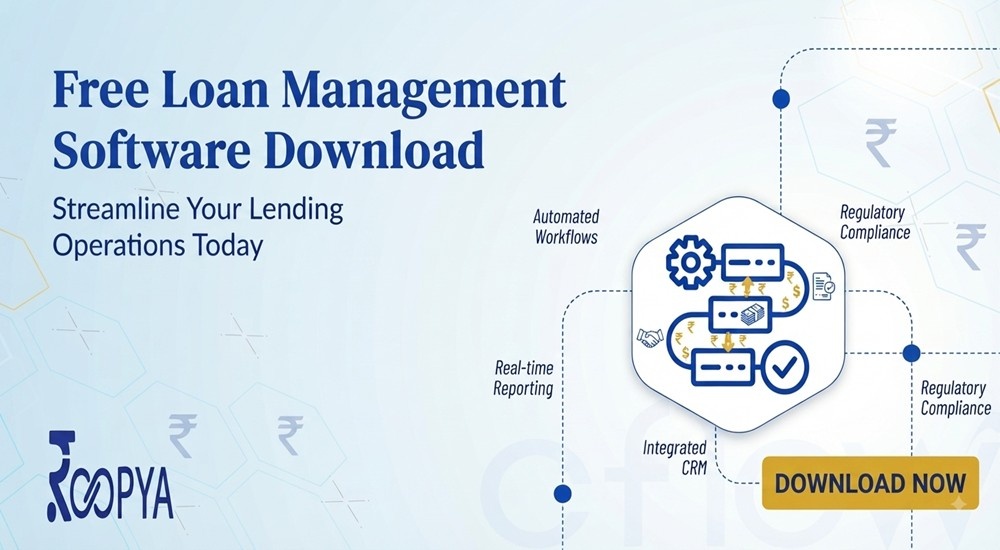
Whether you are an NBFC looking to digitise your operations, a fintech building a new lending product, or an MFI scaling into new geographies, this guide will help you make an informed decision and avoid the traps that derail many lenders in their search for free loan software.
1. What Is a Loan Management System (LMS)?
A Loan Management System (LMS) is a software platform that automates and manages the lifecycle of a loan—from origination and disbursement through repayment tracking, collections, and closure. It is the operational engine of a lending business, replacing manual ledgers and spreadsheets with a structured, automated, and auditable digital system.
A complete loan management system typically covers the following functional areas:
- Loan origination and application processing
- Borrower onboarding, KYC, and document management
- Credit underwriting and decisioning
- Loan sanctioning, agreement generation, and disbursal
- EMI scheduling, repayment tracking, and ledger management
- Collections management, overdue alerts, and NPA tracking
- Accounting integration and regulatory reporting
- Customer communication—SMS, WhatsApp, email notifications
Without an LMS, lenders rely on spreadsheets, manual entries, and fragmented tools. This creates data silos, calculation errors, compliance gaps, and—most critically—an inability to scale. A lender processing 50 loans a month on a spreadsheet cannot manage 500 loans a month without hiring disproportionately or investing in technology. The right LMS solves this scaling problem definitively.
2. Why Are Lenders Searching for ‘Free Loan Management Software Download’?
The search intent behind this query reveals a real pain point. Early-stage NBFCs are often constrained by capital. Newly licensed MFIs need to prove their model before committing to expensive enterprise software. Small co-operative lenders operate on tight margins. And many lenders—even established ones — are simply unaware that world-class loan management technology is now available at zero upfront cost through cloud-based delivery models.
There are broadly four types of lenders searching for free loan management software:
- Newly licensed NBFCs and MFIs who need an operational platform immediately but have limited initial capital for technology investment.
- Established lenders who are unhappy with their current LMS — often legacy, expensive, or inflexible — and want to evaluate alternatives before committing.
- Fintech entrepreneurs who are building a lending product and want to test their credit model and workflows before going to market.
- Co-operative societies, credit unions, and informal lenders who are digitizing for the first time and need an accessible starting point.
For all of these profiles, the ideal solution is not a traditional ‘free download’ of old software—it is a modern, cloud-based loan management platform with zero upfront cost, free trial access, and a pay-as-you-grow pricing model that scales with the business.
3. The Problem with Traditional ‘Free Download’ Loan Software
When lenders search for free loan management software to download, they often find one of three things—and none of them are ideal:
3.1 Outdated Open-Source Software
There are several open-source loan management tools available for free download—platforms like Mifos, Apache Fineract, and similar community-driven projects. These tools were built for specific use cases (often microfinance in developing markets) and require significant technical expertise to install, configure, and maintain. They are not designed for the Indian regulatory environment—they lack RBI-compliant bureau integrations, eKYC support, Aadhaar-based eSign, and GST/accounting integrations that Indian lenders require. Running them requires a dedicated IT team, server infrastructure, and ongoing technical maintenance. For most lenders, the ‘free’ label masks substantial hidden costs.
3.2 Freemium Tools with Severe Limitations
Some software vendors offer a ‘free’ version of their LMS with extremely limited functionality—often capped at a small number of loans, lacking key features like bureau integration or reporting, and requiring upgrade to paid tiers for anything meaningful. These tools serve as marketing funnels rather than genuine operational platforms.
3.3 Pirated or Cracked Software
Some search results lead to pirated versions of paid LMS software. Beyond being illegal, pirated software carries serious risks—malware, data security vulnerabilities, no updates or support, and regulatory non-compliance. No responsible lender should operate on pirated software, particularly when handling borrower data and financial transactions.
The good news is that the landscape has fundamentally changed. Cloud-based, SaaS loan management platforms like Roopya have made world-class LMS technology genuinely accessible—with zero upfront costs, no downloads, no server maintenance, and pricing that only kicks in at meaningful scale.
4. Cloud-Based LMS vs. Downloadable Software: Why the Cloud Wins
Understanding the difference between traditional downloaded software and modern cloud-based LMS is essential for any lender making this decision.
- No Installation Required: Cloud-based LMS runs entirely in the browser. There is nothing to download, install, or configure. You can be operational within hours of signing up—not weeks.
- Automatic Updates: Regulatory requirements, bureau APIs, and technology standards change constantly. A cloud-based platform is updated automatically by the provider. Downloaded software requires manual updates and often lags significantly behind regulatory changes.
- No Infrastructure Cost: Downloaded software requires servers, database management, backup systems, and IT support. Cloud-based LMS is hosted entirely by the provider—you pay nothing for infrastructure.
- Security and Compliance: Reputable cloud LMS providers like Roopya maintain enterprise-grade security—data encryption, access controls, audit trails, and regular security audits. Downloaded software security depends entirely on your own IT team’s capability.
- Scalability: Downloaded software must be scaled by adding more server capacity—a capital expense. Cloud platforms scale automatically with demand at no additional infrastructure cost.
- Anywhere Access: Cloud-based LMS is accessible from any device, anywhere—desktop, tablet, or mobile. This is critical for lenders with field agents, multiple branches, or remote operations.
For virtually every lending use case—from a single-branch NBFC to a national MFI—a cloud-based loan management system offers dramatically superior economics, functionality, and compliance compared to any downloadable alternative.
5. What Does a World-Class Free Loan Management System Include?
Not all ‘free’ LMS offerings are created equal. Here is what a genuinely useful, enterprise-ready loan management system should include—and what Roopya delivers at zero upfront cost:
5.1 Complete Loan Origination and Application Management
The LMS should handle the full loan application journey—digital forms, document upload, KYC verification, credit bureau checks, and automated credit decisioning. Roopya includes 20+ pre-configured loan product journeys, covering personal loans, business loans, MSME credit, microfinance, gold loans, home loans, and more. There is no need to build application workflows from scratch.
5.2 Automated KYC and Regulatory Compliance
A compliant loan management system must handle Aadhaar eKYC, PAN verification, CERSAI filings, and credit bureau reporting. These are not optional features—they are regulatory requirements for every licensed lender in India. Roopya comes pre-integrated with all major KYC providers and credit bureaus (CIBIL, Experian, CRIF, and Equifax), with compliance features updated automatically as RBI guidelines evolve.
5.3 Loan Ledger and Repayment Management
At its core, an LMS must accurately maintain loan ledgers—principal outstanding, interest accrual, fees, penalties, and repayment history—for every loan in the portfolio. Roopya’s loan ledger engine handles complex amortization schedules, bullet repayments, flexi-EMI structures, and moratorium periods with complete accuracy and full audit trails.
5.4 Collections and NPA Management
Managing overdue accounts is one of the most operationally intensive parts of lending. A good LMS automates collection workflows—generating overdue notices, triggering field agent assignments, managing settlement negotiations, and tracking NPA aging. Roopya’s collections module reduces Days Past Due (DPD) and improves collection efficiency through intelligent, automated workflows.
5.5 No-Code Business Rule Engine (BRE)
Credit policy configuration should be in the hands of business users—not developers. Roopya’s no-code BRE allows credit and risk teams to define, test, and deploy credit policies visually—without writing a single line of code. Rules can be updated in real time as market conditions or portfolio performance data warrants.
5.6 AI-Powered Document Processing
Manual document verification is a bottleneck. Roopya’s AI engine automatically extracts and validates data from income proofs, bank statements, GST returns, salary slips, and ITR documents—with accuracy exceeding 99%. Fraud signals and document anomalies are flagged automatically, reducing risk and processing time simultaneously.
5.7 Automated Notifications and Borrower Communication
Borrowers expect timely communication at every stage of their loan journey. Roopya’s communication engine automates SMS, WhatsApp, and email notifications for application status updates, EMI reminders, payment confirmations, and overdue alerts—keeping borrowers informed and reducing inbound support queries.
5.8 Accounting Integration and Financial Reporting
A complete LMS must integrate with accounting systems and generate the financial reports that management, investors, and regulators require. Roopya integrates with leading accounting platforms and generates automated reports—portfolio performance, aging analysis, collection efficiency, disbursement schedules, and regulatory filings—directly from the platform.
5.9 Multi-Channel Origination Support
Modern lenders originate through multiple channels—direct digital, DSA/agent networks, embedded finance partnerships, and co-lending arrangements. Roopya’s unified platform handles all channels from a single backend, with channel-specific workflows, pricing, and reporting.
5.10 Scalable Infrastructure Without Additional Cost
As your loan portfolio grows, your LMS must grow with it—without requiring additional infrastructure investment or complex migrations. Roopya’s cloud infrastructure scales automatically, handling volumes from 100 loans to 100,000 loans with the same platform, the same performance, and no infrastructure overhead.
6. Roopya: The Smartest Free Loan Management System for Indian Lenders
Roopya is not a stripped-down freemium tool or an outdated open-source download. It is a full-featured, no-code, cloud-based lending infrastructure platform built specifically for the Indian market—and it is free to start, with no upfront costs and a pay-as-you-use model that scales with your business.
Here is what makes Roopya the right choice for lenders who have been searching for free loan management software:
Go Live in One Day
Traditional LMS implementations take months and cost lakhs in setup fees. Roopya eliminates this entirely. Pre-built loan product templates, plug-and-play integrations, and a no-code configuration interface mean most lenders can be fully operational—with live applications being processed—within 24 hours of signing up. There is nothing to download, no servers to configure, and no developers required.
300+ Pre-Integrated APIs — Ready Out of the Box
Bureau integrations, KYC providers, eSign platforms, payment gateways, accounting tools, GST data providers, and bank account verification services—all 300+ integrations are pre-built into Roopya. There is no custom development required to connect these services. For lenders building their tech stack from scratch, this is equivalent to months of development work delivered instantly.
Truly No-Code Configuration
Every aspect of Roopya’s platform—loan product configuration, credit policy rules, application workflows, communication templates, and reporting dashboards—is configurable through an intuitive visual interface. Business users can make changes independently, without involving a technical team. This is not marketing language; it is a genuine architectural commitment that Roopya has maintained across every product update.
Pay-As-You-Use Pricing — Zero Upfront Cost
Roopya’s pricing model is designed to align with a lender’s growth journey. There are no upfront licence fees, no mandatory annual contracts, and no large implementation costs. Lenders pay based on actual usage—meaning a new NBFC processing its first 50 loans pays almost nothing, while a mature lender processing thousands of loans a month scales their usage and cost proportionally. This is the truest form of ‘free to start’ in the lending technology market.
AI and Machine Learning Throughout
Roopya is not a traditional rule-based LMS with AI bolted on as an afterthought. Machine learning powers credit scoring, document analysis, fraud detection, and collection propensity modelling throughout the platform. These capabilities improve continuously as the platform processes more data—making Roopya more valuable the longer you use it.
RBI Compliance — Always Current
The regulatory environment for lending in India evolves constantly. New KYC norms, bureau reporting requirements, data localization rules, and Fair Practice Code updates—keeping a downloaded LMS compliant with all of these changes requires constant effort and often external expertise. Roopya’s cloud-based model means compliance updates are pushed automatically, keeping your platform current with every regulatory change without any action on your part.
Trusted by India’s Modern Lenders
IndiaKaLoan, QuickFinShop, Recapita, Findoc, EazyCredit, and a growing cohort of NBFCs and fintech lenders across India run their loan management operations on Roopya. These are not pilot customers or case studies from years ago—they are active users processing live loan portfolios today. Their trust is the strongest validation of the platform’s reliability and capability.
7. How to Get Started with Roopya’s Free Loan Management System
Getting started with Roopya requires no download, no IT infrastructure, and no technical expertise. Here is the process:
- Step 1—Sign Up: Visit roopya.money and register for a free account. No credit card required, no commitment.
- Step 2—Configure Your Loan Product: Use Roopya’s no-code interface to configure your loan product—tenure, interest rate, fees, eligibility criteria, and repayment structure.
- Step 3 — Set Up Your Credit Policy: Define your credit rules in the Business Rule Engine—bureau score thresholds, income criteria, employment type filters, and geographic parameters.
- Step 4—Connect Your Integrations: Enable the KYC providers, credit bureaus, eSign platforms, and payment gateways you need—all pre-integrated and available with a few clicks.
- Step 5 — Go Live: Begin accepting loan applications through your branded digital interface. Process your first application end-to-end within hours of setup.
The entire process—from sign-up to live application processing—can be completed in a single working day. Most lenders are genuinely surprised at how quickly they become operational.
8. Evaluating Free Loan Management Software: A Checklist for Lenders
Whether you are evaluating Roopya or any other loan management system, use this checklist to assess whether the platform truly meets your needs:
- Is it genuinely free to start, or does ‘free’ mean a severely limited demo version?
- Is it cloud-based, or does it require downloading and installing software on your servers?
- Does it comply with Indian regulatory requirements—RBI KYC norms, credit bureau integrations, CERSAI filing, and data localization?
- Does it support the specific loan products you offer—personal loans, business loans, microfinance, or others?
- Is there a no-code configuration option, or will you need a developer for every change?
- What third-party integrations are pre-built? Are all major Indian bureaus, KYC providers, and payment gateways supported?
- How does pricing scale? What does the cost look like at 100 loans per month, 1,000, and 10,000?
- Is there a dedicated support team familiar with the Indian lending regulatory environment?
- What does the customer base look like? Are there active, verifiable customers using the platform for live portfolios?
- How frequently is the platform updated? Is there a public product roadmap or changelog?
9. Common Misconceptions About Free Loan Management Software
Misconception 1: ‘Free software is always low quality’
This was true in the era of desktop software. In the cloud era, the freemium and pay-as-you-use models have enabled best-in-class vendors to offer genuinely high-quality platforms at zero upfront cost. The cost is recovered through volume-based pricing as the customer grows. Roopya is a direct example—enterprise-grade functionality available completely free to start.
Misconception 2: ‘I need to download software to have full control’
The opposite is true in practice. Downloaded software requires you to manage servers, backups, updates, and security — giving you the burden of control without the benefit. Cloud-based LMS gives you full operational control through configuration and APIs while the vendor handles all infrastructure. You control the business logic; Roopya handles the technology infrastructure.
Misconception 3: ‘Free means no customer support’
Roopya provides dedicated onboarding support, product documentation, and customer success management—regardless of your initial usage level. New lenders get the same quality of onboarding support as established portfolio customers.
Misconception 4: ‘Cloud software is less secure than on-premise.’
Leading cloud providers invest far more in security infrastructure than any individual NBFC or MFI could justify. Roopya maintains enterprise-grade data encryption, role-based access controls, complete audit trails, regular security audits, and compliance with Indian data localization requirements. This is a higher security standard than most on-premise deployments.
10. The Future of Loan Management Technology in India
The trajectory of loan management technology in India is unmistakably towards cloud-based, AI-powered, API-first platforms. Several macro trends are accelerating this shift:
- Account Aggregator (AA) Integration: The AA framework allows borrowers to share financial data directly with lenders through a consent-based model. LMS platforms that support AA integration will have a significant underwriting advantage, particularly for thin-file borrowers. Roopya supports AA integration natively.
- Co-Lending Arrangements: RBI’s co-lending framework requires deep technical integration between partner lenders. Cloud-based LMS platforms with open APIs are far better positioned for co-lending than legacy, closed systems.
- Embedded Finance: Lending is increasingly delivered inside non-financial platforms—e-commerce, payroll systems, and B2B marketplaces. This requires an LMS that can be accessed via API without a dedicated borrower portal. Roopya’s API-first architecture is built for this.
- Collections Automation: As MSME and retail lending portfolios grow, intelligent collections automation—using ML-based propensity scoring, automated contact strategies, and digital settlement workflows—will separate efficient lenders from struggling ones.
- Regulatory Technology (RegTech): RBI’s digital lending guidelines, FLDG caps, and ongoing regulatory evolution require lenders to adapt quickly. Cloud-based platforms that update automatically will always be ahead of downloaded software that requires manual updates.
Lenders who build their operations on modern, cloud-based LMS platforms today are investing in infrastructure that will support growth for the next decade. Those who cling to downloadable software or spreadsheets will find the operational and regulatory gap widening uncomfortably fast.
11. Why Roopya Is the Right Choice—Even If You Started Your Search Looking for a Free Download
If you began reading this article looking for free loan management software to download, we hope the picture is now clearer. The ‘download’ model—whether paid or free—carries hidden costs that typically far exceed what a modern cloud-based platform charges. Server infrastructure, IT staff, security maintenance, compliance updates, and integration development all add up to a total cost of ownership that makes so-called ‘free’ downloaded software significantly more expensive than Roopya’s pay-as-you-use model.
Roopya gives you everything you were looking for when you searched for free loan software—zero upfront cost, immediate access, a comprehensive feature set, and the flexibility to grow at your own pace—without any of the hidden costs or risks of the download model.
Go to roopya.money today, sign up for free, and experience what a world-class loan management system feels like. No downloads. No hidden fees. No lock-in. Just the most powerful lending infrastructure platform in India, available from day one.

