Future of Loan Origination Systems: AI, Automation & Analytics

Lending has always been fundamentally about one thing: accurately assessing risk and deploying capital to creditworthy borrowers efficiently. For decades, that process was slow, manual, and deeply subjective — governed by relationship managers, paper-based workflows, and credit committees that could take weeks to reach a decision.
The loan origination system (LOS) transformed that model by digitising the process. But the first generation of digital LOS platforms simply replicated manual workflows on a screen — they were faster, yes, but they were not fundamentally smarter. The next generation is different. Driven by artificial intelligence, end-to-end automation, and deep analytics, the future of loan origination is not just digital; it is intelligent.
Start Free Trial
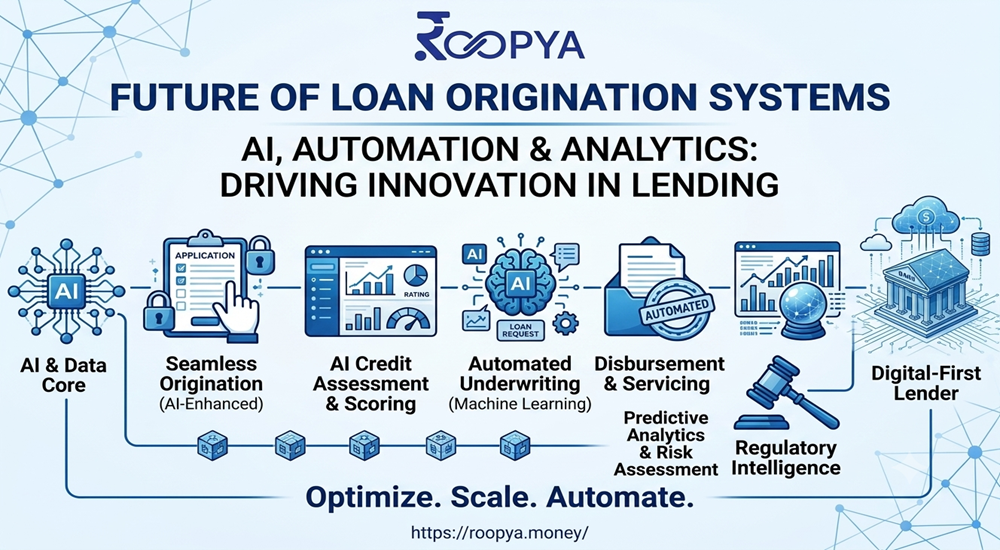
For lenders in India — NBFCs, banks, MFIs, and fintech companies — understanding this trajectory is not optional. The lending market is growing at over 30% annually in digital disbursements, and borrower expectations are being set by the best consumer technology experiences in the world. The lenders who will win the next decade are those investing today in AI-powered, analytics-driven loan origination infrastructure.
This guide explores the forces shaping the future of loan origination systems, the specific technologies driving that change, and how Roopya’s next-generation platform is helping modern lenders get ahead of the curve — today.
1. Where Loan Origination Systems Came From — and Why They Must Evolve
To understand the future, it helps to briefly appreciate the past. Traditional loan origination involved a borrower filling out a paper form, submitting physical documents, waiting for a credit officer to manually verify data, pull a bureau report, and present the case to a credit committee. A personal loan could take two to four weeks from application to disbursement.
The first wave of digital loan origination systems moved this process online. Borrowers could fill digital forms; documents could be uploaded rather than physically submitted; bureau pulls could be triggered electronically. Processing time dropped from weeks to days. But the underlying decisioning logic remained largely rule-based and human-supervised — the software followed rigid if-then logic and still depended on human underwriters for most credit decisions.
The limitations of this model are increasingly apparent in today’s lending environment:
- Borrower expectations have shifted dramatically. Customers who experience instant approvals on consumer apps expect the same from their lender. A 48-hour turnaround, once considered impressive, is now a conversion killer.
- The credit-worthy population is expanding beyond traditional data sources. Hundreds of millions of Indians are creditworthy but have thin or no bureau files — salaried workers paid in cash, small business owners without formal GST registrations, young professionals at the start of their financial lives. First-generation LOS platforms simply cannot assess these borrowers reliably.
- The volume of data available for credit assessment has exploded. Mobile usage patterns, bank transaction data, GST filings, utility payment histories, and social signals all contain meaningful predictive information about credit risk. Rule-based systems cannot synthesise this data at scale.
- Fraud has become more sophisticated. As application processes moved online, so did fraud — with organised rings deploying synthetic identities, manipulated documents, and network-based schemes that simple rule systems cannot detect.
The answer to all of these challenges is a loan origination system built around AI, automation, and analytics — not as add-ons, but as the foundational architecture of the platform.
2. The Role of Artificial Intelligence in Next-Generation Loan Origination
2.1 AI-Powered Credit Scoring Beyond Bureau Data
Traditional credit scoring relies almost entirely on bureau data — payment history, outstanding debt, credit enquiry volume, and credit age. This works reasonably well for borrowers with established credit histories, but it systematically excludes a vast segment of creditworthy individuals who simply have not yet entered the formal credit system.
AI-driven credit scoring changes this equation fundamentally. Machine learning models can synthesise hundreds of variables — including alternative data sources like bank transaction analysis, mobile usage patterns, GST filing consistency, utility payment behaviour, and employment verification signals — to generate highly predictive credit scores for borrowers who would be invisible to traditional bureau-only underwriting.
These models do not just consider more data; they identify non-linear relationships and interaction effects between variables that no human underwriter — and no simple rule set — could detect. The result is credit assessment that is simultaneously more accurate for traditional borrowers and more inclusive for new-to-credit populations.
Roopya’s AI credit engine already incorporates 300+ data signals, bureau scores, and alternative data integrations into its scoring models — with lenders able to configure and calibrate the models against their own portfolio performance data.
2.2 AI-Driven Document Intelligence
Document processing is one of the most labour-intensive stages of traditional loan origination. Income proof, bank statements, salary slips, ITR filings, GST returns, balance sheets — each requires careful reading, data extraction, cross-referencing, and anomaly detection.
Modern AI document intelligence platforms use optical character recognition (OCR) combined with natural language processing (NLP) and computer vision to extract, structure, and verify data from any document format — printed, handwritten, photographed, or scanned — with accuracy levels exceeding 99%.
But the future goes further than extraction. AI systems can now detect document fraud at a level far exceeding human capability: identifying font inconsistencies, digital manipulation artefacts, template reuse across applications, and statistical anomalies in financial data that indicate fabrication or inflation. These capabilities are not theoretical — they are live in Roopya’s document intelligence engine, running on every application processed through the platform.
The downstream impact is significant: document processing time drops from hours to seconds, human reviewer requirements fall dramatically, and fraud detection rates improve substantially — all simultaneously.
2.3 Conversational AI and Guided Application Journeys
The loan application process is inherently complex, and borrower drop-off during the application journey is one of the most persistent challenges in digital lending. Borrowers abandon applications when they are confused about what documents to upload, uncertain about eligibility, or frustrated by forms that do not speak their language.
Conversational AI — chatbots and voice-driven interfaces powered by large language models — is transforming the application experience. Instead of filling a static form, borrowers engage in a natural dialogue that dynamically adjusts based on their responses, explains requirements in plain language, handles multiple Indian languages, and proactively resolves confusion before it leads to abandonment.
For lenders targeting Tier 2 and Tier 3 markets, or reaching low-literacy populations, conversational AI is not just a convenience — it is a prerequisite for reaching these segments at scale. Roopya’s conversational interfaces support multiple regional languages and have achieved 95% borrower satisfaction scores in pilot deployments.
2.4 Predictive AI for Portfolio-Level Decision Making
The value of AI in loan origination extends beyond the individual application. At a portfolio level, AI systems can continuously analyse the relationship between origination-time data signals and eventual loan performance — identifying which variables are truly predictive of default, which borrower segments are performing better or worse than expected, and where credit policy adjustments would improve risk-adjusted returns.
This creates a feedback loop that traditional LOS platforms cannot achieve: each loan originated teaches the system more about what good credit looks like in your specific portfolio, making subsequent decisions progressively more accurate. Roopya’s analytics layer surfaces these insights to credit and risk teams through intuitive dashboards — no data science team required.
3. End-to-End Automation: Removing the Human from the Loop (Where It Makes Sense)
3.1 Straight-Through Processing (STP)
Straight-through processing — the ability to take a loan application from submission to disbursement without any human intervention — is the north star of automated loan origination. For a significant proportion of applications (typically clean profiles with strong bureau scores and verifiable income), STP is already achievable today with the right platform.
Roopya’s no-code Business Rule Engine (BRE) enables lenders to configure the precise conditions under which applications should be auto-approved, auto-rejected, or referred to a human underwriter. Credit teams define the policy; the platform executes it — consistently, at scale, and in real time. Lenders using Roopya report STP rates of 40–70% on their personal loan portfolios, meaning the majority of clean applications never require a human underwriter to look at them.
3.2 Automated KYC and Identity Verification
Know Your Customer verification has historically been one of the most significant bottlenecks in loan origination — requiring physical document submission, branch visits, or expensive manual review. AI-powered automated KYC changes this completely.
Modern automated KYC stacks combine Aadhaar eKYC (biometric and OTP-based), PAN verification through NSDL, Digilocker document retrieval, VKYC (video KYC), and liveness detection to complete full, RBI-compliant KYC verification in under two minutes — entirely digitally. Roopya’s pre-integrated KYC stack covers all of these verification methods, with automatic failover between providers to ensure maximum completion rates.
3.3 Automated Bureau Orchestration
The future of bureau integration is not simply pulling a single CIBIL report. Next-generation loan origination systems orchestrate multi-bureau strategies — pulling reports from CIBIL, Experian, CRIF, and Equifax selectively based on borrower profile, product type, and lender policy, then synthesising the results through a bureau waterfall logic that maximises data quality while minimising bureau costs.
This kind of bureau orchestration — with automatic retry logic, bureau scorecard normalisation, and real-time performance monitoring — is built into Roopya’s platform as a standard feature, not a custom integration project.
3.4 Automated Offer Generation and Pricing
Static loan offers — one rate fits all — are rapidly giving way to risk-based pricing that matches the loan offer to the specific risk profile of each borrower. Automated pricing engines within next-generation LOS platforms compute the optimal offer for each approved application: the right loan amount, tenure, interest rate, and fee structure to maximise acceptance probability while maintaining the lender’s required risk-adjusted return.
This level of personalisation at scale is only possible through automation. Roopya’s offer engine supports configurable pricing bands, risk-based rate adjustments, and promotional pricing rules — all manageable by the lender’s credit team without any developer involvement.
3.5 Digital Agreement Execution and eSign Automation
The final mile of loan origination — agreement execution — has traditionally required physical document printing, courier despatch, wet signatures, and return shipment. Modern loan origination systems automate this entirely through legally valid eSign integrations (Aadhaar OTP-based, Digilocker-based, or DSC-based).
Roopya’s eSign integration supports all major providers, with automatic generation of personalised loan agreements, digital delivery to the borrower, real-time status tracking, and immediate disbursal trigger upon signature completion — all without a single piece of paper.
4. Analytics: Turning Loan Origination Data into Competitive Advantage
4.1 Real-Time Origination Dashboards
In traditional lending operations, understanding how the origination funnel is performing required days of manual reporting. By the time a manager received a report, the data was already stale. Modern loan origination analytics platforms provide real-time visibility into every stage of the origination funnel — application volumes, completion rates, approval rates, decline reasons, processing times, and channel performance — updated continuously.
This real-time visibility enables lenders to identify and respond to operational issues as they happen: a sudden drop in KYC completion rates, an unexpected spike in bureau pull failures, or a conversion dip on a specific product. Roopya’s operational dashboards provide this visibility as a standard feature, with configurable alerts for anomalies that require immediate attention.
4.2 Funnel Analytics and Conversion Optimisation
Every stage of the loan application journey — from initial landing on the application page to final disbursement — represents a potential point of borrower drop-off. Funnel analytics track exactly where borrowers are abandoning the process and quantify the revenue impact of each drop-off point.
Armed with this data, lenders can make targeted interventions: simplifying a document upload step that causes disproportionate abandonment, adding a pre-eligibility check to filter out ineligible borrowers early and save them time, or introducing a save-and-resume feature for applications that are abandoned mid-way. Roopya’s analytics layer provides this funnel visibility across all channels — web, mobile app, and agent interfaces — in a unified view.
4.3 Credit Policy Performance Analytics
Credit policy is not a one-time configuration; it is a living document that should be continuously refined based on portfolio performance. But in most lending organisations, the feedback loop between portfolio performance and credit policy adjustment is measured in months — limited by the speed at which reporting teams can produce vintage analyses and the bandwidth of credit committees to review and update policy.
Next-generation LOS platforms collapse this cycle dramatically. By connecting origination-time data to loan performance outcomes within the same platform, they enable continuous, automated monitoring of credit policy performance — identifying rules that are too conservative (rejecting profitable borrowers), too loose (approving borrowers who are defaulting), or simply misaligned with the current risk environment. Roopya’s credit analytics module provides this vintage analysis and policy performance monitoring as a standard capability.
4.4 Fraud Analytics and Network Intelligence
Individual fraud detection — identifying a single manipulated document or a mismatched identity — is table stakes. The future of fraud analytics in loan origination is network intelligence: identifying coordinated fraud rings by analysing relationships between applications across time and across borrowers.
Network graph analytics can surface patterns invisible to document-level checks: the same mobile number appearing across multiple applications for different identities; a cluster of applications from the same IP address or device; identical bank statement templates used by multiple supposedly unrelated borrowers; or a DSA agent submitting an unusual concentration of applications with strikingly similar financial profiles. Roopya’s fraud intelligence engine applies network analysis to every application, flagging suspicious clusters for human review before any funds are disbursed.
4.5 Regulatory Analytics and Compliance Reporting
Regulatory reporting in lending is increasingly data-intensive. RBI’s Fair Practice Code, credit bureau reporting obligations, CERSAI filings, and periodic regulatory submissions all require accurate, timely data from the origination system. Manual extraction and compilation of this data is both error-prone and resource-intensive.
Modern loan origination analytics platforms automate regulatory reporting by continuously maintaining structured data in the formats required by each regulatory body — so that generating a regulatory submission becomes a one-click operation rather than a multi-day project. Roopya’s compliance module provides automated bureau reporting, CERSAI integration, and configurable regulatory report generation as standard features.
5. The Account Aggregator Revolution and Its Impact on Loan Origination
India’s Account Aggregator (AA) framework — a consent-based financial data sharing ecosystem regulated by the RBI — is arguably the single most transformative development for loan origination in the coming decade. Under the AA framework, borrowers can consent to share their verified financial data — bank statements, investment portfolios, insurance policies, GST data, and more — directly with lenders in a structured, machine-readable format.
The implications for loan origination are profound. Instead of asking a borrower to upload a bank statement (which may be manipulated), an AA-enabled LOS can pull the borrower’s actual transaction data directly from their bank — with the borrower’s consent, in real time, in a standardised format that can be fed directly into AI underwriting models.
This eliminates one of the most significant bottlenecks in digital underwriting: the gap between what borrowers claim on their application and what their financial reality actually looks like. For lenders, AA data enables faster, more accurate credit decisions with lower operational risk. For borrowers — particularly those who are new to credit or who have thin bureau files — AA data provides a pathway to credit that would otherwise be inaccessible to them.
Roopya’s platform is AA-ready, with pre-built integrations to all major AA TSPs (Technology Service Providers) and the infrastructure to incorporate AA data directly into the credit decisioning workflow without any additional development by the lender.
6. Embedded Finance and API-First Loan Origination
The traditional model of loan origination assumes that a borrower consciously seeks out a lender, visits their website or branch, and applies for a loan. Embedded finance inverts this model: lending products are integrated directly into the platforms and experiences where borrowers are already spending their time — e-commerce checkout flows, payroll and HR platforms, accounting software, gig economy apps, and merchant portals.
For embedded finance to work, loan origination must be API-first — fully accessible through clean, well-documented APIs that partner platforms can integrate quickly and reliably. The loan application, KYC verification, credit decision, offer presentation, eSign, and disbursement trigger must all be available as discrete API endpoints that a partner can orchestrate within their own user experience.
Roopya is built API-first from the ground up. Every function of the loan origination process is exposed as a clean API, enabling partners to embed Roopya-powered lending into their platforms without building any lending infrastructure themselves. This makes Roopya not just a loan origination system for direct lenders, but a white-label lending infrastructure for fintech partnerships, distribution platforms, and embedded finance use cases.
7. The Rise of No-Code LOS Configuration
One of the most underappreciated trends in the future of loan origination systems is the democratisation of configuration. First-generation LOS platforms required deep technical expertise — and typically months of vendor-managed implementation — to configure credit policies, adjust workflows, add new products, or integrate new data sources.
This dependency on vendor development cycles is incompatible with the pace of a modern lending business. Credit policies need to change when market conditions shift. New product ideas need to be tested quickly. New data integrations need to be added when better signals become available. Waiting weeks or months for a developer to implement these changes is a structural competitive disadvantage.
No-code LOS platforms — like Roopya — solve this problem by giving business users direct control over platform configuration. Credit analysts can update the BRE without writing code. Product managers can launch new loan products by selecting from pre-built templates. Operations teams can adjust workflows and notification rules through visual interfaces. The result is a lending operation that can evolve at business speed, not technology speed.
8. What Indian Lenders Must Do Now to Prepare for the Future
The future of loan origination is not a distant possibility — it is already arriving in stages. Lenders who want to participate in the next decade of India’s credit growth need to take concrete steps now:
- Audit your current origination stack for AI readiness. Does your current LOS support ML model integration, alternative data sources, and automated decisioning? If not, a platform modernisation is not optional — it is urgent.
- Invest in data infrastructure. AI-powered origination requires clean, structured, accessible data. If your loan data is trapped in legacy systems or spreadsheets, building the data infrastructure to support AI decisioning is a prerequisite.
- Embrace the Account Aggregator ecosystem. Lenders who build AA-enabled origination workflows now will have a decisive data quality advantage over competitors who continue to rely on borrower-submitted documents.
- Move to API-first origination architecture. As embedded finance grows, lenders whose origination processes are not accessible via API will be structurally excluded from the most important distribution channels of the next decade.
- Choose platforms, not custom builds. The pace of innovation in AI, automation, and analytics is too fast for any single lender to keep up with through custom development. Choosing a platform partner like Roopya — that continuously invests in these capabilities — provides access to the cutting edge without the development burden.
9. Why Roopya Is Built for the Future of Loan Origination
Roopya was not designed to digitise manual lending processes — it was designed to transcend them. From the first line of code, Roopya was built around AI, automation, and analytics as foundational capabilities, not afterthoughts. Here is what that means in practice:
- AI-Native Credit Decisioning: Machine learning models trained on portfolio performance data, incorporating 300+ signals including alternative data, bureau scores, and AA data.
- Automated KYC at Scale: Full KYC verification in under 2 minutes through pre-integrated Aadhaar eKYC, VKYC, PAN, and Digilocker — zero manual intervention.
- No-Code BRE: Business users configure complex, multi-variable credit policies and decisioning workflows without developer involvement.
- AI Document Intelligence: 99%+ accuracy OCR with fraud detection, anomaly identification, and automatic data extraction from all document types.
- Real-Time Analytics: Live origination dashboards, funnel analytics, credit policy performance monitoring, and fraud network intelligence — all in one platform.
- AA-Ready Architecture: Pre-built Account Aggregator integrations ready to deploy without custom development.
- API-First Design: Every function accessible as a clean API for embedded finance and partner distribution.
- 1-Day Go-Live: 300+ pre-integrated APIs, 20+ pre-configured product journeys, and a no-code setup interface mean most lenders are live in 24 hours.
- Pay-As-You-Use: Zero upfront costs. No capital expenditure. Scale without financial risk.
The lenders who will define India’s credit landscape in 2030 are making their technology choices now. Roopya exists to give every lender — from a newly licensed NBFC to a large bank modernising its retail stack — access to the AI, automation, and analytics capabilities that will define the future of loan origination.
Schedule a free demo today and see the future of loan origination — live on your own product.

