How Roopya Makes Lending Faster, Smarter, and Simpler

Lending has always been a business built on trust — trust that the borrower will repay, trust that the lender will be fair, and trust that the system connecting both will work reliably. For decades, that system was built on paper, manual labour, and institutional inertia. It was slow. It was expensive. And it left enormous segments of the Indian population without access to formal credit.
Roopya was built to change that. At its heart, Roopya is a next-generation, no-code digital lending infrastructure platform designed specifically for the Indian financial ecosystem — for NBFCs, banks, microfinance institutions, and fintech lenders who want to build, scale, and operate lending businesses without the traditional burden of software complexity, regulatory headaches, or runaway operational costs.
Start Free Trial
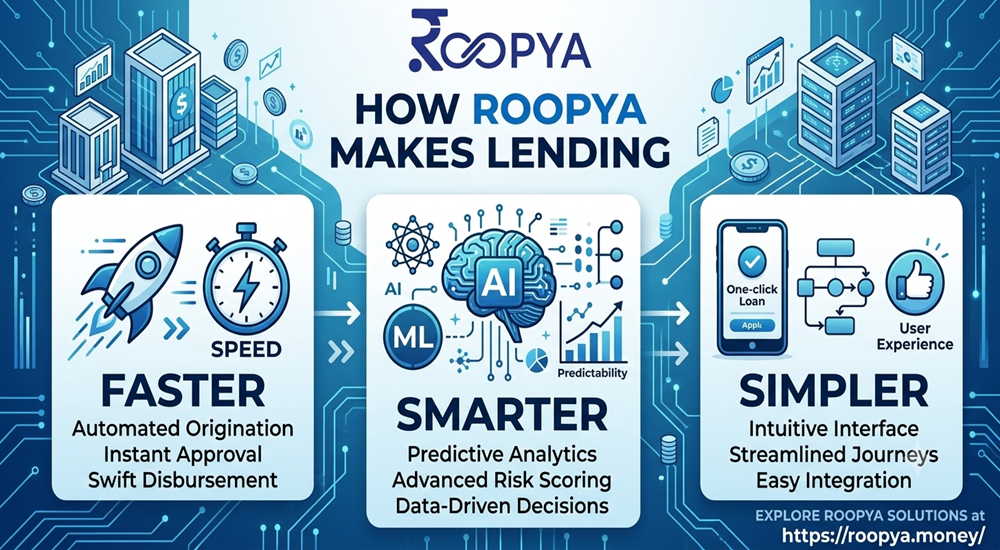
The promise is simple and powerful: go live in one day, pay only for what you use, and grow without limits. But behind that promise lies a sophisticated, thoughtfully engineered platform that touches every part of the lending lifecycle — from the moment a borrower submits an application to the moment the final EMI is collected. This article takes a deep look at exactly how Roopya delivers on that promise — how it makes lending faster, smarter, and simpler for every lender that uses it.
1. The Problem Roopya Was Built to Solve
To understand why Roopya matters, it helps to understand the problem it was designed to fix. Traditional lending technology has three fundamental flaws that hold lenders back.
The first is speed — or rather, the lack of it. Setting up a traditional loan origination or management system takes anywhere from six to eighteen months. Technology vendors demand large upfront payments, custom development projects drag on, and by the time a lender is finally live, market conditions have already shifted. In a competitive lending environment where a borrower decides in minutes and moves on in seconds, this is simply too slow.
The second flaw is complexity. Legacy lending software is notoriously rigid and opaque. Changing a credit policy requires raising a developer ticket. Launching a new loan product means months of configuration work. Adding a new API integration — say, a new credit bureau or a KYC provider — requires extensive custom development. Business users are perpetually dependent on technology teams, and technology teams are perpetually overloaded with backlog. Lending strategy and lending technology move at two completely different speeds, and this misalignment is enormously costly.
The third flaw is cost structure. Traditional lending software charges large upfront licence fees, followed by significant annual maintenance costs, plus additional charges for every integration, every customisation, and every new product launch. For early-stage NBFCs or MFIs operating on tight margins, this cost structure is prohibitive. It effectively reserves serious lending technology for only the largest institutions — everyone else makes do with spreadsheets, manual processes, and the risks that come with them.
Roopya was architected from scratch to eliminate all three of these flaws simultaneously. The result is a platform that is fast to deploy, genuinely easy to use, and priced in a way that grows with the lender rather than constraining them.
2. Faster: How Roopya Eliminates the Time-to-Market Problem
2.1 One-Day Go-Live
The most striking claim Roopya makes — and the one that surprises most lenders hearing it for the first time — is that you can go live in a single day. Not a week. Not a month. One day. This is not a marketing exaggeration; it is the direct result of deliberate architectural choices made at every level of the platform.
Roopya achieves one-day go-live through a combination of pre-built loan product journeys, plug-and-play API integrations, and a no-code configuration interface that empowers business users — not developers — to set up the platform. There is no bespoke development required. There is no lengthy data migration exercise. There is no drawn-out testing cycle. A lender logs in, selects their loan product type, configures their credit policy through the visual Business Rule Engine, connects their preferred KYC and bureau integrations (already pre-built in the platform), and begins processing applications.
For NBFCs receiving their RBI licence and needing to get operations underway immediately, this capability is transformative. For established lenders launching a new product line, it means capturing market opportunity before competitors even begin their development cycles.
2.2 Pre-Configured Loan Product Journeys
Roopya ships with more than 20 pre-configured loan product journeys covering the full range of credit products in the Indian market — personal loans for salaried and self-employed borrowers, business and SME loans, microfinance and JLG products, gold loans, home loans and LAP, payday and salary advance products, and auto loans. Each journey comes pre-built with the appropriate application form fields, document requirements, KYC flows, and decisioning logic for that product type.
Rather than building from a blank canvas, lenders on Roopya start from a sophisticated, tested foundation and customise from there. The difference in speed is extraordinary — what would take a traditional vendor three to six months to build is available on day one.
2.3 300+ Pre-Integrated APIs
One of the biggest time sinks in traditional lending technology implementation is API integration. Connecting to credit bureaus, KYC providers, eSign platforms, payment gateways, banking APIs, GST data sources, and accounting systems each require separate development efforts, testing cycles, and maintenance contracts. It is not unusual for a traditional implementation to spend two to three months on integrations alone.
Roopya has already done this work. The platform ships with more than 300 pre-integrated APIs covering every major service provider in the Indian lending ecosystem — CIBIL, Experian, CRIF, Equifax, Aadhaar eKYC, NSDL PAN, Digilocker, video KYC providers, eSign platforms, NACH mandate registration, payment gateways, core banking connectors, GST Suvidha Providers, Account Aggregator endpoints, and much more. These integrations are available on day one, tested and maintained by Roopya’s engineering team, so lenders never have to think about them again.
2.4 Instant Credit Decisioning
Speed is not just about how quickly a lender can go live — it is about how quickly they can serve borrowers once they are live. In the digital lending era, borrower patience is measured in seconds, not days. A lender that takes 24 hours to give a credit decision will lose that borrower to a competitor who responds in 60 seconds.
Roopya’s automated credit decisioning engine delivers decisions in real time — often within seconds of application submission. The moment a borrower submits their application, Roopya simultaneously triggers KYC verification, credit bureau pulls, and document analysis. The results are fed into the Business Rule Engine, which applies the lender’s configured credit policy and generates a decision — approve, reject, or refer — without any human intervention required for clean profiles. Borrowers receive their outcome immediately, keeping conversion rates high and drop-off rates low.
3. Smarter: How Roopya Uses AI to Transform Lending Decisions
3.1 AI-Powered Document Analysis
Document processing is one of the most labour-intensive aspects of traditional lending. A typical personal loan application might require a borrower to submit six to eight documents — PAN, Aadhaar, salary slips, bank statements, Form 16, and utility bills. In a manual process, a loan officer reviews each document individually, extracts relevant data by hand, and then inputs that data into the system. This is slow, error-prone, and completely unscalable.
Roopya’s AI-powered document analysis engine handles all of this automatically. Advanced OCR and NLP algorithms extract key data fields from every document type — ID numbers from Aadhaar and PAN cards, income figures from salary slips and bank statements, tax figures from ITR documents, and transaction patterns from six to twelve months of bank statements — with accuracy exceeding 99%. The entire process takes seconds, not hours.
More importantly, the AI does not just extract data — it analyses it. Roopya’s document intelligence engine cross-references extracted data against declared information, identifies inconsistencies and anomalies, flags potential fraud signals (unusual transaction patterns, mismatched income declarations, templated or doctored documents), and generates a confidence score for each document submission. This level of intelligent document review far surpasses what human reviewers can consistently achieve, especially at scale.
3.2 ML-Based Credit Scoring
Traditional credit scoring relies almost entirely on bureau scores — a useful but incomplete picture of a borrower’s creditworthiness. Bureau scores are backward-looking, do not account for alternative data signals, and completely exclude the estimated 300 million Indians who are new to credit or have thin credit files.
Roopya’s ML-based credit scoring engine goes far beyond bureau scores. It analyses thousands of data points drawn from bureau reports, bank statement patterns, GST filings, business performance metrics, employment data, and behavioural signals to generate a comprehensive credit assessment. For thin-file borrowers — young professionals, gig economy workers, first-time entrepreneurs — alternative data scoring can unlock creditworthiness that traditional models completely miss. For established borrowers, ML scoring delivers superior risk stratification, enabling lenders to price risk more accurately and reduce losses.
Roopya’s ML models are continuously trained on portfolio performance data, improving their accuracy over time as the platform learns from every lending decision made across its client base.
3.3 The Self-Learning Business Rule Engine
The Business Rule Engine (BRE) is where a lender’s credit policy lives. It is the set of rules and conditions that determines who gets approved, at what amount, at what rate, and on what terms. In traditional systems, the BRE is a static, developer-maintained configuration that requires technical intervention to change. This means credit policy updates — which business and risk teams may need to make weekly in response to portfolio performance — are bottlenecked behind development queues.
Roopya’s no-code BRE is designed for business users. Credit and risk teams can log into Roopya’s intuitive visual interface and modify decisioning rules directly — adjusting income thresholds, changing bureau score cutoffs, adding new eligibility criteria, configuring product-level parameters — without writing a single line of code and without raising a developer ticket. Changes take effect immediately, giving lenders real-time control over their credit policy.
What makes Roopya’s BRE truly smart is its self-learning capability. The engine analyses approval and rejection patterns, correlates rule outcomes with subsequent repayment performance, and generates actionable recommendations for rule improvements. It identifies which rules are driving rejections of good borrowers, which thresholds are allowing high-risk applications through, and how rule changes would be expected to affect approval rates and portfolio quality. Risk teams get the intelligence of a full analytics team built into their decisioning infrastructure.
3.4 Intelligent Fraud Detection
Lending fraud is a significant and growing problem in India’s digital credit ecosystem. Synthetic identities, doctored documents, income inflation, and coordinated fraud rings cost Indian lenders thousands of crores annually. Traditional fraud detection relies on rule-based triggers — which are visible to fraudsters and easily circumvented.
Roopya’s AI-driven fraud detection operates at multiple layers simultaneously. At the document layer, it detects signs of tampering, templating, or artificial generation. At the identity layer, it cross-references submitted information against multiple authoritative data sources to detect mismatches. At the network layer, it identifies suspicious patterns across applications — shared device fingerprints, linked phone numbers, common addresses — that might indicate coordinated fraud. And at the behavioural layer, it flags unusual application patterns that deviate from expected norms for the borrower profile.
Roopya’s fraud detection has delivered an 80% reduction in fraudulent applications for lenders on the platform, protecting portfolio quality and reducing losses without creating friction for legitimate borrowers.
3.5 Predictive Collections and Early Warning
Smart lending does not stop at disbursement. Roopya’s AI capabilities extend into portfolio management and collections through a predictive Early Warning System (EWS). The EWS continuously monitors portfolio signals — repayment behaviour, bureau updates, bank account activity, and macroeconomic indicators — to identify borrowers showing early signs of stress, often weeks before a missed EMI occurs.
When the EWS flags a borrower at risk, Roopya triggers appropriate intervention workflows automatically — personalised communication campaigns, restructuring offers, collections agent assignment, or escalation protocols, depending on the risk level and the lender’s configured strategy. Lenders using Roopya’s AI-driven collections have reported 60% better recovery rates compared to traditional reactive collections approaches.
4. Simpler: How Roopya Removes Complexity from Lending Operations
4.1 Truly No-Code Platform
The word ‘no-code’ is used liberally in the software industry, often to describe tools that merely reduce coding rather than eliminate it entirely. Roopya’s no-code commitment is genuine. Every aspect of the platform that a lending business needs to configure, manage, or modify — loan product parameters, credit policies, application form fields, communication templates, reporting dashboards, collections workflows — can be done through Roopya’s visual interface by business users without any technical knowledge.
This has profound operational implications. It means lending strategy and lending technology finally move at the same speed. When the risk team decides to tighten credit policy in response to rising delinquencies, they can make the change in Roopya immediately — not next sprint, not next month. When the product team wants to launch a new loan product variant with a different pricing structure, they can configure and launch it in hours, not quarters.
4.2 Unified End-to-End Platform
Many lending technology stacks are actually a patchwork of different tools — one vendor for loan origination, another for loan management, a third for collections, a fourth for analytics, and various point solutions for KYC, eSign, and payments. Each integration between these systems is a potential point of failure, a source of data inconsistency, and an ongoing maintenance burden.
Roopya is a unified platform covering the entire lending lifecycle under one roof. Loan Origination System (LOS), Loan Management System (LMS), Collections, Early Warning, Analytics, and Advanced Reporting are all native modules within the same platform, sharing the same data layer and operating without inter-system friction. Lenders get a single source of truth for every loan, every borrower, and every portfolio metric — from origination through final repayment.
4.3 Pay-As-You-Use Pricing
Simplicity in operations must be matched by simplicity in commercial structure. Roopya’s pay-as-you-use pricing model is as straightforward as it sounds — lenders pay based on actual usage, with zero upfront licence fees and no capital expenditure requirements. There are no hidden charges for integrations that are already pre-built. There are no additional fees for launching a new loan product using a pre-configured journey. There are no surprise charges for regulatory updates, which Roopya handles automatically.
This pricing model makes Roopya’s enterprise-grade lending infrastructure accessible to lenders at every stage of growth — from an NBFC processing its first hundred loans to an established institution disbursing thousands of crores each month. The platform grows with the lender, and the commercial model grows with the platform.
4.4 Seamless Multi-Channel Origination
Modern borrowers do not come through a single channel, and neither should a lender’s origination strategy. Roopya supports origination across every relevant channel from a unified backend — direct digital (web and mobile), DSA and agent-assisted, branch-based, API-driven embedded finance partnerships, and co-lending arrangements. Each channel can have its own configured application form, pricing parameters, and decisioning rules, all managed centrally.
This multi-channel capability is particularly valuable for lenders looking to scale through fintech partnerships or embedded finance integrations. Roopya’s Open API architecture lets partner platforms originate loans directly through API calls, enabling truly embedded credit experiences where borrowers never leave the partner’s interface.
4.5 Automated Compliance and Reporting
Regulatory compliance is one of the most operationally burdensome aspects of running a lending business in India. Keeping up with evolving RBI guidelines, maintaining required documentation and audit trails, filing credit bureau reports accurately and on time, managing CERSAI registrations, and producing regulatory reports on schedule — all of these tasks consume significant staff time and carry material compliance risk if done incorrectly.
Roopya systematically eliminates this burden. The platform is continuously updated to reflect the latest RBI regulations and compliance requirements — lenders on Roopya do not need to track regulatory changes and implement them manually. Digital consent management, comprehensive audit trails, automated credit bureau reporting, and CERSAI integration are all built into the platform as standard features. Regulatory reports can be generated on demand or scheduled for automatic delivery, pulling from the platform’s unified data layer without manual assembly.
4.6 Customer Portal and Borrower Experience
Simplicity on the lender side must be matched by simplicity on the borrower side. Roopya includes a configurable customer portal that gives borrowers a clear, transparent view of their loan status, EMI schedule, repayment history, and account statements — reducing inbound support queries and improving borrower satisfaction. Automated communication workflows keep borrowers informed at every stage of their journey — application receipt, document requests, approval notifications, EMI reminders, and payment confirmations — through their preferred channels of SMS, WhatsApp, and email.
5. Real-World Impact: What Roopya Delivers in Numbers
The claims of speed, intelligence, and simplicity are compelling in theory. But what do they mean for a lender’s actual business performance? Roopya’s platform consistently delivers measurable outcomes across the lenders that operate on it:
- 10x Faster Processing: Intelligent document processing reduces verification time from hours to seconds, enabling dramatically higher throughput with the same operations team.
- 40% Better Credit Accuracy: ML-powered credit scoring delivers superior risk stratification compared to bureau-only models, reducing bad debt while improving approval rates for creditworthy borrowers.
- 80% Fraud Reduction: AI-driven fraud detection identifies and blocks fraudulent applications across all channels, protecting portfolio quality without adding friction for legitimate borrowers.
- 60% Better Collections: AI-driven collections optimisation — predictive early warning, intelligent borrower segmentation, and automated intervention workflows — significantly improves recovery rates.
- Zero Upfront Cost: Pay-as-you-use pricing eliminates capital expenditure barriers, making enterprise-grade lending infrastructure accessible at any scale.
- 1-Day Go-Live: Pre-built infrastructure and no-code configuration means lenders capture market opportunity immediately rather than waiting months for implementation.
- 95% Borrower Satisfaction: Roopya’s conversational AI handles borrower interactions with contextual understanding, achieving near-perfect satisfaction scores in borrower engagement touchpoints.
These are not theoretical projections — they are outcomes consistently achieved by Roopya’s client base, which includes IndiaKaLoan, QuickFinShop, Recapita, Findoc, EazyCredit, and Lona Seva, among others.
6. Who Roopya Is Built For
Roopya’s platform is deliberately designed to serve the full spectrum of the Indian lending market:
- New-Generation NBFCs: Freshly licensed institutions that need enterprise-grade technology from day one, without the capital expenditure or implementation timeline of traditional software. Roopya lets them go live immediately and scale without changing platforms as they grow.
- Established NBFCs Modernising Their Stack: Lenders running on legacy systems who recognise that their technology is limiting their growth, costing them efficiency, or creating compliance risk. Roopya offers a modern replacement with minimal disruption.
- Microfinance Institutions (MFIs): Lenders serving rural and semi-urban populations through group lending models need software that handles JLG structures, field agent workflows, and high-volume small-ticket processing. Roopya’s MFI-configured journeys handle all of this natively.
- Fintech Lenders: Digital-first lenders building innovative credit products need a technology partner that can move as fast as their product vision. Roopya’s Open API architecture, no-code configurability, and embedded finance capabilities make it the natural choice.
- Banks Launching Digital Lending Products: Banks looking to build or modernise digital retail or MSME lending products benefit from Roopya’s rapid deployment capability and pre-integrated ecosystem.
7. Getting Started with Roopya
Beginning the journey to faster, smarter, simpler lending with Roopya is designed to be as frictionless as the platform itself. Lenders can request a personalised demo through roopya.money, where Roopya’s team will walk through the platform against the lender’s specific product type, target segment, and operational requirements.
The onboarding process is structured to deliver value immediately — within the first day of onboarding, a lender’s team can have their first loan product configured, their first integrations connected, and their first test application processed through the full origination workflow. There is no lengthy requirements-gathering phase, no custom development project, and no waiting period.
Roopya’s pricing requires no upfront commitment, making it possible to begin with a single product line or a pilot programme and expand as confidence in the platform grows. The platform is built to scale — the same infrastructure that handles a lender’s first hundred applications handles their hundred-thousandth, without any architectural changes or additional investment.
In a lending market that moves faster every year — where borrower expectations rise, regulatory requirements evolve, and competitive intensity increases — the right technology partner is not just an operational choice. It is a strategic one. Roopya is built to be that partner: not just a software vendor, but a lending infrastructure foundation that grows with every lender who builds on it.
The future of lending in India will be built by institutions that move fast, decide smart, and operate simply. Roopya is the platform that makes all three possible — today, at scale, for every kind of lender.

