LMS vs Core Banking System: What Indian NBFCs Actually Need in 2026

India’s lending ecosystem is changing rapidly. From digital onboarding and AI-based underwriting to co-lending and RBI compliance, modern NBFCs are under pressure to scale faster while keeping operations efficient and compliant.
One of the biggest technology questions NBFCs face in 2026 is:
Start Free Trial
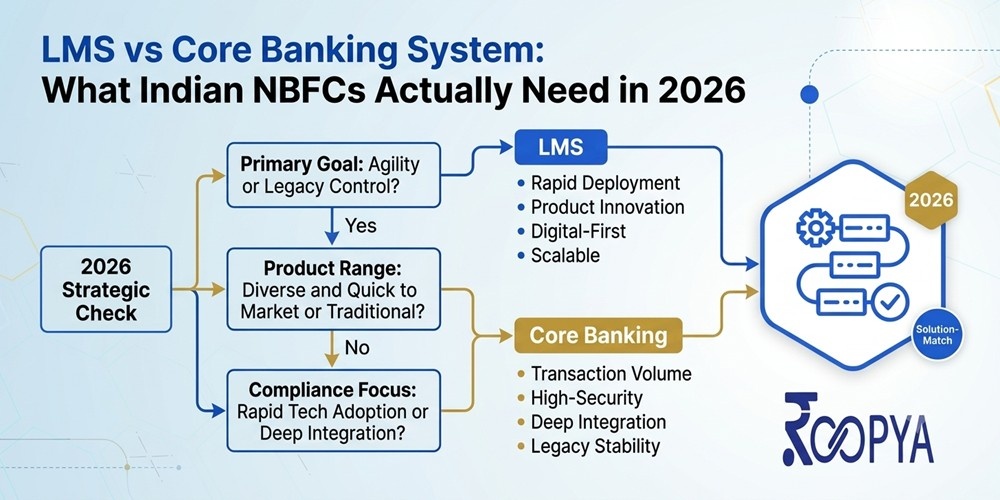
Should you use a Core Banking System (CBS) or a Loan Management System (LMS)?
Many lenders still assume both systems are the same. In reality, they serve very different purposes.
A Core Banking System is designed mainly for traditional banking operations such as deposits, savings accounts, branch banking, and internal financial management. On the other hand, a Loan Management System focuses entirely on the lending lifecycle — from loan disbursement and EMI collection to delinquency tracking, co-lending, and recovery automation.
For Indian NBFCs, fintech lenders, microfinance institutions, and digital lending startups, the choice can directly impact scalability, customer experience, compliance, and profitability.
In this guide, we will explain:
- What an LMS is
- What a Core Banking System is
- Key differences between LMS and CBS
- Why NBFCs prefer LMS platforms in 2026
- RBI compliance considerations
- Integration requirements
- Cost comparison
- Which solution is best for your lending business
What Is a Loan Management System (LMS)?
A Loan Management System (LMS) is software specifically designed to manage the entire post-loan lifecycle.
It helps NBFCs automate:
- Loan servicing
- EMI schedules
- Collections
- NACH/UPI autopay
- DPD tracking
- Recovery workflows
- Customer communication
- Compliance reporting
- Portfolio analytics
- Co-lending operations
Modern LMS platforms like those offered by Roopya Money are cloud-based, API-first, and designed for digital lending operations.
Key Functions of an LMS
Loan Account Management
Manage thousands or millions of active loans from a centralized dashboard.
EMI Scheduling
Automatically generate EMI calendars based on:
- Reducing balance
- Flat interest
- Daily interest
- Weekly repayment
- Bullet loans
Collection Automation
Automate repayment collection using:
- NACH
- UPI Autopay
- eMandates
- Payment gateways
- WhatsApp reminders
- SMS alerts
DPD & Delinquency Tracking
Monitor overdue accounts in real-time using:
- Bucket classification
- Risk segmentation
- Recovery prioritization
RBI Compliance
Generate:
- Audit logs
- Bureau reports
- Regulatory reports
- Consent tracking
- Digital lending records
Co-Lending Support
Support multi-lender loan participation and revenue sharing.
Analytics & Reporting
Track:
- Portfolio health
- NPA trends
- Collection efficiency
- Risk indicators
- Geographic performance
What Is a Core Banking System (CBS)?
A Core Banking System (CBS) is centralized banking software primarily used by banks.
CBS platforms are designed to handle:
- Savings accounts
- Current accounts
- Deposits
- Treasury
- Branch banking
- Internal accounting
- Customer records
- Interbank transactions
CBS became essential when banks moved from branch-based operations to centralized digital banking systems.
Large banks in India rely heavily on CBS platforms for daily operations.
However, many NBFCs mistakenly adopt CBS platforms even when they only require lending functionality.
Why CBS Was Popular Earlier
Before digital lending became mainstream, many NBFCs used lightweight banking systems because:
- Loan volumes were smaller
- Collections were manual
- Compliance requirements were simpler
- APIs were uncommon
- Mobile lending did not exist
In 2026, lending businesses operate very differently.
Today’s NBFCs require:
- Real-time APIs
- AI-driven workflows
- Instant onboarding
- Embedded finance
- Automated collections
- RBI digital compliance
- Co-lending infrastructure
Traditional CBS platforms often struggle to support these requirements efficiently.
LMS vs Core Banking System: Key Differences
| Feature | LMS | Core Banking System |
| Primary Focus | Lending operations | Banking operations |
| Best For | NBFCs & fintechs | Banks |
| EMI Management | Advanced | Limited |
| Collection Automation | Strong | Basic |
| DPD Tracking | Real-time | Often manual |
| Co-Lending | Supported | Limited |
| API Integrations | Extensive | Moderate |
| Loan Analytics | Advanced | General |
| Customer Journeys | Digital-first | Branch-first |
| RBI Digital Lending Compliance | Specialized | Partial |
| Cloud Deployment | Common | Less flexible |
| Scalability for Lending | High | Moderate |
| Mobile Lending | Optimized | Not optimized |
| Recovery Workflows | Automated | Limited |
Why Indian NBFCs Prefer LMS Platforms in 2026
The Indian lending market has evolved dramatically due to:
- UPI growth
- Embedded finance
- Digital KYC
- GST-based underwriting
- Account Aggregator framework
- RBI digital lending regulations
Because of these changes, NBFCs require lending-focused technology instead of generic banking software.
-
Faster Loan Processing
Modern LMS platforms automate:
- Repayment setup
- Loan servicing
- Disbursement reconciliation
- Customer notifications
This reduces operational workload significantly.
-
Better Collection Efficiency
Collections are the heart of NBFC profitability.
A good LMS enables:
- Auto-debit management
- Bounce handling
- DPD alerts
- Recovery assignment
- Field collection tracking
Without these capabilities, lenders face rising NPAs.
-
Digital Lending Compliance
RBI’s digital lending regulations require lenders to maintain:
- Transparent borrower communication
- Consent records
- Audit trails
- Data protection
- Recovery monitoring
LMS platforms are specifically designed for these workflows.
-
Easier Integration Ecosystem
NBFCs now rely heavily on integrations such as:
- Aadhaar KYC
- PAN verification
- Bureau checks
- GST APIs
- Account Aggregator
- Payment gateways
- WhatsApp APIs
An API-first LMS simplifies integration management.
When Does an NBFC Need a Core Banking System?
Although LMS platforms are ideal for lending operations, some institutions may still require CBS capabilities.
You May Need CBS If:
You Handle Deposits
Deposit-taking NBFCs may require banking-grade accounting systems.
You Operate Like a Full Bank
Institutions offering:
- Savings products
- Current accounts
- Treasury services
may benefit from CBS infrastructure.
Complex Internal Accounting
Large financial institutions sometimes integrate CBS for enterprise-level accounting.
However, even these organizations increasingly combine:
- CBS for banking
- LMS for lending
instead of relying on CBS alone.
Why LMS Is Better for Digital Lending Startups
Indian fintechs prioritize:
- Speed
- Scalability
- Automation
- API integrations
- Mobile-first experiences
Traditional CBS systems are often:
- Expensive
- Slow to customize
- Difficult to integrate
- Not optimized for embedded lending
An LMS platform allows startups to launch lending products quickly.
Cloud LMS vs Traditional CBS
Cloud LMS Advantages
Lower Infrastructure Cost
No expensive hardware setup.
Faster Deployment
Launch within weeks instead of months.
Automatic Updates
Compliance and feature updates happen automatically.
Better Scalability
Scale from 1,000 loans to 10 lakh+ loans efficiently.
Remote Accessibility
Teams can work from anywhere securely.
RBI Compliance Requirements in 2026
Modern NBFCs must comply with RBI requirements related to:
- Digital lending transparency
- Bureau reporting
- Data security
- KYC tracking
- Consent management
- Collection governance
An LMS helps automate compliance operations.
Essential Compliance Features
Audit Logs
Every action must be traceable.
Consent Capture
Borrower approvals must be recorded.
Collection Monitoring
Recovery activities must remain compliant.
Data Encryption
Sensitive borrower data must be protected.
Credit Bureau Integration
Regular reporting is mandatory.
Key LMS Features Every NBFC Needs
Automated EMI Collection
The system should support:
- NACH
- UPI Autopay
- Payment links
- QR collections
Delinquency Management
Advanced DPD tracking helps reduce NPAs.
Recovery Workflow Automation
Assign cases automatically based on:
- Region
- Bucket
- Risk level
Customer Self-Service
Borrowers should access:
- Loan statements
- Repayment history
- Payment options
Real-Time Dashboards
Management teams require instant visibility into:
- Portfolio performance
- Collection ratios
- Recovery trends
Integration Requirements for Modern NBFCs
A modern LMS should integrate with:
| Integration Type | Purpose |
| CKYC APIs | Customer verification |
| Bureau APIs | Credit checks |
| GST APIs | MSME underwriting |
| Account Aggregator | Bank data access |
| Payment Gateways | EMI collection |
| WhatsApp APIs | Notifications |
| E-sign APIs | Digital agreements |
| Video KYC | Compliance |
Cost Comparison: LMS vs CBS
LMS Cost
Modern cloud LMS pricing usually depends on:
- Loan volume
- Active users
- API usage
- Modules selected
Typical Range
₹50,000 to ₹15 lakh+ annually depending on scale.
CBS Cost
CBS implementation often includes:
- License fees
- Hardware setup
- Customization
- Maintenance
- Integration costs
Typical Range
₹25 lakh to several crores.
For most NBFCs, CBS becomes unnecessarily expensive.
Challenges of Using CBS for Lending
Poor Lending Flexibility
Many CBS platforms were designed decades ago and struggle with:
- BNPL
- Embedded lending
- Instant loans
- Co-lending
Slow Product Launch
Launching new loan products may require lengthy development cycles.
Weak Collection Tools
CBS systems usually lack advanced:
- Recovery workflows
- DPD automation
- Field collection management
Hybrid Approach: LMS + CBS
Some large institutions use a hybrid architecture:
| System | Role |
| CBS | Banking & accounting |
| LMS | Lending operations |
This approach combines:
- Enterprise-grade finance management
- Modern lending automation
However, for most NBFCs, a standalone LMS is sufficient.
Use Cases by Lending Segment
Personal Loan NBFCs
Need:
- Fast approvals
- EMI automation
- Collection analytics
Best Fit: LMS
MSME Lenders
Need:
- GST underwriting
- Bank statement analysis
- Working capital workflows
Best Fit: LMS
Gold Loan Companies
Need:
- LTV tracking
- Branch workflows
- Auction management
Best Fit: LMS
Microfinance Institutions
Need:
- Group collections
- Weekly EMI tracking
- Field recovery tools
Best Fit: LMS
Large Banks
Need:
- Deposit systems
- Treasury
- Branch operations
Best Fit: CBS + LMS
Future of Lending Technology in India
The future of Indian lending will be driven by:
- AI underwriting
- Embedded finance
- Open banking
- Account Aggregator ecosystem
- Real-time collections
- Predictive risk analytics
These innovations require highly flexible lending infrastructure.
This is why most fintech lenders are moving toward API-first LMS platforms instead of traditional banking systems.
How Roopya Money Helps NBFCs Scale
Roopya Money provides advanced digital lending solutions designed specifically for Indian NBFCs and fintech companies.
Key Solutions
Loan Management System
Automate servicing, collections, DPD management, and reporting.
Loan Origination System
Digitize onboarding, KYC, underwriting, and approvals.
Collection System
Improve recovery efficiency using automated workflows.
Early Warning System
Detect risky accounts before they become NPAs.
Lending Analytics
Gain portfolio-level visibility using real-time dashboards.
API Integrations
Connect with bureau, GST, AA, CKYC, payment, and e-sign providers.
Final Verdict: LMS or Core Banking System?
For most Indian NBFCs in 2026, the answer is clear.
If your business focuses mainly on lending, collections, digital onboarding, and portfolio management, a modern Loan Management System is the better choice.
A Core Banking System may still be necessary for full-service banks or large deposit-taking institutions, but it is not optimized for modern digital lending operations.
An LMS provides:
- Faster deployment
- Better lending automation
- Lower cost
- Stronger compliance support
- Better scalability
- Modern API ecosystem
- Improved borrower experience
As India’s lending market becomes more digital and compliance-driven, NBFCs need technology built specifically for lending — not legacy banking infrastructure.
The Indian lending market in 2026 demands speed, automation, compliance, and scalability. Traditional Core Banking Systems were not designed for today’s digital-first lending ecosystem.
A modern Loan Management System empowers NBFCs to:
- Automate operations
- Improve collections
- Launch products faster
- Stay compliant
- Scale efficiently
For lenders looking to modernize operations and grow competitively, investing in the right LMS platform is no longer optional — it is essential.
To explore digital lending solutions for your NBFC, visit: Roopya Money

