Scale Faster with Roopya’s Loan Management Platform: The Definitive Guide for Modern Lenders

Scaling a lending business in India has never been more complex — or more rewarding. The credit market is expanding rapidly, regulatory expectations are rising, and borrowers are demanding faster, more seamless experiences than ever before. The lenders who are winning in this environment share one thing in common: they have moved away from fragmented, legacy technology and adopted a unified, intelligent loan management platform that lets them grow without friction.
Roopya’s loan management platform was built precisely for this moment. Designed from the ground up for Indian NBFCs, banks, microfinance institutions, and fintech lenders, Roopya brings together every function of the lending lifecycle — origination, underwriting, disbursement, servicing, collections, and analytics — into a single no-code platform that goes live in one day and scales without limits.
Start Free Trial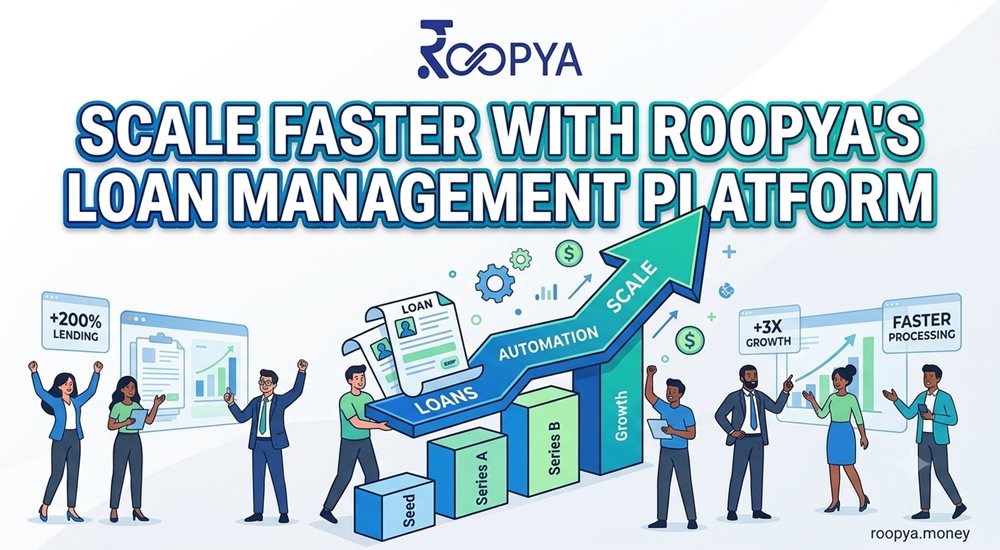
This guide explores what a loan management platform truly is, why it is the single most important investment a modern lender can make, and how Roopya’s platform delivers the speed, intelligence, and compliance you need to grow your loan book faster than your competition.
1. What Is a Loan Management Platform?
A loan management platform is a comprehensive, end-to-end technology system that manages every stage of a loan’s lifecycle — from the moment a borrower submits an application to the final repayment and closure of the account. Unlike point solutions that address only one part of the lending process (such as a standalone KYC tool or a basic EMI calculator), a true loan management platform unifies the entire lending operation under a single, integrated infrastructure.
The platform typically encompasses four major functional domains:
- Loan Origination: The front-end application journey, borrower onboarding, KYC verification, credit bureau integration, document management, underwriting, credit decisioning, and loan offer generation.
- Loan Servicing and Management: Post-disbursement account management, EMI scheduling, amortisation calculation, repayment tracking, prepayment processing, interest accrual, and borrower communication.
- Collections Management: Delinquency tracking, automated payment reminders, field agent workflows, legal escalation triggers, settlement management, and recovery analytics.
- Analytics and Reporting: Portfolio-level performance dashboards, credit risk analytics, early warning signals, regulatory reporting, and business intelligence for strategic decision-making.
When all four domains are managed on a single, integrated platform, lenders gain extraordinary operational efficiency, data consistency, and the ability to make real-time decisions across the entire portfolio. Roopya delivers exactly this — a truly unified loan management platform purpose-built for the Indian lending ecosystem.
2. Why Scaling Requires More Than Just Capital
A common misconception among growth-stage lenders is that scaling is primarily a capital problem. Raise more funds, disburse more loans, grow the book. In practice, the most common reason ambitious lending businesses hit a ceiling is not a lack of capital — it is the failure of their operational infrastructure to keep pace with growth.
Here is what actually happens when a lender tries to scale on inadequate technology:
- Processing bottlenecks multiply. What took five people to manage at 500 loans a month now requires fifty people at 5,000 loans — and quality still deteriorates. Manual workflows do not scale linearly; they collapse under volume.
- Credit quality suffers. Inconsistent manual underwriting leads to policy drift. Different loan officers apply credit rules differently. Portfolio NPA begins to creep up at exactly the moment when investors are paying the closest attention.
- Compliance failures compound. The regulatory burden — KYC documentation, bureau reporting, CERSAI filings, Fair Practice Code adherence, audit trail maintenance — grows proportionally with loan book size. Manual compliance management at scale is not just inefficient; it is a regulatory liability.
- Customer experience degrades. Longer processing times, inconsistent communication, and slow responses to servicing queries push borrowers to competitors at the worst possible time — when the market is growing fastest.
- Data becomes siloed. When origination, servicing, collections, and analytics run on separate systems (or spreadsheets), the data required to make intelligent portfolio decisions is fragmented and unreliable.
The answer to each of these problems is the same: a unified, intelligent, automated loan management platform. When technology handles the operational complexity of scale, your team can focus on growth — not firefighting.
3. The Roopya Loan Management Platform: An Architecture Overview
Roopya’s loan management platform is built on a modern, cloud-native, microservices architecture that separates infrastructure concerns from business logic — meaning your credit team can configure and modify lending rules, product parameters, and workflows without any dependency on software developers. Here is an overview of the core architectural pillars:
3.1 No-Code Configuration Layer
Every aspect of Roopya’s platform — from loan application form design to credit decisioning rules to repayment schedule templates — can be configured by business users through an intuitive visual interface. This is genuinely no-code: not ‘low-code’ with hidden developer dependencies, but a fully visual, drag-and-drop environment for building and managing lending workflows. When RBI regulations change, your compliance team can update relevant rules immediately. When you launch a new loan product, your product team can configure it end-to-end without IT involvement.
3.2 Pre-Integrated API Ecosystem (300+ Integrations)
One of the most significant time and cost drains for lenders building or upgrading their technology stack is integration work. Connecting to credit bureaus, KYC providers, eSign platforms, payment gateways, accounting systems, and banking APIs individually can take months and cost crores. Roopya eliminates this entirely. The platform ships with 300+ pre-integrated APIs covering every major service category a lender needs: CIBIL, Experian, Equifax, CRIF, Aadhaar eKYC, NSDL PAN, Digilocker, VKYC, NACH/e-NACH, UPI, IMPS, GST data, ITR data, Account Aggregator, CERSAI, and dozens more.
3.3 AI and Machine Learning Core
Roopya’s platform is not merely automated — it is intelligent. AI capabilities are embedded at every stage of the lending lifecycle. Document analysis uses advanced OCR and NLP to extract and verify data from identity documents, bank statements, salary slips, and GST returns with 99%+ accuracy. Credit scoring models trained on historical lending data deliver more predictive risk assessments than bureau scores alone. The Business Rule Engine (BRE) learns from approval and rejection patterns, continuously suggesting optimisations to your credit policy. Collections workflows use behavioural analytics to determine the optimal communication channel, timing, and message for each delinquent borrower.
3.4 Open API Architecture for Embedded Finance
Roopya’s platform exposes every function through a comprehensive REST API layer, enabling partners, fintechs, and distribution networks to integrate lending capabilities directly into their own platforms. This means your DSA network can originate loans through a dedicated portal, your fintech partners can embed loan journeys into their apps, and your internal CRM or ERP can access loan data in real time — all without custom development on Roopya’s side.
4. Core Modules of the Roopya Loan Management Platform
4.1 Loan Origination System (LOS)
The origination module is where your relationship with a borrower begins. Roopya’s LOS supports the complete application journey — from the first touchpoint to loan sanction — through a highly configurable, mobile-responsive digital interface. Borrowers can complete applications in minutes on any device. Smart form validation, real-time KYC, instant bureau pulls, and AI-powered document analysis work in parallel to deliver rapid underwriting decisions. With 20+ pre-configured loan product journeys available out of the box, you can go live with a new loan product in less than a day.
Key origination capabilities include: digital application forms with smart validation, Aadhaar and PAN eKYC, video KYC (VKYC), bureau integration with CIBIL/Experian/Equifax/CRIF, AI-powered OCR for document extraction, configurable credit scorecard integration, no-code credit decision workflows, digital eSign for loan agreements, and automated sanction letter generation.
4.2 Loan Management System (LMS)
Once a loan is disbursed, the LMS takes over — managing every aspect of the loan’s life until final closure. Roopya’s LMS handles complex amortisation schedules for multiple interest calculation methods (flat rate, reducing balance, daily reducing balance), automated EMI generation and tracking, prepayment and part-payment processing with automatic schedule recalculation, interest accrual, penalty calculation, and loan restructuring workflows. A dedicated borrower portal allows customers to view their account, download statements, make payments, and raise service requests — reducing support costs while improving satisfaction.
Key LMS capabilities include: flexible amortisation schedule generation, multi-currency and multi-currency support, automated payment allocation (principal, interest, penalty), prepayment and foreclosure processing, loan restructuring and moratorium management, NOC and closure certificate generation, borrower self-service portal, and co-borrower and guarantor management.
4.3 Collections and Recovery Management
Collections is where portfolio quality is won or lost in the final mile. Roopya’s collections module uses AI-driven behavioural analytics to identify borrowers at risk of delinquency before they actually miss a payment — enabling proactive intervention that is far more effective than reactive recovery. Automated communication workflows deliver payment reminders through the optimal channel (WhatsApp, SMS, email, voice call) at the optimal time for each individual borrower. Field agent management tools assign delinquent accounts, track agent activity, and manage payment collection in the field. Legal escalation workflows automatically trigger notices and legal actions based on configurable delinquency thresholds.
Roopya’s AI-driven collections engine delivers 60% better recovery rates compared to traditional manual collections approaches, by optimising every touchpoint in the recovery journey.
4.4 Early Warning System (EWS)
Roopya’s Early Warning System is a proactive risk management tool that monitors your entire portfolio continuously, using predictive analytics to identify accounts that show signs of future stress — before they become NPA. Behavioural signals, transactional patterns, bureau alerts, and macroeconomic indicators are synthesised into risk scores that update in real time. When an account crosses a configurable risk threshold, the EWS automatically triggers an alert and initiates a pre-defined intervention workflow — such as a relationship manager call, a restructuring offer, or a collections escalation.
4.5 Analytics and Business Intelligence
Roopya’s lending analytics module gives decision-makers real-time visibility into portfolio performance, credit risk, operational efficiency, and business growth. Customisable dashboards display the metrics that matter most — approval rates, disbursal volumes, NPA levels, collection efficiency, EMI bounce rates, and product-wise profitability. AI-driven natural language reporting allows team members to query the portfolio in plain English and receive instant, data-driven answers. Regulatory reports for RBI, CERSAI, and credit bureau submissions can be generated automatically, saving hours of compliance work each month.
5. How Roopya Helps You Scale: The Numbers That Matter
Scaling with Roopya is not just a qualitative improvement in operations — it delivers measurable, quantifiable business outcomes that directly impact your loan book growth and profitability:
- 10x Faster Processing: Roopya’s intelligent document processing reduces verification time from hours to seconds. A process that previously required a team of document analysts working for two hours now completes automatically in under two minutes, enabling dramatically higher throughput without additional headcount.
- 40% Better Credit Accuracy: Machine learning-powered credit scoring models deliver superior predictive accuracy compared to traditional bureau-score-only underwriting. Better credit decisions mean lower NPA, lower provisioning costs, and higher investor confidence.
- 80% Fraud Reduction: Roopya’s built-in AI fraud modules — cross-referencing identity data, detecting document tampering, identifying behavioural anomalies, and running deduplication checks — catch fraudulent applications at the point of entry, before any money is disbursed.
- 60% Better Collections: The AI-driven collections engine optimises recovery strategies based on individual borrower behaviour, achieving dramatically higher resolution rates than manual or rule-based collection approaches.
- 40-60% Lower Processing Costs: Automation of KYC, document processing, credit decisioning, EMI calculation, payment allocation, and regulatory reporting eliminates the manual labour cost associated with each loan processed.
- 1-Day Go-Live: For new lenders launching on Roopya, or established lenders migrating from legacy systems, the average time from contract signing to processing live applications is one day — compared to six to twelve months for traditional lending software implementations.
6. Scaling Across Loan Products: What Roopya Supports
One of the most significant advantages of Roopya’s loan management platform is its breadth. Rather than deploying a different system for each loan product — with all the integration complexity, data silos, and management overhead that entails — Roopya manages your entire product portfolio from a single platform:
- Personal Loans: Salaried and self-employed journeys with bureau-led underwriting, income computation from bank statements and ITR, and instant disbursement to savings accounts.
- Business and SME Loans: GST-based turnover analysis, banking surrogate underwriting, CIBIL MSME report integration, and business vintage verification.
- Microfinance Loans (MFI): Joint Liability Group (JLG) and Self Help Group (SHG) lending models, group meeting management, rural field agent workflows, and cashless disbursement to Jan Dhan accounts.
- Gold Loans: Collateral valuation integration, LTV configuration, auction management workflows, and pledge release processing.
- Home Loans and Loan Against Property (LAP): Long-tenor amortisation, property valuation integration, legal due diligence tracking, MODT management, and disbursement tranche processing.
- Payday and Salary Advance Loans: Employer verification, salary credit tracking, ultra-short-tenor amortisation, and high-frequency disbursement capabilities.
- Auto and Vehicle Loans: RC verification, insurance integration, hypothecation management, and RC endorsement workflows.
- Buy Now Pay Later (BNPL): Merchant integration, transaction-level credit decisions, short-cycle billing, and embedded repayment collection.
7. Compliance and Regulatory Management at Scale
As your loan book grows, your regulatory obligations grow with it. Managing compliance manually at scale is one of the highest-risk activities in any lending business. A missed audit trail entry, a delayed bureau report, or a non-compliant customer communication can result in regulatory sanctions, reputational damage, or operational restrictions. Roopya’s loan management platform eliminates this risk through compliance-by-design.
Every action on the Roopya platform is automatically logged with a timestamp, user identity, and contextual details — creating an immutable audit trail that satisfies RBI inspection requirements. Customer consent is captured digitally with cryptographic signatures. KYC documentation is stored in a compliant, encrypted document vault with configurable retention periods. Credit bureau reporting is automated and reconciled. CERSAI registration and modification workflows are built in. The Fair Practice Code obligations around communication, processing timelines, and complaint resolution are enforced through platform configuration, not manual discipline.
Critically, Roopya’s platform is continuously updated to reflect regulatory changes as they are notified by RBI, SEBI, and other relevant authorities — meaning your compliance posture is always current without any action required from your team.
8. From Startup to Scale: Roopya Grows With You
One of the most common mistakes lenders make when choosing a technology platform is selecting a tool that fits their current size but cannot accommodate future growth — requiring a painful, expensive platform migration at exactly the moment when they should be focused on scaling their business.
Roopya is architected to serve lenders at every stage of growth:
- Newly Licensed NBFCs: Zero upfront cost, 1-day go-live, and pay-as-you-use pricing make Roopya the ideal platform for lenders launching their first loan product. You get enterprise-grade infrastructure from day one, without enterprise-level capital expenditure.
- Growth-Stage Lenders: As your loan book grows from hundreds to thousands to lakhs of accounts, Roopya’s cloud infrastructure scales automatically. No capacity planning, no server procurement, no expensive infrastructure upgrades — the platform handles all of it.
- Established NBFCs and Banks: For larger institutions, Roopya offers advanced analytics, multi-entity management, sophisticated risk models, and custom workflow capabilities that support complex, multi-product lending operations at institutional scale.
Several of Roopya’s customers — including IndiaKaLoan, QuickFinShop, Recapita, Findoc, EazyCredit, and LoanSeva — started on the platform at early stages and have scaled their operations significantly without ever needing to migrate to a different system.
9. Embedded Finance: Extending Your Reach Through Partnerships
Modern loan growth does not come only from direct-to-customer channels. The most dynamic lenders in India today are growing through partnerships — co-lending arrangements, DSA networks, fintech distribution partnerships, and embedded lending integrations with non-financial platforms. Roopya’s open API architecture makes all of these partnership models possible without custom development.
Through Roopya’s embedded finance capabilities, partners can integrate loan origination directly into their own platforms — whether that is a payroll platform offering salary advances, an e-commerce platform offering BNPL at checkout, or an agricultural input supplier offering crop loans to farmers. Each partner gets a branded, channel-specific loan journey while you retain complete control over credit policy, pricing, and portfolio management in your Roopya dashboard.
This capability transforms Roopya from a loan management platform into a lending distribution engine — one that lets you scale your loan book through multiple channels simultaneously, without proportional increases in operational headcount or infrastructure cost.
10. Why Roopya Is the Right Loan Management Platform to Scale Faster
There are many loan management platforms in the market. What makes Roopya the right choice for lenders who want to scale faster?
- Built for India, by India: Roopya is not a global platform adapted for the Indian market. It was built from the ground up for India’s regulatory environment, its technology infrastructure, its credit bureau ecosystem, and its borrower demographics. Every integration, every compliance workflow, and every product template reflects the realities of lending in India.
- Speed of Deployment: The single most important competitive advantage for a growth-stage lender is speed. Roopya’s 1-day go-live is not a marketing claim — it reflects the reality that pre-built integrations, pre-configured product templates, and a no-code setup interface genuinely eliminate the months of implementation work required by traditional platforms.
- True No-Code: Business users — your credit team, your product team, your compliance team — can configure and modify every aspect of the platform without developer involvement. This means your technology responds to your business needs at business speed, not development sprint speed.
- Pay-As-You-Use Pricing: Capital efficiency is critical for scaling lenders. Roopya’s zero upfront cost, pay-as-you-use pricing model means your technology investment scales with your loan book — you never overpay for capacity you haven’t used yet.
- AI at Every Stage: From document processing to credit scoring to collections optimisation, Roopya’s AI capabilities deliver measurable improvements in accuracy, efficiency, and outcomes at every stage of the lending lifecycle.
- Full Compliance Coverage: In a regulatory environment that continues to evolve rapidly, a compliance-by-design platform is not a nice-to-have — it is a business necessity. Roopya’s continuously updated compliance framework means you can focus on growth without compliance as a bottleneck.
The lending market is large, growing, and increasingly competitive. The lenders who will capture the most value in the next five years are those who build their operations on technology that lets them move faster, decide smarter, and scale without friction. Roopya is that platform.
Request a free demo today and see how quickly you can go from where you are now to where you want to be.

