Loan Management Software with End-to-End Automation: The Definitive Guide for NBFCs, Banks & Modern Lenders

Managing loans manually is no longer viable for any lender that wants to grow. The Indian lending market — one of the fastest-expanding financial ecosystems in the world — demands speed, precision, and regulatory compliance at a scale that spreadsheets, paper files, and disconnected systems simply cannot deliver. The answer is loan management software with end-to-end automation: a unified platform that orchestrates every step of the loan lifecycle, from the moment a borrower submits an application to the final repayment, without manual intervention at any stage.
Loan management automation is not a single feature; it is an architectural philosophy. It means that every touchpoint in the lending journey — application capture, KYC, underwriting, disbursement, repayment scheduling, collections, regulatory reporting — is handled by intelligent software that acts consistently, quickly, and compliantly, every single time. No missed follow-ups. No inconsistent credit decisions. No compliance gaps buried in a stack of paper files.
Start Free Trial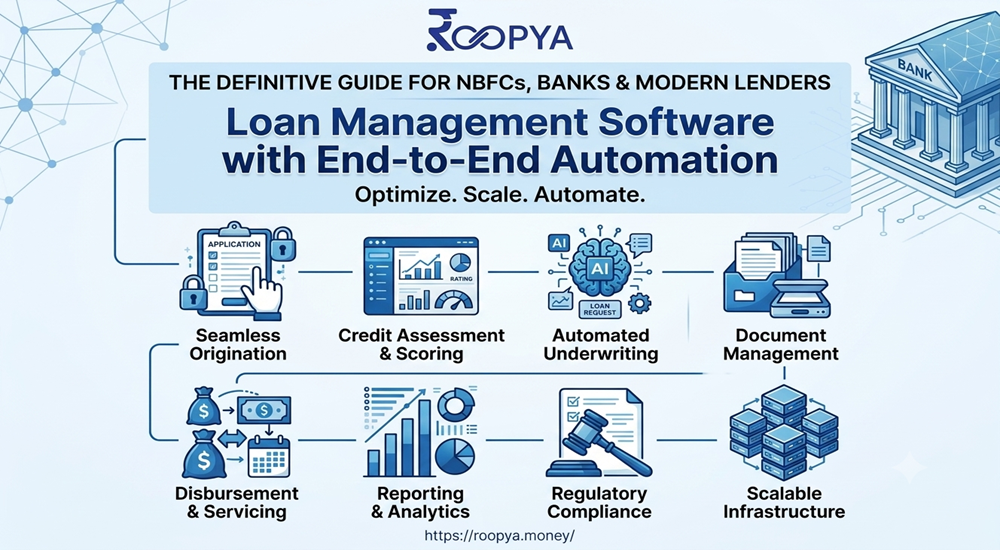
For NBFCs, banks, microfinance institutions, and fintech lenders operating in India today, implementing an end-to-end automated loan management system is no longer a competitive advantage — it is the price of admission. This guide explains exactly what such a system is, how it works, what features to look for, and why Roopya’s platform is the most powerful and fastest-to-deploy loan management solution available to Indian lenders.
1. What Is Loan Management Software with End-to-End Automation?
Loan management software is a digital platform that administers the complete lifecycle of a loan product — from initial application through origination, disbursement, repayment management, and eventual closure or write-off. End-to-end automation means that each of these stages is handled by the system automatically, with data flowing seamlessly from one stage to the next without manual re-entry, handoffs between siloed systems, or human bottlenecks.
A fully automated loan management system is typically comprised of several integrated modules:
- Loan Origination Module: Captures and processes applications, runs KYC and credit bureau checks, performs AI-powered document verification, and delivers instant credit decisions.
- Underwriting and Credit Decisioning Module: Applies your credit policy through a no-code Business Rule Engine, scores applications against risk models, and generates sanctioned loan offers.
- Loan Disbursement Module: Automates the transfer of funds to borrowers upon agreement execution, with integration into payment rails including NEFT, RTGS, IMPS, and UPI.
- Repayment and EMI Management Module: Generates repayment schedules, sends automated reminders, processes inward payments, and updates loan accounts in real time.
- Collections and Delinquency Management Module: Identifies overdue accounts, triggers escalating follow-up workflows, and manages recovery processes with full audit trails.
- Reporting and Regulatory Compliance Module: Generates MIS reports, credit bureau submissions, RBI regulatory filings, and internal risk dashboards automatically.
When these modules are fully integrated and automated within a single platform — as they are on Roopya — the result is a loan management system where a single credit officer can productively oversee portfolios that would previously have required entire teams.
2. The Problem with Non-Automated Loan Management
Before exploring the solution, it is worth understanding the scale of the problem. Most lenders in India — particularly NBFCs and MFIs that grew rapidly over the last decade — are still managing significant portions of their loan portfolios through semi-manual processes. The symptoms are recognisable:
- Application data is collected in one system, re-entered into a second system for underwriting, and copied again into an Excel sheet for disbursement tracking. Every re-entry introduces error risk.
- Credit decisions vary between officers because the credit policy exists in a policy document rather than a configured decisioning engine. Two officers reviewing the same application may reach different conclusions.
- Repayment reminders are sent manually by a team member checking a spreadsheet each morning. When that person is absent, reminders do not go out — and delinquency rates tick upward.
- Collections teams work from printed lists of overdue borrowers, with no real-time updates as payments come in through different channels. Borrowers who have already paid are still being chased.
- Regulatory reporting — CIBIL submissions, RBI MIS reports — requires a dedicated team spending days each month extracting, formatting, and submitting data from multiple source systems.
The cost of this inefficiency is enormous. Industry research consistently shows that manual loan processing costs 3-5x more per application than automated processing. Beyond direct cost, manual processes produce slower decisions (leading to lower conversion rates), higher delinquency (due to inconsistent collections), and elevated regulatory risk (due to audit trail gaps). For a lender managing 10,000 active loans, even a 1% improvement in collection efficiency translates to lakhs of rupees in recovered revenue each month.
3. The End-to-End Automation Journey: How It Works on Roopya
To make end-to-end automation concrete, let us trace the complete journey of a loan on Roopya’s platform — from first borrower touch to final closure.
Stage 1: Automated Application Capture
A borrower discovers your loan product through your website, a DSA agent, or an embedded finance partner. They initiate an application through a branded digital interface — desktop or mobile — powered by Roopya. The application form is pre-configured for your specific loan product, with smart field validation running in real time. As the borrower types their PAN number, Roopya validates the format instantly. As they enter their pincode, the system confirms serviceability. Incomplete or invalid entries are flagged immediately, ensuring that only complete, valid applications proceed to the next stage.
If the borrower reaches a drop-off point, Roopya’s automation engine can trigger an SMS or WhatsApp message with a link to resume the application — recovering applications that would otherwise be lost.
Stage 2: Automated KYC and Identity Verification
The moment the application form is submitted, Roopya triggers a parallel suite of automated KYC checks. Aadhaar eKYC, PAN verification through NSDL, and Digilocker document fetching all run simultaneously, with results returned within seconds. For applicants where video KYC is required, the platform schedules a VKYC session automatically and alerts the borrower. All KYC data is captured, stored, and timestamped in a tamper-proof audit trail — meeting PMLA and RBI KYC norms without manual oversight.
Stage 3: Automated Bureau Pull and Credit Scoring
Simultaneously with KYC, Roopya’s platform triggers credit bureau pulls from your chosen bureau — CIBIL, Experian, CRIF, or Equifax — using the borrower’s PAN as the identifier. The bureau report is retrieved, parsed, and ingested automatically. Derogatory marks, enquiry history, repayment track record, and credit utilisation are all extracted and scored by the platform’s AI credit engine. The entire process takes under 30 seconds and requires no human intervention.
Stage 4: AI-Powered Document Analysis
The borrower uploads supporting documents — salary slips, bank statements, ITR filings, GST returns — through the application portal. Roopya’s AI-powered OCR engine processes each document automatically, extracting key data fields with 99%+ accuracy. For bank statements, the system performs automated transaction categorisation, income computation, recurring obligation identification, and cash flow analysis. Anomaly detection algorithms flag inconsistencies — doctored documents, mismatched income figures, inflated bank balances — that would take a human reviewer hours to identify.
Stage 5: Automated Credit Decisioning via the BRE
With all data in hand — KYC verified, bureau scores retrieved, documents analysed — Roopya’s Business Rule Engine (BRE) evaluates the application against your configured credit policy. The BRE is fully no-code: your credit team configures eligibility rules, score cutoffs, income thresholds, product-specific parameters, and exception workflows through a visual interface, without writing any code. The decisioning engine applies these rules consistently to every application and returns an instant decision — approve, conditional approve, reject, or refer for manual review — with a full decision audit trail. Approved applications automatically receive a configured loan offer.
Stage 6: Digital Agreement Execution and eSign
Once a borrower accepts their loan offer, Roopya generates the loan agreement automatically — populated with the borrower’s details, the sanctioned terms, the repayment schedule, and all required disclosures. The agreement is delivered to the borrower digitally, and eSign is executed via Aadhaar OTP or Digilocker, creating a legally valid, paperless contract under the IT Act. The signed agreement is automatically stored in the borrower’s digital file, with timestamp and audit trail.
Stage 7: Automated Disbursement
Disbursement is triggered automatically upon agreement execution — or, for loans requiring additional verification steps, upon the completion of a configured checklist. Roopya integrates with NEFT, RTGS, IMPS, and UPI rails, enabling same-day or real-time disbursement to the borrower’s verified bank account. Disbursement records are automatically updated in the loan account, and the borrower receives an automated disbursement confirmation via SMS and WhatsApp.
Stage 8: Automated Repayment Management and EMI Tracking
From the disbursement date, Roopya’s repayment management engine takes over. The system generates a complete repayment schedule, sets up automated e-NACH or UPI Autopay mandates where configured, and monitors every repayment cycle. Borrowers receive automated pre-due reminders — via SMS, WhatsApp, or email — at configurable intervals (7 days before, 3 days before, day-of). When a payment is received, the loan account is updated in real time, interest is computed accurately, and the outstanding principal is adjusted. Foreclosure and part-payment calculations are handled automatically.
Stage 9: Automated Delinquency Management and Collections
When a payment is missed, Roopya’s collections automation engine activates immediately. Escalating communication workflows — starting with a gentle SMS reminder on Day 1 overdue, progressing through WhatsApp messages, calls (via integrated dialler platforms), and field agent assignment — are triggered automatically based on configurable rules. The system tracks all contact attempts, records borrower responses, and updates the overdue account status in real time. NPA classification, provisioning triggers, and regulatory delinquency reporting are all handled automatically.
Stage 10: Automated Regulatory Reporting and Compliance
Throughout the loan lifecycle, Roopya maintains a complete, tamper-proof audit trail of every action taken on every loan account. Monthly CIBIL reporting, RBI MIS submissions, FIU-IND reporting, and internal risk dashboard generation are all produced automatically from live loan data — no manual extraction or formatting required. The compliance team’s monthly reporting burden shrinks from days to hours.
4. Core Features of Roopya’s End-to-End Automated Loan Management System
No-Code Configuration
Every aspect of the loan management workflow — product parameters, credit policies, communication templates, escalation rules, disbursement conditions, and reporting formats — is configurable through Roopya’s no-code interface. Business users make changes in minutes; no developer involvement required. This gives lenders the agility to launch new products, adjust credit policies in response to market conditions, or comply with new regulatory requirements without waiting in a technology backlog.
300+ Pre-Built API Integrations
End-to-end automation is only possible when all the external services required at each stage of the loan lifecycle are connected and communicating seamlessly. Roopya comes pre-integrated with over 300 APIs — covering all major credit bureaus, KYC providers, eSign platforms, banking APIs, payment gateways, accounting software, GST data providers, telco APIs, and more. Every integration is maintained and updated by Roopya’s engineering team — so when a bureau updates its API, you are not scrambling to rebuild the connection.
AI and Machine Learning Throughout
Roopya’s automation is not rule-only; it is intelligent. Machine learning models trained on lending data power document OCR, fraud detection, credit scoring, and even collections prioritisation — identifying which overdue accounts are most likely to self-cure versus which require immediate field intervention. These models are continuously retrained on your portfolio data, improving in accuracy as your loan book grows.
Multi-Product, Multi-Lender Architecture
A single Roopya instance can manage multiple loan products — personal loans, business loans, gold loans, home loans, microfinance — with completely separate product configurations, credit policies, and workflows for each. For lenders operating under multiple entity structures (co-lending arrangements, for example), Roopya supports multi-lender ledger management within the same platform.
Real-Time Portfolio Analytics and MIS
Roopya’s analytics dashboard gives lenders a live view of their entire loan portfolio — disbursements by product, geography, and vintage; collection efficiency trends; NPA ratios; channel-wise application and sanction rates; and bureau score distributions across the book. Executive-level dashboards and granular operational reports are both available, with drill-down capability to the individual loan account level.
Embedded Finance and Open API Architecture
For lenders who want to embed their loan products within partner platforms — fintech apps, e-commerce platforms, payroll systems — Roopya exposes a comprehensive open API layer. Partners can originate loans, check eligibility, retrieve application status, and process disbursements entirely through API calls, without redirecting borrowers to a lender portal. This enables true embedded finance at scale.
Co-Lending Support
Co-lending between banks and NBFCs — a regulatory framework that allows banks to lend to priority sector borrowers through NBFC partners — requires complex joint ledger management, shared credit policies, and proportional accounting. Roopya’s co-lending module handles all of this automatically, making it one of the few platforms in India purpose-built to support co-lending at scale.
5. Benefits of End-to-End Loan Management Automation
Dramatically Faster Processing
Manual loan processing can take days or weeks. Roopya’s end-to-end automation compresses the full origination cycle — from application submission to disbursement — to under 15 minutes for clean profiles. For collections, automated reminders and payment processing mean that no overdue account goes unactioned, even during weekends and holidays.
Significant Cost Reduction
Automation eliminates the labour-intensive manual steps that drive up the cost per loan processed. Lenders on Roopya consistently report reductions of 40–60% in operational costs compared to their pre-automation state. With fixed technology costs and variable volume, the cost-per-loan falls continuously as the portfolio grows.
Consistent, Policy-Driven Credit Decisions
With credit policy embedded in the BRE, every application is evaluated identically — no officer bias, no policy interpretation gaps, no off-policy exceptions slipping through. This consistency not only improves portfolio quality; it provides a defensible, documented basis for every credit decision, which is increasingly important in a regulated environment.
Better Borrower Experience
Borrowers in the digital age have high expectations. They want instant decisions, clear communication, and convenient repayment options. Roopya’s automation delivers all three: instant credit decisions, automated multi-channel communication at every lifecycle stage, and flexible repayment methods including UPI, NACH, and online banking. Better borrower experience translates directly into higher repayment rates and stronger word-of-mouth referral.
Lower NPA and Delinquency
Collections automation is one of the highest-return investments in lending technology. Automated early-warning triggers, systematic escalation workflows, and real-time payment tracking ensure that no overdue account is missed and every recoverable borrower receives timely, appropriately escalating communication. Lenders using Roopya’s collections automation report meaningful reductions in 30+ DPD rates compared to manual collections approaches.
Regulatory Confidence
In a rapidly evolving regulatory environment, audit-readiness is essential. Roopya’s automated audit trails, digital consent records, regulatory report generation, and real-time credit bureau reporting mean that lenders are always inspection-ready — without dedicating significant compliance headcount to data gathering and report preparation.
6. Who Needs End-to-End Loan Management Automation?
The short answer is: any lender that processes more than a few hundred loans per month. But the specific use cases where automation delivers the most value include:
- High-Volume Retail Lenders: Personal loan and consumer finance companies processing thousands of applications daily need automation to maintain speed and consistency at scale.
- MSME and Business Lenders: Business loan underwriting involves complex, multi-source data — GST returns, banking surrogates, bureau MSME reports — that AI-powered automation processes far more accurately than manual review.
- Microfinance Institutions: MFIs serving large numbers of small borrowers in rural geographies benefit enormously from automated collections and repayment management, where manual follow-up would be impractical at scale.
- Co-Lending Partners: Banks and NBFCs in co-lending arrangements need a platform that manages the joint ledger, shared underwriting, and proportional accounting automatically.
- Fintech Lenders: Digital-native lenders need a tech stack that matches their pace — instant decisions, API-first architecture, and the ability to launch new products in days, not months.
- New-to-Market NBFCs: Newly licensed NBFCs can launch with enterprise-grade automation from day one, without building a technology team, by choosing a platform like Roopya.
7. End-to-End Automation vs. Point Solutions: Why Integrated Wins
Many lenders attempt to build end-to-end automation by stitching together point solutions — a separate loan origination system, a separate collections tool, a separate analytics platform, and a separate customer communication tool. On paper, this approach seems flexible. In practice, it creates new problems:
- Data Silos: Each system holds a different version of the borrower’s information. Reconciling these silos requires manual effort and introduces data quality risk.
- Integration Maintenance: Every connection between point solutions must be built, documented, and maintained. When one vendor updates their API, every connected system is potentially affected.
- Incomplete Audit Trails: With data spread across multiple systems, constructing a complete, defensible audit trail for any given loan requires pulling records from every platform — a compliance nightmare.
- Vendor Management Complexity: Managing multiple vendor contracts, support relationships, and renewal timelines is a significant distraction for lending operations teams.
An integrated platform like Roopya eliminates all of these problems. A single system of record, a single vendor relationship, a single audit trail. The platform is designed from the ground up so that every module speaks the same language — no integration tax, no data translation layer, no reconciliation overhead.
8. How Roopya’s Loan Management Platform Stands Apart
Roopya is purpose-built for the Indian lending market. It is not a global platform adapted for India; it was designed from the ground up with India’s regulatory framework, data infrastructure, and borrower demographics in mind. Here is what sets Roopya apart from every other loan management platform in the market:
- 1-Day Go-Live: Most loan management platforms require months of implementation. Roopya’s pre-configured product journeys, plug-and-play API integrations, and no-code setup interface enable lenders to go live in 24 hours.
- 300+ Pre-Integrated APIs: Every external service you need — bureaus, KYC providers, eSign, payment rails, GST data, accounting software — is already connected and tested. No custom development required.
- True No-Code for Business Users: Credit policy changes, workflow updates, communication template edits, and new product launches are all done by business users through a visual interface. No developer tickets, no waiting in engineering backlogs.
- Pay-As-You-Use Pricing: Zero upfront licence fees or capital expenditure. Roopya charges based on actual usage volume, aligning the platform’s incentives perfectly with your growth.
- AI at Every Stage: Roopya’s AI capabilities go beyond basic automation — intelligent document processing, ML credit scoring, predictive collections prioritisation, and self-learning BRE rules are all native to the platform.
- Co-Lending Ready: Roopya’s co-lending module is one of the most sophisticated in the Indian market, supporting complex co-lending structures with automated ledger management and regulatory reporting.
- Trusted by Leading Lenders: IndiaKaLoan, QuickFinShop, Recapita, Findoc, EazyCredit, and a growing roster of NBFCs, MFIs, and fintech lenders run their entire loan management operations on Roopya.
9. Implementation: What Does Going Live on Roopya Look Like?
One of the most common objections to adopting a new loan management platform is the fear of a lengthy, disruptive implementation. Roopya was designed specifically to make this concern irrelevant. Here is how the onboarding process works:
- Day 1 – Configuration: Your team works with Roopya’s onboarding specialists to configure your loan product parameters, credit policy rules, communication templates, and user access settings through the no-code interface. For standard product types, pre-built templates mean this takes hours, not days.
- Day 1 – Integration Activation: Pre-built bureau, KYC, eSign, and payment integrations are activated through API key configuration. No custom development is required for standard integrations.
- Day 1 – User Training: Roopya’s interface is designed for non-technical users. Credit officers, collections managers, and operations staff can be onboarded with a half-day training session.
- Day 1 – Go Live: With configuration complete and integrations activated, the platform is ready to process live applications. Many Roopya customers process their first live loan application within 24 hours of beginning onboarding.
For lenders migrating an existing portfolio from a legacy system, Roopya provides data migration support — importing historical loan account data, repayment schedules, and customer records into the new platform. This migration can run in parallel with continued operation of the legacy system, minimising disruption.
10. The Future of Loan Management Automation in India
The trajectory of loan management technology in India is clear, and it points toward deeper automation, more intelligent decisioning, and broader connectivity across the financial ecosystem.
The Account Aggregator (AA) framework — now live and scaling rapidly — will transform the quality of financial data available to lenders. AA-enabled loan management systems will be able to access a borrower’s complete financial picture — bank accounts, investments, insurance, tax filings — in real time and with borrower consent, enabling dramatically more accurate underwriting and earlier identification of borrower stress.
The OCEN (Open Credit Enablement Network) framework will make it possible for any digital platform to originate loans on behalf of lenders, using standardised APIs. Loan management systems that are OCEN-ready will be able to tap into a vast new origination channel without any custom integration work. Roopya’s open API architecture positions it perfectly for the OCEN ecosystem.
Generative AI and large language models are beginning to find application in loan management — in customer-facing conversational interfaces for application journeys, in internal tools for credit analysis and report generation, and in sophisticated fraud detection systems. Roopya is actively investing in these capabilities, ensuring that its customers benefit from each generation of AI advancement without having to switch platforms.
The lenders who invest now in end-to-end automated loan management infrastructure will be the ones best positioned to capture the next wave of growth in Indian credit — whether it comes through embedded finance, digital public infrastructure, or new borrower segments opening up through improved data availability.

