India’s Leading Loan Management System: The Complete Guide for NBFCs, Banks & Modern Lenders

India’s credit market has never been more dynamic — or more demanding. With over 10,000 registered NBFCs, a rapidly expanding microfinance sector, and banks under relentless pressure to reduce costs while growing their retail books, the technology that manages a loan portfolio after disbursement has become as strategically important as the technology that originates it.
A Loan Management System (LMS) — also known as loan servicing software or loan portfolio management software — is the operational backbone of any lending institution. It tracks every rupee disbursed, every EMI due, every repayment received, every delinquency triggered, and every compliance obligation generated across an entire loan portfolio. Done well, it is invisible. Done poorly, it is catastrophic — leading to revenue leakage, NPA mismanagement, regulatory penalties, and borrower dissatisfaction.
Start Free Trial
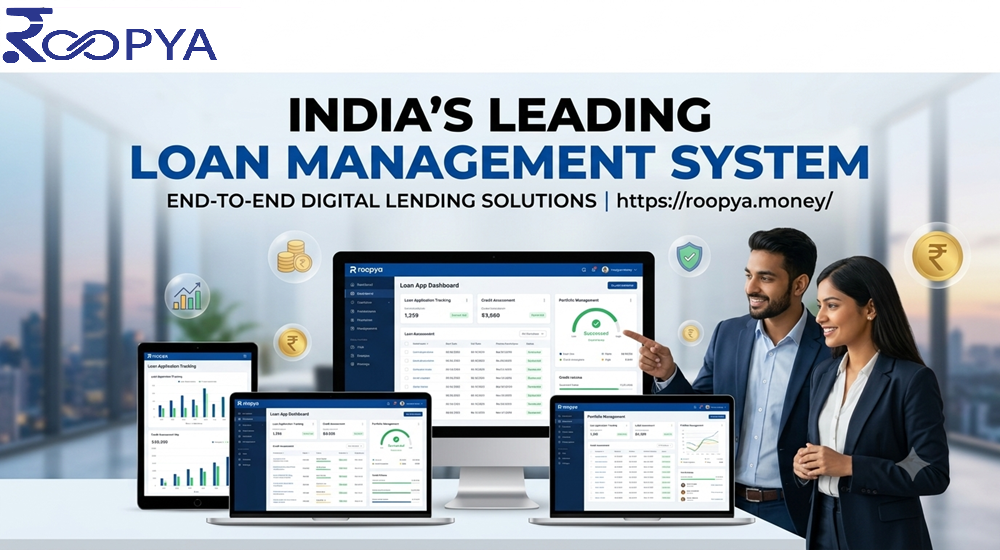
This guide is the most comprehensive resource available for any Indian lender — NBFC, bank, MFI, or fintech — looking to understand, evaluate, and select a Loan Management System. We will cover what an LMS does, which features matter most, how Roopya’s platform stands apart, and why the right choice today can compound into a meaningful competitive advantage over the next five years.
1. What Is a Loan Management System?
A Loan Management System is a software platform that manages the full post-disbursement lifecycle of a loan — from the moment money leaves the lender’s account to the moment the loan is fully repaid or written off. It is the operational core of a lending business, handling everything from EMI scheduling and repayment processing to collections, interest accrual, escrow management, regulatory reporting, and customer communication.
While a Loan Origination System (LOS) handles the front end of lending — application, underwriting, and sanction — the Loan Management System manages the back end: the ongoing, day-to-day servicing of an active loan portfolio. Together, LOS and LMS form the complete lending technology stack. Roopya is unique in India in offering both as a unified, no-code platform — eliminating the integration complexity that plagues lenders using separate systems for origination and servicing.
The scope of a modern LMS extends well beyond simple repayment tracking. Today’s loan management platforms must handle multi-product portfolios, complex interest calculation methodologies, dynamic repayment schedules, co-lending arrangements, regulatory capital reporting, and real-time borrower communication — all simultaneously, at scale, with zero tolerance for error.
2. Why Loan Management Is the Highest-Stakes Technology Decision for a Lender
Many lending executives focus their technology attention on the origination and disbursement stages — the exciting, growth-facing parts of the business. But in reality, the Loan Management System is where more value is created or destroyed than anywhere else. Consider:
- Revenue Integrity: Interest accrual, fee calculation, penalty computation, and prepayment handling must all be executed flawlessly. A bug in your LMS interest engine does not just affect one loan — it affects every active account, potentially for years.
- NPA Management: India’s gross NPA ratio remains a persistent challenge across the lending sector. Early identification of at-risk accounts, automated escalation of delinquent borrowers, and intelligent collections workflows are all functions of the LMS. A weak LMS means slower NPA recognition and higher credit losses.
- Regulatory Compliance: The RBI mandates precise, real-time reporting on loan portfolios — provisioning norms, income recognition rules (IRAC), CERSAI updates, credit bureau reporting, and more. An LMS that cannot generate accurate regulatory reports in a timely manner is an existential risk.
- Borrower Experience: Borrowers expect instant EMI receipts, real-time outstanding balance visibility, prepayment calculators, and responsive customer support. A manual or legacy LMS cannot deliver these experiences, leading to higher complaint rates and borrower churn.
- Operational Efficiency: Manual loan servicing is enormously expensive — requiring large teams for reconciliation, collections calling, statement generation, and compliance filing. A modern LMS automates all of these, reducing operational cost per account by 50–70%.
3. Core Modules of India’s Leading Loan Management System
3.1 Loan Account Setup and Disbursement Management
The foundation of any LMS is the ability to accurately set up a loan account at the point of disbursement. This includes recording all key loan parameters — principal amount, interest rate (fixed, floating, or reducing balance), tenure, repayment frequency (monthly, bi-monthly, weekly), moratorium period, processing fees, insurance premiums, and any other charges. The LMS generates a complete repayment schedule — typically in the form of an amortisation table — that defines exactly how much principal and interest is due on each payment date throughout the loan’s life.
Roopya’s LMS handles all standard and complex interest calculation methodologies including reducing balance, flat rate, and IRR-based calculations. It supports multiple disbursement structures — single disbursement, tranche-based disbursement for home loans and project finance, and revolving credit lines for working capital facilities.
3.2 EMI and Repayment Processing
The heart of a Loan Management System is repayment processing — accurately capturing, allocating, and accounting for every payment received from every borrower, every day. A robust LMS supports all payment channels: NACH/e-NACH mandates for auto-debit, UPI, NEFT/RTGS bank transfers, payment gateway integrations, cash collection at branches or via field agents, and cheque processing.
Critically, repayment allocation must follow the correct waterfall — typically applied in order of overdue charges, interest, and then principal — with full configurability for lenders who use different allocation sequences. Roopya’s repayment engine supports fully configurable allocation waterfall rules, ensuring accounting accuracy across diverse product types.
3.3 Interest Accrual and Financial Accounting
Daily interest accrual is one of the most computationally intensive functions of a Loan Management System. The LMS must calculate and post interest accrual entries for every active loan account every day — even weekends and holidays — ensuring that the balance sheet reflects the correct carrying value of the loan portfolio at all times.
Roopya’s LMS is tightly integrated with accounting functions, generating automatic journal entries for disbursements, repayments, accruals, fee income, and provisioning — eliminating the need for manual accounting reconciliation and reducing month-end close time dramatically.
3.4 Automated NACH and e-Mandate Management
For most Indian lenders, NACH (National Automated Clearing House) is the primary mechanism for collecting EMIs from borrowers. A modern LMS must seamlessly manage the full NACH lifecycle — mandate registration, presentation scheduling, success/failure tracking, bounce management, re-presentation logic, and mandate modification for restructured loans.
Roopya’s LMS is pre-integrated with all major NACH service providers, with automated presentation scheduling that maximises recovery rates while minimising unnecessary bounce charges. Failed NACH presentations automatically trigger collections workflows — no manual intervention required.
3.5 Collections and Delinquency Management
Collections management is where a Loan Management System’s value is most directly felt on the income statement. A sophisticated LMS automatically identifies delinquent accounts, segments them by bucket (0-30 DPD, 31-60 DPD, 61-90 DPD, and NPA), and assigns them to appropriate collections strategies — automated WhatsApp reminders and IVR calls for early delinquency, field agent visit allocation for severe delinquency, legal escalation workflows for NPA accounts.
Roopya’s collections module includes an intelligent allocation engine that assigns delinquent accounts to field agents based on geography, agent workload, and historical recovery rates. Digital field collection apps allow agents to record visits, capture payments, and update account status in real time — providing management with live collections dashboards.
3.6 Prepayment, Foreclosure, and Loan Restructuring
Borrowers regularly request prepayments, partial pre-closures, or full foreclosures. Each of these events requires precise recalculation of outstanding principal, accrued interest, prepayment penalty (where applicable), and a revised repayment schedule for partial prepayments. Handling these manually is error-prone and time-consuming. Roopya’s LMS automates the complete prepayment and foreclosure workflow — calculating the correct settlement amount, generating a No Objection Certificate (NOC) upon full repayment, and updating all downstream systems automatically.
Loan restructuring — a critical tool during economic stress or for RBI-mandated relief schemes — requires modifying key loan parameters: extending tenure, reducing interest rate, or granting a moratorium. Roopya’s restructuring module allows bulk portfolio restructuring with a few clicks, generating new amortisation schedules and regulatory disclosures automatically.
3.7 NPA Recognition and Provisioning
Under the RBI’s Income Recognition and Asset Classification (IRAC) norms, lenders must accurately classify loan accounts by asset quality — Standard, Special Mention Account (SMA-0, SMA-1, SMA-2), Sub-Standard, Doubtful, and Loss — and maintain the corresponding provisioning levels on their balance sheet. This is not optional; it is a non-negotiable regulatory requirement.
Roopya’s LMS automates IRAC classification, running daily asset quality assessment across the entire portfolio and flagging accounts approaching or crossing classification thresholds. Provisioning entries are generated automatically, and RBI reporting packs can be exported at the click of a button — eliminating weeks of manual spreadsheet work at quarter-end.
3.8 Co-Lending and Securitisation Support
Co-lending — where an NBFC and a bank jointly originate loans under the RBI’s co-lending model — requires sophisticated split accounting: tracking each party’s share of the principal, interest income, and credit risk at the individual loan level. Securitisation and direct assignment transactions require the LMS to maintain a shadow accounting view of transferred portfolios for servicing purposes.
Roopya’s LMS is one of very few platforms in India built to natively handle co-lending accounting, making it the preferred choice for NBFCs actively pursuing co-lending partnerships with public and private sector banks.
3.9 Customer Self-Service Portal and Communication
Modern borrowers expect 24/7 access to their loan account information — outstanding balance, next EMI date, payment history, interest certificate for tax purposes, and the ability to initiate prepayments or raise service requests. A Loan Management System that relies entirely on phone calls and branch visits for customer service is simply not competitive in today’s market.
Roopya’s LMS includes a fully branded customer self-service portal and mobile app, allowing borrowers to view their account, download statements and NOCs, make payments, and raise service requests — all without agent intervention. Automated communications via WhatsApp, SMS, and email keep borrowers informed at every stage of the loan lifecycle.
3.10 Regulatory Reporting and Compliance
A Loan Management System must generate a wide range of regulatory reports accurately and on time — credit bureau reporting to CIBIL, Experian, CRIF, and Equifax; CERSAI filing for secured loans; CIC data submission; RBI supervisory returns; and internal MIS reports for management and the board. Roopya’s LMS generates all standard regulatory reports in the required formats, with scheduling and automated submission capabilities that dramatically reduce the compliance team’s workload.
4. Advanced Capabilities That Separate Leading LMS Platforms
4.1 Portfolio Analytics and Early Warning System
The best Loan Management Systems do not just record what has happened — they predict what is about to happen. Roopya’s AI-powered portfolio analytics engine continuously monitors portfolio health indicators — payment velocity, bureau score trends, sector concentration, geographic spread, and vintage analysis — and generates early warning signals for accounts showing pre-delinquency behaviour. This allows credit and collections teams to intervene proactively, before a Standard account slips into SMA territory.
4.2 No-Code Configuration and Product Flexibility
Every lender has unique product parameters, fee structures, interest methodologies, and collections policies. A truly flexible Loan Management System allows business users — not IT developers — to configure these parameters through an intuitive interface. Roopya’s no-code configuration engine supports unlimited product variants, custom fee types, configurable repayment schedules, and policy-driven collections workflows — all without a single line of custom code.
4.3 Integration with Accounting and ERP Systems
The LMS cannot function in isolation. It must integrate bidirectionally with the lender’s core accounting system — whether Tally, SAP, Oracle Financials, or a custom ERP — ensuring that loan accounting entries are reflected accurately in the general ledger without manual re-entry. Roopya offers pre-built integrations with Tally and major accounting platforms, with an open API for custom ERP connections.
4.4 Multi-Branch and Multi-Geography Support
Lenders operating across multiple branches, states, or geographies need their LMS to enforce state-specific interest rate caps (particularly for microfinance), manage branch-level portfolios independently, and provide consolidated reporting at the entity level. Roopya’s LMS supports unlimited branch hierarchies and enforces product rules by geography — critical for MFIs and large NBFCs with pan-India operations.
5. Loan Management System vs. Loan Origination System: A Clear Distinction
These two terms are frequently conflated, particularly by lenders evaluating their technology stack for the first time. Here is the clearest way to think about the distinction:
A Loan Origination System (LOS) manages the pre-disbursement lifecycle — from borrower application through credit assessment, underwriting, sanctioning, and disbursement. A Loan Management System (LMS) manages the post-disbursement lifecycle — from the first EMI through final closure or write-off.
Most lenders need both, and the integration between them is critical. A borrower sanctioned in the LOS must be seamlessly set up in the LMS at disbursement, with all loan parameters transferred accurately. Roopya’s platform provides both LOS and LMS as a unified, integrated system — eliminating the integration gap, reducing data errors, and providing a single source of truth for the entire loan lifecycle.
6. Who Needs a Loan Management System?
The short answer: any institution that has an active loan portfolio. More specifically:
- NBFCs: Whether consumer finance, MSME lending, gold loans, or vehicle finance, NBFCs need a robust LMS to manage growing portfolios, meet RBI compliance obligations, and scale operations without proportional headcount growth.
- Banks: Public and private sector banks need LMS capabilities for their retail lending portfolios — personal loans, home loans, vehicle loans, and credit card receivables — often with higher volumes and more complex regulatory requirements than NBFCs.
- Microfinance Institutions (MFIs): MFIs have uniquely complex servicing needs — weekly repayment cycles, group lending structures, and operations in low-connectivity rural environments. Roopya’s LMS is specifically designed to handle MFI-specific workflows.
- Housing Finance Companies (HFCs): Long-tenor home loan portfolios with tranche disbursement, floating rate resets, and CERSAI obligations require specialised LMS capabilities that most generic platforms cannot deliver.
- Fintech Lenders: Digital-first lenders need a fully API-driven LMS that integrates seamlessly with their custom applications and provides real-time portfolio visibility through dashboards and data exports.
7. How Roopya’s Loan Management System Works in Practice
Roopya’s LMS is a cloud-native, no-code platform built from the ground up for Indian lending regulations and market conditions. Here is how it serves a typical lender:
- Loan Account Creation: At disbursement, all loan parameters flow automatically from the LOS to the LMS — no manual re-entry. The LMS generates the amortisation schedule, sets up the NACH mandate, and sends the borrower a welcome communication with their repayment schedule.
- Daily Operations: Each day, the LMS runs automated batch processes — interest accrual, NACH presentation, payment reconciliation, DPD computation, and early warning flag generation — without manual initiation.
- Collections Workflow: Delinquent accounts are automatically bucketed and assigned to appropriate collections strategies — WhatsApp nudges, IVR calls, or field agent visits — based on configurable rules.
- Customer Service: Borrowers access their account via self-service portal. Service requests are routed to the right team automatically, with SLA tracking.
- Regulatory Reporting: At month-end and quarter-end, compliance reports — credit bureau submissions, CERSAI updates, RBI returns — are generated automatically and submitted through integrated channels.
- Portfolio Analytics: Management accesses real-time dashboards showing portfolio health, collections performance, NPA trends, and early warning signals — from any device, at any time.
8. Benefits of Roopya’s Loan Management System
Dramatic Operational Cost Reduction
By automating the most labour-intensive functions of loan servicing — NACH management, payment reconciliation, interest accrual, statement generation, and collections — Roopya’s LMS enables lenders to manage significantly larger portfolios with the same or smaller teams. Customers report operational cost reductions of 50–70% compared to their previous manual or legacy systems.
Superior Portfolio Quality
Early warning systems, automated collections triggers, and intelligent account monitoring help lenders identify and address delinquency before it escalates. Lenders using Roopya’s LMS report measurable improvements in collections efficiency and NPA rates within the first year of implementation.
Regulatory Confidence
Automated IRAC classification, real-time provisioning computation, and scheduled regulatory report generation mean that compliance obligations are met consistently and accurately. Finance and compliance teams can focus on analysis rather than data compilation, and regulators find well-organised, complete submissions — reducing inspection risk.
Borrower Satisfaction
Self-service portals, proactive communication, instant receipts, and accurate account statements dramatically improve the borrower experience. Higher satisfaction translates to better renewal rates, referral business, and lower complaint volumes — all of which have direct revenue implications.
Scalability and Speed
Roopya’s cloud-native architecture scales automatically as your portfolio grows — from 1,000 accounts to 1,000,000, the platform performance remains consistent. New product types can be launched in days, new branches onboarded in hours, and new regulatory requirements implemented through configuration rather than custom development.
9. Key Questions to Ask When Evaluating a Loan Management System
- Does it support all the interest calculation methodologies relevant to your product portfolio — reducing balance, flat rate, daily accrual?
- Is NACH integration pre-built with all major NACH service providers, including bounce management and re-presentation logic?
- Can it handle your specific repayment frequency — weekly for MFI, monthly for personal loans, quarterly for business loans?
- Is IRAC classification and provisioning fully automated, with RBI-format regulatory reports available on demand?
- Does it support co-lending accounting if you have or plan to have co-lending arrangements?
- Can non-technical business users configure new products, fee types, and policies without IT involvement?
- Is the platform cloud-native and built to scale, or will performance degrade as your portfolio grows?
- What is the implementation timeline? Can you go live quickly, or are you looking at a 6–12 month implementation?
- What is the total cost of ownership, including implementation, licensing, and ongoing support?
10. The Future of Loan Management Systems in India
The next generation of Loan Management Systems in India will be defined by three major forces: artificial intelligence, open banking, and regulatory technology (RegTech).
Artificial intelligence will transform collections — moving from rule-based strategies to dynamic, ML-driven contact strategies that predict the optimal time, channel, and message for each individual delinquent borrower. AI will also power real-time fraud detection in repayment processing, identifying suspicious patterns before losses occur.
Open banking — driven by the Account Aggregator framework — will allow lenders to access real-time borrower financial data for proactive portfolio monitoring. Rather than waiting for a payment to miss, lenders will be able to identify liquidity stress in a borrower’s bank account days before an EMI due date, enabling proactive intervention.
RegTech will increasingly automate the compliance function — with real-time credit bureau submissions, automated CERSAI filings, and AI-generated regulatory reports replacing the manual, error-prone processes that still characterise compliance at many Indian lenders today.
Roopya is already building these next-generation capabilities into its platform — ensuring that lenders who choose Roopya today are investing in a system that will remain competitive for the decade ahead.
11. Why Roopya Is India’s Leading Loan Management System
Roopya was purpose-built for the Indian lending market. It understands India’s regulatory framework, India’s payment infrastructure, India’s borrower demographics, and India’s unique product complexity. This is not a global platform that has been adapted for India — it is an Indian platform built from day one for India’s lenders.
- 1-Day Go-Live: Pre-configured product templates, pre-built integrations, and a no-code setup interface mean most lenders can go live within 24 hours.
- Complete LOS + LMS: Roopya uniquely offers both loan origination and loan management as a single, integrated platform — eliminating the data gaps and integration costs of using separate systems.
- 300+ Pre-Integrated APIs: Every major payment provider, bureau, KYC service, NACH platform, and accounting system is pre-connected.
- No-Code Configuration: Business users configure products, fees, workflows, and policies independently — no developer or IT team required.
- Pay-As-You-Use Pricing: Zero upfront costs. No capital expenditure. You pay only for what you process — making Roopya accessible at every stage of growth.
- RBI-Compliant by Design: IRAC classification, provisioning computation, credit bureau reporting, CERSAI integration, and regulatory report generation are all built in as standard features.
- AI-Powered Portfolio Intelligence: Real-time early warning systems, collections optimisation, and predictive analytics are native capabilities — not expensive add-ons.
- Trusted Across India: IndiaKaLoan, QuickFinShop, Recapita, Findoc, EazyCredit, and dozens of other leading lenders manage their portfolios on Roopya today.
If you are ready to replace your legacy LMS or build a loan servicing operation that can grow without limits, Roopya offers a free demo and a no-obligation trial. Go live in a day. Manage every loan with confidence.

