Loan Management System (LMS): Complete Guide for NBFCs & Fintech

In today’s fast-evolving financial ecosystem, lending businesses are rapidly shifting from manual processes to digital-first solutions. A Loan Management System (LMS) has become the backbone of modern lending, helping NBFCs, fintech companies, and banks manage loans efficiently from disbursement to closure.
If your lending business still relies on spreadsheets or outdated software, you are already behind the competition. Modern borrowers expect instant approvals, seamless repayment tracking, and digital experiences, and that’s exactly what an advanced LMS delivers.
Platforms like Roopya Loan Management System are transforming how lenders operate by offering AI-powered, cloud-based, and fully automated lending infrastructure.
Start Free Trial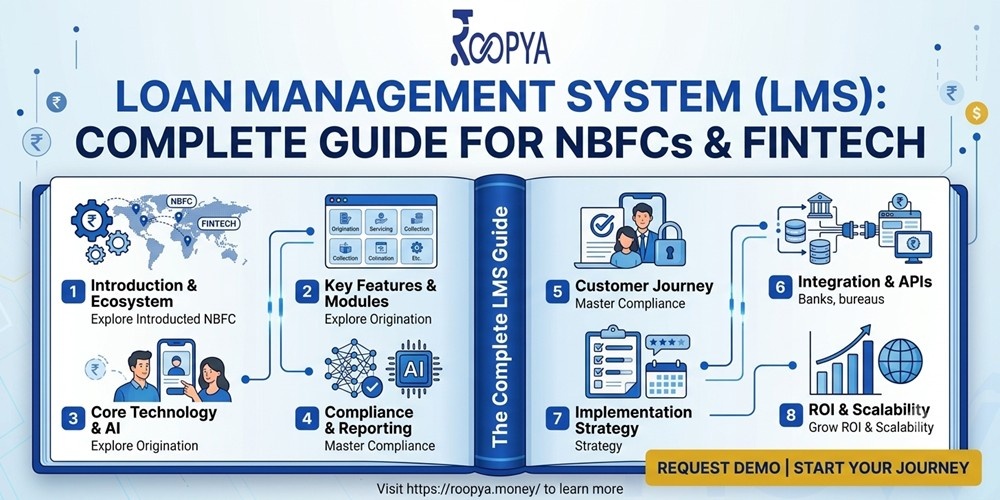
What is a Loan Management System (LMS)?
A Loan Management System (LMS) is a digital platform designed to automate and manage the entire lifecycle of a loan—from application and disbursement to repayment, collections, and closure.
It acts as a centralized system where lenders can:
- Track loan accounts
- Manage EMIs and repayments
- Handle collections and overdue accounts
- Generate reports and analytics
In simple terms, LMS ensures that every loan is accurately tracked, efficiently managed, and compliant with regulations.
How Loan Management System Works
A modern LMS works across multiple stages of the lending lifecycle:
1. Loan Origination & Disbursement
- Digital application processing
- KYC verification
- Credit scoring and approval
- Loan disbursement
2. Loan Servicing
- EMI schedule generation
- Interest calculation
- Account management
- Payment tracking
3. Repayment & Collections
- Automated reminders (SMS, Email, WhatsApp)
- Late payment tracking
- Collection workflows
4. Closure & Reporting
- Loan closure
- NOC generation
- Financial reporting
Once a loan is disbursed, LMS takes over and manages everything until repayment is completed, ensuring financial accuracy and operational efficiency.
Key Features of a Modern Loan Management System
A powerful LMS is not just software—it’s a complete lending ecosystem. Here are the must-have features:
1. AI-Powered Credit & Risk Management
- Automated credit scoring
- Fraud detection
- Predictive analytics
Modern LMS platforms use AI to reduce risk and improve approval accuracy.
2. Cloud-Based Infrastructure
- 99.9% uptime
- Scalability
- Data security
Cloud-native LMS solutions enable lenders to scale operations without infrastructure limitations.
3. EMI & Payment Management
- Automated EMI scheduling
- Multiple payment modes (UPI, NACH, NEFT)
- Real-time payment tracking
4. Document & Data Management
- Centralized document storage
- OCR-based data extraction
- Secure digital records
5. Analytics & Reporting
- Real-time dashboards
- Portfolio performance tracking
- NPA & risk analysis
6. Customer Self-Service Portal
- Loan account dashboard
- EMI payment history
- Download statements
7. Compliance & Regulatory Support
- RBI reporting
- Audit trails
- Data security
An LMS helps lenders stay compliant with financial regulations and avoid penalties.
Benefits of Loan Management System for NBFCs & Fintech
1. Faster Loan Processing
Automation reduces approval time from days to minutes, improving customer experience.
2. Reduced Operational Costs
Manual work is minimized, saving time and resources.
3. Better Portfolio Management
Real-time insights help lenders monitor loan performance and reduce NPAs.
4. Improved Collection Efficiency
Automated reminders and tracking improve repayment rates.
5. Enhanced Compliance & Security
Built-in compliance ensures adherence to RBI guidelines and data protection laws.
6. Improved Customer Experience
Borrowers get:
- Instant approvals
- Transparent loan tracking
- Digital repayments
LMS vs Traditional Loan Management
| Feature | Traditional System | Modern LMS |
|---|---|---|
| Processing Speed | Slow | Instant |
| Data Management | Manual | Automated |
| Risk Analysis | Limited | AI-driven |
| Customer Experience | Poor | Digital-first |
| Scalability | Low | High |
Traditional systems create inefficiencies, while LMS provides automation, accuracy, and scalability.
LMS vs LOS: What’s the Difference?
Many lenders confuse LMS with LOS (Loan Origination System). Here’s a simple breakdown:
- LOS (Loan Origination System): Handles loan application → approval
- LMS (Loan Management System): Handles post-disbursement → repayment
Both systems work together to create a complete digital lending ecosystem.
Why NBFCs Need Loan Management System
The Indian lending market is growing rapidly, and competition is increasing. NBFCs that adopt LMS gain a significant advantage:
- Faster loan approvals
- Better customer retention
- Lower default rates
- Higher operational efficiency
Without LMS, managing multiple borrowers, repayments, and compliance becomes complex and error-prone.
Latest Trends in Loan Management Systems
AI & Machine Learning
AI is revolutionizing lending with:
- Smart credit scoring
- Fraud detection
- Predictive analytics
API-Based Lending
Modern LMS integrates with:
- Credit bureaus
- Payment gateways
- KYC APIs
Mobile-First Lending
Borrowers now prefer:
- Mobile applications
- Instant loan approvals
- Digital payments
Cloud-Based Systems
Cloud LMS platforms are replacing legacy systems due to:
- Flexibility
- Scalability
- Cost efficiency
Cost of Loan Management System in India
The cost of LMS varies depending on:
- Features
- Customization
- Scale
Modern platforms offer pay-as-you-use models, making LMS affordable for startups and NBFCs.
How to Choose the Best Loan Management System
Before selecting an LMS, consider:
✅ 1. Scalability
Can it grow with your business?
✅ 2. Integration
Does it support APIs (KYC, payment, credit bureau)?
✅ 3. Automation
Does it reduce manual work?
✅ 4. Compliance
Is it aligned with RBI regulations?
✅ 5. User Experience
Is it easy for both lenders and borrowers?
Why Choose Roopya Loan Management System?
The Roopya Loan Management System stands out as a next-generation LMS designed for NBFCs and fintech companies.
Key Advantages:
- No-code configuration
- AI-powered decision engine
- Cloud-native platform
- End-to-end lending lifecycle management
- Advanced analytics & reporting
It enables lenders to launch, manage, and scale their lending operations faster than ever.
A Loan Management System (LMS) is no longer optional—it’s essential for any lending business looking to survive and grow in 2026.
From automation and compliance to AI-driven insights and customer experience, LMS transforms traditional lending into a smart, scalable, and digital-first ecosystem.
If you want to stay ahead in the competitive NBFC and fintech space, investing in a powerful LMS like Roopya is the smartest decision you can make.
Ready to transform your lending business?
Visit https://roopya.money/ and request a FREE DEMO today!

