Loan Management System vs Manual Processing: Which Is Better?

The lending industry in India is undergoing a seismic transformation. With the rise of NBFCs, fintechs, and digital lenders, the volume of loan applications processed each day has grown exponentially. Yet, many financial institutions still rely on manual processes — spreadsheets, physical files, and email chains — to manage their entire loan lifecycle.
This raises a critical question: Is manual loan processing still viable in 2026, or is a Loan Management System (LMS) the definitive answer for lenders who want to scale, comply, and compete?
In this article, we break down the key differences between a Loan Management System and manual processing across every dimension that matters — speed, cost, accuracy, compliance, and customer experience — so you can make a fully informed decision.
Start Free Trial
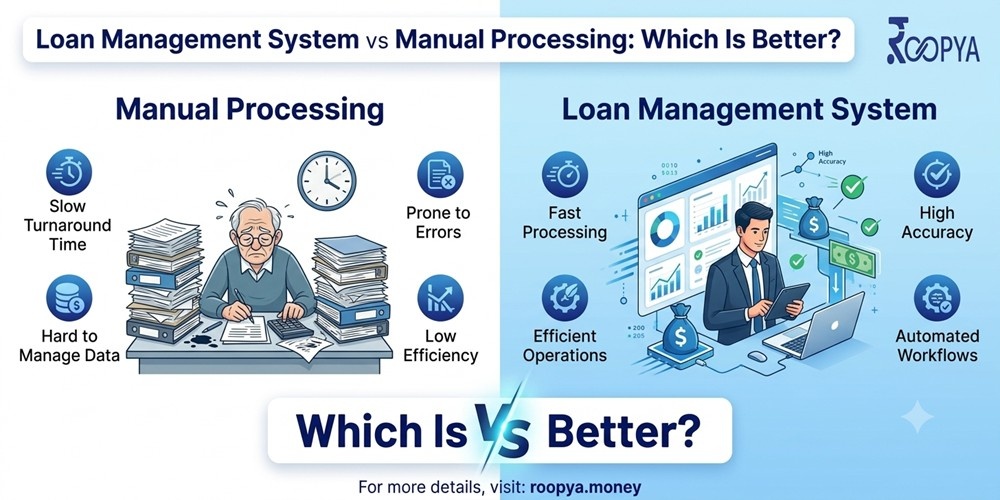
What Is Manual Loan Processing?
Manual loan processing refers to managing the end-to-end lending lifecycle — from application intake to disbursement and collections — using human effort and non-automated tools like spreadsheets, paper forms, emails, and disconnected databases.
While this approach was the industry norm for decades, it comes with significant operational limitations as loan volumes grow:
- High dependency on individual staff for every step of the loan lifecycle
- Error-prone data entry across multiple touchpoints
- Slow turnaround times that frustrate borrowers
- Difficult to maintain regulatory audit trails
- Near-impossible to scale without proportional headcount increase
- Poor visibility into portfolio performance in real time
What Is a Loan Management System (LMS)?
A Loan Management System is purpose-built digital software that automates and centralises the management of loans — from application and origination through servicing, repayment, and collections. Modern LMS platforms, like Roopya’s, are cloud-native, no-code, and integrated with hundreds of APIs for credit bureaus, payment gateways, KYC providers, and more.
Key capabilities of a modern LMS include:
- Automated repayment schedules and amortisation calculations
- Real-time portfolio dashboards and analytics
- Integrated payment processing and reconciliation
- Regulatory compliance management and audit trails
- Customer portal for self-service loan management
- Early warning systems to predict potential defaults
- Configurable business rules with no coding required
Head-to-Head Comparison: LMS vs Manual Processing
The table below summarises the critical differences across ten key dimensions lenders must consider:
| Feature | Manual Processing | Loan Management System (LMS) |
| Loan Processing Speed | 3–10 business days | Minutes to hours |
| Error Rate | High (human entry) | Near-zero (automated) |
| Scalability | Limited by headcount | Unlimited via automation |
| Compliance Tracking | Manual, error-prone | Automated, audit-ready |
| Cost Per Loan | High operational cost | Significantly reduced |
| Data Security | Vulnerable to loss/breach | Encrypted, role-based access |
| Customer Experience | Slow, inconsistent | Fast, digital, transparent |
| Real-time Reporting | Not available | Instant dashboards |
| Integration | Siloed systems | 300+ pre-integrated APIs |
Deep Dive: Where Manual Processing Falls Short
1. Speed and Turnaround Time
In a competitive lending market, turnaround time is a differentiator. Manual loan processing typically takes three to ten business days because each step — verification, credit assessment, documentation, approval — requires human action at every stage. Borrowers today expect decisions in hours, not days. An LMS automates each stage sequentially, reducing loan processing time from days to minutes.
Roopya’s platform, for instance, delivers a 10x faster processing speed by automating document verification, credit decisioning, and disbursement initiation in a single unified workflow.
2. Error Rates and Data Accuracy
Manual data entry is inherently error-prone. A misplaced decimal, a wrong account number, or an overlooked repayment schedule can lead to significant financial and reputational damage. Studies across the global lending industry consistently show that manual processing introduces data errors at rates between 1% and 4% of all records — which translates to real losses at scale.
An LMS eliminates manual data entry at every step. Data flows automatically from application forms to credit engines to disbursement systems, with validation rules preventing invalid entries in real time.
3. Regulatory Compliance
For NBFCs operating under RBI guidelines, compliance is non-negotiable. Manual processes make maintaining complete audit trails extremely difficult. Documents get lost, approvals go unlogged, and generating regulatory reports becomes a time-consuming exercise every quarter.
A modern LMS like Roopya keeps every interaction — every approval, every override, every communication — timestamped and stored in a tamper-proof audit log. Regulatory reports can be generated in seconds rather than days, ensuring that your institution is always inspection-ready.
4. Scalability
This is where manual processing faces its most fundamental limitation. As loan volumes grow, manual operations require proportionally more staff, more training, and more oversight. Hiring and training cycles slow down growth, and the marginal cost of each additional loan remains stubbornly high.
An LMS scales on infrastructure, not headcount. Whether you are processing 100 loans per month or 100,000, the same platform handles the workload — with no proportional increase in cost or error rate. This elastic scalability is what enables modern fintechs and NBFCs to grow at pace without operational chaos.
5. Customer Experience
Today’s borrowers — particularly the digitally native millennial and Gen Z segment that drives retail and MSME lending growth — expect the same experience from their lender that they get from a food delivery app: instant, transparent, and mobile-first. Manual processing cannot deliver this.
A good LMS provides borrowers with a self-service portal to track their loan status, view repayment schedules, make payments, and raise queries — all without picking up a phone or visiting a branch. This dramatically improves satisfaction, reduces customer service overhead, and drives repeat business.
6. Cost Per Loan
When the full cost of manual processing is accounted for — staff salaries, paper and printing, error correction, compliance penalties, and the cost of slow turnaround leading to lost customers — the cost per loan can be three to five times higher than an automated alternative. An LMS amortises its cost across every loan processed, driving the marginal cost steadily toward zero as volume grows.
Roopya’s pay-as-you-use pricing model means lenders do not pay large upfront licensing fees. You pay for what you process, making the ROI case exceptionally clear from day one.
Why NBFCs and Modern Lenders Are Switching to LMS
Across India, a growing number of NBFCs, microfinance institutions, and digital-first lenders are migrating from spreadsheet-based workflows to full-stack LMS platforms. The drivers are consistent:
- RBI’s increasing scrutiny of digital lending practices has made compliance automation mandatory, not optional
- Borrower expectations for instant decisions and digital journeys are now baseline requirements
- Competition from fintech lenders with fully automated stacks is forcing traditional institutions to modernise
- The cost economics of manual processing become untenable beyond a few hundred loans per month
- Investor and board-level demand for real-time portfolio visibility requires digital infrastructure
How Roopya’s LMS Solves the Problem
Roopya is India’s leading digital lending infrastructure platform, offering a unified LOS (Loan Origination System) and LMS (Loan Management System) designed specifically for modern lenders — NBFCs, banks, MFIs, and DSAs.
Here is what sets Roopya apart from generic lending software:
- Go live in just one day — the fastest onboarding in the industry
- Zero upfront cost — pay only for what you process
- 300+ pre-integrated APIs including credit bureaus, payment gateways, and KYC providers
- Truly no-code platform — business users configure everything without developer support
- AI-powered document analysis with 99%+ accuracy and real-time fraud detection
- Built-in compliance engine that stays current with RBI and regulatory changes
- Early warning system with predictive analytics to reduce default risk proactively
Roopya’s clients report up to 80% reduction in fraud, 60% improvement in collections performance, and 40% better credit scoring accuracy compared to their previous manual or legacy systems.
When Might Manual Processing Still Make Sense?
In the interest of balance, it is worth acknowledging that manual processing may still be appropriate in very limited scenarios:
- Micro-lenders processing fewer than 20 loans per month with no growth ambitions
- Community-based lending groups without any regulatory obligations
- Pilot programmes testing new loan products before committing to automation
However, even in these cases, the availability of affordable, pay-per-use LMS platforms like Roopya makes the business case for automation compelling from nearly any starting point.
Conclusion: The Verdict Is Clear
The comparison between a Loan Management System and manual processing is not really a debate in 2026 — it is a foregone conclusion. Manual processing carries structural limitations in speed, accuracy, compliance, scalability, and cost that make it increasingly incompatible with the demands of modern lending.
A well-implemented LMS does not just replace manual effort — it transforms lending operations into a strategic advantage. It enables lenders to process more loans, with fewer errors, at lower cost, while delivering the digital experience that borrowers now demand as a baseline.
For NBFCs and modern lenders in India looking to compete and grow, the question is not whether to adopt a Loan Management System. The question is: how quickly can you make the switch?
Roopya makes that transition faster and more affordable than any other platform in the market — with a one-day go-live, zero upfront cost, and a comprehensive suite of lending tools designed to take you from origination to collections in a single, unified platform.
Ready to replace manual processing with an intelligent LMS? Visit roopya.money to request a free demo.

