How to Migrate from Legacy Lending Systems to Roopya A Step-by-Step Guide for NBFCs, Banks & MFIs

There is a moment every lender eventually reaches — a moment when the software that once felt adequate starts to feel like an anchor. Reports take forever to generate. New loan products require months of IT involvement. Integration with a bureau or a new KYC provider means expensive development sprints. Every regulatory change triggers a panic. And somewhere in the background, competitors who have moved to modern platforms are processing applications in seconds while your team is still entering data into spreadsheets.
If any of that sounds familiar, you are not alone. A large proportion of India’s NBFCs, co-operative banks, MFIs, and even mid-size scheduled banks are still running loan operations on legacy systems — software that was built a decade or more ago, before APIs, cloud infrastructure, AI, and digital KYC changed what lending technology could do. These systems were not failures when they were built. They were the best available option. But the lending world has moved on, and legacy systems have not moved with it.
The good news is that migrating to a modern, no-code lending platform like Roopya is no longer a years-long, high-risk project. With the right approach, the right partner, and a clear understanding of what migration actually involves, lenders can move from legacy infrastructure to a next-generation platform without data loss, without operational disruption, and without the horror stories that used to define system migrations.
Start Free Trial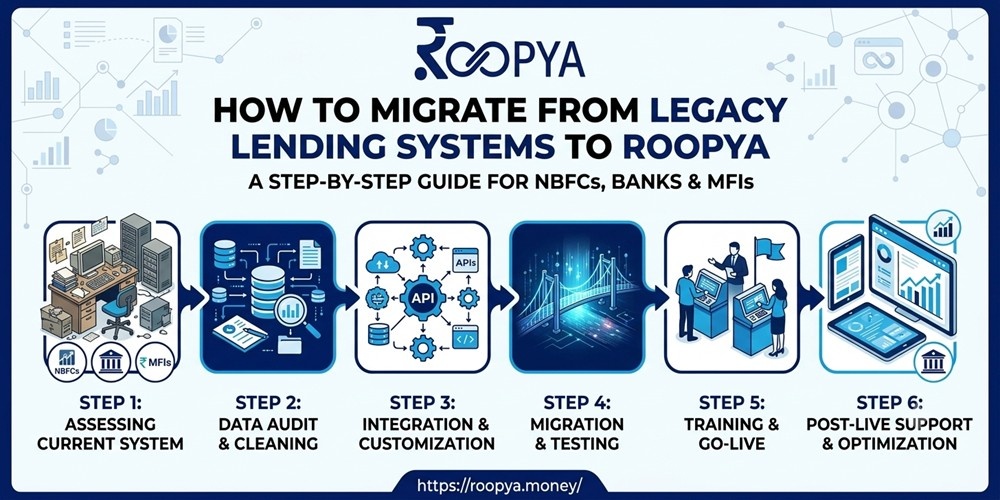
This guide walks you through everything — why legacy systems hold lenders back, what Roopya offers as a replacement, and exactly how to plan and execute a migration that is smooth, fast, and built to last.
1. The Real Cost of Staying on a Legacy Lending System
Before discussing how to migrate, it is worth being clear-eyed about what staying costs — because the costs of inaction are often invisible until they become catastrophic.
1.1 Lost Business to Faster Competitors
Modern digital lenders using no-code platforms like Roopya can approve and disburse a personal loan in under 15 minutes. If your legacy system takes two to three days to process the same application — because of manual data entry, offline bureau checks, or paper-based KYC — you are not competing in the same race. Borrowers, particularly millennials and Gen Z applicants, will not wait. They apply with whoever responds first.
1.2 Compounding Operational Costs
Legacy systems are expensive to maintain in ways that rarely show up on a single line item. There is the ongoing licensing cost of the old software. There is the cost of the IT team required to keep it running. There is the cost of manual workarounds — the spreadsheets, the WhatsApp groups, the offline trackers — that your operations team uses to compensate for what the system cannot do. There is the cost of errors that arise from manual data entry. Add it all up, and legacy system maintenance often costs more than migration would.
1.3 Regulatory Risk
India’s lending regulatory environment is not static. RBI guidelines on digital lending, KYC norms, fair practice codes, and data localisation have evolved significantly in recent years and will continue to evolve. Legacy systems, built on older architecture with limited configurability, struggle to accommodate regulatory changes quickly. Each new RBI circular becomes an IT project. Each compliance deadline becomes a scramble. Modern platforms like Roopya are continuously updated for regulatory changes — so the compliance burden shifts from your internal team to your software provider.
1.4 Inability to Launch New Products
One of the clearest signs that a legacy system is limiting your business is how long it takes to launch a new loan product. On a modern no-code platform, a new loan product — with its own eligibility rules, documentation requirements, credit policy, and borrower journey — can be configured and launched in a day. On a legacy system, the same task typically requires weeks of development, testing, and deployment. Every product launch delay is a revenue opportunity missed.
1.5 Integration Debt
The Indian lending ecosystem now runs on APIs — credit bureaus, account aggregators, eSign providers, payment gateways, GST data, bank statement analysers, insurance platforms, and dozens more. Legacy systems, built before API-first architecture was standard, typically have poor or no integration with modern data providers. Each new integration requires custom development, which adds to what the industry calls ‘integration debt’ — a growing backlog of connectivity problems that slows everything down.
2. Why Roopya Is the Right Migration Destination
Not every modern lending platform is a suitable migration destination for every lender. The right platform must be powerful enough to handle your full operational complexity, flexible enough to accommodate your specific credit policy, and practical enough to deploy without a 12-month implementation programme. Roopya meets all three criteria, and several more specific to the Indian market.
2.1 Built Specifically for Indian Lending
Roopya was designed from the ground up for India’s regulatory environment, India’s data ecosystem, and India’s borrower demographics. It is not a global platform adapted for India. It natively supports Aadhaar eKYC, PAN verification, CIBIL and Experian bureau pulls, Digilocker, GST-based underwriting, Account Aggregator integration, and RBI-mandated audit trails. For an Indian NBFC or bank migrating from a legacy system, Roopya requires far less customisation than any international platform would.
2.2 No-Code Configuration
Legacy system migrations have historically been painful partly because new systems also required significant technical implementation. Roopya breaks this cycle. Its no-code architecture means that credit policy rules, loan product configurations, borrower journey steps, and operational workflows are all configurable through an intuitive visual interface — no coding required. Your business and operations teams can own the configuration without depending on developers.
2.3 300+ Pre-Integrated APIs
One of the biggest headaches in a legacy migration is rebuilding integrations. With Roopya, this problem largely disappears. The platform ships with 300+ pre-integrated APIs covering every category you need — credit bureaus (CIBIL, Experian, Equifax, CRIF), KYC providers, eSign platforms, payment gateways, accounting software, bank statement analysers, insurance platforms, and more. You do not rebuild integrations; you inherit them.
2.4 1-Day Go-Live Capability
For lenders nervous about downtime during migration, Roopya’s ability to go live within a single day is a game-changer. New loan products and channels can be launched on Roopya while your legacy system continues to service the existing portfolio — a parallel running approach that eliminates operational risk entirely. The cutover happens on your schedule, not the platform’s.
2.5 Pay-As-You-Use Pricing
Legacy system migrations have sometimes failed because of the enormous upfront cost of the replacement system — capital expenditure that was hard to justify before the benefits were proven. Roopya’s pay-as-you-use pricing model eliminates this barrier. There are no large upfront licence fees. You pay based on actual usage, and the investment scales with your business rather than preceding it.
3. Pre-Migration: Assessing Your Current System
A successful migration begins not with the new platform, but with a thorough understanding of the old one. Before you can move forward, you need to know exactly what you are moving from. This assessment phase is often underinvested but is foundational to everything that follows.
3.1 Catalogue Your Current System’s Functions
Create a comprehensive inventory of what your legacy system currently does. This should include every loan product it handles, every integration it maintains, every report it generates, every workflow it automates, and every manual workaround that compensates for what it cannot do. Do not rely on documentation alone — documentation for legacy systems is almost always incomplete or outdated. Interview your operations, credit, technology, compliance, and collections teams to build a complete picture.
3.2 Assess Your Data
Data is the most complex element of any migration. You need to understand: how much historical loan data exists, what format it is in, how clean it is, what fields are used consistently versus sporadically, and what the business and regulatory requirements are for data retention. In India, RBI requires certain loan records to be retained for specific periods. Your migration must preserve this data in a format that meets regulatory requirements and remains queryable for audits, collections, and reporting.
3.3 Identify Integration Dependencies
Map every external system and data provider your current platform connects to. This includes credit bureaus, KYC providers, core banking systems, accounting platforms, collection systems, insurance integrations, and internal databases. Understand which of these integrations are critical to daily operations and which are secondary. Roopya’s pre-integration library will resolve most of these automatically, but you need the map to confirm coverage.
3.4 Define Your Success Criteria
Before beginning migration, define what success looks like — specifically and measurably. This might include: all active loan accounts accessible in the new system by a specific date, no disruption to EMI collections during the transition, new loan application processing fully live on Roopya within 30 days, zero data loss in migration, and all integrations functioning at go-live. Clear success criteria make migration progress measurable and prevent scope creep.
4. Planning the Migration: The Roopya Migration Framework
Roopya’s implementation team works with migrating lenders through a structured five-phase migration framework designed to minimise risk while accelerating deployment. Here is how it works:
Phase 1: Discovery and Design (Week 1–2)
Roopya’s implementation team conducts a deep-dive discovery session with your technology, operations, credit, and compliance stakeholders. The output is a detailed Migration Blueprint covering: the complete list of loan products to be configured on Roopya, the credit policy parameters and BRE rules to be implemented, the integrations to be activated, the data migration scope and approach, the go-live timeline and parallel-run strategy, and the training and change management plan.
Phase 2: Platform Configuration (Week 2–3)
Using the Migration Blueprint, Roopya configures your instance of the platform. This includes setting up all loan product journeys, configuring the Business Rule Engine with your credit policy, activating required integrations, customising borrower-facing interfaces with your branding, configuring user roles and access controls, and setting up reporting dashboards. Because Roopya is a no-code platform, this configuration is done through the visual interface — not through code — which dramatically compresses the timeline compared to traditional implementations.
Phase 3: Data Migration (Week 3–4)
This is typically the most technically complex phase. Roopya’s data engineering team extracts data from your legacy system, transforms it into Roopya’s data schema, and loads it into your new instance through a secure, validated migration pipeline. Key steps include: data extraction from the legacy system (via database export, API, or flat file, depending on what the legacy system supports), data cleansing and standardisation, schema mapping and transformation, validation against defined rules, and a reconciliation check to confirm completeness and accuracy before go-live.
For lenders with large, complex portfolios, Roopya supports staged data migration — migrating closed accounts and historical records first, then migrating active accounts in a final cutover window that is planned to minimise operational impact.
Phase 4: Testing and Parallel Running (Week 4–5)
Before go-live, Roopya runs a comprehensive testing programme covering functional testing of all configured loan products and workflows, integration testing of all activated APIs, user acceptance testing (UAT) with your team, performance testing under expected application volumes, and compliance validation of audit trail and reporting outputs.
Many lenders choose to run Roopya in parallel with their legacy system for a short period — typically two to four weeks — processing new applications on Roopya while the legacy system continues to service the existing portfolio. This approach eliminates go-live risk entirely and gives your team time to build confidence in the new platform before full cutover.
Phase 5: Go-Live and Hypercare (Week 5–6)
Roopya’s go-live process is designed to be a non-event. With thorough configuration, clean data migration, and a proven testing programme behind you, the cutover is a planned, controlled transition rather than a crisis. Roopya provides dedicated implementation support during the first two to four weeks post-go-live — a hypercare period during which any issues are resolved immediately and your team receives hands-on support as they build operational fluency on the new platform.
5. Data Migration in Depth: What Moves, What Stays, What Gets Left Behind
Data migration deserves its own detailed discussion because it is the element of system migration that causes the most anxiety — and the most problems when not handled carefully.
5.1 What Moves to Roopya
- Active Loan Accounts: All open loan accounts — including outstanding principal, accrued interest, payment history, and account status — are migrated to Roopya’s loan management module.
- Borrower Master Data: All borrower profiles including personal information, KYC data, contact details, and relationship history are migrated and available in the new system.
- Historical Loan Records: Closed loan accounts are migrated for regulatory compliance, portfolio analytics, and collections reference.
- Document Repository: Where the legacy system stores digital documents (KYC documents, loan agreements, sanction letters), these are migrated to Roopya’s secure document store.
- Transaction History: EMI payment records, prepayment transactions, and fee collections are migrated to maintain a complete financial history for each borrower.
5.2 What Gets Rebuilt, Not Migrated
- Business Rules: Credit policy rules are reconfigured on Roopya’s BRE rather than migrated from the legacy system, since the underlying logic is better expressed in Roopya’s no-code rule engine.
- Integrations: Connections to bureaus, KYC providers, and other data sources are re-established through Roopya’s pre-integrated API library rather than carried over from the legacy system.
- Reports and Dashboards: Reporting is rebuilt on Roopya’s native analytics engine, which offers significantly more capability than most legacy systems.
5.3 Data Quality: The Hidden Migration Risk
The most common cause of migration delays and problems is not technical — it is data quality. Legacy systems accumulate years of inconsistent, incomplete, and sometimes contradictory data. Duplicate borrower records, missing fields, non-standardised formats, and inaccurate account status flags are common. Roopya’s data migration team performs a data quality assessment before migration begins, identifies issues, and works with your team to resolve them. Investing time in data cleansing before migration dramatically reduces risk during the migration itself.
6. Change Management: The Human Side of Migration
Technology migrations fail less often because of technical problems than because of people problems. Your operations team, credit team, collections team, and branch staff will need to learn a new system, adapt their workflows, and trust a new platform with their day-to-day work. Getting this right requires deliberate change management.
6.1 Stakeholder Communication
From the moment a migration decision is made, communicate proactively with every team that will be affected. Explain why the migration is happening, what will change, what will stay the same, and what the timeline looks like. Uncertainty breeds resistance; transparency builds buy-in.
6.2 Role-Based Training
Roopya provides role-based training for every user type — operations executives, credit underwriters, branch managers, compliance officers, and senior management. Training is delivered through a combination of live sessions, recorded walkthroughs, and a sandbox environment where users can practise without affecting live data. Most users reach comfortable operational proficiency within three to five days of training.
6.3 Champions and Super-Users
Identify two or three internal champions in each business unit — people who are curious about the new system, willing to learn it deeply, and capable of helping their colleagues. These super-users become the first line of internal support post-go-live, reducing the support burden on your IT team and Roopya’s implementation team while accelerating adoption across the organisation.
6.4 Feedback Loops
In the weeks following go-live, create structured feedback channels for users to report issues, suggest improvements, and share their experience. This is not just good practice — it is valuable intelligence about how your Roopya configuration might be optimised. Many lenders find that the first few weeks of live operations surface small configuration improvements that make the system significantly more comfortable for their teams.
7. Common Migration Concerns — and How Roopya Addresses Them
‘We cannot afford downtime during the migration.’
Roopya’s parallel-run approach eliminates operational downtime entirely. New applications are processed on Roopya from day one of the parallel-run period, while your legacy system continues to service the existing portfolio. The cutover of the portfolio itself is planned during a low-activity window — typically a weekend — and is supported by Roopya’s implementation team throughout.
‘Our data is in a terrible state. We’re worried about migration accuracy.’
Roopya’s data engineering team has migrated data from dozens of legacy systems and is experienced in handling poor-quality data. The migration process includes a data quality audit, a cleansing phase, and a multi-step validation process before any data enters the production system. Nothing goes live without reconciliation checks confirming completeness and accuracy.
‘We have very specific credit policy rules that a standard platform cannot handle.’
Roopya’s Business Rule Engine is designed for exactly this challenge. It can express arbitrarily complex, multi-variable credit policy rules through its visual interface. If your credit policy has been the reason you stayed on a legacy system — because previous platforms could not handle your rules — Roopya’s BRE is likely to change your assessment.
‘We are worried about regulatory compliance during the transition.’
Roopya maintains complete audit trails from day one. Every action in the system — application processing, credit decisions, document access, user activity — is logged with timestamps and user attribution. Regulatory reports can be generated for any period, including periods during which data was migrated from the legacy system. Your compliance posture improves immediately upon going live on Roopya.
‘We have tried migrations before and they failed.’
This concern is the most understandable of all. Legacy migrations have a poor reputation, and for good reason — many have been poorly planned, underresourced, and technically ambitious in ways that exceeded the capability of both the lender and the platform. Roopya’s migration framework is designed with this history in mind. The five-phase approach, the parallel-run strategy, and the hypercare period are all specifically designed to eliminate the failure modes that have sunk previous migrations.
8. Life After Migration: What Changes When You Move to Roopya
The benefits of a successful migration are felt immediately and compound over time. Here is what lenders typically experience in the weeks and months following go-live on Roopya:
- Application processing time drops from days to minutes. Automated KYC, instant bureau pulls, and AI-powered document analysis eliminate the manual steps that caused delays.
- Operational headcount requirements reduce. Tasks that previously required dedicated data entry and document processing staff are fully automated on Roopya. Teams can be redeployed to higher-value activities.
- New product launches go from months to days. With Roopya’s no-code product configuration, your credit and product teams can launch new loan products independently of IT — in hours, not months.
- Compliance burden decreases significantly. Automated audit trails, built-in regulatory reporting, and RBI-aligned platform updates eliminate the compliance scramble that characterises legacy system operations.
- Data quality and visibility improve dramatically. Roopya’s analytics and reporting capabilities give management real-time visibility into portfolio performance, application funnel metrics, and operational KPIs that legacy systems could never provide.
- Borrower experience transforms. A mobile-first, paperless, real-time application journey converts more applicants and generates higher NPS scores than any legacy-based borrower experience can match.
9. Is Your Organisation Ready to Migrate? A Self-Assessment Checklist
- Do you have documented credit policies that can be translated into BRE rules? (If not, Roopya’s implementation team can help document them.)
- Is there a clear internal owner for the migration project — someone with authority to make decisions and coordinate across departments?
- Has your IT team confirmed they can support a data extraction from the legacy system — either via database export, API, or flat file?
- Do you have a defined go-live date that creates the right urgency without creating panic?
- Have you briefed senior management on the migration plan and obtained their visible support?
- Have you identified internal champions and super-users in each affected business unit?
- Do you have a clear data retention policy that defines what historical data must be migrated versus archived?
If you can answer yes to most of these, your organisation is ready to begin. If some answers are no, Roopya’s implementation team can help you address them as part of the pre-migration planning phase.
10. Starting Your Migration to Roopya: Next Steps
The process of moving from a legacy lending system to Roopya begins with a conversation. Roopya’s implementation team offers a no-obligation Discovery Call in which they will learn about your current system, your portfolio, your business goals, and your concerns — and give you a clear picture of what a migration to Roopya would look like for your specific situation.
There is no standard migration. Every lender’s legacy system is different, every portfolio has its own characteristics, and every organisation has its own readiness level. What Roopya offers is not a generic migration service but a structured, experienced, and deeply Indian-market-aware implementation team that has helped dozens of lenders make exactly this transition.
If your legacy system is holding your lending business back — if it is slowing you down, costing you more than it should, and preventing you from competing with the digital lenders who are taking your market — the right time to begin your migration is now. Not next quarter, not after the next regulatory update, and not once you have resolved all the internal concerns that will always exist. The lenders who are winning in India’s digital credit market made the decision to move and moved.
Roopya can take you live in 30 days. The question is whether you are ready to move.

