10 Reasons Your Business Needs a Loan Origination System

In an era where a borrower can apply for a loan from their smartphone at midnight and expect a decision before breakfast, the gap between lenders who have modernised their origination process and those who have not is growing wider every quarter. The technology at the centre of this transformation is the Loan Origination System — or LOS.
A Loan Origination System is a purpose-built software platform that manages every stage of the loan lifecycle from the moment a borrower expresses interest to the moment funds are disbursed. It replaces fragmented, manual, error-prone processes with a unified, automated, data-driven workflow that is faster, more consistent, and dramatically cheaper to operate.
Start Free Trial
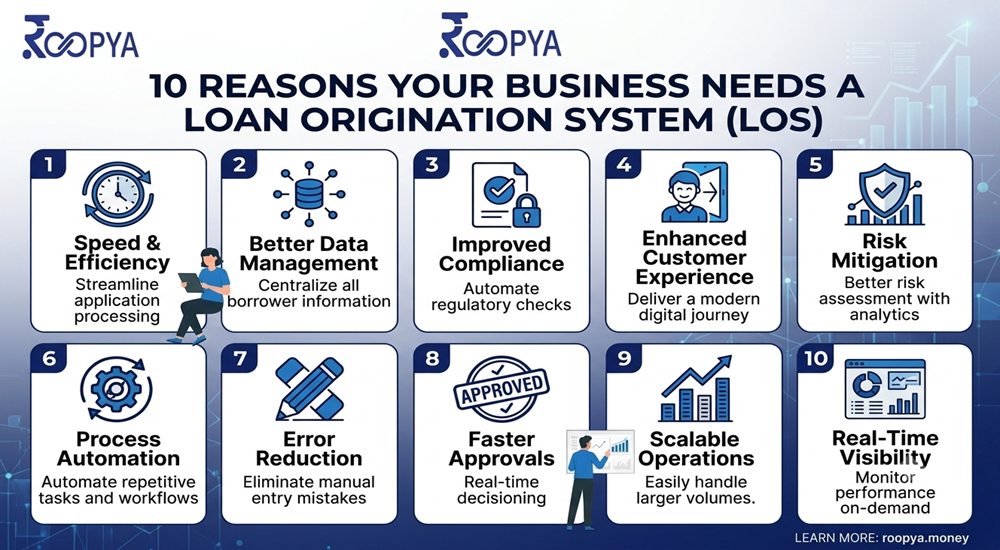
Yet despite the clear advantages, many lenders — particularly growing NBFCs, microfinance institutions, and early-stage fintech companies — continue to rely on spreadsheets, disconnected tools, and manual processes that were simply not designed for the scale or speed the modern credit market demands.
If you are wondering whether a Loan Origination System is right for your lending business, this article is for you. Here are ten compelling, concrete reasons why your business needs one — and why the time to act is now.
Reason 1: You Are Losing Borrowers to Faster Lenders
Speed is the single most important competitive variable in digital lending today. When a borrower applies for a personal loan, MSME credit, or any other financial product online, they rarely apply with just one lender. Research consistently shows that borrowers apply with two to four lenders simultaneously — and accept the first offer that arrives.
A manual loan origination process — where applications are received by email, documents are reviewed by hand, credit bureau pulls are done individually, and credit decisions travel through a chain of approvals — simply cannot compete with an automated Loan Origination System that completes the same steps in minutes.
With Roopya’s LOS, the entire journey from application submission to conditional sanction can be completed in under 15 minutes for a clean profile. Instant KYC verification, automated bureau pulls, AI-powered document analysis, and real-time credit decisioning happen simultaneously — not sequentially. The borrower receives a personalised offer while competitors are still processing the application.
If your current process takes hours or days to generate a credit decision, you are not just slow — you are invisible to the most attractive segment of the borrowing population.
Reason 2: Manual Processes Cannot Scale With Your Ambitions
Every fast-growing lending business hits the same wall. In the early days, a small team can manage a modest application volume manually. But as loan disbursements grow — from hundreds to thousands per month — the manual model breaks. Hiring more people is expensive, slow, and introduces more variability. Training new underwriters takes weeks. And even the best human team cannot match the consistency, speed, and throughput of a well-configured Loan Origination System.
A Loan Origination System scales horizontally. Whether you are processing 500 applications a month or 50,000, the platform handles the volume with the same infrastructure, the same turnaround time, and the same quality of credit decision. There are no queues, no bottlenecks, and no need to double your headcount every time you expand into a new geography or launch a new product.
Roopya’s cloud-native LOS is engineered for exactly this kind of exponential growth. The platform has processed millions of loan applications for lenders across India, scaling seamlessly from startup volumes to enterprise-level throughput without a single infrastructure change on the lender’s side.
Reason 3: Inconsistent Credit Decisions Are Destroying Your Portfolio Quality
One of the most insidious problems in manual loan origination is inconsistency. Two underwriters reviewing identical applications can — and regularly do — reach different conclusions. Decisions are influenced by individual judgment, workload, time of day, and the subtle biases every human carries. This inconsistency is not just an operational problem; it is a portfolio risk.
A Loan Origination System enforces consistent, rules-based credit decisioning across every single application. Your credit policy — income thresholds, bureau score cutoffs, employment type filters, geographic restrictions, debt-to-income ratios, LTV limits — is codified into the system’s Business Rule Engine (BRE) and applied uniformly, every time, without exception.
Roopya’s no-code BRE allows your credit and risk teams to build and modify complex, multi-variable credit policies through an intuitive visual interface — no coding required. More importantly, the system learns from your portfolio’s performance over time, surfacing data-driven suggestions to sharpen your policy as your book matures. The result is a more consistent, more defensible credit decision process that directly improves portfolio quality and reduces delinquencies.
Reason 4: Compliance Is Becoming Too Complex to Manage Manually
The regulatory environment for lenders in India has never been more demanding. RBI guidelines on KYC, data localisation, Fair Practice Code, credit bureau reporting, CERSAI filing, and digital lending frameworks have created a compliance burden that is genuinely difficult to manage without dedicated technology.
Manual compliance processes — maintaining physical audit trails, manually pulling and filing bureau reports, managing consent records in spreadsheets — are not just inefficient; they are risk factors. A single compliance failure can result in regulatory action, reputational damage, and business disruption.
A modern Loan Origination System handles compliance by design. Roopya’s platform automatically maintains comprehensive digital audit trails for every application — recording every action, every data access, every decision, and every communication with timestamps. Digital consent is captured and stored at the point of collection. Credit bureau reporting is automated. CERSAI integration is built in. Regulatory reports can be generated in minutes rather than days.
As regulatory requirements evolve — and they will continue to evolve — Roopya’s platform is continuously updated to remain compliant, so your team does not need to track and implement every change manually.
Reason 5: Your KYC Process Is Creating Friction That Kills Conversions
KYC is a non-negotiable regulatory requirement, but the way it is implemented can make or break your borrower conversion rate. A KYC process that requires physical document submission, branch visits, or lengthy manual verification drives abandonment. Research across digital lending platforms consistently shows that application drop-off rates increase by 30–50% with every additional friction point in the KYC journey.
A Loan Origination System with integrated digital KYC eliminates this friction. Aadhaar eKYC, PAN verification, Digilocker-based document retrieval, and Video KYC (VKYC) are all completed digitally, within the application flow, in under two minutes. The borrower never leaves the interface, never visits a branch, and never sends a physical document.
Roopya’s LOS comes pre-integrated with all major KYC service providers in India. The integration is already built, tested, and compliant — there is nothing to develop or configure. The moment a borrower provides consent, the KYC process begins automatically and completes before they have finished reading the next screen. This seamlessness is the difference between a conversion and an abandonment.
Reason 6: Manual Document Review Is Your Biggest Underwriting Bottleneck
For most lenders still operating manual processes, document review — income proof, bank statements, salary slips, GST returns, ITR documents — is the single biggest bottleneck in the underwriting workflow. A skilled analyst might review 15–20 applications per day. Documents get misplaced. Data entry from physical documents introduces errors. And fraudulent or manipulated documents sometimes slip through without detection.
An AI-powered Loan Origination System transforms document review from a bottleneck into a non-issue. Optical Character Recognition (OCR) and Natural Language Processing (NLP) extract key data fields from uploaded documents in seconds. Bank statement analysis — averaging income, identifying salary credits, flagging irregular transactions, detecting EMI obligations — is completed automatically. Fraud detection algorithms identify manipulated documents, inconsistent metadata, or suspicious patterns that human reviewers routinely miss.
Roopya’s intelligent document processing achieves over 99% accuracy across all supported document types and completes analysis in under 30 seconds per document. An analyst reviewing 20 applications per day is replaced by a system that reviews 2,000 — with greater accuracy and zero fatigue. This is not incremental improvement; it is a fundamental transformation of your underwriting capacity.
Reason 7: You Are Spending Too Much Per Loan Originated
The cost per loan originated — including staff costs, technology costs, branch costs, and compliance overhead — is one of the most important financial metrics for any lending business. In a manual origination model, this cost is stubbornly high. Each application requires human attention at multiple stages. Errors require rework. Compliance checks are manual. And the cost scales linearly with volume — more loans means proportionally more cost.
A Loan Origination System fundamentally changes the cost structure of loan origination. By automating KYC, document analysis, credit decisioning, offer generation, and agreement execution, the system dramatically reduces the human time required per application. Error rates fall. Rework decreases. Compliance overhead is absorbed by the platform. And critically, the marginal cost of processing an additional application approaches zero.
Lenders who have migrated to Roopya’s LOS consistently report cost-per-origination reductions of 40–65% within the first six months of implementation. For a lender processing 1,000 loans per month at an average origination cost of ₹2,500, that represents a monthly saving of ₹10–16 lakh — savings that flow directly to the bottom line or can be reinvested in growth.
Reason 8: You Cannot Effectively Serve Multiple Loan Products on One Platform
Most lending businesses do not operate a single loan product. A typical NBFC might offer personal loans, business loans, MSME credit lines, and perhaps a gold loan or vehicle loan product. Managing these across disconnected systems — or worse, on spreadsheets — creates operational chaos. Different underwriting criteria, different document requirements, different pricing structures, and different regulatory considerations for each product multiply the complexity exponentially.
A Loan Origination System designed for multi-product operations allows you to configure and manage every loan product from a single unified platform, with product-specific workflows, eligibility rules, pricing logic, and documentation requirements. Launching a new product does not require building a new system; it requires configuring a new product journey within the existing platform.
Roopya ships with 20+ pre-configured loan product journeys — personal loans, business loans, MSME credit, gold loans, home loans, loan against property, payday loans, auto loans, and microfinance products. Each journey is fully configurable. New products can be launched in days, not months. And all products are managed, monitored, and reported on through a single operational dashboard.
Reason 9: You Are Missing the Embedded Finance and Partnership Opportunity
One of the fastest-growing channels in lending today is embedded finance — the integration of loan products directly into non-financial platforms. E-commerce platforms offering purchase financing at checkout. Payroll platforms providing salary advances within the employee portal. B2B marketplaces offering working capital to their vendor network. These channels generate high-quality, low-acquisition-cost loan applications at enormous scale.
Accessing these channels requires a Loan Origination System with robust API capabilities. Without API-first infrastructure, a lender simply cannot participate in embedded finance partnerships. The partner platform needs to be able to trigger a loan application, receive a real-time credit decision, and deliver a loan offer — all within their own user interface, without redirecting the borrower to an external portal.
Roopya’s LOS is built API-first. Every function — application initiation, KYC triggers, bureau pulls, credit decisions, offer delivery, eSign — is accessible via clean, well-documented APIs. Partners can embed Roopya-powered lending into their platforms with a single integration. Lenders using Roopya have accessed DSA networks, fintech partnerships, and corporate partnerships through the same API layer, dramatically expanding their origination reach without proportional increases in cost.
Reason 10: You Cannot Get Meaningful Data Insights From Your Current Process
Data is the most valuable asset a lending business generates — but only if it can be captured, organised, and analysed. In a manual origination process, critical data is buried in spreadsheets, email threads, and paper files. Application conversion rates, drop-off points, underwriter productivity, credit policy performance, bureau score distribution, and channel-level profitability are either impossible to measure or require enormous manual effort to compute.
A Loan Origination System captures structured data at every stage of the application journey and makes it instantly available through dashboards, reports, and analytics tools. You can see exactly where applicants are dropping off in the application funnel. You can measure the performance of each credit rule in your BRE. You can compare portfolio performance across channels, products, geographies, and time periods. You can identify fraud patterns before they become losses.
Roopya’s LOS includes a comprehensive analytics and reporting layer that gives credit teams, operations managers, and business leaders real-time visibility into every dimension of the origination process. AI-powered insights surface patterns and anomalies that would be invisible in a manual process — enabling faster, smarter decisions at every level of the organisation. In a data-driven lending environment, this visibility is not a nice-to-have; it is a core competitive advantage.
Why Roopya Is the Right Loan Origination System for Your Business
There are many Loan Origination Systems in the market. What makes Roopya different — and why it is the platform of choice for India’s most ambitious modern lenders — comes down to five core advantages:
- 1-Day Go-Live: Roopya is not a software project; it is a plug-and-play platform. Pre-built integrations, pre-configured product journeys, and a no-code setup interface mean most lenders go live within 24 hours of onboarding. There is no development sprint, no integration project, and no months-long implementation cycle.
- Truly No-Code: Business users — credit teams, risk managers, product heads — can configure credit policies, decisioning rules, product parameters, and workflow logic independently, without any developer involvement. When RBI changes a regulation or your risk team wants to tighten a credit policy, it is a 10-minute configuration change, not a software ticket.
- 300+ Pre-Integrated APIs: Every major credit bureau (CIBIL, Experian, Equifax, CRIF), KYC provider (Aadhaar eKYC, PAN, Digilocker, VKYC), eSign platform, payment gateway, accounting tool, and banking API is already connected. There is nothing to build or negotiate.
- Pay-As-You-Use Pricing: Zero upfront licence fees. No capital expenditure. You pay only for what you process, making enterprise-grade loan origination infrastructure accessible to lenders at every stage of growth — from a newly licensed NBFC to a large-scale bank.
- AI Throughout: Document OCR with 99%+ accuracy, ML-based credit scoring, intelligent fraud detection, a self-learning Business Rule Engine, and NLP-powered analytics are all standard features of the Roopya platform — not expensive add-ons.
Roopya is trusted by IndiaKaLoan, QuickFinShop, Recapita, Findoc, EazyCredit, and a growing number of India’s most progressive lenders. If you are ready to leave behind the limitations of manual loan origination and build a scalable, intelligent, compliant lending operation, Roopya offers a free demo and a no-obligation trial. Go live in a day. Grow without limits.
Conclusion: The Cost of Waiting Is Higher Than the Cost of Acting
Every week your lending business operates without a Loan Origination System is a week of lost conversions, unnecessarily high operational costs, inconsistent credit decisions, compliance exposure, and missed growth opportunities. The lending market in India is moving fast. Borrowers’ expectations are rising. The regulatory environment is getting more complex. And the lenders who invest in modern infrastructure today will be the ones who dominate market share tomorrow.
The ten reasons outlined in this article are not theoretical — they are the real, measurable business outcomes that lenders experience when they make the shift from manual origination to a modern Loan Origination System. Faster decisions. Lower costs. Better risk management. Scalable operations. Regulatory confidence. And the data intelligence to keep improving.
With Roopya, the transition is faster and easier than you might think. A 1-day go-live, zero upfront cost, and a dedicated implementation team mean there is no reason to delay. The question is not whether your business needs a Loan Origination System. The question is how much longer you can afford to wait.

