Payday Loan Software : The Complete Guide to Choosing the Right Platform for Short-Term Lending in 2026

Payday lending runs on speed. A borrower applies because they need money today, not next week, and every extra hour your loan origination process takes is an hour closer to losing that customer to a competitor — or worse, to an unregulated lender. At the same time, regulators in India have tightened the rules around digital lending, and margins on small-ticket loans are thin enough that a single bad piece of software can quietly erase your profitability.
This guide walks through what payday loan software actually is, why generic loan management systems fail at this job, the features that genuinely matter, and how a platform like Roopya (roopya.money) is built specifically to handle the volume, speed, and compliance demands of payday and salary-advance lending in India.
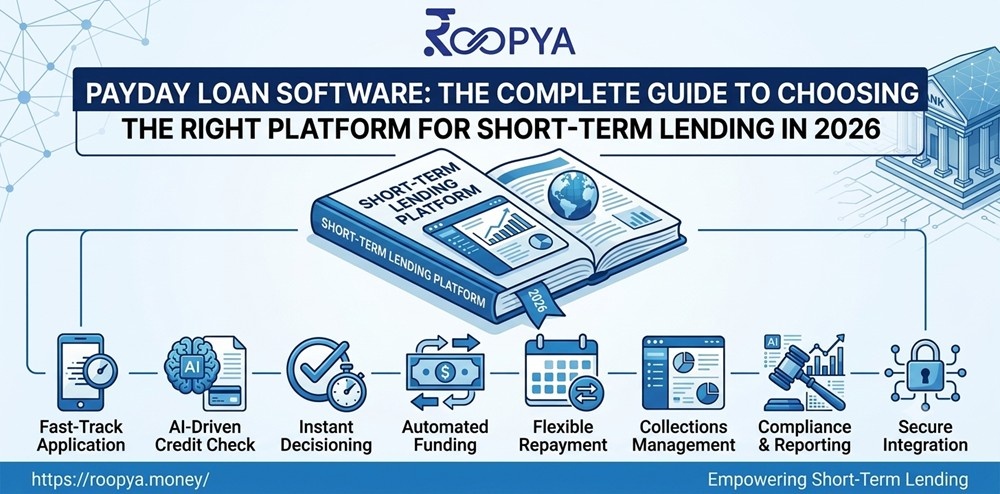
What Is Payday Loan Software?
Payday loan software is a purpose-built digital lending platform that automates the entire lifecycle of short-term, small-ticket consumer credit — from application and KYC to underwriting, disbursement, repayment, and collections. Unlike traditional core banking or term-loan systems, it is designed around three realities of payday lending: applications must be decisioned in minutes, volumes can run into the thousands per day, and a large share of revenue comes from repeat borrowers who expect a frictionless repeat-loan experience.
In practice, this category of software covers payday loans, salary advances, earned wage access (EWA), and short-tenure instant personal loans — all products where the loan amount is small, the tenure is days rather than years, and the customer journey has to be 100% digital to be commercially viable.
Key Characteristics That Define Payday Lending Technology
- Loan size: Typically Rs.1,000 to Rs.50,000 per loan
- Tenure: 7 to 30 days, occasionally up to 90 days for emergency loans
- Decision speed: Instant to 15 minutes is now the market expectation
- Volume: Thousands of applications a day for an active lender
- Repeat usage: Majority of revenue typically comes from repeat borrowers across multiple cycles a year
- Channel: Entirely mobile and app-driven, with no physical branch visit
Why Generic Loan Management Systems Don’t Work for Payday Lending
Many NBFCs and fintechs first try to run payday products on a loan management system (LMS) built for term loans, mortgages, or business loans. It rarely works well, for five structural reasons.
Volume and Speed Mismatch
A system designed for a few hundred manually-reviewed applications a month simply cannot process thousands of applications a day with instant decisions. Payday lending needs an API-first, automation-first architecture from the ground up — not a workflow tool with some automation bolted on.
Compliance Built for the Wrong Product
RBI’s digital lending guidelines, interest rate transparency norms, the Fair Practices Code, and the Digital Personal Data Protection Act (DPDPA) all apply differently to short-tenure, high-frequency lending than to a 15-year home loan. A generic LMS usually has generic compliance modules that were not built with payday-specific obligations — like cooling-off periods between loans or rate-cap checks on very short tenures — in mind.
Customer Experience Expectations
Someone applying for a payday loan needs the money urgently. A multi-day, document-heavy process that might be perfectly acceptable for a mortgage will cause massive drop-off in payday lending, where conversion falls sharply once the application-to-approval time crosses roughly 15 minutes.
Risk and Fraud Profile
Unsecured, minimal-documentation, high-frequency lending attracts a different — and typically higher — fraud profile than secured or long-tenure lending. Device fingerprinting, velocity checks, and behavioral scoring matter far more here than they do in traditional lending.
Unit Economics
With margins often in the low hundreds of rupees per loan, the cost of processing each loan has to stay very low. That is only possible with very high automation rates — manual review processes that work fine at low volume become economically impossible at payday-lending scale.
Core Features the Best Payday Loan Software Should Have
Instant, Mobile-First Application and Onboarding
The application should be a short, mobile-native experience: data pre-filled from Aadhaar, PAN, and bank statements wherever possible, Aadhaar OTP or DigiLocker-based digital KYC, camera-based document capture with OCR, and the ability to save and resume an incomplete application. Every additional field or screen is a point of drop-off.
Real-Time Credit Assessment and Underwriting
This is where payday lending technology earns its keep. Look for automated, parallel credit bureau checks (CIBIL, Experian, Equifax), AI-driven bank statement analysis that reads salary credits and spending patterns in seconds, alternative-data scoring for thin-file customers, and a configurable rule engine so credit policy can be adjusted without a developer. The best platforms turn what used to be a multi-hour underwriting process into a sub-minute automated decision.
Instant Disbursement Infrastructure
Approval is only half the journey. The platform needs integrated e-signature (NSDL, Digio, Leegality), penny-drop bank account verification, and direct disbursement rails (IMPS, UPI, NEFT) so funds move within seconds of the loan agreement being signed — with automatic retry logic if a disbursement fails.
Flexible Servicing Built for Short Tenures
Payday and salary-advance loans often repay as a single bullet payment, but the system still needs to support eNACH or UPI auto-debit mandates, partial payments, prepayment, and rollover or tenure extension (where regulation permits), all with accurate, automatic interest recalculation.
Automated, Compliant Collections
Because the collection window is short, the platform should run a tiered, automated outreach strategy from day one of delinquency — SMS, WhatsApp, email, and voice — with one-click payment links, promise-to-pay tracking, and configurable settlement workflows. All of this needs built-in guardrails for RBI’s Fair Practices Code on calling hours and frequency.
Self-Service Customer Portal
A large share of support load disappears when borrowers can see their loan status, download statements, make a payment, and apply for a repeat loan without calling support. The repeat-loan flow needs to be near-instant for proven, good-standing customers.
Compliance and Audit Infrastructure as a Default, Not an Add-On
This means RBI digital lending guideline adherence (LSP disclosures, grievance redressal, fair practices), automated interest-rate cap checks, DPDPA-compliant consent management, cooling-off period enforcement, and a complete, immutable audit trail of every decision the system makes.
Fraud Detection That Matches the Risk Profile
Device fingerprinting, location and IP consistency checks, duplicate PAN/Aadhaar/bank-account detection, velocity monitoring across applications, face-match verification against KYC documents, and ML-based anomaly scoring should all run automatically and in real time.
Analytics That Actually Drive Decisions
Real-time dashboards for application funnels, approval and default rates by segment, collection efficiency, repeat-customer behavior, and portfolio vintage analysis let a lending business tune its credit policy continuously rather than reviewing performance once a quarter.
A Genuinely Open Integration Ecosystem
Payday lending depends on a dense web of third-party services — bureaus, KYC providers, bank-statement analyzers, payment gateways, e-sign providers, and communication channels. The fewer of these that need custom development work, the faster and cheaper it is to launch and to add new partners later.
Operational Challenges Unique to Payday Lending
High Volume, Thin Margins
With typical margins of a few hundred rupees per loan, the cost to process each application has to stay low — which is only achievable with a very high level of automation and a pricing model that does not charge per transaction.
Conversion Is Extremely Sensitive to Speed
A meaningful share of applicants will abandon the process if approval takes more than around 15 minutes, which makes real-time bureau checks, automated underwriting, and instant disbursement business-critical rather than nice-to-have.
Fraud Exposure Is Structurally Higher
Minimal documentation and high application volume make payday lending a more attractive fraud target than secured or long-tenure lending, so multi-layer fraud detection has to run on every application, not as a sample-based check.
Collection Windows Are Short
With tenures of days rather than years, there is very little time to recover a loan that starts slipping. Collection strategy has to start from day one with omni-channel, automated outreach rather than a manual call queue that ramps up only after a loan is significantly overdue.
Regulatory Scrutiny Is Increasing
RBI’s continued tightening of digital lending norms means LSP registration, data privacy, interest-rate transparency, and grievance redressal all need to be built into the platform’s default behaviour, not handled as manual compliance overhead.
Repeat Customers Are the Real Business
A large share of payday lending revenue typically comes from repeat borrowers, so the platform needs to make repeat applications fast and low-friction while still enforcing cooling-off periods and responsible-lending limits.
How Roopya Is Built for Payday and Salary-Advance Lending
Roopya (roopya.money) is a no-code, unified lending infrastructure platform built to take a lender from origination through collections on a single system — specifically suited to the speed and volume demands of payday lending.
Fast Go-Live
Roopya is built as a true no-code platform, with loan products, eligibility rules, and workflows configured through a visual interface rather than custom development. A payday or salary-advance product can be configured and launched in days rather than the months a traditional core lending implementation typically takes.
300+ Pre-Integrated APIs
Credit bureaus, KYC and DigiLocker verification, bank-statement analyzers, payment gateways, and e-sign providers come pre-connected, so a lender is not waiting on point-to-point integration work before going live.
No-Code Business Rule Engine
Credit policy, approval thresholds, and underwriting logic can be configured and adjusted by business users through a visual rule engine — useful in payday lending, where policy often needs to be tuned quickly in response to portfolio performance.
AI-Powered Document Analysis and Underwriting
Roopya’s AI layer reads and verifies identity documents and bank statements automatically, flags anomalies, and feeds into real-time credit decisioning that draws on both bureau data and alternative data points — built to support the sub-minute decisions payday lending requires.
Built-In Collections and Early Warning
Rather than treating collections as an afterthought, Roopya includes automated, multi-channel collection workflows alongside an early warning system that uses predictive analytics to flag accounts at risk of default before they actually miss a payment.
Pay-As-You-Use Pricing with Zero Upfront Cost
For a business with thin per-loan margins, a flexible, usage-based pricing model — rather than a large upfront licensing cost — materially changes the economics of getting started.
A Compliant, Continuously Updated Platform
Because regulatory requirements around digital lending keep evolving, Roopya is maintained to stay current with RBI guidance, reducing the manual compliance burden on the lending team.
20+ Pre-Configured Loan Products
Including payday loans, salary advances, and EWA-style products, giving a lender a working starting template rather than a blank canvas.
How to Evaluate Payday Loan Software Before You Buy
A few questions worth asking of any vendor before committing:
- How fast can we actually go live, and what does go live include? Get specifics on whether bureau and KYC integrations, mobile apps, and collection workflows are included in that timeline.
- What is the real cost per loan at our expected volume? Ask for total cost of ownership, not just a headline subscription number.
- How is compliance actually implemented, not just claimed? Ask to see the audit trail, consent management flow, and how interest-rate or cooling-off rules are enforced.
- What does the fraud detection stack actually check? Device fingerprinting, location consistency, duplicate detection, and behavioral scoring should all be demonstrable.
- Can our business team make changes without IT? A platform’s no-code claim is only meaningful if a credit or product manager can genuinely adjust rules without raising a development ticket.
- How does the platform handle peak volume? Ask how the architecture scales and what uptime guarantees exist.

