Personal Loan Origination System: Key Features, Benefits & Why Modern Lenders Choose Roopya

Personal loans are the fastest-growing segment of India’s consumer credit market. Unlike secured products such as home or auto loans, personal loans are unsecured — making fast, accurate underwriting both more critical and more technically demanding. The lender who can assess risk with precision and approve a creditworthy borrower in minutes wins the business. The lender who cannot is left behind.
At the heart of this capability is a Personal Loan Origination System (PLOS) — the technology infrastructure that takes a borrower from the moment of application to the moment of disbursal, with minimum friction and maximum accuracy. For NBFCs, banks, microfinance institutions, and fintech lenders, a modern personal loan origination system is not optional; it is the foundation on which profitable, compliant, and scalable lending is built.
Start Free Trial
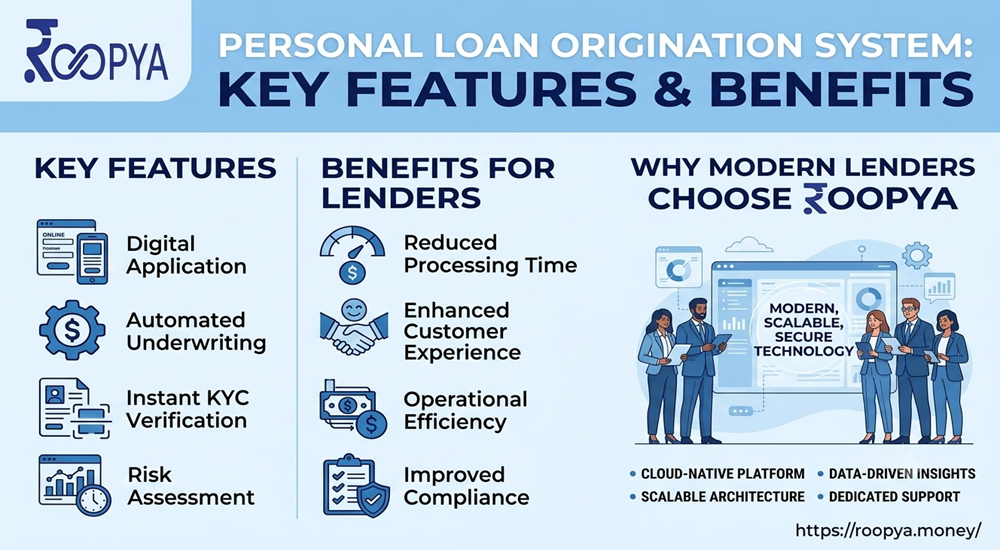
This guide breaks down everything you need to know — what a personal loan origination system does, the key features that separate great systems from mediocre ones, the measurable benefits they deliver, and how Roopya’s platform is setting the new standard for personal loan origination in India.
1. What Is a Personal Loan Origination System?
A Personal Loan Origination System is a specialised software platform that automates and manages the complete lifecycle of a personal loan application — from the borrower’s first touchpoint through eligibility checking, KYC, credit assessment, credit decision, offer generation, documentation, eSign, and disbursal trigger.
Unlike generic loan software, a purpose-built personal loan origination system is optimised for the specific characteristics of unsecured personal lending: high volumes, diverse borrower profiles (salaried, self-employed, gig workers), short decision timelines, and income-based underwriting without collateral security.
Modern systems like Roopya go beyond simple workflow automation. They embed artificial intelligence at every stage — scoring documents, detecting fraud, evaluating creditworthiness through alternative data, and continuously optimising credit policies based on portfolio performance. The result is a system that not only processes loans faster but processes them smarter.
In the Indian lending context, a personal loan origination system must also be designed around the country’s unique regulatory and infrastructure landscape — Aadhaar-based eKYC, CIBIL and Experian bureau integration, RBI compliance mandates, and Account Aggregator (AA) data flows. Roopya was built from day one with these requirements as core design principles, not afterthoughts.
2. The Scale of India’s Personal Loan Market — Why the Right System Matters More Than Ever
India’s personal loan market has undergone a seismic shift over the past five years. Digital lending platforms have collectively disbursed hundreds of thousands of crores in unsecured personal credit, driven by smartphone penetration, Jan Dhan banking inclusion, and growing consumer comfort with digital financial services.
The RBI’s Digital Lending Guidelines of 2022 and subsequent updates have raised the bar for compliance, borrower protection, and audit trail requirements. Simultaneously, competition has intensified as well-capitalised fintechs and large bank-NBFC partnerships compete aggressively for the same creditworthy borrowers.
In this environment, a lender’s personal loan origination system is a genuine competitive weapon. The ability to process an application in under two minutes, deliver a real-time credit decision, and trigger disbursal within the same session directly translates into higher conversion rates, better NPS scores, and a lower cost per acquisition — all of which determine whether a lending business is profitable at scale.
Roopya’s clients consistently report 40–60% reductions in processing costs and loan turnaround times falling from days to minutes after deploying the platform’s personal loan origination capabilities. These are not marginal improvements; they are transformational changes in unit economics.
3. Key Features of a World-Class Personal Loan Origination System
Not all personal loan origination systems are created equal. The features below represent the capabilities that define best-in-class platforms — and that Roopya delivers as standard.
Feature 1: Smart Digital Application Interface
The personal loan origination journey begins with the borrower. A high-quality digital application interface is not just a form — it is an intelligent, guided experience that adapts to the borrower’s inputs in real time. Smart field validation catches errors as they are entered (incorrect PAN format, invalid IFSC, pincode mismatches). Progressive disclosure shows only the fields relevant to the borrower’s employment type, reducing cognitive load and abandonment rates.
Roopya provides 20+ pre-configured loan product journeys including multiple personal loan variants — salaried, self-employed professional, and self-employed non-professional — with product-specific application forms tailored to each borrower profile. The interface is fully mobile-responsive and designed for completion on a 5-inch smartphone screen in under 4 minutes.
Critically, Roopya also supports multi-channel entry points: borrowers can apply through your branded website, mobile app, DSA tablet application, WhatsApp flow, or embedded partner platform — all feeding into the same backend origination engine.
Feature 2: Automated eKYC and Identity Verification
KYC is mandatory for every personal loan in India, and it is historically one of the biggest sources of delay and drop-off in the application funnel. A modern personal loan origination system eliminates this bottleneck entirely through automated digital KYC integrations.
Roopya’s platform integrates with Aadhaar eKYC (UIDAI-compliant OTP-based verification), NSDL PAN verification, Digilocker for document-based KYC, and video KYC (VKYC) providers for in-person equivalent verification without branch visits. The entire KYC process is completed in under two minutes, with data auto-populated into the application form to reduce borrower effort.
For lenders serving NRI borrowers or borrowers without Aadhaar linkage, Roopya supports alternative KYC pathways, ensuring no eligible applicant falls out of the funnel due to KYC friction. All KYC data is stored with RBI-compliant audit trails and consent management, eliminating compliance risk.
Feature 3: Real-Time Credit Bureau Integration
The credit bureau pull is the cornerstone of personal loan underwriting. A best-in-class personal loan origination system triggers bureau checks automatically — the moment a borrower submits their application and provides digital consent — without any manual intervention.
Roopya is pre-integrated with all four major credit bureaus operational in India: CIBIL TransUnion, Experian, CRIF High Mark, and Equifax. Lenders can configure which bureau to pull from based on product, borrower geography, or risk policy. Multi-bureau pulls for high-ticket loans are supported natively.
Bureau reports are parsed and key fields — credit score, DPD history, number of open accounts, total outstanding, enquiry count, and write-off history — are automatically extracted and presented to the credit decisioning engine. No manual bureau report reading is required. Roopya also supports CIBIL MSME reports for self-employed borrowers applying for personal loans on the basis of business income.
Feature 4: AI-Powered Document Processing and OCR
Personal loan applications involve multiple documents — salary slips, bank statements, Form 16, ITR, and utility bills for address verification. Manual document review is the single biggest operational cost and bottleneck in personal loan origination. A modern system eliminates this with AI-powered document processing.
Roopya’s intelligent OCR and NLP engine processes documents with 99%+ field extraction accuracy. Bank statements are automatically parsed to compute average monthly balance, inflow patterns, outflow patterns, EMI obligations identified from debit entries, and income stability indicators. Salary slips are parsed for gross income, net take-home, employer name, and deduction breakdown. ITR data is extracted and cross-verified against bank statement cash flows.
Beyond data extraction, Roopya’s AI layer performs fraud detection — checking for tampering indicators, inconsistencies between documents (e.g. declared income vs. bank credits), duplicate documents across applications, and synthetic identity signals. These checks happen automatically in seconds, flagging suspicious applications for human review while clearing clean applications straight through to decisioning.
Feature 5: No-Code Business Rule Engine (BRE)
Your credit policy is your competitive advantage. The Business Rule Engine is where that policy lives in your personal loan origination system. A no-code BRE lets your credit and risk team define, test, and deploy complex multi-variable eligibility rules without writing a single line of code — enabling policy changes in minutes rather than weeks.
Roopya’s BRE for personal loan origination supports rules across every dimension of underwriting: minimum CIBIL score thresholds by employment category, income-to-EMI ratio limits, geographic eligibility (pincode-level, city-tier, state), employer category filters (listed company, PSU, SME), vintage requirements for employment and bank account, maximum permissible existing EMI obligations, and DPD history cutoffs.
Rules can be stacked in waterfall logic — if a borrower fails Filter A, they need not be evaluated against Filter B. Rules can be time-scheduled — apply stricter criteria during economic stress periods and relax them when portfolio performance is strong. And Roopya’s BRE includes a built-in testing environment where risk teams can simulate new rules against historical application data before going live, eliminating guesswork from policy changes.
Feature 6: Alternative Data and Bank Statement Analysis
A growing segment of personal loan applicants in India are thin-file borrowers — individuals with limited or no credit bureau history, including first-time borrowers, young professionals, and workers in the informal sector. A traditional personal loan origination system would reject these applicants outright. A modern system incorporates alternative data to underwrite them accurately.
Roopya’s personal loan origination platform integrates with the Account Aggregator (AA) framework, enabling consented, real-time sharing of financial data — bank statements, investment account data, and insurance data — directly from financial institutions to lenders. This dramatically improves underwriting quality for new-to-credit borrowers.
Beyond AA, Roopya’s bank statement analysis module performs cash flow-based underwriting: computing 12-month average credits, identifying salary or business income patterns, detecting regular large debits that may indicate undisclosed EMIs, and scoring income stability independently of credit bureau data. This gives lenders a richer, multi-dimensional view of creditworthiness — not just a credit score — leading to better lending decisions across the full spectrum of borrower profiles.
Feature 7: ML-Powered Credit Scoring
Bureau scores are a starting point, not the complete picture. A sophisticated personal loan origination system overlays bureau data with internal credit scoring models — trained on your own historical portfolio data — to generate proprietary risk assessments that are more accurate than generic bureau scores for your specific borrower segment.
Roopya’s machine learning credit scoring engine evaluates hundreds of variables simultaneously — bureau attributes, income metrics, employment characteristics, document quality signals, application behaviour data, and geographic risk indicators — to produce a borrower-level probability of default (PD) estimate. This PD feeds directly into loan offer personalisation: higher-risk borrowers receive smaller loan amounts, shorter tenures, or higher interest rates; lower-risk borrowers receive more favourable offers. The scoring model is continuously retrained on fresh portfolio data, improving its accuracy as your lending book grows.
Feature 8: Instant Credit Decisioning Engine
Speed of decision is the single most important driver of conversion in personal loan origination. Studies consistently show that conversion rates drop precipitously with each hour of delay between application submission and credit decision. A world-class personal loan origination system delivers decisions in seconds, not hours or days.
Roopya’s decisioning engine synthesises all data streams — bureau data, document analysis outputs, BRE evaluation, and ML credit scores — into a final credit decision in real time. The engine supports three outcomes: auto-approve (the application passes all criteria and is immediately sanctioned), auto-reject (the application fails a hard cutoff and is declined with a configured decline reason), and refer-to-human (the application passes hard cutoffs but requires manual review due to policy exceptions or risk signals).
Auto-approve rates on Roopya’s platform consistently exceed 70% for lenders with well-configured policies — meaning more than seven in ten eligible applicants receive an instant decision without any human involvement. This is the operational model that enables personal lending at scale.
Feature 9: Personalised Loan Offer Generation
Credit decisioning and loan offer generation are distinct stages, and getting offer personalisation right is critical for both borrower satisfaction and portfolio risk management. A basic system approves a borrower for a fixed amount and rate. A sophisticated personal loan origination system generates a personalised offer — loan amount, tenure, interest rate, processing fee, and EMI — calibrated precisely to the borrower’s risk profile and your product pricing policy.
Roopya’s offer engine supports risk-based pricing, where interest rates are set within a band based on the ML credit score. It supports offer bucketing — segmenting approved borrowers into tiers with pre-defined offer parameters for each tier. And it supports counter-offers — when a borrower applies for more than their assessed capacity, the system automatically generates a counter-offer at the maximum eligible amount, rather than a flat rejection, significantly recovering applications that would otherwise have been lost.
Feature 10: Digital Agreement Execution and eSign
Once a borrower accepts their loan offer, the next step is loan documentation — generating the loan agreement, sanction letter, and repayment schedule, and obtaining the borrower’s legal signature. In traditional lending, this required physical document preparation, courier dispatch or branch visit, manual signature collection, and physical storage. A modern personal loan origination system replaces all of this with digital execution.
Roopya integrates with leading eSign providers to support Aadhaar OTP-based eSign — legally valid under the IT Act 2000 and its Amendments. Loan agreements are auto-generated from templates populated with the borrower’s specific loan parameters. The borrower receives the agreement on their device, reviews it, and signs electronically in under 60 seconds. The executed agreement is stored securely in Roopya’s document vault with a complete audit trail — timestamp, OTP verification record, and IP metadata.
Feature 11: NACH/eNACH Mandate Registration
Repayment setup is an integral part of the origination process, not an afterthought. A complete personal loan origination system includes automated NACH (National Automated Clearing House) or eNACH mandate registration, ensuring that repayment instructions are in place before or at the time of disbursal.
Roopya supports eNACH mandate registration via net banking and debit card — fully digital, completed within the same origination session, with success confirmation before disbursal is triggered. This eliminates the post-disbursal mandate collection follow-up that plagues many NBFCs and directly improves Day 1 repayment rates.
Feature 12: Disbursal Workflow Integration
Loan disbursal is the final step of origination and the moment of truth for the borrower. A modern personal loan origination system should seamlessly hand off completed applications to the payment and disbursal layer — automatically, with all required data and approvals pre-populated.
Roopya integrates with major payment gateways and banking APIs for real-time IMPS and NEFT disbursal. Disbursal can be triggered automatically on completion of all pre-disbursal conditions (eSign completed, mandate registered, disbursal checklist cleared) or routed through a final human approval step for high-ticket applications. The entire origination-to-disbursal journey — from application submission to money in the borrower’s account — can be completed in under 30 minutes for straight-through-processing eligible applications.
Feature 13: Multi-Channel and Embedded Finance Support
Today’s personal loan origination does not happen only on a lender’s own website or app. Borrowers are reached through a growing ecosystem of channels — fintech apps, e-commerce platforms, salary disbursement platforms, health insurance portals, and DSA networks. A modern personal loan origination system must be deliverable through all of these channels through APIs.
Roopya’s embedded finance layer allows any partner platform to initiate a personal loan origination flow through simple API calls — with borrower data pre-populated from the partner’s user profile, reducing application time and improving conversion. Channel-specific credit policies, interest rates, and loan parameters are all configurable within the same platform. This opens personal loan origination to the full breadth of India’s digital ecosystem, dramatically expanding addressable origination volume.
4. The Measurable Benefits of a Modern Personal Loan Origination System
Dramatic Reduction in Loan Turnaround Time (TAT)
Manual personal loan processing typically takes 3 to 7 business days from application to disbursal. A fully automated personal loan origination system compresses this to under 30 minutes for straight-through-processing eligible applications. This speed advantage directly translates to higher conversion — borrowers who get a decision in minutes are far less likely to have gone to a competitor in the interim.
Lower Cost Per Loan Originated
Every manual step in the origination process has a cost — staff time, physical document handling, courier, branch infrastructure. Automation systematically eliminates each of these costs. Roopya’s clients report cost-per-loan reductions of 40–60% compared to manual processing — savings that flow directly to the bottom line or can be reinvested in borrower acquisition.
Higher Approval Rate Quality
A well-configured personal loan origination system approves better borrowers — not just more borrowers. By combining bureau data, AI-powered document analysis, alternative data, and ML-based credit scoring, the system makes more accurate risk assessments than human underwriters operating under time pressure. The result is a portfolio with lower delinquency rates, better NPA ratios, and stronger long-term profitability.
Full Regulatory Compliance
India’s digital lending regulatory environment is complex and evolving. A modern personal loan origination system manages compliance automatically — maintaining digital consent records for every data access, generating audit trails for every decisioning step, producing credit bureau reporting feeds, and adapting to regulatory changes as they are published. Roopya’s platform is continuously updated for RBI compliance, eliminating the compliance risk of manual or outdated systems.
Superior Borrower Experience
Borrower experience is a genuine competitive differentiator in personal lending. A digital, fast, transparent origination process — where the borrower knows exactly where they stand at every step — generates significantly higher NPS scores and repeat borrowing rates than opaque, slow, manual processes. Digital-native borrowers, who now represent the majority of the personal loan addressable market, actively prefer lenders who offer fully digital origination.
5. How Roopya’s Personal Loan Origination System Delivers All of This — and More
Roopya is not a generic lending platform with personal loan functionality bolted on. It is a purpose-built, no-code digital lending infrastructure platform designed specifically for the Indian market — its regulatory requirements, its borrower demographics, and its credit infrastructure ecosystem.
- 1-Day Go-Live: Roopya’s pre-configured personal loan product journeys, plug-and-play API integrations, and no-code setup interface allow lenders to go live and process real applications within 24 hours of onboarding — without any development work.
- Truly No-Code: Every aspect of the personal loan origination system — application forms, eligibility rules, credit policy, offer parameters, communication templates, workflow routing — is configurable through a visual interface. No developer is required to launch, change, or optimise your personal loan product.
- 300+ Pre-Integrated APIs: Every integration a personal loan lender needs — KYC providers, credit bureaus, eSign platforms, payment gateways, bank statement analysis providers, AA framework connectors — is already built and tested in Roopya’s platform.
- Pay-As-You-Use Pricing: No large upfront licence fee or capital expenditure. Lenders pay based on actual origination volume, making Roopya equally accessible to early-stage NBFCs originating a few hundred loans a month and large institutions originating tens of thousands.
- AI Embedded at Every Stage: From document OCR to fraud detection to ML credit scoring to NLP-driven analytics, AI is not an add-on in Roopya — it is core infrastructure running on every single application.
- Trusted by Leading Lenders: IndiaKaLoan, QuickFinShop, Recapita, Findoc, EazyCredit, and others have deployed Roopya for their personal loan origination operations and consistently report faster TAT, lower costs, and stronger portfolio quality.
If you are ready to build a personal loan origination operation that competes with the best in the market — fast, accurate, compliant, and scalable — Roopya offers a free demo with a live walkthrough of the personal loan origination system. Go live in a day. Grow without limits.

