How Roopya Helps Reduce Loan Servicing Costs: A Complete Guide for Modern Lenders

For every lender — whether a seasoned NBFC, a scheduled commercial bank, or an emerging fintech — the cost of servicing a loan portfolio is one of the most consequential and least discussed numbers in the business. Loan servicing encompasses everything that happens after a loan is disbursed: collecting EMI payments, managing delinquencies, handling prepayments, updating borrower records, generating statements, managing escrow accounts, responding to customer queries, filing regulatory reports, and ultimately closing the account. Each of these activities carries a cost, and collectively they can consume a surprisingly large share of the income generated by a loan portfolio.
According to industry benchmarks, the average cost to service a retail loan in India ranges from ₹800 to ₹2,500 per loan per year for institutions relying primarily on manual or semi-automated processes. For a lender with 50,000 active loan accounts, this translates to operational expenditure of ₹4 crore to ₹12.5 crore annually — just on servicing — before a single rupee of credit loss is accounted for. The margin pressure this creates is enormous, particularly as interest rates tighten and competition from digital lenders intensifies.
Start Free Trial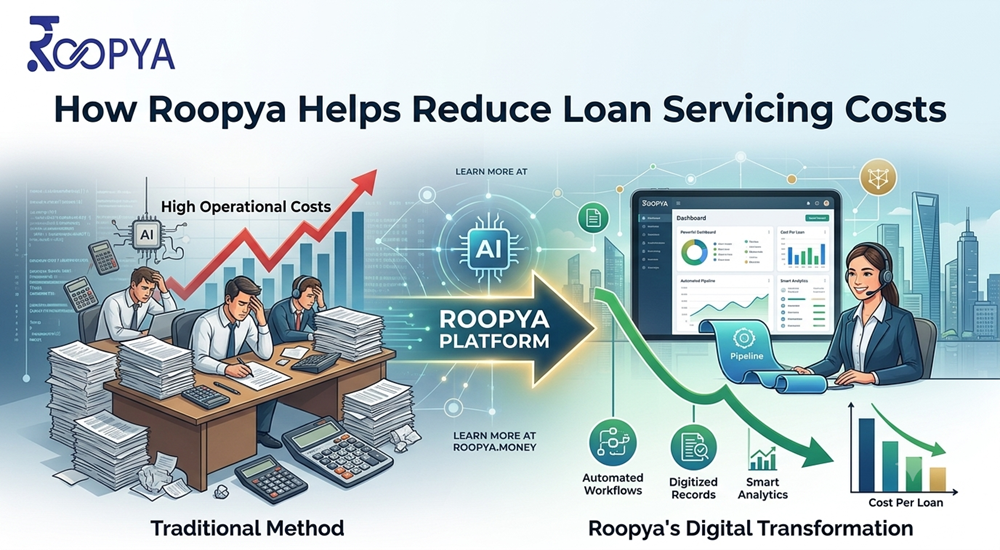
Roopya was built specifically to solve this problem. As a next-generation, no-code digital lending infrastructure platform, Roopya’s Loan Management System (LMS) and end-to-end automation capabilities systematically attack every major driver of loan servicing cost — replacing expensive manual workflows with intelligent, automated processes that get smarter over time. The result, for lenders on the Roopya platform, is a loan servicing cost reduction of 40 to 60 percent compared to traditional approaches.
This guide breaks down exactly how Roopya achieves these savings — component by component, workflow by workflow — so you can understand precisely where the value comes from and why the impact is as significant as it is.
1. Understanding the Real Drivers of Loan Servicing Costs
Before examining how Roopya reduces loan servicing costs, it is worth understanding what drives those costs in the first place. Loan servicing expenses cluster around five major categories:
- People costs: Loan servicing in traditional institutions is labour-intensive. Collections agents, customer service representatives, operations executives who process payment updates, compliance officers who handle regulatory filings — the headcount required to service even a moderately-sized portfolio is substantial. In India, people costs typically account for 45 to 60 percent of total loan servicing expenses.
- Technology and infrastructure costs: Legacy loan management systems often require expensive licensing, dedicated server infrastructure, and large IT teams to maintain. Integration between systems — LOS, LMS, core banking, accounting — is frequently manual or semi-automated, adding both cost and risk.
- Collections and recovery costs: Chasing overdue EMIs is expensive. Collection agent salaries, field visit costs, legal fees for recovery proceedings, and the cost of the communication infrastructure (calls, SMS, WhatsApp) all add up. For lenders with high delinquency rates, collections can be the single largest servicing cost.
- Compliance and reporting costs: RBI-mandated reporting, credit bureau submissions, CERSAI filings, FIU reports, and internal audit requirements all demand significant time and resource investment when done manually.
- Customer service costs: Borrower queries about EMI dates, outstanding balances, NOC issuance, prepayment quotes, and account statements generate a constant stream of inbound contact that requires staffed support channels.
Roopya’s platform systematically addresses each of these five cost categories through automation, intelligence, and seamless integration. Let us examine each area in detail.
2. Automated Payment Processing: Eliminating the Manual EMI Cycle
In a traditional loan servicing operation, the EMI collection cycle generates an enormous volume of manual work. Payment files must be reconciled against borrower accounts. Failed payments must be identified, investigated, and escalated. Partial payments must be allocated across principal, interest, fees, and penalties according to the amortisation schedule. Prepayments must trigger recalculation of outstanding balances and revised schedules.
Each of these steps, performed manually, introduces delay, error, and cost. A single misposted payment can trigger a cascade of incorrect statements, missed delinquency triggers, and erroneous credit bureau reporting — each of which carries its own remediation cost.
Roopya’s Loan Management System automates the entire payment processing cycle end to end:
- NACH and UPI AutoPay integration: Roopya connects directly with NPCI’s NACH (National Automated Clearing House) infrastructure and UPI AutoPay, enabling automated, schedule-driven EMI collection without manual intervention. Mandates are created digitally during the loan origination process and executed automatically on due dates.
- Real-time payment reconciliation: Every payment received — whether via NACH, UPI, NEFT, RTGS, cash, or cheque — is automatically reconciled against the corresponding loan account within seconds. No manual matching, no overnight batch cycles, no reconciliation backlogs.
- Automated amortisation updates: Upon payment confirmation, Roopya automatically updates the amortisation schedule, recalculates outstanding principal and interest, and reflects the updated position in the borrower’s account and the lender’s portfolio dashboard in real time.
- Prepayment and foreclosure automation: When a borrower initiates a prepayment or requests a foreclosure quote, Roopya generates the accurate outstanding amount — including accrued interest, applicable charges, and any prepayment penalties per the loan agreement — automatically and instantly. No manual calculation, no error, no delay.
The labour saving from payment automation alone is significant. Lenders on Roopya report that payment processing work that previously required a team of 8 to 12 operations staff can be handled by a team of 2 to 3 with the same volume, simply by shifting the manual work to automated workflows.
3. AI-Driven Collections: The Biggest Single Lever for Cost Reduction
Collections is where loan servicing cost reduction has the highest leverage. For every percentage point improvement in collection efficiency — fewer borrowers going delinquent, faster resolution of overdue accounts, higher recovery rates on written-off assets — the financial impact on a lender’s P&L is disproportionately large. Not only do collections costs themselves fall, but credit losses fall too, and the two effects compound.
Traditional collections operations are blunt instruments. Every overdue account gets the same treatment: a sequence of SMS reminders, phone calls from collection agents, and eventually field visits or legal notices. This approach is both expensive and ineffective, because different borrowers respond to fundamentally different types of intervention.
Roopya’s AI-driven collections engine replaces this one-size-fits-all model with a precision, data-driven approach:
3.1 Early Warning System (EWS)
Roopya’s Early Warning System uses predictive analytics to identify borrowers showing early signs of financial stress — before their first missed EMI. Behavioural signals such as declining transaction frequency, changes in bank balance patterns, and account usage shifts are monitored continuously. When risk signals cross configurable thresholds, the EWS triggers proactive intervention workflows — a personalised communication, a temporary restructuring offer, or a soft outreach call — at a fraction of the cost of a full delinquency resolution process.
Preventing a borrower from entering delinquency is dramatically cheaper than recovering an account that has already gone 90 days past due. Roopya’s EWS typically reduces roll-forward rates — the proportion of accounts that move from early delinquency to deeper delinquency — by 25 to 35 percent.
3.2 Intelligent Allocation and Prioritisation
When accounts do become delinquent, Roopya’s ML models score each account on multiple dimensions: probability of self-cure, propensity to respond to digital outreach vs. agent contact, expected recovery value, and optimal intervention timing. Based on these scores, the collections workflow engine automatically assigns accounts to the most cost-effective resolution channel — self-cure monitoring, automated digital reminder, IVR call, agent call, or field visit — in priority order.
This means your most expensive resource — a field collections agent — is deployed only on accounts where field intervention is genuinely necessary, not as a default response to any overdue account. The result is a dramatic reduction in cost per recovery, typically 35 to 50 percent lower than traditional agent-first models.
3.3 Omnichannel Automated Communication
Roopya’s collections module sends automated, personalised reminders via SMS, WhatsApp, email, and IVR at configurable intervals and frequencies — based on the account’s delinquency stage, the borrower’s communication preference history, and the time of day most likely to generate a response. These communications are triggered without any human involvement and cost a fraction of a cent each, compared to the ₹50 to ₹200 cost of a human-agent contact.
For a lender with 10,000 accounts in early delinquency each month, shifting 70 percent of first-contact resolution to automated channels can save ₹35 to ₹70 lakhs per year in collections communication costs alone.
3.4 Digital Payment Links and Self-Service Resolution
Roopya’s automated collection communications include personalised, secure payment links that allow borrowers to resolve their overdue accounts instantly — without speaking to an agent. Digital payment acceptance via UPI, net banking, or card means that a delinquent borrower can cure their account at 2 AM on a Sunday without any human involvement on the lender’s side. Resolution speed improves, agent workload drops, and borrower satisfaction increases simultaneously.
4. No-Code Workflow Automation: Eliminating Operations Headcount
Beyond payment processing and collections, a loan servicing operation involves dozens of recurring operational workflows — loan account maintenance, statement generation, NOC issuance, insurance renewal tracking, escrow management, rate reset processing for floating-rate products, legal notice generation, and portfolio reporting, among many others.
In traditional operations, each of these workflows is a source of headcount, error, and delay. Roopya’s no-code workflow automation engine allows lenders to configure any operational process as a fully automated workflow — with conditional logic, API integrations, document generation, notifications, and approval gates — all through a visual drag-and-drop interface, without writing any code.
- Automated statement generation: Monthly loan account statements are generated automatically and delivered to borrowers via email and the self-service borrower portal — without any operations team involvement. A process that might require 2 to 3 staff days per month for a large portfolio is reduced to zero human effort.
- Automated NOC issuance: When a loan is fully repaid, Roopya automatically generates and delivers the No Objection Certificate to the borrower digitally — typically within minutes of the final payment clearing. What was previously a 3 to 7 day process involving multiple handoffs is eliminated entirely.
- Insurance and renewal tracking: For products with linked insurance (home loans, auto loans), Roopya tracks renewal dates and sends automated alerts to both the borrower and the lender’s operations team, preventing coverage lapses that can expose the lender to uninsured collateral risk.
- Regulatory report generation: RBI returns, credit bureau monthly submissions, CERSAI registrations and modifications, and FIU reports are generated automatically from live portfolio data at the configured schedule — eliminating the 2 to 5 days of manual data compilation that these tasks typically require.
The aggregate headcount saving from workflow automation is often the largest single line item in a Roopya lender’s cost reduction story. Lenders consistently report that operational teams which previously required 15 to 25 people to service a portfolio of 20,000 to 30,000 accounts can be restructured to teams of 5 to 8 with the same volume — a 60 to 70 percent reduction in operations headcount cost.
5. Self-Service Borrower Portal: Deflecting Customer Service Costs
Customer service — answering borrower queries, issuing statements, providing prepayment quotes, processing address changes, handling complaints — is a persistent and often underestimated component of loan servicing cost. A busy lender might handle 5,000 to 15,000 inbound borrower contacts per month, each requiring 5 to 15 minutes of agent time.
Roopya’s integrated borrower self-service portal puts the most common borrower needs directly in the borrower’s hands — accessible 24/7 from any device, without requiring any contact with the lender’s customer service team:
- Real-time account balance and outstanding principal view
- Downloadable monthly statements and repayment schedules
- Instant prepayment and foreclosure quotes
- EMI due date reminders and payment history
- Digital NOC download post loan closure
- Profile and contact detail update
- Grievance submission and status tracking
When borrowers can self-serve these needs, the inbound contact volume to the customer service team drops dramatically — typically by 50 to 70 percent. For a lender spending ₹50 lakhs per year on customer service staffing, this translates to a direct saving of ₹25 to ₹35 lakhs annually.
Beyond cost, self-service availability improves borrower satisfaction scores, which in turn improves referral rates and renewals — a revenue benefit on top of the cost reduction.
6. Integrated Technology Stack: Eliminating Integration Costs and Errors
A hidden but significant driver of loan servicing costs in many lenders is the fragmentation of their technology stack. When the LOS, LMS, core banking system, accounting software, collection platform, customer service tool, and regulatory reporting system are separate products from different vendors, the integration overhead is enormous.
Data must be manually transferred or batch-synced between systems. Discrepancies between systems create reconciliation work. Integration maintenance requires ongoing IT involvement. Every change to one system potentially breaks integrations with others. Audit trails are incomplete because no single system has a full view of every loan’s lifecycle.
Roopya eliminates this fragmentation by providing a unified, end-to-end lending infrastructure on a single platform — from origination through servicing, collections, and closure. The LOS and LMS are not separate products loosely integrated; they are different modules of the same underlying platform, sharing a single data model and real-time data layer.
Beyond the core platform, Roopya’s 300+ pre-integrated APIs connect seamlessly to external systems — core banking, accounting software (Tally, SAP), CRMs, payment gateways, and regulatory portals — through standardised, maintained connectors. Lenders do not need to build or maintain these integrations; they are available out of the box.
The cost saving from integration consolidation is meaningful: lenders typically save ₹20 to ₹50 lakhs per year in IT maintenance costs, plus an incalculable saving in the operational cost of managing data discrepancies between fragmented systems.
7. AI-Powered Analytics: Reducing the Cost of Credit Risk
Loan servicing cost is not only about operational processes. The single largest servicing cost for many lenders is credit loss — the portion of the portfolio that defaults and is not recovered. While credit loss is primarily a function of underwriting quality, servicing decisions — how early risk is identified, how effectively at-risk accounts are managed, how smartly restructuring is offered — significantly influence the ultimate loss outcome.
Roopya’s portfolio analytics and credit risk tools give lenders real-time visibility into portfolio health, delinquency trends, and concentration risks — enabling proactive management rather than reactive firefighting:
- Portfolio dashboards: Real-time views of DPD (Days Past Due) distribution, PAR (Portfolio at Risk) ratios, product-wise and geography-wise performance, and vintage analysis — all updated live as payments are processed.
- Predictive default models: ML models that score each active account’s probability of default in the next 30, 60, and 90 days — enabling targeted intervention before accounts become hard to recover.
- ECL (Expected Credit Loss) computation: Automated ECL calculation per Ind AS 109 requirements, reducing the compliance cost of provisioning calculations.
- Stress testing: Scenario-based stress testing of the portfolio against macro shocks — interest rate rises, sector-specific downturns, geographic events — enabling proactive capital planning.
Lenders who actively use Roopya’s portfolio analytics tools report 15 to 25 percent lower net credit losses compared to their pre-Roopya experience — a saving that dwarfs any operational cost reduction in absolute rupee terms.
8. Pay-As-You-Use Pricing: Eliminating Technology Overhead
A frequently overlooked component of loan servicing cost is the technology platform cost itself. Traditional enterprise loan management systems typically involve large upfront licensing fees (often ₹50 lakhs to ₹2 crores), annual maintenance charges, per-user licence fees, and significant implementation costs. These fixed costs are incurred regardless of loan volume, creating a punishing unit economics profile for lenders at earlier stages of growth.
Roopya’s pricing model is fundamentally different. There are zero upfront costs. No licence fees. No implementation charges. Lenders pay on a purely usage-based model — a per-transaction or per-account fee that scales proportionally with the portfolio. This means:
- Early-stage lenders with small portfolios pay small amounts — they are not burdened with fixed technology costs before they have achieved scale.
- Fast-growing lenders scale their technology cost in proportion to revenue — maintaining consistent unit economics as the portfolio grows.
- There is no capital expenditure on technology — preserving capital for lending, which is a far higher-return use.
For a lender previously paying ₹80 to ₹120 lakhs per year in legacy LMS licensing and maintenance, switching to Roopya’s usage-based model typically reduces technology cost by 50 to 70 percent at equivalent loan volumes — while simultaneously receiving a vastly superior product.
9. Compliance Automation: Reducing Regulatory Burden
Regulatory compliance is a growing cost for Indian lenders. The volume and complexity of RBI reporting requirements has increased substantially over the past five years, with new mandates around digital lending guidelines, FLDG disclosures, co-lending reporting, and credit bureau submission formats adding to an already demanding compliance calendar.
Roopya’s compliance automation capabilities systematically reduce the cost of meeting these obligations:
- Automated credit bureau reporting: Monthly CIBIL, Experian, CRIF, and Equifax data files are generated automatically from live loan data and submitted through pre-integrated bureau portals. What previously required 3 to 5 days of manual data preparation is reduced to a scheduled, automated process requiring no human effort.
- CERSAI integration: Security interest registrations and modifications for secured loans are filed automatically through Roopya’s CERSAI integration — eliminating manual filing queues and the compliance risk of delayed registration.
- RBI returns: Standard RBI regulatory returns are auto-populated from live portfolio data and flagged for review before submission — dramatically reducing the time required for compliance reporting.
- Audit trail and data lineage: Every action on every loan account is logged with timestamp, user identity, and data state — providing the complete, tamper-evident audit trail that regulatory inspections require, without any manual documentation effort.
Compliance teams that previously required 4 to 6 dedicated staff to manage reporting obligations for a mid-sized NBFC can typically manage the same volume with 1 to 2 people when Roopya’s automation handles the data preparation.
10. The Roopya Advantage: Quantifying the Total Cost Reduction
Bringing all of these cost reduction levers together, the aggregate impact on loan servicing cost for a lender deploying Roopya’s platform is substantial and measurable. Here is a summary of typical savings across the key cost categories:
- Payment processing and reconciliation: 70–80% reduction in operations staff time. Estimated annual saving: ₹15–40 lakhs for a 20,000-account portfolio.
- Collections: 35–50% reduction in cost per recovered rupee. 25–35% reduction in roll-forward rates. Estimated annual saving: ₹30–80 lakhs depending on delinquency rates.
- Operations workflow automation: 60–70% reduction in operations headcount. Estimated annual saving: ₹40–100 lakhs.
- Customer service deflection: 50–70% reduction in inbound contact volume. Estimated annual saving: ₹20–50 lakhs.
- Technology platform cost: 50–70% reduction vs. legacy LMS. Estimated annual saving: ₹40–100 lakhs.
- Compliance automation: 60–70% reduction in compliance team effort. Estimated annual saving: ₹15–30 lakhs.
- Credit loss reduction (portfolio analytics): 15–25% reduction in net credit losses. Value varies by portfolio size and baseline loss rate.
For a mid-sized NBFC with a portfolio of 20,000 to 50,000 active accounts, the aggregate annual cost saving from deploying Roopya’s platform typically ranges from ₹1.5 crore to ₹4 crore — against a usage-based platform cost that is a fraction of this figure. The return on investment is typically realised within the first three to six months of operation.
11. Getting Started with Roopya: Reducing Your Loan Servicing Costs from Day One
One of Roopya’s most powerful differentiators is speed of deployment. Unlike traditional LMS implementations that take six to twelve months and require expensive consulting engagements, Roopya is designed for a 1-day go-live. Pre-built product configurations, pre-integrated APIs, and a no-code setup interface mean that a lender can have a fully operational loan management and servicing platform live — with NACH integration, borrower portal, collection workflows, and analytics dashboards — within 24 hours of onboarding.
This means the cost reduction benefits begin immediately. There is no six-month implementation period during which you are paying for both the old system and the new one. There is no army of consultants required to configure the platform. And because Roopya is no-code, your business team — not your IT department — is in control of configuring and evolving the platform as your products and processes change.
Roopya is trusted by modern Indian lenders including IndiaKaLoan, QuickFinShop, Recapita, Findoc, EazyCredit, and Lona Seva — lenders across NBFC, MFI, and fintech segments who have deployed the platform to power their servicing operations and dramatically reduce their cost base.
If you are ready to take a serious look at what loan servicing cost reduction can mean for your business’s profitability and scalability, Roopya offers a no-obligation demonstration. You will see exactly how the platform handles your specific loan products, your collection workflows, and your compliance requirements — and you will receive a tailored estimate of the cost savings you can expect based on your current operations.

