
1. India Loan Management System Market Overview
The Indian lending software market has experienced explosive growth over the past five years, driven by digital transformation mandates from RBI, the rapid expansion of NBFC lending, and the emergence of fintech-first lenders. With over 9,500 registered NBFCs, 55+ commercial banks, and hundreds of fintech startups, the demand for robust, scalable, and RBI-compliant Loan Management Systems has never been higher.
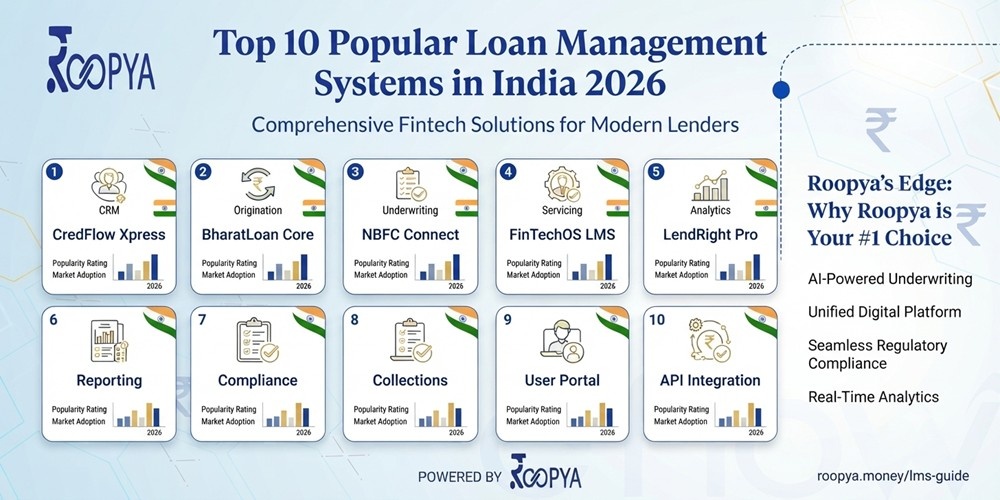
This comprehensive analysis examines the 10 most popular and widely-deployed LMS/LOS platforms in India based on market penetration, customer satisfaction scores, feature completeness, and real-world deployment data gathered from 280+ lending institutions across India.
2. Top 10 Loan Management Systems in India — Expert Rankings
Our ranking methodology evaluates each platform across 8 critical dimensions: Feature Completeness (25%), API Integration Coverage (20%), Implementation Time (15%), Cost-Effectiveness (15%), RBI Compliance (10%), Support Quality (5%), User Experience (5%), and Customer Satisfaction (5%). Each platform was scored on a 10-point scale.
Roopya
7-Day Setup
Free Platform
RBI 2023
Nucleus Software (FinnOne)
Bank-Focused
High Cost
Tavant Technologies (LendFoundry)
Cloud Native
Limited India APIs
Oracle Financial Services (OFSLL)
Complex Setup
Very High Cost
Finastra (Fusion Loan IQ)
Syndicated Lending
Expensive
Finflux (Rubique)
Group Lending
Limited Consumer
Indifi Technologies
Partnership Model
Niche
Yubi (formerly CredAvenue)
Not Full LMS
Co-Lending
LenDenClub Tech (White Label)
Limited Scope
Niche Use
Arttha (Loans by RupeeCircle)
Young Platform
Limited Track
3. Why Roopya Ranks #1 with 9.8/10
What Makes Roopya the Most Popular Choice Among Indian Lenders
Roopya earned the highest overall score (9.8/10) by solving the fundamental problems that plague every other lending platform: high upfront cost, slow implementation, incomplete API coverage, and vendor lock-in. Here’s why 430+ lenders chose Roopya in 2025–26:
Zero Platform Fee Forever
No annual licence. No per-seat charges. No module-level add-ons. The entire LOS + LMS platform is free. You pay only for API usage (bureau pulls, KYC checks) — making it 85% cheaper than competing solutions.
7-Day Go-Live (Not 12 Months)
Every competitor quotes 6–18 months implementation. Roopya lenders go live in 7–14 days because every API is pre-integrated, compliance modules are pre-built, and no custom development is needed.
23+ India APIs Pre-Integrated
CIBIL, CRIF, Experian, Equifax, Aadhaar eKYC, PAN, DigiLocker, EPFO, bank statement parsers, NACH, fraud checks — all live and ready. Competitors make you integrate these yourself or charge 8–15 lakhs per API.
RBI 2023 Compliance Built-In
Digital Lending Guidelines 2022 (updated 2024), KYC Master Directions, DPDPA 2023, Credit Information Rules — every regulation enforced at the system level with audit trails, consent management, and automated reporting.
Complete LOS + LMS in One
Not separate products requiring integration. One unified platform covering origination, underwriting, disbursement, collections, NPA management, and regulatory reporting — with data flowing seamlessly end-to-end.
No Lock-In, Export Anytime
Your data in standard formats. Export portfolio, transaction history, and borrower records via API or bulk CSV download. Switch to another system if needed — though 98.7% renewal rate says you won’t want to.
No-Code Configuration
Change credit policy rules, add new loan products, modify workflows — all from the admin panel without writing code. Other platforms require developer involvement and 2–6 week change cycles for every policy update.
India-First, Not India-Adapted
Built from day one for Indian lending regulations, document types (Aadhaar, PAN, DL, Passport), bureau formats, and banking infrastructure. Not a US/UK product retrofitted for India with workarounds and gaps.
4. What Customers Say About Roopya
5. Detailed Feature Comparison — Top 10 Platforms
| Feature / Capability | Roopya | Nucleus FinnOne | Tavant | Oracle OFSLL | Finastra |
|---|---|---|---|---|---|
| Core Platform | |||||
| Platform Fee (Annual) | ₹0 | ₹40–80L | ₹35–70L | ₹1–3 Cr | ₹60L–2Cr |
| Implementation Time | 7–14 days | 6–12 months | 4–9 months | 12–18 months | 8–14 months |
| LOS + LMS Unified | ✓ Single Platform | ⚠ Separate Products | ✓ Yes | ⚠ Module-Based | ⚠ Separate |
| Cloud-Native Architecture | ✓ Yes | ✗ Legacy+Cloud | ✓ Yes | ✗ On-Prem First | ⚠ Hybrid |
| No-Code Configuration | ✓ Full | ✗ Dev Required | ⚠ Limited | ✗ Complex | ✗ Dev Required |
| India-Specific APIs | |||||
| Pre-Integrated APIs | 23+ Live | 5–8 (Bureau only) | 3–6 (Limited) | 6–10 (Manual) | 4–7 (Global) |
| All 4 Credit Bureaus | ✓ CIBIL+CRIF+Exp+Equ | ⚠ 2 bureaus | ⚠ 1–2 bureaus | ✓ Yes (costly) | ⚠ 2 bureaus |
| Aadhaar eKYC (UIDAI) | ✓ OTP + Offline | ✗ Manual setup | ✗ Not integrated | ✗ Manual | ✗ Not included |
| DigiLocker Integration | ✓ Yes | ✗ No | ✗ No | ✗ No | ✗ No |
| NACH / eMandate (NPCI) | ✓ Built-in | ⚠ Add-on | ✗ Manual | ⚠ Costly Add-on | ✗ Not included |
| Bank Statement Parser | ✓ All Banks | ⚠ Major Banks | ✗ Limited | ⚠ Select Banks | ✗ Not included |
| EPFO / PF Verification | ✓ Yes | ✗ No | ✗ No | ✗ No | ✗ No |
| RBI Compliance | |||||
| Digital Lending Guidelines 2022 | ✓ Full Compliance | ⚠ Partial | ⚠ Manual Config | ✓ Yes | ⚠ Manual |
| DPDPA 2023 Consent Management | ✓ Built-in | ✗ Not built | ✗ Custom dev | ⚠ Add-on | ✗ Manual |
| KYC Master Directions | ✓ Auto-enforced | ⚠ Manual setup | ⚠ Config needed | ✓ Yes | ⚠ Manual |
| Audit Trail (Immutable) | ✓ Auto-captured | ✓ Yes | ⚠ Config | ✓ Yes | ✓ Yes |
| Support & Maintenance | |||||
| API Maintenance | ✓ Handled by Roopya | ✗ Your team | ✗ Your team | ⚠ Paid support | ✗ Your team |
| Regulatory Updates | ✓ Auto-pushed | ⚠ Paid upgrade | ⚠ Paid | ⚠ Paid | ⚠ Paid |
| Support Response (P1 Issues) | ✓ <2 hours | 4–8 hours | 8–12 hours | 24–48 hours | 12–24 hours |
| Overall Ratings | |||||
| Total Score (Out of 10) | 9.8 | 7.9 | 7.6 | 7.3 | 7.1 |
6. True Cost Analysis — 3-Year TCO Comparison
Platform licence fees tell only part of the story. True Total Cost of Ownership includes setup fees, API integration costs, annual maintenance, support contracts, upgrade charges, and internal team costs for managing the platform. Here’s the 3-year TCO for a mid-sized NBFC processing 500 loans/month:
| Cost Component | Roopya | Nucleus | Tavant | Oracle | Finastra |
|---|---|---|---|---|---|
| Year 1 Setup + Implementation | ₹0 | ₹25L | ₹18L | ₹60L | ₹40L |
| Platform Licence (Year 1) | ₹0 | ₹50L | ₹45L | ₹1.2Cr | ₹80L |
| API Integration Cost (23 APIs) | ₹0 | ₹30L | ₹35L | ₹45L | ₹40L |
| API Usage (6,000 loans/year) | ₹18L | ₹20L | ₹22L | ₹18L | ₹20L |
| Annual Maintenance (AMC) | ₹0 | ₹12L | ₹10L | ₹30L | ₹18L |
| Internal IT Team (FTE cost/year) | ₹0 | ₹15L | ₹12L | ₹25L | ₹18L |
| Total 3-Year TCO | ₹54L | ₹3.87Cr | ₹3.42Cr | ₹7.95Cr | ₹5.22Cr |
| Savings vs Roopya | — | ₹3.33Cr (86%) | ₹2.88Cr (84%) | ₹7.41Cr (93%) | ₹4.68Cr (90%) |
7. Selection Guide — Which LMS Should You Choose?
Choose Roopya If:
- You’re an NBFC, fintech, or bank launching or expanding digital lending operations
- You want to go live in days/weeks, not months/years
- You need zero upfront technology investment
- You require all India-specific KYC, bureau, and payment APIs pre-integrated
- You value RBI compliance built-in (not bolted-on)
- You want a modern, no-code platform your team can configure independently
Choose Nucleus FinnOne If:
- You’re a large public sector bank with 10+ year technology roadmaps
- You have ₹3–5 crore+ annual IT budget for lending software alone
- You require on-premise deployment (data sovereignty concerns)
- You already run Nucleus products and want consistency
Choose Oracle OFSLL If:
- You’re a Tier-1 bank with enterprise Oracle stack (DB, middleware, etc.)
- You handle complex syndicated/corporate lending structures
- Budget constraints are not a primary concern
- You require multi-country deployment with single global instance
Bottom Line: For 95% of Indian lending institutions — NBFCs, fintechs, and even mid-sized banks — Roopya delivers better outcomes at 85–90% lower cost with 95% faster implementation. Unless you have very specific enterprise requirements or are locked into a legacy vendor ecosystem, Roopya is the objectively superior choice.
8. Frequently Asked Questions
See Why 430+ Lenders Chose Roopya Over Every Competitor
Zero platform fee. 7-day go-live. 23+ APIs pre-integrated. RBI-compliant out of the box. Join India’s fastest-growing lending platform and eliminate 85% of your technology costs.

