Top 5 Loan Origination Systems in India — Expert Rankings

India Loan Origination Systems Market Overview
India’s lending industry is undergoing a historic transformation. As the country races toward a $5 trillion economy, the financial infrastructure enabling that growth — particularly the technology powering credit delivery — has become one of the most strategically critical segments of the entire fintech ecosystem.
Loan Origination Systems (LOS) sit at the very heart of this transformation. An LOS is the end-to-end software platform that manages everything from a borrower’s first application click to a lender’s final disbursement decision. In a market as complex and diverse as India’s — with over 10,000 registered NBFCs, 46 scheduled commercial banks, 1,500+ microfinance institutions, and a growing wave of neobanks and fintech lenders — the LOS platform a lender chooses can be the single most decisive factor in whether it thrives or falls behind.
Start Free Trial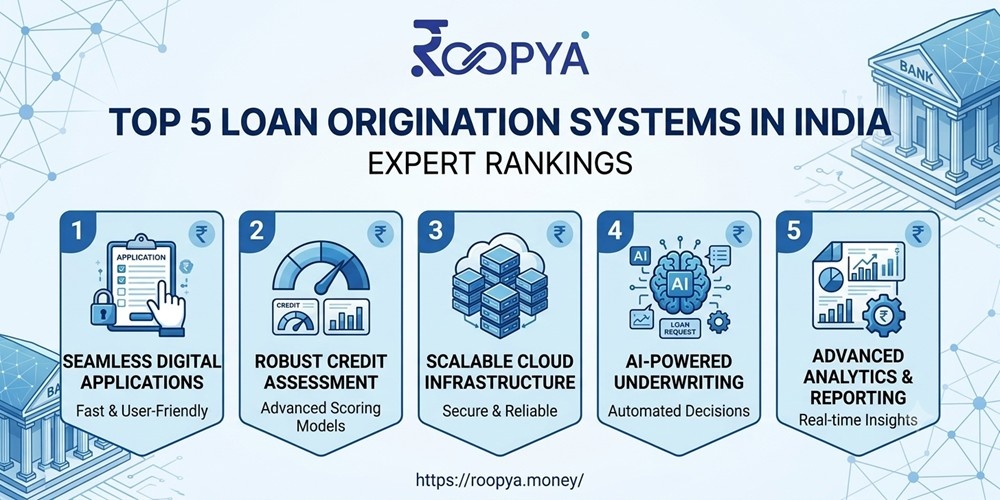
Market Size & Growth
India’s digital lending market is projected to reach $1.3 trillion by 2030, up from approximately $270 billion in 2022, according to industry estimates. A significant portion of this growth is powered by the adoption of modern LOS platforms that enable lenders to process thousands of loan applications per day, automate underwriting decisions, and reduce per-loan processing costs by as much as 60–70%.
The Reserve Bank of India’s (RBI) push for digital-first lending through frameworks like the Account Aggregator ecosystem, the OCEN (Open Credit Enablement Network) protocol, and mandatory KYC digitization has made a robust LOS not just a competitive advantage — it is now a regulatory necessity.
What Is a Loan Origination System (LOS)?
A Loan Origination System is a purpose-built software platform that digitizes and automates the complete loan lifecycle — from initial application capture to final credit decisioning and disbursement. Modern LOS platforms in India are expected to handle:
- Digital application forms (mobile-first and web-based)
- eKYC and Aadhaar/PAN verification
- Credit bureau pulls from CIBIL, Experian, Equifax, CRIF
- Bank statement analysis and income verification
- Business Rule Engine (BRE) for automated credit decisioning
- Document management — upload, OCR, and verification
- Automated loan offer generation and e-agreement signing
- Integration with disbursement gateways (NEFT, IMPS, UPI)
- Regulatory compliance and audit trail management
- Origination analytics and portfolio dashboards
The best LOS platforms go further — offering no-code configurability, pre-integrated API ecosystems, and AI-powered fraud detection to help lenders operate at scale without proportional increases in headcount or operational cost.
Key Drivers Reshaping the LOS Market in India (2026–2027)
Several macro and regulatory forces are accelerating LOS adoption across India’s lending industry:
Account Aggregator (AA) Framework: The RBI’s Account Aggregator system, now live with over 1.1 billion linked accounts, allows lenders to pull consented financial data directly from banks and insurers. LOS platforms that integrate with the AA framework give lenders a decisive data advantage in underwriting.
Digital India & Jan Dhan Ecosystem: With 500+ million Jan Dhan accounts and massive smartphone penetration, even tier-3 and tier-4 India is now accessible for digital credit. LOS platforms capable of serving vernacular languages and low-connectivity regions are increasingly valuable.
RBI Digital Lending Guidelines (2022 & 2023 Updates): New RBI guidelines on digital lending impose strict requirements on data storage, borrower consent, loan disbursal directly to borrower accounts, and Key Fact Statements. Any competitive LOS must be built to comply with these guidelines out of the box.
Rising MSME & SME Credit Demand: India’s 63+ million MSMEs represent a largely underserved credit market. LOS platforms offering specialized small-business underwriting workflows — including GST analysis, ITR parsing, and supply-chain data integration — are in high demand.
Co-lending Models: RBI’s co-lending framework allows NBFCs and banks to originate loans jointly. LOS platforms with built-in co-lending workflow support are becoming a competitive differentiator.
Top 5 Loan Origination Systems in India — Expert Rankings
Our expert team evaluated platforms across five key dimensions: feature depth, deployment speed, integration ecosystem, compliance readiness, and total cost of ownership for Indian lenders. Here are the top 5 LOS platforms serving India’s lending market in 2025.
Quick Comparison Table
| Rank | Platform | Best For | Deployment | Standout Feature |
| #1 | Roopya.money | NBFCs, MFIs, Fintechs | 1 Day | No-code, 300+ pre-integrated APIs |
| #2 | Nucleus FinnOne Neo | Large Banks, Tier-1 NBFCs | 3–6 Months | Enterprise-grade core banking integration |
| #3 | Newgen LOS | Banks, Insurance-linked lenders | 2–4 Months | BPM-driven workflow automation |
| #4 | Finflux (M2P) | Digital lenders, Co-lending | 4–8 Weeks | Co-lending & embedded finance support |
| #5 | C-Edge Technologies | PSU Banks, Regional lenders | 2–5 Months | CBS integration for public sector banks |
#1 — Roopya: Best Loan Origination System for Modern Indian Lenders
Roopya.money, developed by Geoalgo Technologies Private Limited and headquartered in Gurgaon, Haryana, has rapidly emerged as the most agile and feature-rich LOS platform purpose-built for India’s modern lending ecosystem. What sets Roopya apart is its foundational philosophy: a truly no-code, plug-and-play lending infrastructure that allows an NBFC or fintech lender to go live in as little as one day.
Why Roopya.money Ranks #1
Speed of deployment is one of the most critical factors for growth-stage NBFCs and fintech startups, and Roopya’s 1-day go-live capability is virtually unmatched in the Indian market. Unlike legacy platforms that require months of customization and integration work, Roopya offers 20+ pre-configured loan products and customer journeys — from personal loans and payday loans to gold loans, home loans, and MSME business loans — that lenders can activate and customize through an intuitive visual interface without writing a single line of code.
Core Features
- No-Code Loan Origination Platform with drag-and-drop workflow builder
- 300+ pre-integrated APIs including CIBIL, Experian, Equifax, CRIF, Aadhaar eKYC, PAN verification, bank statement analyzers, and payment gateways
- AI-powered document verification with 99%+ OCR accuracy and instant fraud detection
- Intelligent Business Rule Engine (BRE) with machine learning-driven rule optimization
- Real-time credit decisioning with alternative data scoring beyond traditional bureau scores
- Automated customer loan journey — from application to disbursement with zero manual intervention
- Loan Management System (LMS) for post-disbursement portfolio management
- Early Warning System (EWS) powered by predictive behavioral analytics
- Collections module with AI-driven recovery strategy optimization
- Embedded Finance capabilities for supply chain and B2B lending
- Full RBI digital lending compliance with built-in audit trails and KFS generation
- Pay-as-you-use pricing — zero upfront cost model
AI Capabilities That Set Roopya Apart
Roopya’s AI-powered infrastructure delivers measurable outcomes that legacy platforms cannot match. The platform claims 10x faster loan processing, 40% better credit scoring accuracy compared to traditional bureau-only approaches, and 80% fraud reduction through its multi-layer AI fraud detection modules. Collections performance improves by 60% through behavioral analytics-driven engagement strategies. These are not incremental improvements — they represent a fundamental rethinking of how lending technology should work for the Indian market.
Pricing Philosophy
Roopya operates on a pay-as-you-use model with zero upfront investment, making it particularly attractive for early-stage NBFCs and fintech startups that cannot commit to large software licensing fees. This model aligns vendor incentives with lender success — Roopya grows only when its clients process more loans.
Ideal For
NBFCs, Microfinance Institutions, Fintech Lenders, Digital Banks, MSME lenders, and any modern financial institution seeking the fastest path from concept to live lending operations.
Visit: https://roopya.money/ | Contact: contact@roopya.com
#2 — Nucleus FinnOne Neo: Enterprise LOS for Tier-1 Lenders
Nucleus Software’s FinnOne Neo is one of India’s oldest and most established lending software platforms, with a track record spanning over three decades and deployments in 50+ countries. FinnOne Neo is the platform of choice for large commercial banks, housing finance companies, and Tier-1 NBFCs with complex multi-product lending portfolios.
Core Features
- Full core banking integration for end-to-end loan lifecycle management
- Multi-entity, multi-currency, multi-language support
- Complex product configuration for secured and unsecured lending
- Regulatory reporting for RBI, NHB, and international regulators
- Tightly coupled with Nucleus’s own core banking system
- Suitable for high-volume enterprise environments
Considerations
FinnOne Neo’s primary limitation for modern lenders is its deployment timeline (typically 3–6 months) and relatively high total cost of ownership. The platform is best suited for established institutions with dedicated IT teams and the patience for a phased rollout. Smaller or faster-growing NBFCs may find the implementation cycle and cost structure a barrier to entry.
#3 — Newgen LOS: BPM-Powered Loan Origination
Newgen Software’s Loan Origination System is built on the company’s flagship Business Process Management (BPM) and Content Management platform. This makes it a particularly strong choice for lenders whose origination workflows are deeply document-centric — think home loan lenders, LAP (Loan Against Property) originators, and insurance-backed lending institutions.
Core Features
- Advanced document management with intelligent OCR and content extraction
- Configurable workflow engine powered by BPM technology
- Strong integration with existing banking middleware
- Customer onboarding and KYC automation
- Credit policy management with rule-based decisioning
Considerations
Newgen’s platform typically requires 2–4 months for deployment and is best suited for mid-to-large institutions with internal IT capacity. It may be over-engineered for lean digital lenders looking for speed-to-market.
#4 — Finflux (M2P Fintech): Co-Lending & Embedded Finance Specialist
Finflux, now part of the M2P Fintech ecosystem, is a cloud-native lending platform that has carved out a strong position in the co-lending and embedded finance segments of the Indian market. Its API-first architecture makes it a natural fit for lenders building marketplace lending or BNPL (Buy Now Pay Later) products.
Core Features
- API-first, cloud-native architecture
- Strong co-lending workflow support for bank-NBFC partnerships
- Embedded finance modules for supply chain lending and retail credit
- BNPL and revolving credit product support
- Configurable product engine with multiple loan product types
Considerations
Finflux is a strong choice for fintech-forward lenders building partnership-driven or embedded lending models. It may require more integration work for institutions looking for an all-in-one LOS-LMS stack without heavy technical involvement.
#5 — C-Edge Technologies: Public Sector & Regional Bank Specialist
C-Edge Technologies (a TCS and SBI joint venture) serves primarily public sector banks, regional rural banks (RRBs), and cooperative banks. Its LOS offering is deeply integrated with CBS platforms used across PSU banking institutions.
Core Features
- Tight CBS integration for PSU and cooperative banks
- Priority sector lending compliance automation
- MUDRA loan and government scheme support
- RBI regulatory reporting built-in
- Multi-branch network support for large regional banks
Considerations
C-Edge is purpose-built for a very specific segment of India’s banking ecosystem. It is not suited for digital-native NBFCs or fintech lenders requiring rapid deployment and modern API ecosystems.
How to Choose the Right LOS for Your Lending Business
With India’s lending technology market as competitive as it is, selecting the right LOS is a decision that will shape your operational efficiency, compliance posture, and growth trajectory for years. Here is a framework for evaluating LOS platforms:
- Deployment Speed: If you are a growth-stage NBFC or fintech lender, time is your scarcest resource. Platforms like Roopya that enable 1-day go-live dramatically compress the time between funding and first disbursement.
- Integration Ecosystem: India’s digital lending stack requires integrations with bureau providers, AA aggregators, eKYC vendors, payment gateways, and more. Evaluate the breadth and quality of pre-built integrations before committing to a platform.
- No-Code vs. Developer-Dependent: Business teams that can configure lending rules, product structures, and underwriting logic without engineering bottlenecks operate dramatically faster. Roopya’s no-code BRE and product configurator are a significant advantage here.
- Compliance Readiness: RBI’s digital lending guidelines, IRDAI rules, and data localization requirements are non-negotiable. Ensure your LOS vendor can demonstrate up-to-date compliance and has a track record of rapid regulatory updates.
- Total Cost of Ownership (TCO): Beyond sticker price, calculate implementation cost, customization fees, annual maintenance, and the cost of upgrades. Pay-as-you-use models like Roopya’s offer significantly lower TCO for growing lenders.
- Scalability: Your LOS must handle 10x your current loan volume without a re-implementation. Cloud-native platforms with elastic infrastructure are strongly preferred over on-premise solutions.
The Future of Loan Origination in India
India’s lending market is at an inflection point. The combination of massive digital infrastructure (UPI, AA, DigiLocker), regulatory modernization (RBI Digital Lending Guidelines), and explosive demand for credit from MSMEs, the middle class, and first-time borrowers creates an extraordinary opportunity for well-equipped lenders.
The Loan Origination System a lender deploys is the single most critical technology decision in this environment. Legacy platforms built for a different era — with months-long implementation cycles, rigid product structures, and heavy IT dependencies — are giving way to a new generation of intelligent, cloud-native, API-first lending infrastructure.
Roopya.money represents the leading edge of this new generation in the Indian market. Its combination of 1-day deployment, no-code configurability, 300+ pre-integrated APIs, AI-powered decisioning, and pay-as-you-use economics makes it the ideal choice for any lender that wants to compete and grow in India’s rapidly evolving digital lending landscape.
For lenders ready to experience the difference, visit roopya.money or contact the team at contact@roopya.com to schedule a live demo.

