How to Choose the Best Loan Origination Software for Your Business

Loan Origination Software (LOS) is the backbone of any modern lending operation. It automates the end-to-end journey — from application intake and document verification to credit decisioning and disbursement. But with dozens of solutions available in the Indian market, choosing the right LOS for your NBFC, bank, or fintech can be overwhelming.
This guide walks you through everything you need to know to make the right choice — the key features to evaluate, the questions to ask vendors, the red flags to watch for, and how platforms like Roopya are redefining what a modern LOS should look like.
Start Free Trial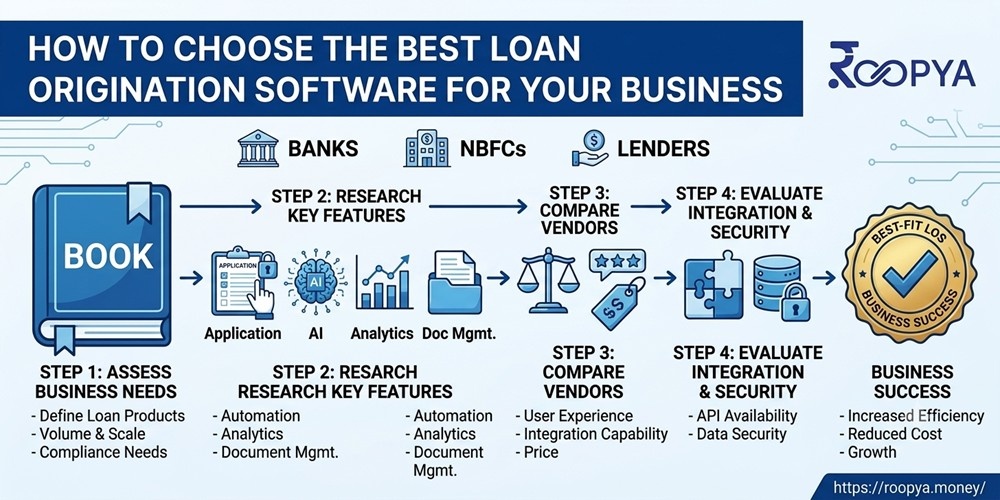
What is Loan Origination Software?
Loan Origination Software is a technology platform that manages and automates the entire loan application lifecycle — from the moment a borrower submits an application to the point when funds are disbursed. A well-built LOS handles:
- Digital application capture across web, mobile, and agent channels
- KYC and document collection and verification
- Bureau pulls and credit scoring
- Automated underwriting and credit decisioning via a Business Rule Engine (BRE)
- Workflow management and approval routing
- Offer generation and sanction letter issuance
- Integration with disbursement and loan management systems
For lenders processing hundreds or thousands of applications per month, a robust LOS is not a luxury — it is a business-critical necessity.
Why Your Choice of LOS Matters
The LOS you choose directly affects three things that determine your competitiveness as a lender: speed, cost, and risk.
Speed: A well-integrated LOS can reduce application-to-disbursement time from days to hours — or even minutes for pre-approved borrowers. This directly impacts customer acquisition, satisfaction, and repeat business.
Cost: Manual loan processing is expensive. Each loan application processed manually costs significantly more in staff time, errors, and rework compared to an automated LOS. The right software dramatically reduces per-loan operating costs.
Risk: A modern LOS with robust credit decisioning, fraud detection, and bureau integrations ensures that loans are originated to the right borrowers — minimising NPAs and portfolio losses.
Choosing the wrong LOS, on the other hand, can result in lengthy implementation timelines, poor scalability, hidden integration costs, and a platform that cannot keep up with your growth.
Key Features to Look for in a Loan Origination Software
-
No-Code Configuration
The best LOS platforms today allow business users — not just IT teams — to configure loan products, workflows, and rules. Look for a platform with a visual, drag-and-drop interface so that your credit and operations teams can make changes without raising IT tickets or waiting for development cycles. Roopya, for instance, is a truly no-code platform that lets you configure complex lending rules, workflows, and credit policies without writing a single line of code.
-
Pre-Built API Integrations
A modern LOS must integrate seamlessly with a wide ecosystem of third-party services — credit bureaus (CIBIL, Experian, Equifax, CRIF), bank statement analysers, eKYC providers, GST APIs, account aggregators, NACH/eMandate gateways, and more. Evaluate how many pre-integrated APIs the platform offers and how quickly new integrations can be added. Roopya, for example, offers 300+ pre-integrated APIs ready to use from day one.
-
Configurable Business Rule Engine (BRE)
Your credit policy is unique. Your LOS must be able to encode that policy precisely — including eligibility rules, scorecard logic, deviation handling, and credit limit calculations. A powerful, configurable BRE is non-negotiable. Avoid platforms where BRE changes require vendor intervention or custom development.
-
AI-Powered Credit Decisioning
Leading LOS platforms now embed machine learning models that go beyond bureau scores. They evaluate alternative data — behavioural data, device signals, bank statement patterns, social indicators — to generate more accurate risk assessments, especially for thin-file or new-to-credit borrowers. AI-powered decisioning increases approval rates on creditworthy borrowers while reducing defaults.
-
Multi-Product and Multi-Channel Support
If your lending business offers multiple loan products — personal loans, business loans, gold loans, payday loans, BNPL — your LOS should handle all of them on a unified platform. Similarly, it should support multiple origination channels: direct-to-consumer apps, agent-assisted journeys, dealer or merchant platforms, and embedded finance partnerships. Switching between different systems for different products is operationally expensive and risky.
-
Fraud Detection Capabilities
Loan fraud is a growing problem in India’s digital lending ecosystem. Your LOS should include built-in fraud detection modules — document forgery detection, duplicate application checks, device fingerprinting, velocity checks, and identity verification. Platforms like Roopya include AI-powered fraud detection that analyses suspicious patterns across all applications in real time.
-
Regulatory Compliance
India’s digital lending regulatory environment is evolving rapidly — from RBI’s Digital Lending Guidelines to data privacy norms and FLDG regulations. Your LOS must be compliant out of the box and must be updated automatically as regulations change. Manual compliance updates are costly and risky. Always ask vendors how they handle regulatory updates and what their track record looks like.
-
Speed of Implementation
Traditional LOS implementations can take 6 to 18 months — a timeline that is simply unacceptable for NBFCs and fintechs that need to move quickly. Ask every vendor for realistic go-live timelines and reference customers. Roopya, for instance, enables lenders to go live in as little as 1 day, thanks to its plug-and-play infrastructure and 20+ pre-configured loan products.
-
Pricing Model
LOS pricing varies widely — from large upfront licence fees plus implementation charges, to pay-per-use or subscription-based models. For growing NBFCs and fintechs, a usage-based model is significantly more favourable, as it aligns costs with actual loan volumes and eliminates the need for large upfront capital expenditure. Always read the fine print on per-API call charges, support fees, and upgrade costs.
-
Scalability and Open Architecture
Your LOS must grow with you. As your loan volumes scale from hundreds to tens of thousands of applications per month, the platform should handle the load without performance degradation. It should also support open API architecture so you can integrate it with your CRM, ERP, accounting systems, and other tools as your tech stack evolves.
Questions to Ask Before You Sign
Before committing to any LOS vendor, get clear answers to these questions:
- What is the realistic go-live timeline, and what support do you provide during implementation?
- How many active NBFC or fintech clients are currently live on your platform?
- How are regulatory updates handled — automatically or through manual upgrades?
- What is the uptime SLA and what is the incident response process?
- How is data security managed — encryption, access controls, audit trails?
- Can we see a live demo with our actual loan product configuration?
- What does total cost of ownership look like over 3 years?
Red Flags to Watch For
Not all LOS platforms are created equal. Watch for these warning signs during vendor evaluations:
- Long implementation timelines with no clear milestones
- Inability to demo a working product with your specific configurations
- Heavy reliance on custom development for standard configurations
- Vague answers about regulatory compliance and update processes
- Pricing that is opaque or loaded with hidden charges
- No reference customers in your segment or loan product category
Why Roopya Stands Out as a Loan Origination Platform
Roopya is India’s next-generation digital lending infrastructure platform, purpose-built for modern financial institutions — NBFCs, banks, MFIs, and fintechs. Here is what sets it apart:
- Go live in 1 day with pre-built loan products and plug-and-play infrastructure
- Truly no-code platform — business users configure everything without IT dependency
- 300+ pre-integrated APIs including all major credit bureaus, eKYC, and payment gateways
- AI-powered credit decisioning, document analysis, and fraud detection
- Pay-as-you-use pricing with zero upfront costs
- Always-updated for regulatory compliance
- Supports 20+ pre-configured loan products across personal, business, gold, and micro-lending
- Comprehensive lending lifecycle — LOS, LMS, Collections, Early Warning, and Analytics on a single platform
Whether you are launching a new NBFC or scaling an existing lending business, Roopya gives you the infrastructure to move fast, stay compliant, and grow confidently.
Choosing the right Loan Origination Software is one of the most consequential technology decisions a lender will make. The right platform can compress your go-to-market timeline from months to days, reduce per-loan costs dramatically, improve credit quality, and create a borrower experience that drives loyalty and referrals.
Evaluate your options carefully — prioritise no-code flexibility, deep integrations, AI-powered decisioning, regulatory compliance, and transparent pricing. And when you are ready to see what a modern LOS truly looks like, explore Roopya’s platform at roopya.money.

