Loan Servicing Software: The Complete Guide for NBFCs, Banks & Digital Lenders

Every loan a lender disburses begins a long second life — one that has nothing to do with origination and everything to do with discipline. EMIs need to be calculated correctly. Payments need to be collected on time, reconciled, and recorded. Borrowers need statements, NOCs, and a way to ask questions. Defaults need to be flagged before they become write-offs. This entire post-disbursement journey is what the lending industry calls loan servicing, and the technology that powers it is loan servicing software.
For decades, Indian NBFCs and banks ran this function on a patchwork of spreadsheets, legacy core banking modules, and manual follow-ups by collection teams. That approach worked when loan books were small and loan products were simple. It breaks down completely once a lender scales past a few thousand active loans, launches multiple products, or tries to serve borrowers digitally. Today, loan servicing software has become as essential to a lending business as the loan origination system that brings borrowers in the door.
Start Free Trial
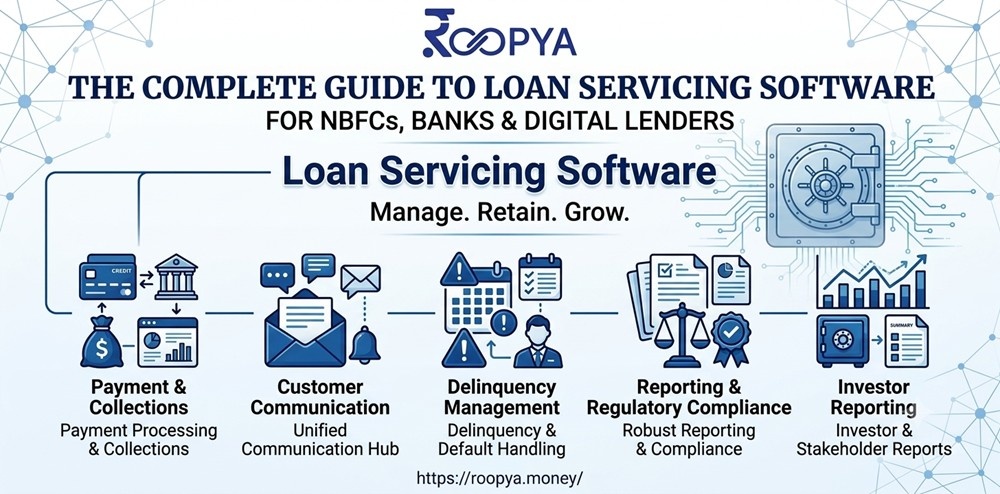
This guide explains what loan servicing software actually does, why it matters more than ever for Indian lenders in 2026, what features separate a modern platform from a legacy one, and how to evaluate the right solution for your institution.
What Is Loan Servicing Software?
Loan servicing software is a technology platform that manages every activity related to an active loan after it has been disbursed — until the loan is fully closed, settled, or written off. It sits at the centre of the loan lifecycle, connecting the borrower, the lender’s finance team, the collections team, and the compliance function on a single system of record.
At its core, loan servicing software is responsible for:
- Calculating and scheduling EMIs accurately, including interest accrual and amortization
- Processing repayments through multiple channels and reconciling them against the loan account
- Tracking the health of every loan — current, overdue, delinquent, or in default
- Managing communications and reminders with borrowers throughout the loan term
- Handling exceptions like prepayment, foreclosure, restructuring, and top-up loans
- Generating statements, certificates, and regulatory reports
- Feeding accurate, real-time data into collections, risk, and finance systems
It is often discussed alongside — but is distinct from — a Loan Origination System (LOS), which handles the application and approval process before disbursement. A loan servicing platform takes over the moment the loan amount hits the borrower’s account, and it remains the system of truth for that loan until the very last rupee is collected or the account is closed.
Why Loan Servicing Software Matters More Than Ever in 2026
1. Loan books are growing faster than manual processes can handle
India’s NBFC sector has seen explosive growth in retail and small-ticket lending, fintech-led personal loans, gold loans, and embedded finance products. A lender that processes a few hundred loans a month can survive on manual EMI tracking. A lender processing thousands of micro-loans daily cannot. Loan servicing software is what allows a lending operation to scale loan volume without scaling headcount at the same rate.
2. Borrowers now expect a digital-first experience
Borrowers who are used to UPI, instant payment confirmations, and self-service apps will not tolerate calling a branch to check their outstanding balance or waiting days for a foreclosure letter. Modern loan servicing software gives borrowers a self-service portal where they can view EMI schedules, download statements, make payments, and raise service requests — without involving a human agent for routine tasks.
3. Regulatory scrutiny on NBFCs has intensified
RBI’s continued tightening of NBFC regulations — around fair practices, NPA classification, provisioning norms, and reporting timelines — means lenders need accurate, auditable, real-time data on every loan account. Spreadsheet-based servicing introduces reconciliation errors and reporting delays that are increasingly difficult to defend during an RBI audit or inspection. Purpose-built loan servicing software builds compliance into the system rather than treating it as an afterthought.
4. Delinquency management has become a science, not an afterthought
Early identification of stress in a loan account — before it becomes a 90+ DPD NPA — depends on having clean, real-time servicing data. Without a proper loan servicing system, early warning signals are invisible until it’s too late to intervene cost-effectively.
5. Multi-product, multi-channel lending demands flexibility
Lenders today are not running one loan product through one channel. A single NBFC might offer personal loans, gold loans, business loans, and BNPL-style credit lines — sourced through branches, apps, and embedded finance partners simultaneously. Legacy servicing systems, often built for a single product type, cannot flex to support this complexity. Modern, configurable loan servicing software can.
Core Features of a Modern Loan Servicing Software Platform
Loan Account & Portfolio Management
The foundation of any loan servicing system is the ability to maintain a complete, accurate, real-time record of every loan account — principal outstanding, interest accrued, fees, penalties, and payment history — across the entire portfolio. A good platform supports multiple loan structures (reducing balance, flat rate, bullet repayment) and multiple product types from a single configurable engine, rather than requiring custom development for every new product.
EMI Scheduling and Amortization
Accurate amortization schedules are non-negotiable. The software must correctly calculate interest accrual, generate EMI schedules at disbursement, and recalculate schedules instantly whenever a borrower makes a part-payment, prepayment, or requests restructuring. Manual recalculation of amortization tables is one of the most common sources of error — and borrower disputes — in lending operations that still rely on spreadsheets.
Payment Processing and Reconciliation
Borrowers pay through many channels today — NACH, eNACH, UPI autopay, payment gateways, cash collection at branch, and third-party collection agents. A capable loan servicing platform should integrate with all of these, automatically match incoming payments to the correct loan account, and reconcile them without manual intervention. Failed payment handling, bounce charges, and re-presentation logic should also be automated.
Delinquency and Collections Management
When a borrower misses a payment, the system should immediately flag the account, calculate days past due (DPD), apply the correct penal charges per the loan agreement, and trigger the appropriate collections workflow — automated reminders first, then escalation to a human agent or field team if the account remains overdue. The best platforms support configurable collection buckets and strategies rather than a single rigid escalation path for every borrower.
Customer Self-Service Portal
A borrower-facing portal or app reduces the operational burden on call centres and branches. Borrowers should be able to view their loan statement, download interest certificates, check their outstanding balance, make a payment, request a NOC after closure, and raise a service ticket — all without picking up the phone.
Prepayment, Foreclosure, and Restructuring Workflows
Loans are rarely static for their full tenure. Borrowers prepay, request foreclosure, ask for restructuring after a financial setback, or want a top-up loan. A modern loan servicing system handles all of these as configurable workflows with automatic recalculation, rather than requiring manual intervention by an operations team every time.
Regulatory and Compliance Reporting
For NBFCs and banks in India, the software should be built to generate RBI-mandated reports — NPA classification, provisioning, ALM statements — directly from servicing data, along with GST/TDS calculations and credit bureau reporting feeds (CIBIL, Experian, Equifax, CRIF). Building compliance into the data layer, rather than bolting it on through manual reports, dramatically reduces audit risk.
Analytics and Dashboards
Real-time visibility into portfolio health — vintage analysis, DPD trends, collection efficiency, product-wise performance — allows lending businesses to make decisions on data rather than gut feel. This is particularly critical for risk and finance teams who need to report portfolio quality upward to the board or to regulators.
API and Integration Layer
No loan servicing platform operates in isolation. It needs to talk to payment gateways, credit bureaus, accounting systems, communication providers (SMS, WhatsApp, email), and increasingly, embedded finance partners who originate loans on behalf of the lender. An open, well-documented API architecture is what determines whether a platform can actually fit into a lender’s existing technology stack — or becomes another disconnected silo.
Loan Servicing Software vs. Legacy Core Banking Modules
Many established NBFCs and banks still run loan servicing as a module within a much older core banking or core lending system. While these systems are stable, they were typically built years or decades ago for a much simpler lending environment, and they show their age in a few consistent ways:
Rigidity. Adding a new loan product, changing an interest calculation method, or modifying a collections workflow in a legacy system often requires a development cycle measured in weeks or months. A modern, no-code loan servicing platform allows business teams to configure these changes themselves, often in hours.
Poor borrower experience. Legacy systems were not designed with self-service portals or mobile-first borrower journeys in mind. Retrofitting them is expensive and usually delivers a clunky result.
Limited integration. Older systems frequently lack modern REST APIs, making it hard to connect to today’s payment gateways, KYC providers, and fintech partners without expensive middleware.
High total cost of ownership. Legacy licensing models often involve large upfront capital expenditure, on-premise infrastructure, and ongoing maintenance contracts — a poor fit for NBFCs that want to scale flexibly and match costs to growth.
This is the gap that cloud-native, API-first loan servicing platforms like Roopya are built to close.
How Roopya Approaches Loan Servicing
Roopya is built as a no-code, AI-first, cloud-native lending infrastructure platform for NBFCs, banks, and modern digital lenders in India. Loan servicing sits at the heart of the platform, working alongside loan origination, collections, early warning, and analytics as part of one unified system — rather than as a disconnected module bolted onto a separate origination tool.
A few things define Roopya’s approach to loan servicing specifically:
No-code configuration. Loan products, interest calculation methods, EMI schedules, penal charge rules, and collection workflows can all be configured by business users through a visual interface — without writing a single line of code or waiting on a developer queue.
Complete account lifecycle coverage. From disbursement to closure, Roopya tracks the full loan lifecycle — including prepayment, foreclosure, restructuring, top-up loans, and co-lending or syndication arrangements — with automatic recalculation at every step.
Integrated payment processing. Roopya supports multiple payment gateways, NACH/eNACH mandate management, and automatic reconciliation, so payments are matched to the correct loan account without manual effort from your operations team.
AI-powered collections and early warning. Rather than treating every overdue account the same way, Roopya’s collection engine uses behavioural data to prioritise outreach and recommend strategies, while the early warning system flags accounts showing risk signals before they slip into delinquency.
Built-in compliance. RBI reporting formats, NPA classification, provisioning calculations, and credit bureau reporting are built into the platform’s data layer, reducing the manual reporting burden on finance and compliance teams.
Borrower self-service. A dedicated customer portal gives borrowers visibility into their loan account, payment history, and documents, reducing inbound service volume for your operations team.
Fast go-live. Because the platform is no-code and pre-integrated with over 300 lending APIs and 20+ pre-configured loan products, lenders can typically configure and launch their loan servicing operations in days rather than the months a custom-built or legacy system implementation would take.
Pay-as-you-use pricing. Rather than large upfront licensing costs, Roopya’s pricing model scales with usage, which matters for NBFCs that need predictable costs as their loan book grows.
Who Needs Loan Servicing Software?
NBFCs scaling retail or small-ticket lending. As loan volumes grow into the thousands or lakhs of accounts, manual servicing becomes operationally and financially unsustainable.
Banks modernising their lending infrastructure. Many banks are looking to digitise loan servicing for specific product lines — personal loans, MSME loans, gold loans — without overhauling their entire core banking system.
Digital-first lenders and fintech NBFCs. Lenders built around app-based or embedded lending models need servicing infrastructure that can keep pace with API-driven, real-time disbursement and repayment flows.
Loan service providers and co-lending partners. Organisations that service loans on behalf of originating lenders need a platform that can handle multi-party reconciliation, reporting, and borrower management cleanly.
Microfinance institutions. MFIs managing large numbers of small loans need automated EMI tracking and collections that don’t depend on field staff manually updating spreadsheets.
How to Choose the Right Loan Servicing Software
When evaluating loan servicing platforms, lenders should look closely at:
Configurability. Can your business team change a loan product or workflow without raising a development ticket? No-code configuration is increasingly the baseline expectation, not a premium feature.
Speed to go-live. A platform that takes six months to implement delays your ability to scale or launch new products. Look for vendors with a track record of fast, proven onboarding.
Compliance depth. Does the platform generate RBI-mandated reports natively, or will your compliance team be exporting raw data and building reports manually?
Integration breadth. Check how many payment gateways, credit bureaus, and KYC providers come pre-integrated, and how easy it is to add a new one.
AI and automation maturity. Genuine AI-driven collections prioritisation and early warning detection deliver measurable improvements in recovery rates and reduce manual workload — this is no longer a “nice to have.”
Pricing model. Understand whether pricing scales with your loan book or requires large fixed commitments regardless of volume.
Vendor track record. Look for platforms already trusted by other NBFCs and lenders in India, ideally ones operating in a similar segment to yours.
Loan servicing is where lending businesses either earn their margins or quietly lose them — through reconciliation errors, missed collections opportunities, compliance gaps, and frustrated borrowers. As India’s NBFC and digital lending sector continues to grow in scale and complexity, manual and legacy approaches to loan servicing are becoming a genuine constraint on growth.
Modern, no-code, AI-driven loan servicing software like Roopya allows NBFCs, banks, and digital lenders to manage the entire post-disbursement loan lifecycle — from EMI calculation to collections to regulatory reporting — on a single, configurable platform that can go live in days and scale alongside the business.
If you’re evaluating loan servicing software for your lending operation, Roopya offers a complete, India-focused platform built specifically for the realities of NBFC and bank lending today.

