Future-Ready Loan Management Software

Future-Ready Loan Management Software: Building the Lending Stack of Tomorrow, Today
Indian lending is changing faster than at any point in its history. Reserve Bank of India data shows digital loan disbursements growing at over 30% year-on-year. Borrowers — particularly those in Tier 2 and Tier 3 cities who are leapfrogging branches entirely — now expect loan journeys that are instant, paperless, and personalised. At the same time, regulators are raising the bar on compliance, data governance, and risk transparency at an unprecedented pace.
For NBFCs, banks, microfinance institutions, and fintech lenders, this convergence of forces creates a simple but urgent challenge: the lending technology stack of five years ago is already obsolete. The question is not whether to upgrade, but how quickly — and to what.
Future-ready loan management software is the answer. It is not simply a digital version of old workflows. It is a fundamentally redesigned lending infrastructure — built for speed, intelligence, compliance, and limitless scale.
Start Free Trial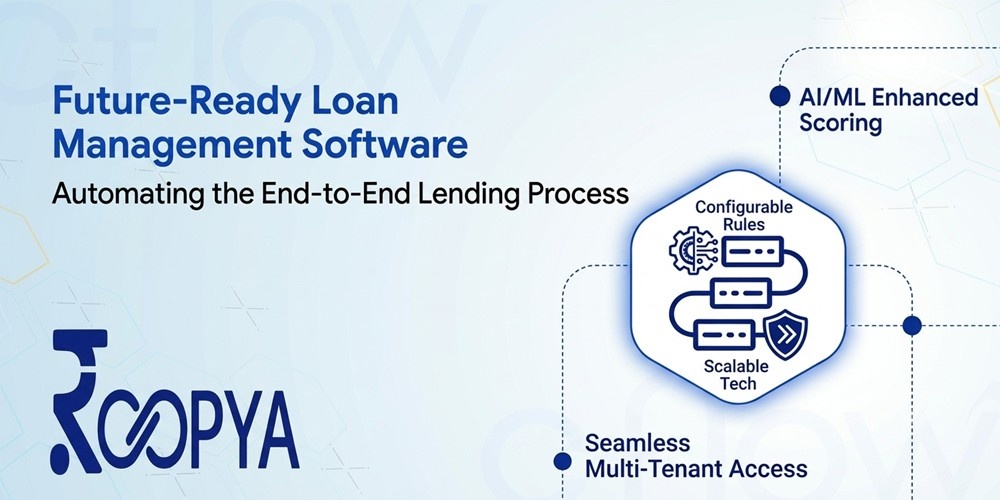
This Blog explores what makes loan management software truly future-ready, which capabilities separate leading platforms from laggards, and how Roopya is helping modern lenders operate at the pace of tomorrow.
1. What Does ‘Future-Ready’ Actually Mean in Loan Management?
The phrase ‘future-ready’ is used loosely in the technology industry, but for loan management software it has a precise meaning. Future-ready loan management software is a platform that:
- Adapts to change without requiring costly, time-consuming custom development — because the market, the regulation, and the competition will all change faster than any development team can respond.
- Scales without proportional cost increases — because the best-run lenders in the next decade will grow their books tenfold without growing their operations team tenfold.
- Uses AI and data natively — not as bolt-on features, but as embedded intelligence that improves every decision, flags every risk, and optimises every workflow automatically.
- Connects to any ecosystem — because the future of financial services is embedded, open, and partner-driven, and a closed platform will always be a limiting factor.
- Keeps pace with regulation automatically — because compliance in India is not a one-time checkbox but an ongoing obligation that evolves constantly.
A system that meets all five criteria is genuinely future-ready. A system that meets only two or three is a temporary solution that will require replacement sooner than its buyers expect.
2. The Problem With Legacy Loan Management Systems
To understand why future-ready loan management software matters so much, it helps to understand what is wrong with the alternatives. Legacy loan management systems — and the manual spreadsheet and document workflows they replaced — suffer from the same cluster of fundamental problems:
Rigid Architecture
Traditional loan management software was built with a fixed data model and a fixed set of workflows. Changing a credit product, adding a new bureau integration, or modifying the EMI calculation logic requires months of developer time and significant cost. In a market where product requirements change quarterly, this rigidity is fatal.
No Native Intelligence
Legacy systems store data but cannot learn from it. They process applications according to fixed rules but cannot detect patterns, predict outcomes, or flag anomalies. Fraud, prepayment risk, and collection probability — all of which AI models can predict with high accuracy — are invisible to traditional platforms.
Siloed Operations
In most legacy implementations, the loan origination system, the loan management system, the collection module, and the accounting software are separate tools built by different vendors, connected by fragile integrations or worse, by manual data export and import. This creates data inconsistencies, operational delays, and a compliance nightmare.
Poor Borrower Experience
Legacy platforms were designed for back-office operations teams, not for borrowers. The result is clunky, branch-dependent borrower journeys that are entirely incompatible with the expectations of today’s mobile-first, digitally empowered customer.
Compliance Risk
Manual, patchwork systems make regulatory compliance extremely difficult. Audit trails are incomplete, bureau reporting is delayed, and KYC records are scattered across multiple systems. With the RBI increasingly focusing on digital lending oversight, this is an existential risk.
Future-ready loan management software eliminates every one of these problems — not by adding features to legacy architecture, but by starting from a different set of architectural principles entirely.
3. Core Pillars of Future-Ready Loan Management Software
3.1 No-Code Configuration for Agile Operations
The single most important characteristic of future-ready loan management software is the ability for business users — not software developers — to configure and modify the system. Credit policies change. Pricing rules evolve. New loan products launch. Regulatory requirements update. In each of these situations, a no-code platform puts the lender in control.
Roopya’s no-code configuration layer lets credit officers, product managers, and risk teams build and modify decisioning rules, product parameters, EMI schedules, and workflow logic through a visual interface — without writing a single line of code. What once took months of development can be done in hours. This is not a convenience; it is a structural competitive advantage.
3.2 AI-Powered Credit Decisioning and Portfolio Intelligence
Artificial intelligence is no longer a future capability for loan management software — it is a present-day requirement. Future-ready platforms embed AI at every critical decision point in the loan lifecycle:
- Underwriting: ML models trained on bureau data, bank statement analysis, GST turnover, and behavioural signals deliver credit decisions that are more accurate than rule-based systems alone — particularly for thin-file or new-to-credit borrowers who would be declined by traditional scorecards.
- Fraud Detection: AI models detect document fraud, identity misrepresentation, and application anomalies that human reviewers routinely miss. Pattern recognition across thousands of historical fraud cases enables real-time flagging at the point of application.
- Early Warning Systems (EWS): AI monitors repayment behaviour, bureau updates, and external signals to identify at-risk accounts weeks before a default occurs — giving collections teams time to intervene proactively.
- Portfolio Analytics: Continuous AI-driven analysis of the loan book surfaces trends, concentration risks, and performance insights that enable better strategic decisions.
Roopya’s AI layer is built into the platform at the infrastructure level — not a separate module, not a vendor add-on. Every lender on Roopya benefits from continuously improving AI models trained on anonymised, aggregated data across the network.
3.3 Cloud-Native, API-First Architecture
Future-ready loan management software lives entirely in the cloud. This is not merely a deployment decision — it has profound implications for scalability, reliability, and connectivity.
Cloud-native architecture means the platform scales automatically in response to application volume — processing 100 loan applications or 100,000 with identical performance and zero additional infrastructure cost. It means uptime guarantees of 99.9%+ backed by globally distributed infrastructure. It means automatic security patching and compliance updates without IT intervention.
API-first design means every function of the platform is accessible via standardised APIs — enabling embedded finance partnerships, white-label lending products, and integrations with any third-party system. Roopya’s open API architecture lets partner fintechs, distribution platforms, and enterprise clients embed lending capabilities directly into their own products, creating origination channels that would be impossible with a closed system.
3.4 End-to-End Digital Borrower Journey
Future-ready loan management software manages the complete borrower lifecycle — not just the back-office processing, but the full front-end digital experience as well. From the first application click to the final repayment confirmation, every touchpoint should be digital, mobile-optimised, and frictionless.
Roopya delivers this through a fully integrated borrower journey: digital application with smart validation, instant Aadhaar eKYC, automated credit bureau pulls, AI-powered document analysis, real-time credit decisions, personalised loan offers, digital eSign, automated disbursement, self-service repayment dashboards, and digital collections workflows — all within a single, unified platform.
3.5 Comprehensive Compliance Automation
The RBI’s regulatory framework for digital lending is evolving rapidly. Future-ready loan management software must not only comply with current regulations but also adapt automatically as requirements change. This means:
- Automated KYC compliance — Aadhaar eKYC, PAN verification, VKYC, and Digilocker integration built in as standard, not optional add-ons.
- Digital consent management — Every data pull, bureau query, and communication is preceded by properly structured, legally valid digital consent.
- Complete audit trails — Every action taken on every loan account is logged with timestamp, user identity, and data state — providing a complete audit trail for regulatory inspection.
- Automated credit bureau reporting — Borrower account data is reported to bureaus automatically on schedule, eliminating manual reporting delays and errors.
- CERSAI and co-lending compliance — Integration with CERSAI for secured lending and co-lending module compliance for lenders participating in co-lending arrangements with banks.
Roopya’s compliance layer is updated continuously as RBI guidelines evolve — meaning lenders on Roopya are always current without any internal IT effort.
3.6 Pre-Integrated Ecosystem of 300+ APIs
No lender operates in isolation. Future-ready loan management software must connect seamlessly to the full ecosystem of financial services infrastructure — credit bureaus, payment systems, accounting platforms, communication tools, and data providers. Building and maintaining these integrations internally is expensive, time-consuming, and technically complex.
Roopya eliminates this challenge entirely with 300+ pre-built API integrations — covering all four major credit bureaus (CIBIL, Experian, CRIF, Equifax), all major KYC service providers, eSign platforms, payment gateways, UPI and NACH mandate management, accounting software (Tally, Zoho Books, QuickBooks), GST data providers, and banking APIs for bank statement analysis. Every integration is maintained, monitored, and updated by Roopya’s infrastructure team — not by the lender’s internal team.
3.7 Account Aggregator (AA) and Open Banking Readiness
The Account Aggregator ecosystem, enabled by RBI and SEBI regulation, represents the most significant shift in credit data access in Indian financial history. AA-enabled underwriting allows borrowers to share their financial data — bank account transaction history, mutual fund holdings, insurance policies — directly with lenders through a consent-based, regulated framework.
For lenders, this means dramatically richer underwriting data for thin-file borrowers, faster turnaround times, and lower fraud risk. For borrowers, it means credit access without the friction of physical bank statements and manual verification.
Future-ready loan management software must be AA-ready — integrated with the AA ecosystem and capable of consuming and processing AA data in real-time underwriting workflows. Roopya is fully AA-integrated, making it one of the most capable platforms for underwriting the next generation of Indian borrowers.
4. The Roopya Advantage: Future-Ready from Day One
Roopya was engineered specifically for the Indian lending market’s unique complexity — its regulatory environment, its technology landscape, and its enormously diverse borrower base. Here is what sets Roopya apart as a genuinely future-ready loan management platform:
1-Day Go-Live
Most enterprise lending software implementations take six to eighteen months. Roopya’s no-code setup, pre-built integrations, and 20+ pre-configured loan product templates enable new lenders to go live within a single business day. This is not a marketing claim — it is a structural outcome of building a platform around pre-built components rather than custom development.
Pay-As-You-Use Pricing
Traditional loan management software demands large upfront licence fees, annual maintenance charges, and expensive implementation costs — before a single loan is processed. Roopya operates on a usage-based pricing model with zero upfront cost. Lenders pay based on what they process, which aligns Roopya’s incentives entirely with the lender’s growth.
Multi-Product, Multi-Segment Support
Roopya supports the full spectrum of Indian lending products on a single platform: personal loans, MSME and business loans, gold loans, home loans and LAP, microfinance and JLG lending, payday and salary advance products, and auto loans. Multiple credit products, multiple customer segments, and multiple origination channels can all be managed from a single operational dashboard — eliminating the complexity and cost of managing multiple specialist platforms.
Proven at Scale
Roopya’s platform is trusted by a growing list of modern Indian lenders including IndiaKaLoan, QuickFinShop, Recapita, Findoc, and EazyCredit. These lenders collectively process thousands of loan applications each month on Roopya’s infrastructure, validating the platform’s reliability, scalability, and compliance credentials in production environments.
5. Key Use Cases for Future-Ready Loan Management Software
New NBFC Launches
A newly licensed NBFC cannot afford to wait six months for a lending platform to go live. With Roopya, new entrants can configure their first loan product, connect their bureau accounts, and begin accepting applications within 24 hours — with enterprise-grade infrastructure from day one.
Legacy Platform Migration
Established lenders running on outdated core banking or LMS platforms face a growing technology gap. Roopya’s open API architecture supports phased migration — enabling lenders to run Roopya in parallel with existing systems, migrate product lines progressively, and decommission legacy infrastructure without operational disruption.
Embedded Finance and Co-Lending
Fintechs, e-commerce platforms, payroll companies, and other non-financial businesses are increasingly seeking to embed lending products in their user journeys. Roopya’s API-first design makes it the ideal backend for embedded finance deployments — delivering the full credit infrastructure through APIs that partners integrate into their own products.
Digital Transformation for Existing NBFCs
Many mid-sized NBFCs have strong underwriting expertise and portfolio quality but are held back by manual operations and outdated technology. Roopya provides a clear, fast path to digital transformation — replacing spreadsheets, paper files, and disparate software tools with a single, unified, fully automated lending platform.
6. What to Look for When Choosing Future-Ready Loan Management Software
- No-code configurability: Can your credit and product teams make changes without developer involvement?
- AI and ML capabilities: Is intelligence built in natively, or would it require a separate purchase and integration?
- Pre-built integrations: How many bureau, KYC, eSign, and payment integrations are available out of the box?
- Compliance posture: Is the platform proactively updated for RBI guidelines, or does compliance require internal IT effort?
- Scalability model: Can the platform handle 10x your current volume without architectural changes?
- Pricing model: Does the vendor share your growth incentives, or do costs escalate regardless of your portfolio performance?
- Time-to-value: How long before you can process your first live loan application?
- Support and SLA: What uptime guarantees and support response commitments does the vendor provide?
Roopya meets every one of these criteria — and does so without the enterprise price tags or implementation timelines that have historically made best-in-class technology inaccessible to smaller and mid-sized lenders.
7. The Future of Loan Management Software in India
Several technology and regulatory developments are set to reshape loan management software over the next three to five years:
Conversational AI in Borrower Journeys
Chatbot and voice-driven loan application and servicing journeys will become standard, particularly for serving low-literacy and vernacular-language borrowers in India’s Tier 3 and rural markets. Future-ready platforms are already integrating conversational AI interfaces — and Roopya’s architecture is built to support them.
Predictive Collections and Proactive Risk Management
The transition from reactive collections (chasing overdue accounts) to predictive collections (identifying at-risk accounts weeks before default) is underway. AI-powered early warning systems that monitor hundreds of behavioural and external signals will become the standard operating model for well-run lenders.
Real-Time Credit Reporting and Bureau Integration
The credit bureau ecosystem in India is evolving toward near-real-time reporting and more granular account-level data. Future-ready loan management software must be capable of both submitting and consuming this higher-frequency data without operational burden on the lender.
Green and Impact Lending
ESG-linked lending products and impact-focused credit programmes are gaining regulatory and investor attention in India. Future-ready platforms will need to track and report on impact metrics alongside financial performance — a capability that requires purpose-built data architecture, not legacy retrofits.
Roopya’s platform is actively evolving across all of these dimensions — with a product roadmap aligned to the future of Indian lending, not the constraints of legacy architecture.
8. Conclusion: The Time to Be Future-Ready Is Now
The lending industry’s transformation is not a future event to be prepared for — it is a present reality to be navigated. Lenders that invest in future-ready loan management software today are not spending on technology for its own sake; they are building the operational infrastructure that will determine their competitive position for the next decade.
Roopya offers a unique proposition: the capabilities of enterprise-grade, AI-powered, cloud-native loan management software — with the accessibility, simplicity, and economics of a modern SaaS platform. No large upfront investment. No months-long implementation. No technical team required to operate it. Just powerful, compliant, scalable lending infrastructure that goes live in a day and grows without limits.
Whether you are launching a new NBFC, scaling an existing lending business, or transforming a manual operation into a digital one, Roopya’s future-ready loan management software is the platform built for where you are going — not just where you are today.

