AI-Powered Autonomous Lending Platform: The Future of Digital Lending in India

Lending has always been about judgment — the judgment of a credit officer assessing risk, a relationship manager evaluating a borrower’s character, or an underwriter weighing financial data against a credit policy. For decades, that judgment lived exclusively inside the human mind. Today, artificial intelligence is not replacing that judgment. It is amplifying it, accelerating it, and making it available at a scale no human organisation could ever achieve alone.
An AI-powered autonomous lending platform is the most significant technological development in financial services since the advent of core banking. It represents the convergence of machine learning, natural language processing, automation, and cloud infrastructure into a single, unified system that can originate, underwrite, disburse, and manage loans — at speed, at scale, and with a consistency and accuracy that manual processes simply cannot match.
Start Free Trial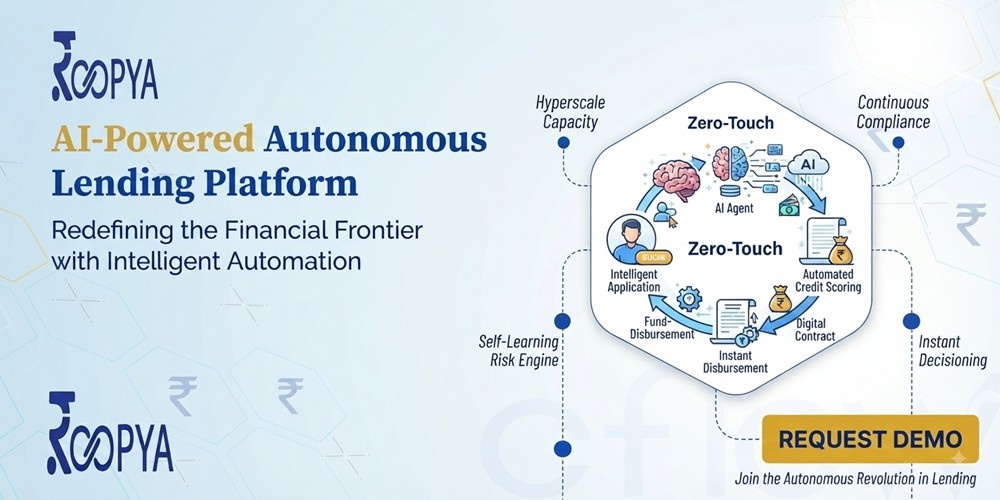
For NBFCs, banks, and MFIs operating in India’s hyper-competitive credit market, this is not a future technology. It is a present imperative. This guide explains what an AI-powered autonomous lending platform is, how it works, what it delivers, and why Roopya is the platform Indian lenders are choosing to power their next chapter of growth.
1. What Is an AI-Powered Autonomous Lending Platform?
An AI-powered autonomous lending platform is a software system that uses artificial intelligence, machine learning, and intelligent automation to manage the complete loan lifecycle — from the moment a borrower initiates an application to the final repayment — with minimal or zero human intervention at each stage.
The word ‘autonomous’ is deliberate. Traditional digital lending platforms digitised the loan process — they replaced paper forms with electronic ones and manual filing with digital storage. But the decision-making, the risk assessment, the document review — these still required humans. An autonomous lending platform does not simply digitise these tasks. It performs them: intelligently, consistently, and continuously.
The core components of such a platform include:
- AI-driven credit underwriting that evaluates thousands of data variables simultaneously to produce accurate, explainable credit decisions in real time.
- Machine learning models that continuously improve their accuracy as they process more loan applications and observe repayment outcomes.
- Natural language processing that reads, extracts, and interprets data from unstructured documents — bank statements, ITRs, GST filings — with human-level accuracy.
- Intelligent process automation that routes applications, triggers integrations, enforces compliance rules, and manages exception workflows without manual orchestration.
- Predictive analytics that forecast borrower behaviour, portfolio risk, and collection outcomes — giving lenders foresight, not just hindsight.
Roopya has built exactly this platform for the Indian lending market — a no-code, AI-first infrastructure that any NBFC, bank, or MFI can deploy in a single day.
2. The Problem With Traditional Lending That AI Solves
Before understanding the solution, it is important to understand the problem. Traditional lending operations — even when supported by basic software — suffer from a predictable set of structural failures:
2.1 Speed and Conversion Loss
In the digital lending era, a borrower who applies for a loan simultaneously submits applications to multiple lenders. The lender that responds first with a relevant, personalised offer wins the business. Traditional underwriting — which involves manual document review, a credit committee meeting, and human correspondence — can take hours, days, or even weeks. By that time, the borrower has already accepted an offer elsewhere. An AI-powered autonomous lending platform closes this gap entirely, delivering credit decisions in seconds.
2.2 Inconsistency in Credit Decisions
Human underwriters, however skilled, are subject to cognitive biases, fatigue, and information overload. Two underwriters reviewing identical applications may reach different conclusions. This inconsistency introduces risk, creates regulatory exposure, and produces unpredictable portfolio outcomes. AI-powered decisioning is perfectly consistent — every application is evaluated against the same model with the same rigour, regardless of time, volume, or complexity.
2.3 Inability to Process Alternative Data
Bureau scores and income statements tell part of a borrower’s credit story. But a vast population of creditworthy borrowers — particularly first-time credit seekers, self-employed individuals, and informal sector workers — have thin or non-existent bureau files. Traditional systems simply reject these applicants, leaving a massive underserved market untouched. AI models can incorporate alternative data sources — utility payments, UPI transaction patterns, GST filing regularity, social signals, and bank statement cash flows — to build credit profiles for borrowers that traditional models cannot evaluate.
2.4 Fraud Detection Limitations
Manual document review misses sophisticated fraud patterns. Fabricated bank statements, forged income documents, identity manipulation — these require pattern recognition at scale to detect reliably. AI-powered document analysis identifies subtle statistical anomalies, inconsistencies in transaction patterns, and metadata signatures that indicate document manipulation, catching fraud that would routinely pass through a manual review process.
2.5 Operational Scaling Constraints
Manual lending operations scale linearly with headcount. To double loan volume, you roughly need to double staff. AI-powered autonomous platforms scale horizontally — the same infrastructure that handles 100 applications a day can handle 100,000 applications a day with no proportional increase in cost or headcount. This makes autonomous lending platforms the only viable foundation for lenders with serious growth ambitions.
3. Core AI Capabilities of Roopya’s Autonomous Lending Platform
3.1 AI-Powered Credit Underwriting Engine
Roopya’s credit underwriting engine uses machine learning models trained on millions of lending data points to evaluate each loan application across hundreds of variables — not just the ten or fifteen that a manual underwriter can reasonably process simultaneously. The model weighs bureau data, income signals, employment stability, geographic risk, product-specific behavioural patterns, and alternative data — producing an accurate, granular risk score for every applicant.
The model is not a black box. Roopya’s underwriting engine provides full explainability — every credit decision is accompanied by a clear set of factors that drove it, ensuring compliance with RBI’s fair practice code and enabling productive human review when required.
3.2 Intelligent Document Processing (IDP)
Documents are the raw material of lending. Every applicant submits a package of documents — identity proof, address proof, income evidence, bank statements, tax returns — and extracting accurate, structured data from these documents is one of the most time-consuming and error-prone steps in the loan process.
Roopya’s Intelligent Document Processing engine uses a combination of computer vision, OCR, and NLP to read any document format — scanned PDFs, smartphone photos, PDF-native files — and extract structured data with over 99% accuracy. It analyses bank statements transaction by transaction, computing net income, identifying cash flow patterns, detecting round-tripping or inflow manipulation, and flagging statistical anomalies that indicate document fabrication.
What takes a trained document analyst 30 minutes per application, Roopya’s IDP engine completes in under 10 seconds — for every application, every time, without fatigue or inconsistency.
3.3 Self-Learning Business Rule Engine (BRE)
Every lender has a credit policy — a set of rules that govern who qualifies for a loan, under what conditions, at what price. Translating that policy into an automated system has historically required expensive software development and long implementation cycles. Roopya’s no-code Business Rule Engine allows credit and risk teams to configure and modify decisioning rules through a visual interface, without writing a single line of code.
But Roopya’s BRE goes further. It is self-learning — it analyses the outcomes of decisions made under current rules, identifies patterns in approvals that defaulted and rejections that would have performed well, and surfaces data-driven suggestions to improve the credit policy over time. This creates a virtuous cycle where the platform gets smarter with every loan processed.
3.4 Real-Time Fraud Detection
Fraud is an existential risk for lenders. Traditional fraud detection relies on post-hoc analysis — identifying fraudulent applications after the fact, often after disbursement. Roopya’s AI-powered fraud detection operates in real time, at the point of application, using a multi-layered model that checks identity authenticity, document integrity, behavioural signals, network relationships between applicants, and known fraud patterns.
The system flags suspicious applications for enhanced review before a credit decision is made — not after — dramatically reducing fraud-related credit losses without increasing friction for genuine borrowers.
3.5 Predictive Collections Intelligence
The loan lifecycle does not end at disbursement. Managing repayments, identifying at-risk accounts early, and optimising collection interventions are critical to portfolio health. Roopya’s predictive collections module uses machine learning to score every active loan account for default probability on a rolling basis — analysing payment behaviour, account activity, external signals, and economic indicators to identify accounts that are likely to slip before they actually do.
This allows collections teams — or automated communication systems — to intervene proactively, at the optimal moment, with the optimal message and channel, dramatically improving recovery rates while reducing the cost and intrusiveness of collection activity.
3.6 AI-Driven Loan Pricing and Offer Personalisation
One-size-fits-all loan pricing leaves money on the table and creates adverse selection. Roopya’s risk-based pricing engine uses the full output of the underwriting model to generate personalised loan offers — amount, tenure, interest rate, processing fee — that are calibrated to the specific risk profile of each borrower. High-quality borrowers receive more competitive terms; higher-risk profiles are priced to reflect actual risk. This optimises the lender’s risk-adjusted return across the portfolio while improving approval rates for creditworthy borrowers who would otherwise have been declined.
3.7 NLP-Powered Borrower Communication
Borrower communication — application status updates, document requests, offer delivery, repayment reminders — is a significant operational burden in traditional lending. Roopya’s NLP-powered communication engine automates the entire communication layer, delivering contextually appropriate, personalised messages through the borrower’s preferred channel (WhatsApp, SMS, email, or in-app) at every stage of the loan lifecycle. Conversational AI handles common borrower queries, reducing support load and improving borrower experience simultaneously.
4. The End-to-End Autonomous Loan Journey on Roopya
Here is how a complete loan journey looks on Roopya’s AI-powered autonomous lending platform, from application initiation to disbursement:
- Stage 1 — Digital Application Capture: The borrower initiates the application through a branded, mobile-optimised interface. Smart forms auto-populate data from Aadhaar and PAN APIs, reducing manual entry and errors. Application completeness is validated in real time.
- Stage 2 — Instant KYC and Identity Verification: On consent, the platform simultaneously triggers Aadhaar eKYC, PAN verification, VKYC (if required), and liveliness checks. Identity is verified in seconds with full regulatory compliance.
- Stage 3 — Automated Bureau Pull and Analysis: Credit bureau reports are pulled from CIBIL, Experian, CRIF, or Equifax automatically. The AI engine parses the full bureau report — not just the score — extracting delinquency patterns, utilisation trends, and enquiry signals.
- Stage 4 — Intelligent Document Processing: The borrower uploads documents. Roopya’s IDP engine reads, extracts, validates, and cross-checks all document data — bank statements, ITRs, salary slips, GST returns — in under 10 seconds, flagging any anomalies.
- Stage 5 — AI Credit Decisioning: All collected and processed data flows into the underwriting engine and BRE. A credit decision — approve, reject, or refer — is generated in real time, with a full audit trail of the decisioning logic.
- Stage 6 — Personalised Offer Generation: For approved applications, the risk-based pricing engine generates a personalised loan offer. The borrower receives the offer instantly via their preferred communication channel.
- Stage 7 — Digital Agreement and eSign: The borrower reviews and digitally signs the loan agreement using Aadhaar OTP-based or Digilocker eSign. No physical documentation, no courier, no branch visit.
- Stage 8 — Automated Disbursement Trigger: The signed agreement automatically triggers the disbursement workflow. Funds are transferred to the borrower’s account via IMPS, NEFT, or UPI — completing the full journey, often in under 15 minutes.
5. Why India Needs Autonomous AI Lending Platforms Now
India’s credit gap is one of the most significant economic challenges and opportunities of this generation. Despite being the world’s most populous country and a rapidly growing economy, a significant proportion of creditworthy individuals and businesses remain outside the formal credit system — not because they are not creditworthy, but because traditional lending institutions cannot reach or evaluate them efficiently.
The Account Aggregator (AA) framework, the expansion of UPI transaction data, the growth of GSTN-linked business data, and the proliferation of digital financial behaviour signals create an unprecedented opportunity to assess and serve borrowers that traditional credit infrastructure cannot touch. But capitalising on this opportunity requires AI — specifically, AI that can process and synthesise diverse, unstructured data at scale and translate it into accurate, real-time credit decisions.
Additionally, the RBI’s push toward digital lending guidelines, the increasing emphasis on explainable credit decisions and digital consent, and the regulatory focus on fair and consistent credit practices all create a compliance environment that is far easier to navigate with an AI-powered platform than with manual processes.
Lenders that deploy autonomous AI lending platforms today are not just improving their current operations. They are building the infrastructure for the next decade of Indian credit growth — a decade that will be defined by scale, speed, and intelligence.
6. Key Benefits of Roopya’s AI-Powered Autonomous Lending Platform
Dramatic Reduction in TAT
Traditional loan processing — from application to disbursement — can take days or weeks. Roopya’s autonomous platform reduces this to minutes for clean profiles. Faster TAT directly translates to higher conversion rates, better borrower satisfaction, and more loans processed per unit of time.
60–70% Reduction in Processing Costs
Automated KYC, AI document processing, and autonomous credit decisioning eliminate the largest cost centres in traditional lending operations. Lenders on Roopya consistently report processing cost reductions of 60–70% compared to manual or semi-manual workflows, significantly improving unit economics.
Improved Portfolio Quality
AI underwriting models, trained on historical loan performance data, produce more accurate risk assessments than manual underwriters — particularly for thin-file and non-traditional borrowers. Lenders using Roopya’s platform report meaningful improvements in portfolio NPA rates as the AI model optimises credit decisions over time.
Massive Scalability
Roopya’s cloud-native infrastructure scales automatically with volume. There is no need to hire proportionally as loan volume grows. The platform handles peak load — festive season surges, marketing campaign spikes, new product launches — without performance degradation or manual intervention.
1-Day Go-Live
Most lending software implementations take six to twelve months. Roopya’s no-code platform, pre-built integrations, and pre-configured product journeys allow lenders to go live in a single day. This speed-to-market advantage is decisive in India’s rapidly evolving lending landscape.
Regulatory Confidence
Every decision made by Roopya’s AI engine is explainable, auditable, and logged. The platform generates full regulatory reports, manages digital consent records, and maintains the complete audit trail required by RBI guidelines — giving compliance teams the confidence they need and regulators the transparency they require.
7. Who Should Use an AI-Powered Autonomous Lending Platform?
Roopya’s platform is built for any lending institution that is serious about growth, efficiency, and competitive relevance in the digital age:
- NBFCs of all sizes: From newly licensed entities needing to launch quickly to established players looking to modernise their technology stack and expand addressable markets.
- Banks and Small Finance Banks: Retail lending divisions seeking to automate high-volume personal loan and MSME lending operations.
- Microfinance Institutions: MFIs expanding from group lending into individual loan products, or looking to bring digital efficiency to existing operations.
- Fintech Lenders: Digital-native lenders that need infrastructure matching their ambition — fast, flexible, AI-first.
- Embedded Finance Providers: Platforms embedding credit products into non-financial user journeys, requiring API-first loan origination infrastructure.
8. Roopya vs. Traditional Lending Software: The Decisive Differences
Traditional lending software was built for a world of branches, paper, and manual review. It digitises existing manual processes. Roopya reimagines those processes entirely:
- Traditional software captures data. Roopya’s AI analyses, interprets, and acts on it.
- Traditional software presents decisions to humans. Roopya’s platform makes decisions autonomously, with human review reserved for genuine exceptions.
- Traditional software improves when developers update it. Roopya’s ML models improve automatically as they process more data.
- Traditional software requires months of implementation. Roopya goes live in a day.
- Traditional software costs a large upfront licence fee. Roopya uses pay-as-you-use pricing — zero upfront, aligned with your growth.
- Traditional software integrates with a limited set of partners. Roopya comes pre-integrated with 300+ APIs — bureaus, KYC providers, eSign platforms, payment gateways, accounting software.
The competitive implication is stark: lenders using traditional software are running an operational model designed for the 1990s in a market that is accelerating into the 2030s. Roopya provides the on-ramp to the future.
9. The Future of AI in Lending: Where the Technology Is Heading
The capabilities of AI-powered autonomous lending platforms are advancing rapidly. Several emerging developments will define the next generation of lending intelligence:
Generative AI for Credit Analysis: Large language models are increasingly capable of reading and synthesising complex financial documents — audit reports, director disclosures, business plans — and providing nuanced credit analysis that supplements quantitative models. Roopya is actively exploring generative AI integration for credit memo generation and complex underwriting support.
Federated Learning for Privacy-Preserving AI: As data privacy regulations tighten globally and in India, federated learning approaches allow AI models to be trained on data distributed across multiple institutions — improving model accuracy without centralising sensitive borrower data. This will enable industry-wide credit models that benefit from collective intelligence while respecting individual privacy.
Voice and Conversational Loan Origination: For Tier 2, 3, and rural markets, text-based digital interfaces remain a barrier. Conversational AI — voice-driven loan applications in regional languages — will expand the addressable market for digital lenders dramatically. Roopya’s platform architecture is designed to support conversational origination channels.
Real-Time Portfolio Stress Testing: AI will increasingly enable real-time portfolio stress testing — dynamically reassessing the entire loan book against changing macroeconomic conditions and updating expected loss estimates continuously, rather than on a quarterly or annual review cycle.
The lenders who invest in AI infrastructure today will be positioned to adopt each of these advances as they mature — because they will already have the data, the platform, and the operational culture to leverage them.
10. Why Roopya Is India’s Leading AI-Powered Autonomous Lending Platform
Roopya is not a global platform adapted for India. It was designed from the ground up for the Indian lending ecosystem — its regulatory requirements, its technology infrastructure, its credit bureau landscape, and its diverse borrower population.
- Built for India: Native integrations with CIBIL, Experian, CRIF, Equifax, Aadhaar, DigiLocker, GSTN, Account Aggregator, UPI, and all major Indian payment infrastructure.
- Truly No-Code: Business and risk teams configure credit policies, product parameters, and workflow rules independently — no developer or IT team required for ongoing operations.
- 300+ Pre-Integrated APIs: Every integration a modern lender needs is already built — activate in a click, not in months.
- 20+ Loan Product Journeys: Personal loans, business loans, MSME credit, gold loans, microfinance, payday loans, auto loans — all pre-configured and ready to launch.
- Pay-As-You-Use: Zero upfront licence cost. You pay only for what you process, making enterprise-grade AI accessible at every stage of growth.
- 1-Day Go-Live: The fastest path from decision to deployment in the Indian lending market.
- Trusted by Modern Lenders: IndiaKaLoan, QuickFinShop, Recapita, Findoc, EazyCredit, and others have chosen Roopya as the foundation of their lending operations.
If you are ready to stop competing with one hand tied behind your back and start building the lending business your market opportunity deserves, Roopya is your platform. Request a free demo today. Go live in a day. Grow without limits.

