Loan Origination Software for NBFC, Bank & Fintech Companies — Free Demo & Downloads

Lending has changed. Borrowers now expect a loan decision in minutes, not weeks, and regulators expect every step of that decision to be documented, auditable, and compliant. Sitting between these two expectations is one piece of technology that decides whether a lender can keep up: loan origination software. At Roopya.money, we build a cloud-based Loan Origination Software (LOS) and Loan Management System (LMS) purpose-built for NBFCs, banks, co-operative societies, microfinance institutions, and fintech lenders who want to originate, underwrite, and disburse loans faster, without adding operational risk. This guide explains what loan origination software is, why it has become essential for every lending business in 2026, what Roopya.money’s platform offers, and how you can get started with a free demo or download today.
Start Free Trial
What Is Loan Origination Software (LOS)?
Loan origination software is a digital platform that manages the entire lifecycle of a loan from the moment a borrower applies to the moment funds are disbursed into their account. Instead of collecting documents over email, verifying identity manually, checking credit bureau reports on a separate portal, and calculating eligibility on a spreadsheet, an LOS brings every one of these steps into a single, automated workflow.
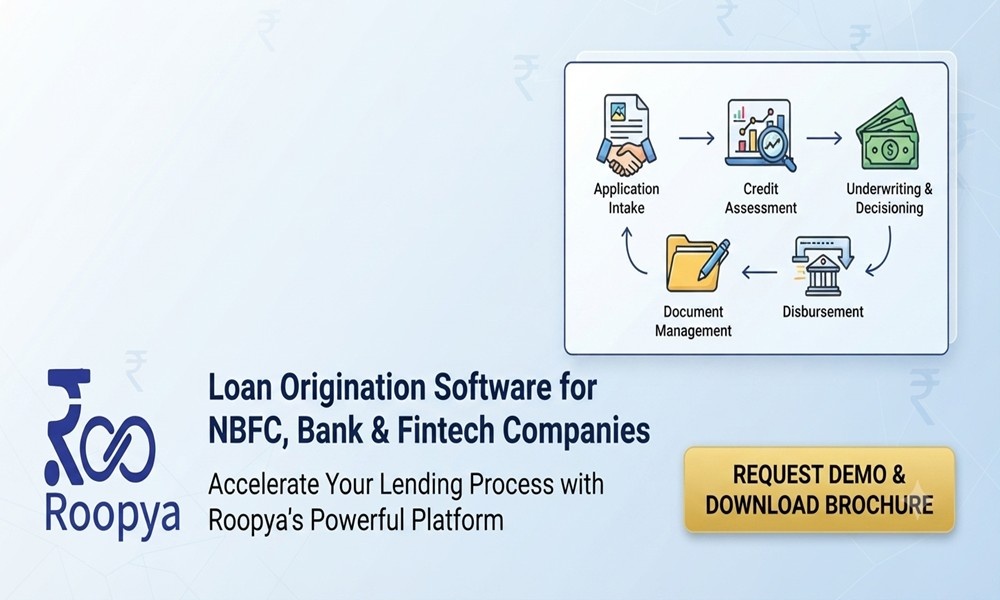
A typical loan origination journey covers:
- Lead capture and application intake (web, app, branch, or DSA channel)
- e-KYC and identity verification (Aadhaar, PAN, video KYC)
- Credit bureau checks (CIBIL, Experian, Equifax, CRIF High Mark)
- Income assessment and bank statement analysis
- Rule-based or AI-assisted credit underwriting and scoring
- Loan approval workflows and sanction letter generation
- e-Sign / e-Stamp of loan agreements
- Disbursal through payment gateways or core banking integration
Once a loan is disbursed, it moves into the Loan Management System (LMS) module, which tracks EMI schedules, collections, NPA classification, and reporting for the life of the loan. Roopya.money offers both LOS and LMS as a single connected platform, so lending institutions don’t have to stitch together multiple vendors.
Why NBFCs, Banks, and Fintech Companies Need a Modern LOS
Every lending institution eventually hits the same wall: growth is capped not by demand for credit, but by how fast the back office can process it. A handful of pressures are pushing NBFCs, banks, and fintech lenders toward dedicated origination software:
1. Faster Turnaround Time (TAT)
Manual file movement between sales, credit, and operations teams routinely stretches a loan decision to several days. An automated LOS compresses this into hours, or even minutes for pre-approved and algorithm-scored products, which directly improves conversion and customer satisfaction.
2. Regulatory and Compliance Pressure
RBI guidelines for NBFCs and digital lenders—covering the Fair Practices Code, Key Fact Statements, penal charges disclosure, and data localization—require lenders to maintain a clean, auditable trail for every loan decision. A purpose-built LOS embeds these checks into the workflow instead of relying on manual compliance reviews after the fact.
3. Rising Cost of Manual Underwriting
Every manual touchpoint adds cost: staff time, rework from data entry errors, and delayed collections when risk signals are missed. Automated credit scoring and rule engines reduce this cost per loan file significantly, which matters more as loan volumes scale.
4. Multi-Channel, Multi-Product Lending
Modern lenders originate through branches, DSAs, embedded finance partners, and their own app or website simultaneously, often across multiple products (personal loans, business loans, gold loans, LAP, microfinance). A single LOS that can configure workflows per product and per channel avoids the need for separate systems for each line of business.
5. Borrower Expectations Have Shifted
Borrowers who are used to instant approvals from digital-first lenders now expect the same experience from every NBFC and bank. Institutions that still rely on paper files and manual verification lose customers to competitors offering a faster, mobile-first application journey.
Key Features of Roopya’s Loan Origination Software
Roopya.money is built specifically for the Indian lending ecosystem—NBFCs, banks, co-operative credit societies, microfinance institutions (MFIs), and fintech NBFC partnerships. Here is what the platform includes:
Configurable Loan Application Workflows
Design a different application journey for each loan product—personal loans, business loans, gold loans, education loans, LAP, or microfinance—without writing code. Add or remove document requirements, approval stages, and eligibility rules per product.
e-KYC and Digital Onboarding
Integrated Aadhaar e-KYC, PAN verification, and video KYC let borrowers complete identity verification from their phone, cutting onboarding time from days to minutes.
Bureau Integration and Credit Scoring
Pull CIBIL, Experian, Equifax, or CRIF High Mark reports directly inside the platform, and combine bureau data with your own risk rules or scorecards to generate an automated credit decision.
Rule-Based Underwriting Engine
Configure eligibility criteria, income multiples, FOIR (Fixed Obligation to Income Ratio) limits, and risk-based pricing rules that apply automatically to every application, reducing inconsistent manual decisions.
Document Management and e-Sign
Collect, store, and verify KYC and income documents in one place, then generate sanction letters and loan agreements with built-in e-Sign and e-Stamp support.
Disbursal and Payment Integration
Connect to payment gateways, NACH/e-NACH mandates, and core banking or accounting systems to disburse funds and set up EMI collection without manual intervention.
Loan Management System (LMS) Module
Once disbursed, loans move automatically into EMI tracking, collections, NPA classification (as per RBI IRAC norms), and MIS reporting—all inside the same platform.
DSA and Channel Partner Management
Onboard and track direct selling agents, connectors, and channel partners, with visibility into sourcing volumes, commission calculations, and conversion rates by partner.
Dashboards and Regulatory Reporting
Real-time dashboards for loan pipeline, approval rates, portfolio quality, and collections, alongside exportable reports formatted for RBI and statutory audit requirements.
Cloud-Hosted, API-First Architecture
Roopya.money is cloud-hosted and built with open APIs, so it can integrate with your existing core banking system, accounting software, credit bureaus, and payment partners rather than forcing a rip-and-replace of your current stack.
Benefits of Using Roopya.money’s LOS
- Reduce loan turnaround time from days to hours through automated workflows
- Lower operating cost per loan file by removing manual, repetitive tasks
- Improve underwriting consistency with rule-based, auditable credit decisions
- Stay audit-ready with a complete digital trail for every application
- Scale to new products, branches, or partner channels without adding proportional headcount
- Give borrowers a mobile-first application experience that improves conversion
- Get a single connected view of origination and collections instead of disconnected systems
Who Can Use Roopya.money’s Loan Management System?
Roopya.money is designed to work for lending institutions of different sizes and business models:
- NBFCs—retail, MSME, gold loan, and vehicle finance NBFCs looking to digitize origination end-to-end
- Banks—cooperative banks and small finance banks that need a modern LOS layered on top of existing core banking
- Fintech Lenders—digital-first lenders and NBFC-fintech partnerships that need to launch and iterate on loan products quickly
- Microfinance Institutions (MFIs)—group and individual microfinance lending with JLG (joint liability group) workflows
- Co-operative Credit Societies—member lending with configurable eligibility and documentation rules
Free Demo and Downloads — How It Works
You don’t need to commit before seeing the platform in action. Roopya.money offers:
- A free, guided demo of the loan origination and loan management modules, walked through by our team on a call
- Downloadable product brochures and feature sheets covering LOS, LMS, and integration capabilities
- A sandbox environment where your credit and operations team can test workflows on sample applications before go-live
To book a demo, visit the Loan Origination Software page on roopya.money and submit the demo request form with your organization type (NBFC, bank, fintech, MFI, or co-operative society) and loan products. Our team typically responds within one business day to schedule a walkthrough tailored to your lending workflow.
Why Choose Roopya over Other Loan Origination Software Providers?
Several LOS and LMS vendors serve the Indian market, but lending institutions choose Roopya.money for a few specific reasons:
- Built for Indian lenders first—bureau integrations, RBI compliance fields, and IRAC-based NPA classification are native to the platform, not bolted on
- Single platform for origination and management—no separate LMS vendor or manual data hand-off between systems
- Configurable without heavy development—product and workflow changes can be made by your team without a long vendor development cycle
- Transparent onboarding—a free demo and sandbox access before any commercial commitment
- Support built for lending operations—implementation support that understands credit and collections workflows, not generic software helpdesk tickets
Getting Started with Roopya
Whether you are an NBFC replacing a spreadsheet-based process, a bank layering digital origination on top of core banking, or a fintech launching a new lending product, the fastest way to evaluate fit is to see the platform against your own workflow. Book a free demo or download the product brochure on Roopya, and our team will walk you through how Roopya’s Loan Origination Software and Loan Management System can be configured for your institution.

