Enterprise Autonomous Lending Software: The Future of Scalable, Intelligent Lending

For most of the last two decades, lending technology was about digitisation — taking paper-based processes and putting them online. Forms moved to screens, documents moved to email, and signatures moved to PDFs. The underlying logic, however, remained stubbornly human: a person still had to review the application, check the documents, run a bureau query, make a credit decision, and communicate the outcome.
That era is ending. Enterprise autonomous lending software represents a fundamentally different category of technology — one where the lending lifecycle is not merely digitised but genuinely automated, from the first touchpoint with a borrower to the final repayment or recovery action. Autonomous systems make decisions, trigger workflows, detect fraud, generate reports, and manage portfolios without waiting for human instruction at every step.
Start Free Trial
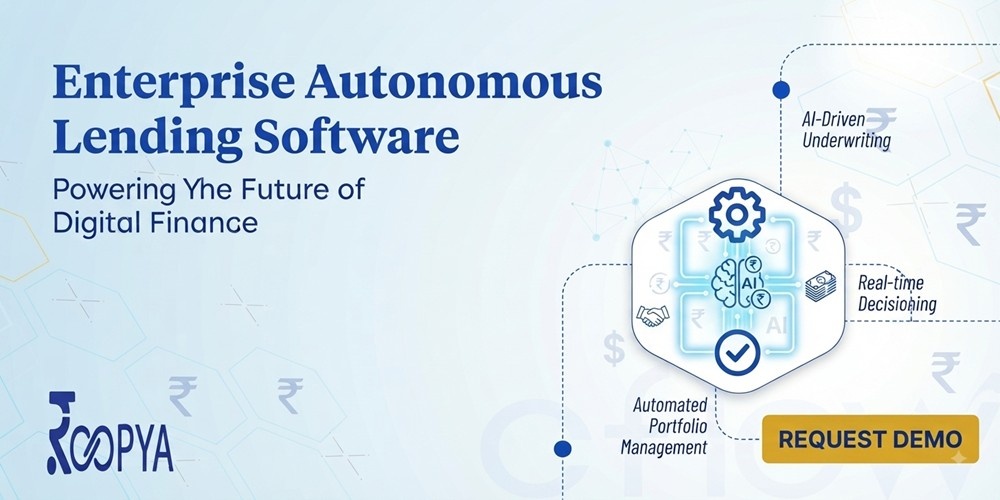
For banks, NBFCs, microfinance institutions, and modern fintech lenders, this shift is no longer optional. The competitive environment, borrower expectations, regulatory obligations, and the sheer economics of lending at scale demand autonomous infrastructure. This comprehensive guide explains what enterprise autonomous lending software is, how it works, what features define the best platforms, and why Roopya has emerged as the leading autonomous lending infrastructure for the Indian market.
1. What Is Enterprise Autonomous Lending Software?
Enterprise autonomous lending software is a technology platform that executes every stage of the lending lifecycle — origination, underwriting, sanctioning, disbursement, servicing, collections, and reporting — through automated, rule-driven, and AI-powered processes, with minimal or zero human intervention for standard cases.
The word ‘enterprise’ signals that the platform is built for scale, complexity, and multi-product, multi-geography, multi-channel operations. An enterprise-grade platform must handle thousands of concurrent loan applications, manage a portfolio of diverse loan products simultaneously, integrate with hundreds of third-party data sources and service providers, satisfy complex and evolving regulatory requirements, and produce real-time analytics for senior management — all without downtime or manual bottlenecks.
The word ‘autonomous’ signals that the system is not just a digital form or a workflow tool. It is an intelligent, self-directing platform that applies credit policies, executes decisioning logic, manages communications, tracks repayments, flags risk signals, and escalates exceptions — all independently, based on configurations set by your credit and operations teams.
Roopya’s platform was built from the ground up with this philosophy. It is described on the company’s own website as ‘Autonomous Lending Systems for Modern Lenders’ — a unified lending infrastructure that powers the complete lifecycle from origination to collections, delivered on a no-code platform that requires zero technical expertise to configure and operate.
2. Why Enterprises Are Moving to Autonomous Lending Infrastructure
The Scale Problem
A lending enterprise processing 10,000 applications per month cannot scale to 100,000 applications per month simply by hiring ten times as many credit officers. Human-led operations do not scale linearly — they scale with friction, inconsistency, and exponentially rising costs. Autonomous lending software, by contrast, scales horizontally on cloud infrastructure. Whether you process 1,000 or 1,000,000 applications, the same system handles it with the same speed and the same consistency.
The Speed Problem
Modern borrowers compare multiple lenders simultaneously. A personal loan applicant who applies on three different platforms will typically choose the first lender to respond with a clear, personalised offer. Enterprise autonomous lending software enables decisions in seconds — not hours or days. The lender who responds fastest wins the customer. The lender relying on manual underwriting loses the race before it begins.
The Consistency Problem
In a manual credit operation, credit decisions vary depending on which analyst reviews the file, what day of the month it is, and how fatigued the team is. These inconsistencies introduce both regulatory risk — if credit policies are not applied uniformly — and portfolio risk, as individual judgment can override sound credit policy in unpredictable ways. Autonomous lending software applies your credit policy with mathematical precision on every single application, every single time.
The Compliance Problem
India’s lending regulatory environment — governed by RBI guidelines, PMLA requirements, Fair Practice Code obligations, credit bureau reporting mandates, and CERSAI filing requirements — is both complex and continuously evolving. An enterprise lender must maintain full compliance across every application it processes, with complete, auditable records of every action taken. Autonomous lending software generates digital audit trails automatically, updates for regulatory changes systematically, and produces regulatory reports on demand — eliminating the compliance burden that manual operations carry.
The Intelligence Problem
Traditional credit underwriting relies on a relatively small number of data points — primarily credit bureau scores and stated income. Modern AI-powered autonomous lending software can evaluate thousands of data points simultaneously: bureau data, bank statement analytics, GST filings, psychometric indicators, device behaviour, transaction patterns, and much more. The result is more accurate credit decisions, better risk-adjusted pricing, and access to underserved borrower segments that traditional models systematically exclude.
3. Core Components of Enterprise Autonomous Lending Software
3.1 Autonomous Loan Origination System (LOS)
The origination layer of an enterprise autonomous lending platform manages the full journey from a borrower’s first interaction to the point of sanction. Key capabilities include configurable digital application forms optimised for web and mobile, real-time field validation and smart autofill, automated KYC via Aadhaar eKYC, PAN verification, Digilocker, and Video KYC, instant credit bureau pulls from CIBIL, Experian, CRIF, and Equifax, AI-powered document ingestion and analysis, and automated credit decisioning through a no-code Business Rule Engine.
Roopya’s Loan Origination Platform supports 20+ pre-configured loan product journeys and can be deployed for a new loan product in less than one day. DSA and agent channels, direct digital channels, and embedded finance partner channels are all supported through the same origination infrastructure.
3.2 No-Code Business Rule Engine (BRE)
The Business Rule Engine is the brain of an autonomous lending system. It is where your credit policy is encoded into automated decisioning logic. A powerful BRE allows credit and risk teams — not developers — to configure eligibility criteria, bureau score thresholds, income requirements, product-level caps, geographic filters, and multi-variable decisioning trees through an intuitive visual interface.
Roopya’s no-code BRE goes further than most competitors. It incorporates machine learning to analyse historical approval and rejection patterns, suggests rule optimisations based on portfolio performance, and adapts to market conditions continuously — while keeping human teams fully in control of the final policy configuration. This is what distinguishes a genuinely intelligent autonomous system from a simple rules engine.
3.3 AI-Powered Document Processing and Verification
Enterprise lending at scale involves processing millions of documents — identity proofs, income certificates, bank statements, GST returns, ITR filings, property documents, and more. Manual document review is the single biggest bottleneck in most lending operations. AI-powered document processing eliminates this bottleneck entirely.
Roopya’s intelligent document processing uses advanced OCR, computer vision, and NLP to extract data from any document format in seconds. The system automatically detects anomalies, flags inconsistencies between stated and verified data, identifies common fraud patterns — altered documents, income inflation, identity fabrication — and feeds verified data directly into the credit decisioning engine. Accuracy consistently exceeds 99%, outperforming manual review teams on both speed and precision.
3.4 Intelligent Credit Scoring and Underwriting
Traditional credit scoring relies primarily on historical bureau data, which systematically excludes new-to-credit borrowers and underrepresents thin-file applicants. Enterprise autonomous lending software incorporates multi-dimensional credit scoring models that evaluate alternative data sources alongside bureau scores.
Roopya’s ML-powered credit scoring evaluates bank statement analytics, cash flow patterns, GST compliance and revenue trends, digital footprint indicators, repayment behaviour on alternative credit products, and contextual risk factors — alongside CIBIL scores and bureau data — to produce a holistic, real-time credit assessment. This enables lenders to serve a broader borrower universe while maintaining disciplined risk management.
3.5 Automated Loan Management System (LMS)
Once a loan is disbursed, the enterprise autonomous lending platform continues to manage the account lifecycle automatically. Core LMS capabilities include automated EMI computation and amortisation scheduling, payment gateway integration for automated collections, borrower self-service portals for statement download, payment tracking, and service requests, automated overdue notifications via SMS, WhatsApp, email, and voice, and portfolio-level analytics and reporting.
Roopya’s LMS integrates natively with the origination layer, creating a seamless, unified lending lifecycle — data and decisions flow automatically between origination and servicing without manual handoffs or data re-entry.
3.6 Autonomous Collections and Recovery Engine
Collections is one of the most operationally intensive parts of lending — and one of the highest-value areas for automation. Roopya’s autonomous collections system applies behavioural analytics to segment borrowers by risk profile and engagement likelihood, then deploys differentiated, automated outreach strategies for each segment.
Early-stage overdue accounts receive gentle automated reminders across digital channels. Higher-risk accounts trigger escalation to collection agents with AI-generated call scripts and priority scoring. Settlement and restructuring offer workflows are automated for eligible accounts. Agent performance is tracked in real time. The result is consistently better recovery rates with significantly lower cost of collections.
3.7 Early Warning System (EWS)
One of the most powerful capabilities of enterprise autonomous lending software is the ability to identify emerging credit risk before a borrower becomes overdue. Roopya’s Early Warning System monitors behavioural signals across the portfolio — changes in repayment patterns, increased utilisation on other credit products, GST filing gaps, negative news alerts — and triggers automated risk management workflows when pre-configured thresholds are crossed.
Proactive intervention at the early warning stage consistently produces better outcomes than reactive collections — reducing default rates and credit losses while preserving customer relationships.
3.8 Embedded Finance and API Architecture
Modern enterprise lenders increasingly originate loans through partner platforms rather than direct channels. A retailer may offer EMI financing at checkout; a payroll platform may offer salary advances; an e-commerce marketplace may offer MSME working capital to its sellers. Enterprise autonomous lending software must be deliverable as an API, not just as a standalone portal.
Roopya’s open API architecture enables full lending workflows — from application to disbursement — to be embedded into any partner platform through well-documented REST APIs. This embedded finance capability opens entirely new distribution channels and revenue streams without requiring separate infrastructure for each partner.
3.9 Lending Analytics and Reporting
Enterprise lenders need real-time visibility into portfolio performance, credit quality, channel productivity, operational efficiency, and regulatory compliance. Roopya’s lending analytics layer provides customisable dashboards, automated regulatory reports, AI-generated portfolio insights, and NLP-powered querying — allowing business users to ask questions in plain English and receive instant data-backed answers.
Predictive analytics capabilities enable portfolio managers to forecast default rates, model the impact of policy changes, and identify the highest-value growth opportunities within their borrower segments.
4. How Roopya’s Enterprise Autonomous Lending Software Works
Roopya is India’s leading autonomous lending infrastructure platform. Built specifically for the complexity and regulatory environment of the Indian lending market, it unifies the complete lending lifecycle — origination, underwriting, servicing, collections, and analytics — on a single, no-code platform. Here is how the autonomous lending lifecycle operates on Roopya:
- Borrower Initiation: A borrower accesses the loan application through your branded digital interface — web, mobile app, or partner platform. The application form is pre-configured for your specific loan product, with smart field validation and autofill.
- Instant KYC: On submission, Roopya simultaneously triggers Aadhaar eKYC, PAN verification, and additional identity checks through pre-integrated APIs. The full KYC process completes in under two minutes without branch visits.
- Bureau Pull & Document Analysis: Credit bureau reports are pulled automatically from the relevant bureau(s). Simultaneously, uploaded documents are processed by the AI engine — data extracted, verified, and anomalies flagged in real time.
- Autonomous Credit Decision: The BRE evaluates all inputs — bureau scores, verified income, document data, alternative indicators — against your configured credit policy. A decision is generated in milliseconds. Clean profiles are approved instantly; complex profiles are escalated to human review with AI-generated recommendations.
- Offer Generation & eSign: Approved applications receive a personalised loan offer. The borrower reviews and signs digitally through Aadhaar OTP-based or Digilocker eSign — no physical documentation required.
- Disbursement: Completed applications trigger automated disbursement workflows. Funds are transferred directly to the borrower’s account through integrated payment rails.
- Lifecycle Management: Post-disbursement, the LMS and Collections modules take over — managing EMIs, payments, overdue outreach, portfolio analytics, and early warning monitoring autonomously.
The complete journey, from application to disbursement, can be completed in under 15 minutes for clean profiles — entirely without human intervention.
5. Industry-Specific Applications
For NBFCs
Non-Banking Financial Companies operate in one of the most competitive and rapidly evolving segments of Indian finance. Enterprise autonomous lending software allows NBFCs to scale their portfolio without proportional headcount growth, maintain tight credit discipline across a distributed operations model, launch new loan products in days rather than months, and compete effectively against larger banks and fintech challengers on speed and borrower experience.
For Banks
For scheduled commercial banks, enterprise autonomous lending software addresses the challenge of modernising retail lending operations that have been built on legacy core banking systems. Roopya’s open API architecture integrates with existing core banking infrastructure, adding autonomous origination, AI underwriting, and modern LMS capabilities without requiring a full system replacement. Banks can run Roopya as a front-end lending layer that connects to their existing backend systems.
For Microfinance Institutions (MFIs)
MFIs face unique challenges — serving low-income, rural, and thin-file borrower populations, often through agent-led group lending models in areas with inconsistent connectivity. Roopya’s autonomous platform supports JLG (Joint Liability Group) lending workflows, offline-capable agent applications, and alternative credit scoring models that evaluate cash flow and behavioural data for borrowers who lack formal credit histories.
For Fintech Lenders and Embedded Finance
Fintech lenders and platforms looking to embed lending capabilities into their existing user journeys benefit from Roopya’s API-first architecture, pay-as-you-use pricing, and rapid deployment capabilities. A fintech can have a fully autonomous lending product live within days, without building origination, underwriting, or collections infrastructure from scratch.
6. Measurable Outcomes from Autonomous Lending Software
The business case for enterprise autonomous lending software is compelling and quantifiable. Lenders deploying Roopya’s platform report:
- 10x faster loan processing: Verification time reduced from hours to seconds through AI-powered document processing and automated bureau integration.
- 40% improvement in credit accuracy: ML-powered scoring models deliver materially better predictive accuracy compared to traditional bureau-only underwriting.
- 80% reduction in fraud incidents: AI fraud detection modules identify suspicious patterns across all applications in real time, significantly reducing fraud-related credit losses.
- 60% improvement in collections recovery: AI-driven collection strategies optimised for individual borrower behaviour produce measurably better recovery outcomes.
- 40–60% reduction in cost per loan: Automation of document processing, KYC, decisioning, and collections reduces operational costs dramatically.
- 95% borrower satisfaction in AI-assisted interactions: Roopya’s conversational AI handles borrower queries with contextual understanding and near-human satisfaction scores.
These outcomes compound over time as Roopya’s self-learning models continuously refine themselves on your specific portfolio data — meaning the platform becomes more accurate and more efficient the longer you use it.
7. What to Look for When Evaluating Enterprise Autonomous Lending Platforms
- True autonomy, not partial automation: Ensure the platform automates the full lifecycle — not just the application form, but underwriting, decisioning, disbursement, collections, and reporting.
- No-code configurability: Business and risk teams should be able to configure credit policies, workflows, and product parameters independently, without developer involvement.
- Pre-built integrations: Evaluate the depth and breadth of pre-integrated APIs — bureau integrations, KYC providers, eSign, payment gateways, and accounting systems should all be available out of the box.
- AI and ML as native capabilities: AI-powered document processing, credit scoring, fraud detection, and early warning should be built into the platform, not available as expensive add-ons.
- Regulatory compliance by design: The platform should maintain continuous compliance with RBI and other applicable regulations, with automated audit trails and regulatory reporting.
- Scalable architecture: Cloud-native infrastructure should scale automatically with your business, without manual provisioning or infrastructure management.
- Deployment speed: Enterprise lenders cannot afford six-month implementation cycles. The best platforms go live in days, not months.
- Transparent pricing: Avoid platforms with large upfront licence fees and opaque pricing. Pay-as-you-use models align vendor and lender incentives.
8. Roopya: India’s Leading Enterprise Autonomous Lending Software
Roopya (Geoalgo Technologies Private Limited) was built with a single mission: to give every lender in India access to enterprise-grade autonomous lending infrastructure, regardless of their size or technical capacity. The platform powers the complete lending lifecycle — from the first borrower touchpoint to the final loan closure — on a unified, no-code, AI-powered infrastructure.
Roopya’s enterprise advantages are clear and measurable:
- 1-Day Go-Live: Pre-built product journeys, plug-and-play integrations, and no-code setup mean lenders can begin processing applications within 24 hours of onboarding.
- 300+ Pre-Integrated APIs: Credit bureaus (CIBIL, Experian, CRIF, Equifax), KYC providers (Aadhaar, PAN, Digilocker, VKYC), eSign platforms, payment gateways, accounting tools — all connected.
- 20+ Loan Product Journeys: Personal loans, business loans, MSME credit, gold loans, home loans, payday loans, auto loans, microfinance — all pre-configured and ready to launch.
- Truly No-Code: Zero coding required to configure credit policies, workflows, product parameters, or reporting — empowering business users fully.
- Pay-As-You-Use: Zero upfront cost. Lenders pay based on actual usage, making enterprise-grade autonomous infrastructure accessible at every stage of growth.
- AI Throughout: Document analysis, credit scoring, fraud detection, early warning, collections optimisation, and NLP analytics — all AI-powered as standard.
- Always Compliant: Continuously updated for RBI requirements, with full audit trails, digital consent management, and automated regulatory reporting.
- Trusted by Modern Lenders: IndiaKaLoan, QuickFinShop, Recapita, Findoc, EazyCredit, LonaSeva — and many more — run their enterprise lending operations on Roopya.
In an industry moving rapidly toward full lending automation, Roopya is not just keeping pace — it is defining the standard. If your lending operation is ready to move beyond incremental digitisation and into true autonomy, Roopya is the platform built for that future.
Request a free demo today and see how Roopya’s enterprise autonomous lending software can transform your lending operations — starting in just one day.

