Free KYC Verification API in India: The Complete Guide for NBFCs, Fintechs & Banks

Know Your Customer — KYC — is the regulatory foundation of every financial product in India. Before a bank account is opened, a loan is disbursed, or an investment account is activated, the customer’s identity must be verified to the satisfaction of regulators. For decades, this was a slow, costly, branch-based process that excluded millions of potential borrowers and customers from the formal financial system.
The emergence of digital KYC APIs has changed everything. Today, a fintech startup, NBFC, or bank can verify a customer’s identity in seconds — without a branch visit, without a physical document, and often without any human intervention. The question is no longer whether to adopt digital KYC, but which KYC verification API to use, how to integrate it, and how to get started quickly and affordably.
Start Free Trial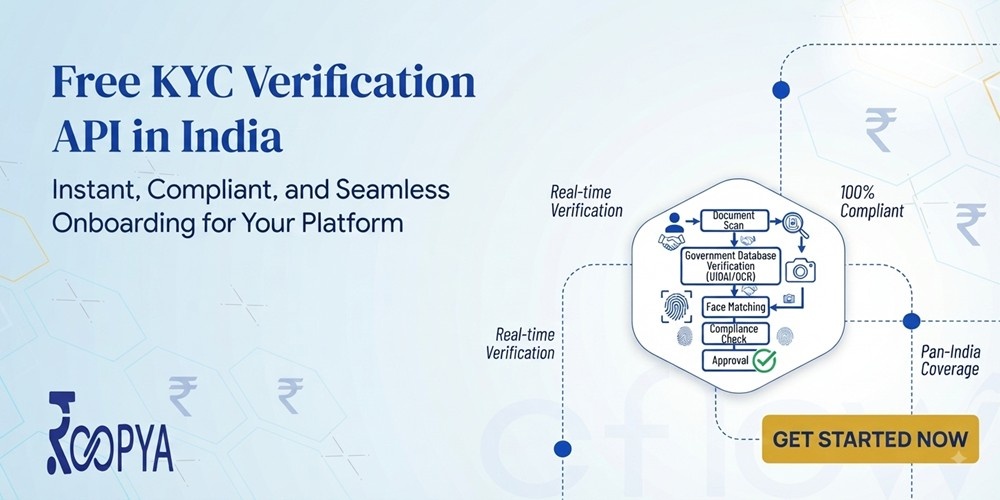
This guide covers everything you need to know about free KYC verification APIs in India — what they are, how they work, which types of KYC verification are available, what to look for in an API provider, and how Roopya’s pre-integrated KYC infrastructure gives lenders and fintechs a faster, more complete path to digital KYC compliance.
1. What Is a KYC Verification API?
A KYC (Know Your Customer) verification API is a software interface that allows a financial platform to digitally verify the identity of its customers by connecting to authoritative government databases, credit bureaus, and identity verification services — programmatically, in real time, and at scale.
Rather than building individual integrations to UIDAI (for Aadhaar), NSDL (for PAN), Digilocker, and video KYC providers from scratch, a KYC verification API acts as a single access point — aggregating multiple verification services behind a unified API layer. Developers make a single API call, and the platform handles the routing, data extraction, verification, and response.
In the Indian lending and fintech context, a KYC verification API typically covers:
- Aadhaar eKYC: OTP-based or biometric identity verification using UIDAI’s Aadhaar database.
- PAN Verification: Real-time PAN card validation against NSDL/ITD records.
- Digilocker Integration: Access to government-issued digital documents (Aadhaar, driving licence, vehicle RC, marksheets) stored in the borrower’s Digilocker account.
- Video KYC (VKYC): Live, agent-assisted video verification for regulated financial onboarding.
- CKYC (Central KYC Registry): Lookup and fetch of existing KYC records from the CERSAI CKYC registry.
- OCR and Document Verification: AI-powered extraction and verification of identity documents — Aadhaar card, PAN card, passport, driving licence, voter ID.
- Facial Liveness and Match: AI-based face match between a selfie and the photo on the identity document, with liveness detection to prevent spoofing.
- Bank Account Verification: Penny drop or account name fetch to verify that a bank account belongs to the verified individual.
2. Why Free KYC Verification APIs Matter for Indian Fintechs and Lenders
India’s digital lending and fintech ecosystem is one of the most dynamic in the world, but it is also one where cost efficiency is a survival imperative — especially for early-stage NBFCs, microfinance institutions, and fintech startups. KYC costs can be a significant portion of customer acquisition cost, and for thin-margin lending products, every rupee of operational cost matters.
Free or trial-access KYC verification APIs allow startups and lenders to:
- Build and test digital onboarding flows without upfront API costs.
- Validate product-market fit before committing to paid API contracts.
- Demonstrate a working KYC integration to investors or regulators.
- Onboard initial customers at minimal cost before scaling volumes.
Beyond cost, the speed advantage of a KYC API is irreplaceable. Manual KYC verification takes one to three days — and in a competitive lending market where borrowers receive multiple offers, that delay can cost you the customer. A well-integrated KYC API completes the entire verification in under 60 seconds.
Roopya’s platform addresses both the cost and speed dimension. Its 300+ pre-integrated APIs include all major KYC services — available to lending partners as part of the platform’s no-code infrastructure, without separate API contracts, procurement processes, or development work.
3. Types of KYC Verification Available via API in India
3.1 Aadhaar eKYC API
The Aadhaar eKYC API, offered through UIDAI-authorised sub-AUAs (Authentication User Agencies), allows a financial institution to verify a customer’s identity and address using their 12-digit Aadhaar number and an OTP sent to their Aadhaar-linked mobile number. This is the gold standard of digital KYC in India — legally valid, RBI-recognised, and completed in under 30 seconds.
When a borrower provides their Aadhaar number and consents to eKYC, the API triggers an OTP to the registered mobile number. On OTP entry, the UIDAI database returns the verified demographic data — name, date of birth, gender, address, and photo — which is then stored as the customer’s verified KYC record. No physical document is required.
Important regulatory note: As per UIDAI and RBI guidelines, only entities with a valid sub-AUA agreement can access Aadhaar eKYC APIs. Roopya maintains the necessary regulatory relationships, allowing lending partners to leverage Aadhaar eKYC through Roopya’s platform without individual sub-AUA agreements.
3.2 PAN Verification API
The PAN (Permanent Account Number) verification API connects to NSDL and Income Tax Department records to validate that a PAN card number is genuine, active, and matches the customer’s name. PAN verification is mandatory for loans above ₹50,000, tax-linked financial products, and most NBFC onboarding flows.
A PAN verification API call typically takes under two seconds and returns the verification status, the name linked to the PAN, and — in more advanced integrations — the category of the PAN holder (individual, company, HUF, etc.). This can be used not just for KYC compliance but also for Form 26AS pulls and income tax return verification.
3.3 Digilocker API
Digilocker is the Government of India’s cloud-based platform for storing and sharing government-issued digital documents. The Digilocker API allows a financial platform to request that a customer share specific documents — Aadhaar, driving licence, vehicle RC, academic certificates — directly from their Digilocker account.
Documents shared via Digilocker are digitally signed by the issuing government authority, making them legally equivalent to physical originals under the IT Act. For KYC purposes, this means lenders can receive verified, tamper-proof identity and address proof documents without any manual document collection or verification.
3.4 Video KYC (VKYC) API
Video KYC, introduced by RBI in 2020, allows regulated entities to complete customer verification through a live video call between the customer and a trained agent. The V-CIP (Video-based Customer Identification Process) is now accepted as a full KYC method for account opening, loan origination, and other regulated financial services.
A VKYC API integration enables a financial platform to initiate, conduct, and record a V-CIP session programmatically — scheduling the call, connecting the customer and agent, guiding the document capture process, and storing the recording with full audit trail. The API handles the regulatory compliance of the VKYC session, including geo-tagging, face match, and document capture.
3.5 CKYC API
The Central KYC Registry (CKYC), maintained by CERSAI on behalf of financial regulators, is a centralised repository of KYC records for financial customers in India. The CKYC API allows a regulated entity to search for an existing CKYC record by PAN, Aadhaar, or CKYC number — and, if found, download the verified KYC record without requiring the customer to re-submit documents.
This is particularly valuable for lenders and financial platforms serving customers who already hold a CKYC record from a previous relationship with a bank or financial institution. The CKYC lookup takes seconds and eliminates duplicate KYC collection entirely for such customers.
3.6 OCR and Document Verification API
AI-powered OCR (Optical Character Recognition) APIs extract data from identity documents — Aadhaar cards, PAN cards, passports, driving licences — uploaded as images or PDFs. Advanced document verification APIs go beyond OCR: they check for tampering, validate document structure and security features, perform face extraction for match against a liveness selfie, and cross-verify extracted data against authoritative databases.
Roopya’s document verification layer achieves 99%+ extraction accuracy with real-time fraud signal detection — identifying inconsistencies in font, format, or data that indicate document manipulation.
3.7 Face Match and Liveness Detection API
A face match and liveness detection API verifies that the person presenting an identity document is the same person who appears in the document photo, and that the verification is being conducted by a live person (not a photograph or video). This is a critical layer of KYC security — particularly for remote digital onboarding where the customer and agent are not in the same location.
Modern face match APIs use deep learning models trained on millions of facial images, achieving accuracy rates above 99.5%. Liveness detection uses passive (texture analysis, depth map) and active (blink, nod, random motion prompts) techniques to defeat spoofing attempts.
4. Key Features to Look for in a KYC Verification API
Not all KYC APIs are equal. When evaluating a KYC verification API — whether free or paid — consider the following criteria:
- Regulatory Compliance: The API must comply with RBI KYC Master Directions, UIDAI guidelines, PMLA requirements, and data localisation rules. Verify that the provider holds all necessary regulatory agreements (sub-AUA for Aadhaar, CERSAI access for CKYC).
- Coverage: A single API provider that covers Aadhaar eKYC, PAN, Digilocker, VKYC, CKYC, OCR, and face match is far simpler to manage than multiple point solutions. Roopya’s 300+ pre-integrated APIs cover the full KYC spectrum from a single platform.
- Response Time: KYC APIs should return results in under two seconds for database-backed verifications (PAN, CKYC) and under 60 seconds for eKYC flows. Slow APIs create friction in the customer onboarding journey.
- Uptime and Reliability: Financial onboarding flows cannot afford KYC API downtime. Look for providers with 99.9%+ uptime SLAs and fallback mechanisms for government API outages.
- Data Security: KYC data includes the most sensitive personal information a customer can share. APIs must be ISO 27001 certified, use end-to-end encryption, store data in India-based servers, and maintain strict access controls and audit logs.
- Developer Experience: Good KYC APIs offer comprehensive documentation, SDKs for popular programming languages, sandbox environments for testing, and responsive developer support.
- Pricing Transparency: Free tiers should clearly state usage limits, what happens when you exceed them, and the pricing model for production volumes.
5. How KYC Verification APIs Work: A Step-by-Step Flow
Understanding the technical flow of a KYC API integration helps developers and product teams plan their onboarding journeys more effectively. Here is a typical Aadhaar eKYC flow:
- Step 1 — Customer Consent: The customer is presented with a consent screen explaining the KYC data that will be accessed and how it will be used. Consent is recorded with a timestamp and IP address for regulatory audit purposes.
- Step 2 — Aadhaar Input: The customer enters their 12-digit Aadhaar number in the financial platform’s interface.
- Step 3 — API Call to UIDAI: The platform makes an encrypted API call to the KYC verification API endpoint, passing the Aadhaar number and the consent token.
- Step 4 — OTP Dispatch: UIDAI sends a one-time password to the Aadhaar-linked mobile number. The customer enters the OTP in the platform interface.
- Step 5 — Data Return: The API returns verified demographic data — name, date of birth, gender, address, photo — in a structured JSON response.
- Step 6 — Record Storage: The platform stores the verified KYC data with the audit trail, completing the customer’s KYC record.
The entire flow, from customer entering their Aadhaar number to KYC completion, typically takes 30 to 60 seconds — compared to 1 to 3 days for manual, document-based KYC.
6. Free KYC Verification API: What ‘Free’ Really Means
The concept of a ‘free KYC verification API’ in India deserves careful examination. Here is what different providers typically mean when they offer free KYC API access:
- Sandbox/Test Mode: Most KYC API providers offer a free sandbox environment where developers can test API calls with dummy data or limited real-data calls. This is standard and appropriate for development and testing purposes but is not suitable for live customer onboarding.
- Free Tier with Usage Limits: Some providers offer a limited number of free API calls per month — typically 50 to 500 verifications — allowing early-stage startups to onboard their first customers at no cost. This is genuinely valuable for proof-of-concept and early traction phases.
- Embedded Free Access via Platform: Platforms like Roopya include KYC API access as part of their lending infrastructure offering. Rather than paying separately for each KYC service, lending partners on Roopya access all KYC services — Aadhaar eKYC, PAN, Digilocker, VKYC, CKYC, OCR, face match — through Roopya’s pre-integrated API layer, without individual API contracts or upfront API costs.
For NBFCs and fintechs building on Roopya’s platform, the effective cost of KYC verification is bundled into the platform’s pay-as-you-use pricing model — meaning there is no separate API procurement process, no minimum commitment, and no upfront integration cost. This is often the most genuinely ‘free to start’ KYC option available in the Indian market.
7. KYC API Integration: Technical Overview for Developers
For developers building digital onboarding flows, here is a high-level technical overview of how a KYC verification API integration typically works:
7.1 Authentication
KYC APIs use industry-standard authentication mechanisms — typically API key authentication for sandbox environments and OAuth 2.0 token-based authentication for production. API keys should always be stored server-side and never exposed in client-side code or mobile app bundles.
7.2 REST API Calls
Most modern KYC APIs follow RESTful conventions — JSON request and response bodies, standard HTTP methods (POST for verification requests, GET for status checks), and HTTP status codes for error handling. A well-documented KYC API will provide complete request and response schemas, sample code in multiple languages, and a Postman collection for quick testing.
7.3 Webhook Callbacks
For asynchronous verification flows — such as VKYC sessions that complete after a delay — KYC APIs use webhooks to notify the integrating platform when a verification is complete. The platform registers a webhook URL, and the API sends a POST request to that URL with the verification result when the process completes.
7.4 Data Handling and Storage
KYC data returned by APIs must be handled with strict security controls. Data must be encrypted at rest and in transit, access must be logged and audited, retention must comply with applicable regulations, and data must not be shared with third parties without explicit regulatory or customer consent. Roopya’s platform handles all data security compliance as part of its infrastructure layer.
8. Regulatory Framework for KYC APIs in India
KYC verification in India is governed by a comprehensive regulatory framework that API providers and their customers must comply with:
- RBI KYC Master Directions (2016, updated 2023): These directions specify the acceptable methods of KYC verification for regulated entities — banks, NBFCs, payment banks, and other financial intermediaries. They explicitly recognise Aadhaar-based eKYC, V-CIP (video KYC), and CKYC as valid KYC methods.
- PMLA (Prevention of Money Laundering Act): All financial entities conducting KYC must maintain records of KYC verification for a minimum of five years and must be able to produce these records for regulatory inspection.
- UIDAI Aadhaar Regulations: Use of Aadhaar for KYC by non-government entities requires either a direct AUA agreement with UIDAI or a sub-AUA arrangement under an existing AUA. Entities that use Aadhaar without proper authorisation face significant regulatory and legal risk.
- DPDP Act (Digital Personal Data Protection Act, 2023): The processing of personal data — including KYC data — must comply with the DPDP Act’s requirements for purpose limitation, data minimisation, consent management, and data subject rights.
- Data Localisation: RBI’s data localisation requirements mandate that financial data — including KYC records — be stored on servers located within India.
Roopya’s KYC infrastructure is designed to be fully compliant with all applicable regulations. The platform manages UIDAI relationships, maintains required audit trails, stores data in India-based infrastructure, and provides built-in consent management — reducing the regulatory burden on lending partners significantly.
9. KYC API Use Cases for Different Financial Sectors
NBFCs and Digital Lenders
For NBFCs, KYC APIs are essential for digital loan origination. Every loan application requires complete KYC of the borrower, and in a high-volume lending environment, the cost and speed of KYC verification directly impacts profitability. Roopya’s KYC integration within its loan origination platform means that KYC is completed automatically as part of the application workflow — no separate system, no manual handoff, and no additional API contract.
Microfinance Institutions (MFIs)
MFIs face a unique KYC challenge: their customers are often from rural or semi-urban areas with limited literacy, unreliable internet connectivity, and sometimes incomplete documentation. KYC APIs that support offline Aadhaar (QR code scan), face match without high-speed internet, and regional language interfaces are particularly valuable for MFI deployment. Roopya’s platform accommodates these requirements with connectivity-resilient KYC flows.
Fintech Startups and Neobanks
For fintech startups, the ability to access a full-featured KYC API without a large procurement budget or long integration timelines is critical. Roopya’s platform effectively functions as a free KYC verification API for fintech partners — all KYC services are pre-integrated and available from day one, with no upfront API costs and no minimum commitment.
Insurance Companies
Insurance companies require KYC for new policy issuance and large claim settlements. KYC APIs for insurance use cases must handle a wide range of customer profiles — individual, corporate, HUF — and must integrate with insurance-specific workflows. Roopya’s 300+ API integrations cover insurance-specific KYC requirements alongside lending-focused use cases.
Wealth Management and Investment Platforms
Investment platforms require KYC for account opening under SEBI regulations. The integration of PAN verification, Aadhaar eKYC, and CKYC lookup is standard for investment onboarding. Roopya’s pre-built KYC stack reduces the time to build compliant investment onboarding from months to days.
10. Why Roopya Is the Best KYC Verification API Platform for Indian Lenders
Roopya is not simply a KYC API provider — it is a complete digital lending infrastructure platform that includes KYC verification as an integrated, pre-built component. Here is why lending partners choose Roopya for their KYC verification needs:
- 300+ Pre-Integrated APIs: Roopya has already done the integration work with all major KYC providers — UIDAI Aadhaar eKYC, NSDL PAN, Digilocker, VKYC providers, CKYC registry, OCR engines, and face match services. Lending partners access all of these through a single platform relationship.
- No Separate API Contracts: Rather than negotiating individual contracts with Aadhaar AUAs, VKYC providers, OCR vendors, and CKYC data providers, Roopya partners access everything through Roopya’s platform — dramatically simplifying procurement and compliance.
- 1-Day Go-Live: Because all KYC integrations are pre-built, an NBFC or fintech partner can have a fully functional, compliant KYC flow live within 24 hours. There is no custom development required.
- No-Code Configuration: KYC workflow configuration — which verification steps are required for which loan products, what sequence of verification to follow, what to do when a particular check fails — is all configurable through Roopya’s no-code interface without developer involvement.
- Full Regulatory Compliance: Roopya manages UIDAI relationships, consent management, data storage compliance, audit trail generation, and PMLA record-keeping on behalf of lending partners. Compliance is built into the platform, not an afterthought.
- AI-Powered Accuracy: Roopya’s document verification layer achieves 99%+ OCR accuracy and real-time fraud detection — catching document manipulations that simpler verification APIs miss.
- Pay-As-You-Use Pricing: Zero upfront costs. Lending partners pay based on actual verification volumes — making Roopya accessible to lenders at every stage of growth, from early-stage startups to large-scale financial institutions.
For any fintech, NBFC, or bank looking to implement digital KYC quickly, compliantly, and cost-effectively, Roopya’s platform represents the most complete and practical path available in the Indian market today.
11. Getting Started: How to Access Roopya’s KYC API Infrastructure
Getting started with Roopya’s KYC verification capabilities is straightforward:
- Step 1 — Register: Create a Roopya account at roopya.money. The onboarding process is simple and takes less than an hour.
- Step 2 — Configure Your Product: Use Roopya’s no-code interface to configure the loan product or onboarding flow you want to build. Select which KYC verification steps are required for your product.
- Step 3 — Sandbox Testing: Access Roopya’s sandbox environment to test the complete KYC flow end to end — including Aadhaar eKYC simulation, PAN verification, document upload, and face match.
- Step 4 — Go Live: Move to production and begin onboarding real customers. Roopya’s pre-integrated KYC APIs handle all verification in real time, with full compliance and audit trail management.
The entire process — from registration to live KYC verification — can be completed in a single day. No procurement negotiations, no custom API development, no regulatory setup complexity.

