Why Roopya Is the Future of Loan Management in India

India’s Lending Revolution Is Already Here
India’s lending market is at a historic inflection point. Fuelled by a young, smartphone-native population, a rapidly expanding middle class, a government pushing hard for financial inclusion, and a regulatory environment that is simultaneously tightening and enabling, the business of lending in India has never been more exciting — or more demanding.
The numbers are staggering. The Indian credit market is projected to cross ₹350 lakh crore by 2030. Digital lending disbursements are growing at over 30% annually. The NBFC sector alone has more than 9,000 registered entities, and new fintech lenders are entering the market every quarter. Yet for all this growth, a large fraction of lenders are still running their operations on technology that was not built for this era — legacy core banking systems, disconnected spreadsheets, and manually-managed workflows that cannot keep pace with the velocity of modern lending.
Start Free Trial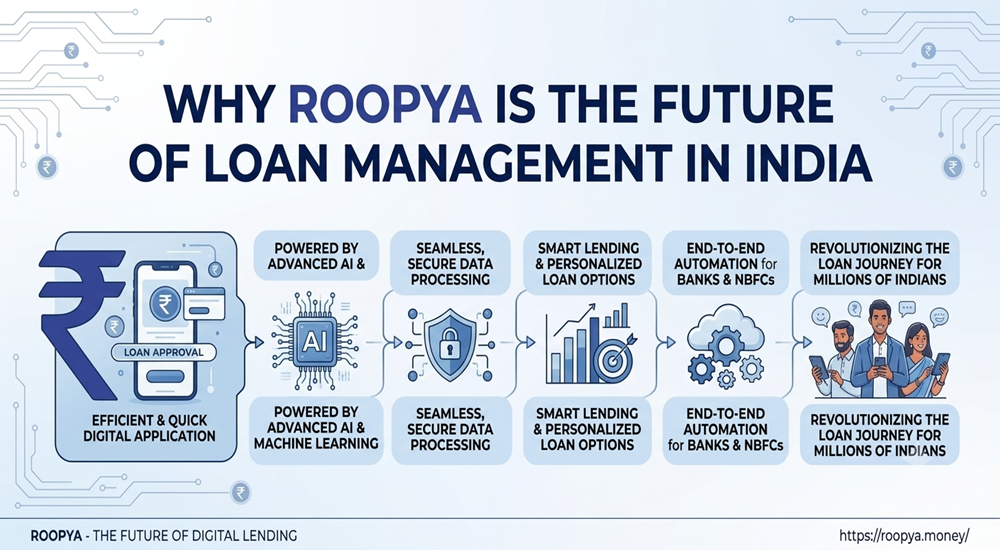
The question for every lender in India today is not whether to digitise — that debate is settled. The question is: which technology will define the next decade of lending operations? Which platform will give lenders the speed, intelligence, compliance, and scalability they need to thrive in an increasingly competitive, AI-driven, regulation-heavy market?
The answer is Roopya. This Blog explains why — in depth.
1. The Broken State of Traditional Loan Management
Before we can understand why Roopya represents the future, we must be honest about the present. The majority of India’s lenders — particularly NBFCs and smaller banks — are managing their loan portfolios on technology that is fundamentally mismatched with the demands of 2025 and beyond.
Traditional loan management systems were built for a world of branch banking, physical documents, and manual underwriting. They are characterised by monolithic architectures that are expensive to modify, vendor-lock-in that makes integration with modern APIs nearly impossible, and interfaces so complex that any configuration change requires a specialist developer and weeks of testing.
The cost of this technological debt is enormous. Lenders report average loan processing times of three to seven business days for personal loans — while digital-native competitors process the same applications in under fifteen minutes. Manual document verification introduces error rates of 8–12%, each of which is a compliance risk. Credit bureau pulls are done manually and inconsistently. Credit policies live in spreadsheets and in the heads of senior underwriters, making scale and consistency impossible.
The consequences are measurable: higher operating costs per loan, lower conversion rates, greater regulatory risk, poor borrower experience, and an inability to compete with agile fintech lenders who have built their operations on modern infrastructure from day one.
This is the gap that Roopya was designed to close — and it does so in ways that go far beyond incremental improvement.
2. What Makes Roopya Fundamentally Different
2.1 Built for India, Not Adapted for India
This distinction matters more than it might initially appear. Most enterprise lending software available in India is a global platform that has been localised — sometimes poorly — for the Indian market. These platforms struggle with Aadhaar eKYC, CIBIL bureau integration, RBI-specific compliance requirements, GST-based underwriting for MSME borrowers, Account Aggregator (AI) connectivity, and the unique challenges of serving Tier 2 and Tier 3 geographies. Customisation is expensive, slow, and never quite complete.
Roopya was architected from the ground up with the Indian lending ecosystem as its primary design constraint. Every integration, every workflow, every compliance module, and every AI model is built for Indian data, Indian regulations, and Indian borrowers. The result is a platform that works out of the box — not after six months of painful customisation.
2.2 The No-Code Advantage: Power Without Programmers
One of the most significant barriers to innovation in lending operations has historically been the dependency on IT teams for every configuration change. When a credit head wants to adjust a bureau score cutoff, add a new income variable to the underwriting model, or launch a new loan product, the traditional path involves raising a ticket, waiting for developer availability, testing in a staging environment, and deploying to production — a cycle that can take weeks or months.
Roopya eliminates this bottleneck entirely. Its no-code platform empowers business users — credit managers, operations heads, product teams — to configure lending workflows, credit policies, business rules, and product parameters through an intuitive visual interface, with changes taking effect in real time. No developer. No ticket. No waiting.
This is not a minor operational convenience. It is a strategic capability. The ability to iterate on credit policy in real time, respond to market conditions within hours rather than weeks, and launch new loan products without a development sprint gives Roopya-powered lenders an adaptability advantage that compounds over time.
2.3 1-Day Go-Live: Rethinking Implementation
Traditional lending software implementations are notoriously painful. Six-month timelines are common. Twelve-month implementations are not rare. The reasons are familiar: complex data migrations, custom integration work, extended user acceptance testing, and the sheer difficulty of configuring monolithic systems to match a lender’s specific requirements.
Roopya has fundamentally rethought this equation. With 20+ pre-configured loan product journeys covering every major lending product category, 300+ pre-integrated APIs covering all major bureaus, KYC providers, eSign platforms, payment gateways, and accounting tools, and a no-code configuration layer that lets lenders set up their credit policies without writing code, the implementation timeline compresses from months to a single day.
This is not a marketing claim — it is an operational reality for lenders including IndiaKaLoan, QuickFinShop, Recapita, Findoc, EazyCredit, and LoanSeva, all of whom went live on Roopya and began processing real loan applications within 24 hours of onboarding. For a newly licensed NBFC, or an established lender entering a new product segment, this speed-to-market advantage can be the difference between capturing first-mover opportunity and watching a competitor do so.
2.4 Pay-As-You-Use: Democratising Enterprise Technology
Enterprise lending infrastructure has historically been accessible only to large institutions with the capital to pay significant upfront licence fees, implementation costs, and annual maintenance charges. A mid-size NBFC or a newly licensed lender could not access the same quality of technology as a large bank — creating a structural disadvantage that compounded over time.
Roopya’s pay-as-you-use pricing model inverts this dynamic. There are no upfront costs. No large licence fees. No capital expenditure. Lenders pay based on actual transaction volume — meaning the platform’s cost scales precisely with revenue. A lender processing 50 loans a month pays for 50 loans. A lender processing 50,000 pays proportionally more, but never more than the economics of their business can support.
This pricing model levels the playing field, making enterprise-grade, AI-powered lending infrastructure accessible to lenders at every stage of growth — from first-day startups to established institutions managing thousands of crores of assets under management.
3. The Technology That Powers Roopya’s Vision
3.1 AI That Is Actually Useful
Artificial intelligence has become one of the most overused and underdelivered promises in enterprise software. Every vendor claims AI capabilities; few deliver them in ways that generate real business value. Roopya is different — not because it uses AI as a marketing label, but because AI is genuinely embedded into every layer of the platform in ways that produce measurable outcomes.
Roopya’s AI-powered document analysis processes identity documents, bank statements, salary slips, GST returns, and ITR filings with 99%+ accuracy. The AI does not just extract data — it detects anomalies, flags fraud signals, cross-references data points across multiple documents, and identifies inconsistencies that human reviewers routinely miss. Document processing that previously took hours of manual work is completed in seconds, with higher accuracy and zero fatigue.
The AI-Enhanced Business Rule Engine goes further. Rather than being a static rule repository, Roopya’s BRE is a self-learning system. It analyses historical approval and rejection outcomes, identifies patterns in portfolio performance, and continuously suggests rule improvements — with human oversight retained at every step. The result is a credit policy that gets smarter over time, not one that stagnates until someone remembers to update a spreadsheet.
Intelligent credit decisioning moves beyond traditional bureau-score-based underwriting. Roopya’s ML models evaluate thousands of data points — alternative data signals, behavioural patterns, real-time financial indicators, cash flow analytics — to deliver risk assessments that are more accurate, more inclusive, and faster than any traditional scoring approach. The platform delivers credit decisions in milliseconds, not minutes.
3.2 Full Lending Lifecycle Coverage
One of the most significant operational challenges facing lenders with fragmented technology stacks is the cost and complexity of managing multiple systems — one for origination, another for loan management, a third for collections, perhaps a fourth for analytics. Each system requires its own integration, its own maintenance, and its own user training. Data silos emerge. Reconciliation becomes a daily exercise. Reporting is inconsistent. The total cost of ownership is far higher than any individual system’s price tag suggests.
Roopya provides complete, unified coverage of the entire lending lifecycle on a single platform:
- Loan Origination System (LOS): Digital application forms, automated KYC, bureau integration, document analysis, credit decisioning, loan offer generation, and eSign — all in one seamless origination workflow.
- Loan Management System (LMS): Complete portfolio management, amortisation schedules, payment processing, prepayment handling, NOC generation, and customer portal — giving lenders full visibility and control over their loan book.
- Collections System: Intelligent collection workflows, automated borrower communication via SMS/WhatsApp/email, EMI reminder management, field agent coordination, payment plan configuration, and recovery analytics.
- Early Warning System (EWS): Predictive risk identification using behavioural analytics, payment pattern analysis, and ML-powered default probability scoring — allowing lenders to intervene proactively, before a loan becomes an NPA.
- Lending Analytics: Real-time portfolio analytics, risk assessment dashboards, performance metrics, and customisable reporting that gives leadership teams instant visibility into every dimension of their lending operations.
A lender on Roopya does not need to integrate five different vendors, manage five different support contracts, or reconcile five different data models. Everything lives in one platform, with one data layer, one API surface, and one support relationship. This operational simplicity is itself a competitive advantage.
3.3 300+ Pre-Integrated APIs: The Ecosystem Advantage
Modern lending requires connecting to a wide ecosystem of third-party services — credit bureaus, KYC providers, eSign platforms, payment gateways, accounting systems, GST portals, banking APIs, telecom verification services, and more. Building and maintaining these integrations is expensive, time-consuming, and technically demanding. Every integration point is a potential point of failure, and keeping integrations current as third-party APIs evolve is a perpetual maintenance burden.
Roopya’s pre-integrated API ecosystem of 300+ connections eliminates this burden entirely. All four major credit bureaus (CIBIL, Experian, Equifax, CRIF) are live and tested. All major KYC providers — Aadhaar eKYC, NSDL PAN, Digilocker, video KYC (VKYC) — are pre-connected. eSign platforms, NACH payment gateways, UPI payment integrations, accounting software, CERSAI, and GST data providers are all ready to use from day one.
When a new integration partner enters the market, or when an existing partner updates their API, Roopya manages the update centrally — all lenders on the platform benefit automatically, with no individual integration work required. This network effect means Roopya’s ecosystem advantage grows over time, compounding the value of every lender’s investment in the platform.
3.4 Open API Architecture for Embedded Finance
The future of lending in India will not be confined to standalone lending apps and portals. It will be embedded — woven into the user journeys of e-commerce platforms, payroll apps, supply chain management tools, and consumer super-apps. A borrower will access a credit product at the point of need, within an interface they already use, without redirecting to a separate lender portal.
Roopya’s open REST API architecture makes this future possible today. Lenders can expose their lending products as API-driven services, enabling partner platforms to originate loans seamlessly through Roopya’s infrastructure. Channel-specific workflows, pricing rules, and credit policies can be configured for each partner independently. The lender retains full control while enabling a distributed origination network that would be impossible to build with traditional monolithic systems.
4. Roopya and the Regulatory Future
4.1 Built for an Evolving Compliance Environment
Regulatory compliance is not a static challenge. The RBI continues to refine and expand its expectations of digital lenders — from guidelines on digital lending (DL Guidelines 2022), to Fair Practice Code requirements, to data localisation mandates, to credit bureau reporting standards, to the evolving framework around the Account Aggregator ecosystem. A lender whose technology cannot keep pace with regulatory evolution faces not just operational risk but existential risk.
Roopya’s compliance architecture is built for change. The platform is continuously updated by Roopya’s dedicated compliance and engineering teams to incorporate new regulatory requirements as they emerge. Lenders on Roopya do not need to manage regulatory technology updates themselves — they are delivered automatically, ensuring the platform is always compliant with the latest requirements.
Specific compliance capabilities built into Roopya include: digital consent management (DPDP Act-aligned), complete application-level audit trails with immutable logs, bureau reporting in CIBIL and Experian formats, CERSAI integration for asset-backed loans, PMLA-compliant KYC workflows, and Fair Practice Code-aligned borrower communication management.
4.2 Account Aggregator Ready
The Account Aggregator (AA) framework is one of the most transformative regulatory developments in Indian financial services history. By enabling borrowers to share their financial data directly with lenders through a consent-based, RBI-regulated framework, AI makes it possible to underwrite thin-file borrowers — those without a strong credit history — using rich, real-time financial data from their banks, investments, and insurance policies.
Roopya is fully AI-ready. Lenders on the platform can initiate AI-based data pulls as part of their standard loan application workflow, receiving bank statements, investment holdings, and insurance data directly within the underwriting process — without any manual upload or document verification. This dramatically improves underwriting quality for new-to-credit and thin-file borrowers, opening up market segments that traditional bureau-only underwriting cannot serve profitably.
5. The Human Impact: What Roopya Means for India’s Borrowers
Technology platforms exist to serve people — and in lending, the ultimate measure of a platform’s value is what it does for borrowers. When lenders operate on Roopya’s infrastructure, the impact on borrower experience is immediate and profound.
A salaried borrower applying for a personal loan through a Roopya-powered lender completes the entire process — application, KYC, bureau check, document upload, credit decision, loan offer acceptance, and eSign — in under fifteen minutes, from their smartphone, without visiting a branch or speaking to a human agent. The loan is disbursed to their bank account the same day.
An MSME owner seeking a business loan submits a GST-linked application through a Roopya-powered NBFC. The platform pulls GST return data directly, analyses twelve months of bank statement transactions using AI, and generates a credit decision in minutes — rather than the two to three weeks a manual underwriting process would require.
A first-time borrower in a Tier 3 city, with no formal credit history, applies through an AI-enabled Roopya workflow. Her bank account data — regular salary credits, consistent utility payments, savings patterns — is analysed by Roopya’s alternative credit scoring model, generating a credit score and a loan offer that would have been impossible under traditional bureau-only underwriting.
These are not hypothetical scenarios. They are the daily operational reality for lenders running on Roopya’s platform. At scale, this means millions of Indians accessing credit faster, more fairly, and more affordably — which is the ultimate measure of what lending technology should accomplish.
6. Roopya vs. Traditional Lending Platforms: An Honest Comparison
How does Roopya compare to the alternatives available to Indian lenders? The comparison is instructive:
- Implementation Time: Legacy platforms require 6–18 months for full implementation. Roopya goes live in 1 day. The opportunity cost of those months — loans not processed, market share not captured — is enormous.
- Pricing Model: Traditional platforms charge large upfront licence fees plus annual maintenance costs regardless of transaction volume. Roopya’s pay-as-you-use model means zero upfront cost and pricing that scales with revenue.
- API Ecosystem: Legacy systems require custom integration work for every third-party connection. Roopya provides 300+ pre-integrated APIs from day one.
- Configurability: Traditional platforms require developer involvement for every policy or workflow change. Roopya’s no-code interface lets business users make changes in real time.
- AI Capabilities: Legacy platforms bolt on AI as an afterthought or charge separately for AI modules. Roopya’s AI — document analysis, credit scoring, fraud detection, BRE optimisation — is native and included.
- Compliance Updates: With traditional platforms, compliance updates require vendor engagement and custom development. Roopya delivers compliance updates automatically to all lenders on the platform.
- Scalability: Legacy monolithic architectures struggle to scale beyond certain transaction volumes. Roopya’s cloud-native architecture scales horizontally without infrastructure provisioning.
- Full Lifecycle Coverage: Most traditional platforms cover either origination or servicing, requiring separate systems for the other. Roopya covers the full lifecycle — origination, management, collections, EWS, and analytics — on one unified platform.
7. The Roopya Ecosystem: Partners, Customers, and the Network Effect
Roopya’s value is not just in its technology — it is in its ecosystem. As more lenders join the Roopya platform, the network effect compounds. Every new lender adds data that improves AI model accuracy. Every new API integration is available to all lenders on the platform. Every compliance update benefits the entire community simultaneously.
Roopya’s growing customer base — including IndiaKaLoan, QuickFinShop, Recapita, Findoc, EazyCredit, and LoanSeva — represents a community of modern lenders who have collectively processed millions of loan applications through the platform. The operational insights, edge cases, and performance data generated by this community continuously improve the platform for all participants.
For new lenders joining Roopya, this means they are not starting from zero. They are inheriting the collective learning of every lender who has come before them — encoded into AI models, pre-configured product journeys, optimised compliance workflows, and a battle-tested platform that has already encountered and solved problems they have not yet faced.
8. What the Future Looks Like — and Why Roopya Is Already There
The lending industry’s technology trajectory over the next five years is relatively clear. AI will move from experiment to infrastructure. Embedded finance will become the primary origination channel for consumer and MSME lending. The Account Aggregator ecosystem will mature, making alternative data underwriting the norm rather than the exception. Regulatory technology will become a core operational capability rather than a compliance checkbox.
On every one of these dimensions, Roopya is not catching up — it is already there. AI is not a roadmap item for Roopya; it is a live, in-production capability powering credit decisions every day. Embedded finance is not a future product feature; it is an operational reality through Roopya’s open API architecture. Account Aggregator connectivity is live. Regulatory compliance is automated and continuously updated.
This means lenders who choose Roopya today are not making a bet on future promises — they are deploying production-ready capabilities that represent the leading edge of lending technology globally. And because Roopya is a cloud-native, continuously-updated platform, lenders benefit automatically from every improvement Roopya’s engineering team delivers — without any implementation work, without any upgrade cycle, and without any additional cost.
9. Roopya’s Vision: Powering India’s Financial Inclusion Mission
India’s government has set an ambitious goal: universal financial inclusion. Every Indian — regardless of geography, income level, credit history, or formal employment status — should have access to appropriate, affordable credit when they need it.
Achieving this goal requires lending infrastructure that can reach the unreached. It requires AI-powered underwriting that can assess creditworthiness without a thick bureau file. It requires digital-first application journeys that work on entry-level smartphones with limited connectivity. It requires AI-enabled financial data sharing that lets a first-time borrower’s bank account history speak for them. It requires unit economics that make small-ticket lending commercially viable.
This is Roopya’s mission — and every capability on the platform is designed with this mission in mind. By giving lenders the technology to operate more efficiently, underwrite more accurately, and serve more borrowers profitably, Roopya is playing a foundational role in India’s financial inclusion story.
The future of loan management software in India is digital, intelligent, compliant, inclusive, and fast. Roopya is not waiting for that future. It is building it — one lender, one loan, one borrower at a time.
10. Conclusion: The Choice Is Clear
Every leader in India’s lending industry faces the same fundamental choice: remain on technology that was built for yesterday’s lending environment, or invest in infrastructure that is designed for where the industry is going.
Roopya offers the clearest path to that future. It is the only platform in India that combines: 1-day go-live with no upfront cost; a genuinely no-code configuration environment; 300+ pre-integrated APIs; full lending lifecycle coverage from origination to collections; native AI at every layer; continuous RBI compliance updates; Account Aggregator readiness; and an open API architecture for embedded finance.
For NBFCs looking to launch and scale. For banks seeking to modernise their retail lending stack. For MFIs aiming to reach more borrowers with better economics. For fintech lenders building the next generation of credit products. Roopya is not just the best option available today — it is the platform that will define what lending looks like in India tomorrow.
The future of loan management software in India has already begun. It runs on Roopya.

