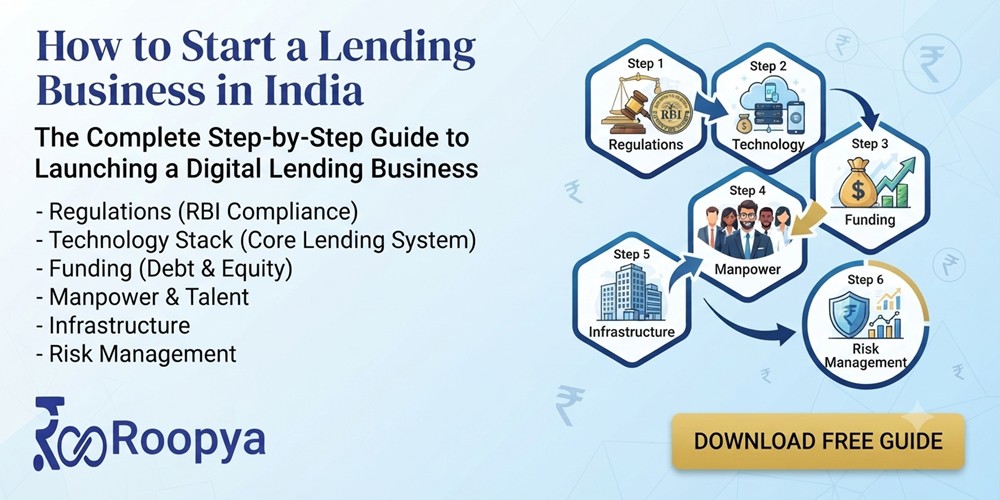
How to Start a Lending Business in India

How to Start a Lending Business in India
The complete step-by-step guide to launching a Digital Lending business — regulations, technology, funding, manpower, infrastructure & risk management.
Everything you need to know to start a digital lending business in India — from RBI NBFC registration and regulatory compliance to technology stack, capital arrangement, team building, and risk management. A practical roadmap with timelines and costs, and how Roopya gets you live in 7 days instead of 6 months.
25 min read · Published 23 Aug 2026
What It Takes to Start a Lending Business
Starting a digital lending business in India requires navigating RBI regulations, building technology, arranging capital, hiring the right team, and managing risk — all simultaneously.
India’s digital lending market is projected to reach $350 billion by 2030, driven by growing credit demand, smartphone penetration, and government initiatives like Account Aggregator and OCEN. For entrepreneurs and businesses looking to enter this space, the opportunity is enormous — but so are the barriers to entry.
To start a lending business in India, you need to clear five major hurdles:
- Regulatory: Obtain RBI NBFC registration (or operate under an exemption/partnership model), comply with RBI Digital Lending Guidelines, and maintain ongoing regulatory reporting
- Technology: Deploy a Loan Origination System , Loan Management System , 30+ API integrations (KYC, bureau, payments, collections), accounting, and compliance reporting
- Capital: Arrange ₹2 crore minimum Net Owned Funds for NBFC registration, plus debt funding for lending operations
- Manpower: Hire a team across credit, operations, technology, compliance, and collections — phased according to growth
- Risk Management: Build credit risk models, fraud detection, NPA monitoring, and compliance protocols
This guide walks you through each of these in detail — with specific timelines, costs, requirements, and practical advice. We also highlight how Roopya can eliminate the technology hurdle entirely, reducing your go-live timeline from 6 months to as little as 1 day.
This guide is for entrepreneurs, business owners, and existing businesses looking to start or expand into digital lending in India. Whether you’re a fintech startup, an existing NBFC wanting to go digital, a manufacturing company looking to offer supplier credit, or a professional exploring lending as a business — this guide covers everything you need.
Choose Your Lending Business Model
Before anything else, you need to decide what type of lending business you want to operate. This determines your regulatory path, capital requirements, technology needs, and timeline. There are four main models:
| Model | Description | Regulatory Path | Min. Capital | Timeline |
|---|---|---|---|---|
| NBFC (Direct Lending) | Register as a Non-Banking Financial Company with RBI and lend directly to borrowers. Full control over credit policy, pricing, and collections. | RBI NBFC Registration | ₹2 Cr NOF | 4–8 months |
| LSP (Lending Service Provider) | Partner with an existing NBFC as a Lending Service Provider. You handle customer acquisition and technology; the NBFC lends. | NBFC partnership + RBI DLG compliance | ₹50L – 2 Cr (tech + ops) | 2–4 months |
| Co-Lending | Partner with a bank or NBFC to co-originate loans. You bring the borrower and share risk; typically 80:20 risk-sharing. | Co-lending agreement + RBI guidelines | ₹5–10 Cr (your 20% share) | 3–5 months |
| P2P Lending Platform | Register as a Peer-to-Peer lending platform with RBI. Connect individual lenders with borrowers. Earn match-making fees. | RBI P2P License | ₹2 Cr NOF | 4–6 months |
Which Model Should You Choose?
NBFC (Direct Lending) is the most common and flexible model, giving full control over credit policy, pricing, collections, and customer relationships — but it requires the most capital and the longest setup time.
LSP Model is faster and cheaper to start. You don’t need NBFC registration or lending capital — the partner NBFC provides both — but you share revenue and have less control over credit decisions.
Co-Lending is ideal if you have some capital but not enough to fund the entire portfolio, and helps with priority sector lending (PSL) compliance.
P2P is a niche model with lower capital requirements but also lower margins — suited to building a marketplace rather than a balance-sheet lending business.
Roopya supports all four models. If you’re an NBFC, Roopya is your complete LOS + LMS. If you’re an LSP, Roopya provides the borrower-facing app and API layer that connects to your partner NBFC. If you’re co-lending, Roopya’s co-lending module handles split disbursements, profit-sharing calculations, and RBI-compliant documentation. If you’re a P2P platform, Roopya provides the matching engine and borrower/lender portals.
Regulatory Requirements
Regulatory compliance is the most critical and time-consuming part of starting a lending business. The RBI is the primary regulator, and every lending business must either obtain an RBI license or operate under a valid exemption.
2.1 RBI NBFC Registration
To lend directly in India, you must register as a Non-Banking Financial Company (NBFC) with the RBI:
| Step | Requirement | Timeline | Cost |
|---|---|---|---|
| 1. Company Incorporation | Register a public or private limited company under the Companies Act. Minimum 2 directors (private limited). | 2–4 weeks | ₹15,000 – 30,000 |
| 2. Minimum Net Owned Funds | Maintain ₹2 crore as NOF — equity capital, not debt. | Before application | ₹2,00,00,000 (capital) |
| 3. RBI NBFC Application | File on RBI COSMOS portal with COI, MOA/AOA, director CIBIL reports, business plan, compliance officer details, IT infra details, source of funds. | 1–2 weeks to prepare | ₹10,000 – 50,000 (filing) |
| 4. RBI Review & Queries | RBI reviews and raises queries; you respond with clarifications, documents, sometimes in-person meetings. | 2–4 months | ₹2–5 lakh (legal/consulting) |
| 5. RBI On-Site Inspection | RBI may inspect your office, IT systems, and governance framework. | 1–2 months | ₹50,000 – 1 lakh |
| 6. Certificate of Registration | RBI issues CoR under Section 45-IA of the RBI Act, 1934. You can commence lending. | 1–2 weeks post-approval | ₹5,000 (CoR fee) |
2.2 Additional Registrations & Licenses
| Registration | Purpose | Authority | Timeline | Cost |
|---|---|---|---|---|
| GST Registration | Tax compliance for fee income, processing charges | GSTN | 1–2 weeks | Nil |
| MSME / Udyam | Business registration (optional, recommended) | Ministry of MSME | 1–3 days | Nil |
| CERSAI Registration | Register security interests for secured loans — mandatory under SARFAESI | CERSAI | 2–4 weeks | ₹10,000 + ₹10–50/filing |
| Credit Bureau Membership | Pull credit reports and report loan data (CIBIL, Experian, Equifax, CRIF) | Bureaus | 4–8 weeks per bureau | ₹50,000 – 2 lakh + per-pull |
| DLT Registration | Send transactional SMS/WhatsApp — mandatory under TRAI DLT | TRAI / DLT platforms | 1–2 weeks | ₹5,000 – 15,000 |
| Data Privacy Compliance | DPDP Act 2023 — consent management, minimization, breach notification | MeitY | Ongoing | ₹1–3 lakh (legal setup) |
| DNAR Registration | Register your app on the Digital Lending Apps Registry | RBI | 2–4 weeks | Nil (currently) |
| ISO 27001 Certification | Information security certification — recommended for trust | ISO auditors | 2–4 months | ₹2–5 lakh |
2.3 RBI Digital Lending Guidelines (DLG 2022)
If you’re operating a digital lending app, you must comply with RBI’s Digital Lending Guidelines issued in September 2022:
- Transparent pricing: all-inclusive APR must be disclosed upfront, no hidden charges
- No automatic credit limit increases: explicit borrower consent required
- Cooling-off period: 7 days to exit paying principal + pro-rata interest, no penalty
- Data collection restrictions: only necessary data, explicit consent per data point
- Funds flow: disbursement direct to the borrower’s account, not a pool account or LSP
- Recovery: no coercive methods; trained agents, code of conduct
- Grievance redressal: 24-hour SLA with escalation to the Nodal Officer
- Key Fact Statement (KFS): standardised disclosure before agreement signing
Roopya is built to be fully compliant with RBI Digital Lending Guidelines out of the box — auto-generating the KFS, enforcing transparent APR disclosure, managing consent, ensuring direct-to-borrower fund flow, and providing built-in grievance redressal with 24-hour SLA tracking and complete audit trails.
2.4 Ongoing Regulatory Reporting
| Return | Frequency | Authority | Key Data |
|---|---|---|---|
| NBS-1 | Monthly | RBI (XBRL) | Asset profile, liabilities, income |
| NBS-2 | Quarterly | RBI (XBRL) | Maturity profile, liquidity |
| NBS-7 | Quarterly | RBI (XBRL) | ALM, maturity buckets |
| DNAR | Quarterly | RBI | App details, LSP partners, loan volumes |
| CERSAI Returns | Per transaction | CERSAI | Security interest reg/mod/satisfaction |
| Credit Bureau Reporting | Monthly/Daily | Bureaus | Disbursal, EMI status, DPD, closures |
| Fair Practices Code | Annual + on change | RBI | Board-approved FPC, customer policies |
| GST Returns | Monthly/Quarterly | GSTN | Fee income, processing charges |
All regulatory returns — NBS-1, NBS-2, NBS-7, DNAR, CERSAI, credit bureau reporting — are auto-generated from live loan data, validated before submission, with alerts if data is missing. No manual compilation, no spreadsheet errors, no missed deadlines.
Technology Infrastructure
Technology is the backbone of a digital lending business. Building it from scratch requires 3–6 months and ₹15–25 lakh in development costs — or you can use Roopya’s no-code lending infrastructure and go live in as little as a day, with zero setup cost.
3.1 Complete Technology Stack
| System | Purpose | DIY Build Time | DIY Cost | Roopya |
|---|---|---|---|---|
| Loan Origination System | Intake, KYC, decisioning, disbursement | 2–3 months | ₹5–10 lakh | Ready day 1 |
| Loan Management System | EMI scheduling, interest, payments, NPA class. | 2–3 months | ₹5–10 lakh | Ready day 1 |
| KYC APIs | eKYC, PAN, DigiLocker, face match | 1–2 months | ₹2–4 lakh + per-call | Pre-integrated |
| Credit Bureau APIs | Pull reports for underwriting | 1–2 mo/bureau | ₹1–2 lakh + per-pull | All 4 bureaus ready |
| Bank Data APIs | AA / statement parsing for cashflow | 1–2 months | ₹2–4 lakh + per-fetch | Pre-integrated |
| Payment & Collection APIs | NACH, UPI, payment links | 1–2 months | ₹2–4 lakh + per-txn | Pre-integrated |
| Accounting & GL | Post disbursements, income, provisions | 1–2 months | ₹2–4 lakh | Ready day 1 |
| Regulatory Reporting Engine | Auto-generate NBS, DNAR, CERSAI, bureau | 1–2 months | ₹2–4 lakh | Ready day 1 |
| Borrower Portal & App | Self-service — statements, payments | 2–3 months | ₹3–5 lakh | White-labeled |
| Communication APIs | SMS, WhatsApp, Email, AI Voice | 1 month | ₹1–2 lakh + per-msg | Pre-integrated |
| Field Agent App | GPS tracking, visit logging | 2–3 months | ₹3–5 lakh | Ready day 1 |
| Data Security & Infra | Encryption, backups, DR, ISO 27001 | 1–2 months | ₹2–5 lakh/yr | Included |
3.2 The Roopya Alternative
Roopya is a truly no-code, unified lending infrastructure — LOS, LMS, 300+ pre-integrated APIs, accounting, compliance reporting, borrower portal, field agent app, and communication — pre-built and ready to use from day one.
Build It Yourself
- 3–5 developers for 3–6 months
- 15+ vendor onboarding contracts
- Ongoing maintenance team (1–2 devs)
- API breakages and updates
- No unified dashboard
- Compliance is your problem
- Delayed go-to-market
Roopya Platform
- Zero setup fee
- Go live in as little as 1 day
- 300+ APIs pre-integrated
- Truly no-code, no developers needed
- Unified dashboard for everything
- RBI compliance built-in
- Roopya handles all maintenance
With Roopya, you spend your time and capital on what matters — getting your NBFC license, arranging funding, building your credit model, and acquiring customers — instead of building and maintaining software. Explore the full Roopya lending platform for a detailed breakdown of every module.
Funding & Capital Arrangement
A lending business is fundamentally capital-intensive. You need equity capital for regulatory requirements and infrastructure, and debt capital to lend to borrowers.
4.1 Types of Capital
| Capital Type | Purpose | Amount Needed | When to Raise | Sources |
|---|---|---|---|---|
| Equity — NOF | RBI-mandated Net Owned Funds | ₹2 Cr min – ₹10 Cr (recommended) | Before NBFC application | Founders, angels, family offices |
| Equity — Runway | Opex for first 12–18 months | ₹3–10 Cr depending on scale | Before launch | VCs, angels, strategic investors |
| Debt — Bank Lines | Capital to lend to borrowers | ₹10–50 Cr (start), scales with AUM | After CoR, before lending | HDFC, ICICI, SBI, Axis |
| Debt — NCDs | Non-Convertible Debentures | ₹10–100 Cr | After 6–12 months | Mutual funds, insurers, pension funds |
| Co-Lending Capital | Partner funds 80%, you fund 20% | Your share: ₹2–10 Cr | After CoR + partnership | PSU banks, large NBFCs |
| Securitisation | Sell loan pools to free up capital | As needed | After 12+ months, ₹50+ Cr AUM | Banks, NBFCs, ARCs, MFs |
4.2 Funding Timeline
Raise ₹2–10 Cr equity from founders, angels, or early-stage VCs — covers NOF, incorporation, RBI fees, initial hiring, and tech setup (or Roopya onboarding). Without this, you cannot apply for NBFC registration.
Start conversations with banks for debt lines while RBI reviews your application. Term sheets take 2–4 months. Target ₹10–20 Cr in committed lines by the time you get your CoR.
Draw down debt from banks and start lending. Begin with a conservative pilot portfolio (₹1–5 Cr AUM) to validate your credit model before scaling.
If your pilot performs well (NPA under 2%, growth on track), raise a Series A (₹10–30 Cr) to fund growth, expand the team, and increase lending capital.
With 12+ months of data, diversify: issue NCDs, set up co-lending with PSU banks for PSL, and explore securitisation to recycle capital.
Once AUM crosses ₹50–100 Cr, securitise loan pools to free capital, raise larger debt lines, explore ECBs, and potentially raise Series B for national expansion.
By using Roopya instead of building technology in-house, you save ₹15–25 lakh in Year-1 tech costs — capital that goes directly into your lending book. You also go live faster, generating revenue sooner and raising debt on better terms: investors and banks see a live lending operation, not a software project.
Manpower & Team Building
Your team is your most important asset. Here’s a phase-wise breakdown of who to hire, when, and what to look for.
Phase 1: Pre-Launch (Months 0–6) — keep it lean, 5–7 people
CEO / Founder
Founder equitySets vision, strategy, and business model. Leads fundraising, RBI relationships, and key partnerships.
Credit Head / Chief Risk Officer
₹15–25 lakh/yrDesigns credit policy, underwriting framework, and risk models. The most important hire — a bad credit model sinks the business regardless of everything else.
Compliance Officer (Nodal Officer)
₹8–15 lakh/yrEnsures RBI compliance, Fair Practices Code, grievance redressal, and regulatory reporting — a mandatory RBI requirement.
Operations Manager
₹8–15 lakh/yrManages day-to-day operations — processing, disbursement, collections coordination, vendor management.
Finance & Accounts Manager
₹8–12 lakh/yrManages books, GL postings, TDS, GST, financial reporting, and fund flow; works with compliance on RBI returns.
Technology Lead (if not using Roopya)
₹15–25 lakh/yrIf building in-house, you need a CTO/lead and 3–5 developers for LOS, LMS, integrations, and portal. With Roopya, you don’t need this role at all.
Using Roopya eliminates the need for a technology team entirely in Phase 1 — saving ₹40–75 lakh/year in salaries alone. That’s 4–6 people you don’t need to hire, manage, or pay. Your founding team focuses on credit, compliance, and customers — not software.
Phase 2: Launch & Early Operations (Months 6–12) — add 5–10 people
Credit Analysts (2–3)
₹5–8 lakh/yr eachReview applications, run credit checks, verify documents. In digital lending, much is automated — analysts handle edge cases and manual reviews.
Collection Officers (2–4)
₹3–6 lakh/yr eachManage EMI collections, delinquent accounts, coordinate field agents. Early-stage collection is largely automated (SMS, WhatsApp, AI voice via Roopya) but late-stage delinquency still needs humans.
Customer Support Executive (1–2)
₹3–5 lakh/yr eachHandle borrower queries, complaints, and support tickets. Roopya’s borrower portal self-serves many queries, but complex issues still need humans.
Phase 3: Growth & Scale (Months 12–24) — add 10–20 people
Sales / Business Development (3–5)
₹5–10 lakh/yr + incentiveBuild distribution — DSA networks, dealer partnerships, corporate tie-ups, digital marketing. Drive loan application volume.
Data Scientist / ML Engineer (1–2)
₹12–20 lakh/yr eachBuild and refine credit scoring, fraud detection, and collection prediction models using portfolio data.
Field Collection Agents (5–10)
₹2.5–4 lakh/yr + incentiveOn-the-ground agents for late-stage delinquency (60+ DPD), equipped with Roopya’s field agent app for GPS tracking and payment collection.
Product Manager (1)
₹12–18 lakh/yrDesigns and launches new loan products, optimises the borrower journey, bridges business, credit, and technology.
Phase-wise Team Size Summary
| Phase | Timeline | Team Size | Key Roles | Annual People Cost |
|---|---|---|---|---|
| Phase 1: Pre-Launch | Months 0–6 | 5–7 | CEO, Credit Head, Compliance, Ops, Finance, Tech Lead (if DIY) | ₹50–80 lakh (₹10–20 lakh with Roopya) |
| Phase 2: Launch | Months 6–12 | 10–17 | + Credit Analysts, Collection Officers, Support | ₹80–150 lakh (₹30–60 lakh with Roopya) |
| Phase 3: Growth | Months 12–24 | 20–37 | + Sales, Data Scientists, Field Agents, PM | ₹150–300 lakh (₹80–180 lakh with Roopya) |
Across all three phases, Roopya reduces headcount by 4–8 people (the entire technology team) and saves ₹40–100 lakh/year in salaries — capital that goes directly into your lending book.
Other Infrastructure & Setup
| Infrastructure | Requirement | Cost (Year 1) | Notes |
|---|---|---|---|
| Office Space | RBI requires a registered office; 1,000–2,000 sq ft sufficient; co-working acceptable. | ₹3–12 lakh/yr | RBI may inspect during review |
| Cloud Hosting | AWS/Azure/GCP, must be hosted in India per data localisation norms. | ₹2–6 lakh/yr | Included with Roopya |
| Data Security | Encryption, access controls, audit logs, DR, ISO 27001. | ₹2–5 lakh/yr | Included with Roopya |
| Bank Accounts | Operating, escrow, and trust accounts per RBI DLG. | ₹10,000–50,000/yr | Must be scheduled commercial banks |
| Insurance | Professional indemnity, cyber liability, fidelity. | ₹1–3 lakh/yr | Recommended for all lenders |
| Audit & Legal | Statutory + internal auditor, compliance consultant, legal counsel. | ₹3–8 lakh/yr | Mandatory annual statutory audit |
| Communication & Tools | Email, collaboration, phone system, CRM. | ₹1–3 lakh/yr | CRM included with Roopya |
Risk Management & What to Watch For
Lending is a risk business. Borrower non-repayment is the primary risk — but several others can destroy a lending business if left unmanaged.
7.1 Credit Risk
The #1 risk in lending. A credit model that approves too many bad borrowers leads to high NPAs and eventual insolvency.
Mitigation: Start with a conservative credit model. Use bureau data for every loan and bank statement data (AA or parser) to verify income. Set conservative LTV ratios and income multipliers. Start with small tickets and short tenures, monitor DPD daily. Roopya pre-integrates all bureau and bank data APIs, with a no-code credit decisioning engine.
7.2 Fraud Risk
Fraudsters use stolen or fake identities to take loans with no intention of repaying — common where face-to-face verification is absent.
Mitigation: Aadhaar eKYC + face match + liveness detection for every borrower. Cross-verify PAN, mobile, and bank ownership (penny drop). Check duplicate applications across devices/IPs. Roopya includes all these checks in the KYC flow.
Borrowers submit fake salary slips, ITR, or bank statements to qualify for loans they wouldn’t otherwise get.
Mitigation: Use Account Aggregator data instead of uploaded statements. Use DigiLocker for government documents and OCR with tampering detection. Roopya’s document engine includes fraud detection automatically.
7.3 Regulatory Risk
RBI can penalise, suspend, or cancel your NBFC license for non-compliance with reporting, DLG, or capital adequacy norms.
Mitigation: Dedicated compliance officer, compliance-built technology like Roopya that auto-generates RBI returns and maintains audit trails, monthly board review, periodic RBI consultant audits.
The DPDP Act 2023 imposes heavy penalties for breaches, unauthorised sharing, or missing consent.
Mitigation: Collect only necessary data with explicit consent, store encrypted in India, maintain a retention/deletion policy. Roopya manages consent and data security as part of the platform.
7.4 Operational Risk
Platform downtime means you can’t process loans, collect EMIs, or serve customers — lost revenue and trust.
Mitigation: Use a platform with 99.9%+ uptime SLA. Roopya runs on enterprise cloud infrastructure with automatic failover and disaster recovery.
Aggressive or coercive recovery leads to regulatory action, reputational damage, and even criminal cases.
Mitigation: Follow RBI’s code of conduct strictly, train all staff, use AI voice calling for early-stage reminders (consistent, polite, fully recorded), escalate to humans only for late-stage delinquency.
7.5 Liquidity & Funding Risk
If debt providers withdraw or reduce lines, you can’t disburse new loans even with strong demand — as happened during COVID-19.
Mitigation: Diversify funding sources, maintain 3–4 debt relationships, build co-lending partnerships, keep capital adequacy above RBI’s minimum (15% for NBFCs).
7.6 Concentration Risk
Concentration in one geography, industry, or segment means a localised shock can cause widespread defaults.
Mitigation: Diversify across geographies, industries, and segments. Set exposure limits and monitor concentration monthly. Roopya’s portfolio analytics dashboard shows concentration metrics in real time.
Roopya isn’t just technology — it’s a risk management platform. Credit decisioning, fraud detection, NPA monitoring, portfolio analytics, compliance reporting, and collection tools are all built in. You set the policies; Roopya enforces them consistently across every loan, every day.
Everything You Need to Start
A complete checklist to track your progress from idea to launch.
Regulatory
Technology
Funding
Manpower
Other Infrastructure
Start Your Lending Business with Roopya
Don’t spend 6 months and ₹25 lakh building technology. Roopya gives you the entire no-code lending platform — LOS, LMS, 300+ APIs, accounting, compliance, borrower portal, collections — ready to use from day one. Focus on your NBFC license, funding, and customers. We’ll handle the technology.
Frequently Asked Questions
How much capital is needed to start a lending business in India?
How long does it take to start a lending business in India?
What licenses are required to start a lending business in India?
Can I start lending without an NBFC license?
How does Roopya help start a lending business?
What is the RBI Digital Lending Guidelines 2022 and how does it affect me?
What is the minimum team size to start a digital lending business?
What are the biggest risks in starting a lending business?
What loan products should I start with as a new lender?
Ready to Start Your Lending Business?
Roopya gives you the technology. You bring the vision, capital, and customers.