Lending Software for Fintech Companies : The Complete Guide

Fintech lenders don’t compete on interest rates alone—they compete on speed, experience, and how well they fit into the moment a customer needs money. A borrower applying for a personal loan through an app expects a decision in minutes, not days. A merchant applying for working capital at a point-of-sale terminal expects the offer to appear instantly, embedded right into the checkout flow. None of that is possible on legacy lending infrastructure built for branch banking. It requires lending software designed from the ground up for how fintechs actually operate: API-first, data-driven, and built to launch new products quickly rather than over quarters.
Start Free Trial
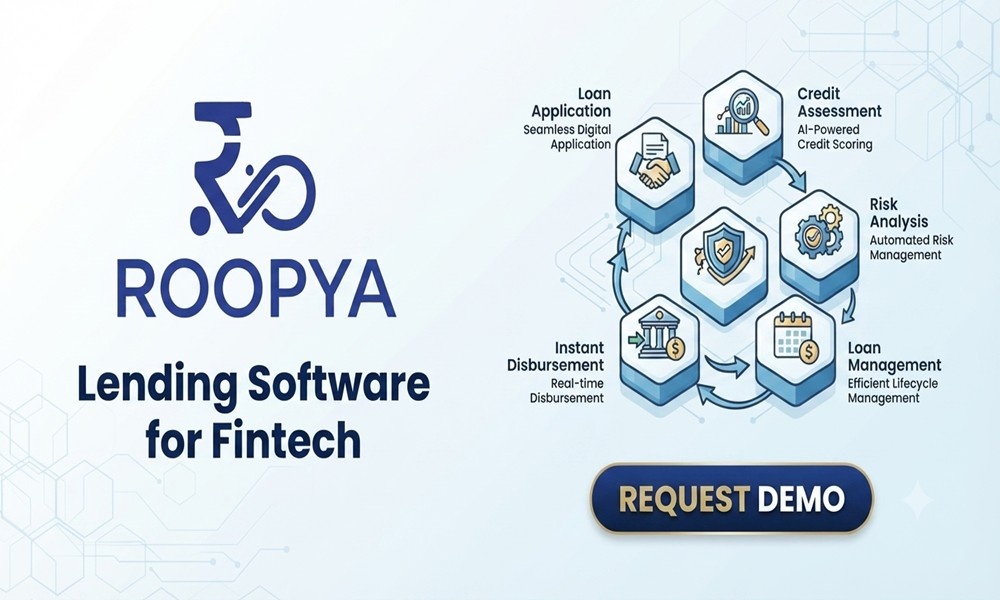
Roopya.money builds lending software for exactly this kind of institution—fintech lenders, NBFCs partnering with fintech platforms, and digital-first lending businesses that need infrastructure as fast and flexible as their go-to-market strategy. This guide covers what fintech lending software actually needs to do, the features that separate a genuinely fintech-ready platform from a repackaged bank system, and how to think about implementation.
What Is Lending Software for Fintech?
Lending software for fintech is a platform that manages the full loan lifecycle—from application and underwriting through disbursement, servicing, and collections—built specifically to support the operating model fintechs use: digital-only origination, embedded distribution through partner platforms, rapid product iteration, and reliance on alternative data for credit decisions. Unlike traditional core lending systems, which are typically built around branch workflows and long implementation cycles, fintech lending software is API-first by design, meaning nearly every function—application submission, KYC, credit checks, disbursement, and repayment tracking—can be triggered and orchestrated programmatically.
Why Fintechs Need Purpose-Built Lending Software
1. Speed to Market Determines Competitive Position
In fintech lending, the company that can launch a new loan product or enter a new segment fastest usually wins the early customer relationships. Lending software built for fintech supports configuring new products—new eligibility rules, new documentation requirements, and new pricing—without a multi-month development cycle.
2. Embedded and API-First Distribution
Much of fintech lending today happens inside someone else’s app: a checkout flow, a marketplace, or a payroll platform. This only works if the lending software exposes clean, well-documented APIs that partner platforms can call directly, rather than requiring borrowers to leave the partner experience and go to a separate lending portal.
3. Alternative Data and Thin-File Underwriting
A large share of fintech lending targets customers who are new to credit or have thin credit files—freelancers, gig workers, and small merchants. Traditional bureau data alone often isn’t enough to underwrite these customers well. Fintech lending software needs to ingest and score alternative data: bank statement transaction patterns, UPI history, GST filings, account aggregator data, and platform-specific data such as marketplace sales history.
4. Multi-Product, Multi-Partner Complexity
Many fintechs don’t lend on their own balance sheet—they operate as lending service providers or co-lend alongside a bank or NBFC partner. This adds a layer of complexity: the software needs to support partner-specific underwriting rules, data sharing agreements, and reconciliation, sometimes across several partners for different products simultaneously.
5. Regulatory Guardrails for Digital Lending
Digital lending in India operates under RBI’s digital lending guidelines, which cover areas like transparent disclosure of loan terms, restrictions on data usage, and requirements around lending service provider arrangements. Lending software needs to build these guardrails into the workflow itself—consent capture, key fact statements, and clear audit trails—rather than treating compliance as a bolt-on.
Core Features of Fintech-Ready Lending Software
API-First Architecture
Every core function—application intake, KYC, credit decisioning, disbursement, repayment—should be accessible via well-documented APIs, enabling both embedded lending journeys and custom front-end experiences built by the fintech’s own product team.
Configurable Credit Decisioning Engine
Risk teams need to build, test, and adjust credit scorecards and eligibility rules without waiting on engineering resources and to run multiple scoring models for different products or partner agreements simultaneously.
Alternative Data Integrations
Native connections to account aggregators, bank statement analysis tools, GST/ITR data, and bureau data (CIBIL, Experian, Equifax, CRIF) let underwriting draw from a fuller picture of a borrower’s financial behavior, not just a bureau score.
Digital KYC and Consent Management
Support for Aadhaar e-KYC, video KYC, and digitally captured, auditable borrower consent—a requirement under digital lending regulations and a practical necessity for a fully remote lending journey.
Partner and Co-Lending Management
Tools to manage multiple lending partners, apply partner-specific underwriting rules, and handle disbursement and collections reconciliation across balance sheets when a fintech operates in a co-lending or lending-service-provider model.
Automated Disbursement and Collections
Straight-through disbursement to verified bank accounts or UPI IDs once approval conditions are met, along with automated repayment reminders, NACH/UPI Autopay mandate management, and collections workflows for overdue accounts.
Real-Time Analytics and Portfolio Monitoring
Dashboards track approval rates, portfolio-at-risk, disbursement volumes, and cohort-level performance, so risk and business teams can spot trends early rather than discovering them in a monthly report.
How Roopya.money Supports Fintech Lenders
Roopya.money’s platform is built around the operating reality of fintech lending: fast product configuration, API-first integration, and support for the partner and co-lending structures that most fintech lenders operate under. Rather than forcing fintechs to adapt their model to a rigid banking system, Roopya.money is designed to let product and risk teams configure workflows, scorecards, and partner rules directly, while maintaining the audit trails and disclosures that RBI’s digital lending framework requires.
Because origination, underwriting, disbursement, and servicing all run on one connected platform, fintechs avoid the common trap of stitching together separate point solutions for each stage of the loan lifecycle—a pattern that tends to create data gaps and reconciliation headaches as loan volumes grow.
Fintech Lending Software vs. Traditional Bank Lending Systems
The differences go beyond features—they reflect fundamentally different design philosophies aimed at different operating models.
| Aspect | Fintech Lending Software | Traditional Bank System |
| Integration model | API-first, built for embedding | Portal-based, limited API access |
| Product launch speed | Days to weeks via configuration | Often months, needs development |
| Underwriting data | Bureau and alternative data sources | Primarily bureau and bank statements |
| Partner/co-lending support | Built-in multi-partner workflows | Usually limited or custom-built |
Implementation: What to Expect
- Define your product and partner model first: Whether you lend on your own NBFC license, as a lending service provider, or via co-lending shapes how the platform needs to be configured.
- Map your data sources: List every credit and verification data source you plan to use — bureaus, account aggregators, GST portals—so integrations can be scoped up front.
- Design your API integration early: Decide which lending functions your own app will call directly versus which will run through the platform’s interface.
- Build compliance checkpoints into the workflow: Consent capture, key fact statements, and disclosure requirements should be part of the application flow from day one, not retrofitted later.
- Pilot with one product or partner: Validate the full loan lifecycle—origination through collections—on a limited scale before expanding to additional products or partners.
Common Pitfalls to Avoid
Treating Compliance as an Afterthought
Retrofitting consent capture, disclosures, and audit trails after a product has launched is far harder than building them into the workflow from the start and creates regulatory risk in the meantime.
Underestimating Reconciliation Complexity
In co-lending or lending-service-provider models, disbursement and collections need to reconcile cleanly across balance sheets. This is frequently underestimated until volumes grow and discrepancies become costly to untangle.
Choosing Point Solutions Over a Connected Platform
Stitching together separate tools for KYC, underwriting, disbursement, and collections can work at a small scale but tends to create data silos and integration overhead that slow the business down as volumes increase.
The Bottom Line
Fintech lending succeeds or stalls on the strength of its underlying software. The winning platforms aren’t necessarily the ones with the longest feature lists—they’re the ones built around how fintechs actually operate: fast product iteration, embedded distribution, alternative data underwriting, and multi-partner complexity handled cleanly rather than as an afterthought.
Roopya.money was built with that operating model in mind, giving fintech lenders and their partners one connected platform to originate, underwrite, disburse, and service loans without stitching together disconnected tools.

