Lending Software: The Complete Guide for Banks and NBFCs in 2026

Lending is no longer just about approving and disbursing money—it’s about doing it fast, accurately, and compliantly and at a scale that keeps up with borrower expectations. Behind every modern loan, from a personal loan approved in minutes to a commercial credit line disbursed to a business, sits a piece of technology working quietly in the background: lending software.
If you run a bank, NBFC, microfinance institution, or any organization that lends money, the software you choose to manage that lending determines almost everything else—how fast you can grow, how well you manage risk, how happy your borrowers are, and how easily you stay on the right side of regulators. This guide walks through what lending software actually is, why it matters more in 2026 than ever before, what to look for when choosing one, and how a platform like roopya.money fits into that picture.
Start Free Trial
What Is Lending Software?
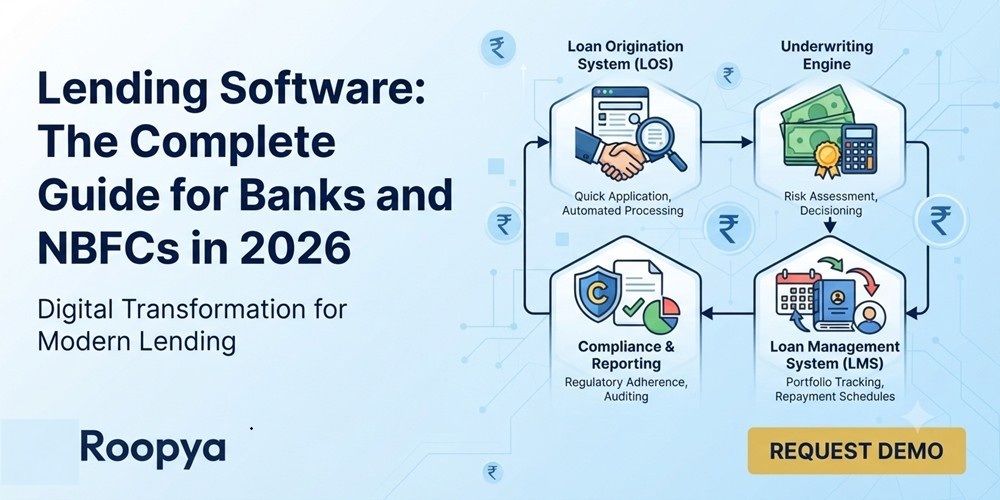
Lending software is a technology platform that automates and manages the entire loan lifecycle—from the moment a borrower applies, through underwriting and disbursement, to servicing, collections, and eventual loan closure. Instead of loan officers tracking applications on spreadsheets, chasing paperwork by email, and manually calculating repayment schedules, lending software brings every step into a single, connected system.
At its core, lending software typically covers:
- Loan origination—capturing borrower information, documents, and application data
- Credit underwriting—assessing creditworthiness using rules, scorecards, or AI-driven models
- Loan servicing—managing repayment schedules, interest accrual, and account statements
- Collections and recovery—tracking overdue accounts and managing follow-ups
- Compliance and reporting—ensuring every step meets regulatory requirements and produces audit-ready records
Some platforms bundle all of this into one system, often called a Loan Management System (LMS), while others specialize in just one part of the lifecycle, such as origination (an LOS, or Loan Origination System) or collections.
Why Lending Software Matters More Than Ever
A few years ago, many banks and NBFCs could get by with a mix of core banking modules, spreadsheets, and manual processes. That is no longer realistic. Borrower expectations have shifted permanently toward digital-first experiences—people expect to apply for a loan from their phone and get a decision the same day, not the same month.
At the same time, lenders are under pressure from multiple directions at once:
Borrower expectations have changed. People compare their loan experience to their last online shopping or food delivery experience. A slow, paper-heavy loan process feels broken by comparison, and borrowers will simply go elsewhere.
Competition has intensified. Fintech lenders and digital-first NBFCs can approve loans in minutes using automated underwriting. Traditional lenders that still rely on manual review cycles measured in days are structurally disadvantaged, regardless of how strong their balance sheet is.
Regulatory scrutiny keeps growing. Rules around fair lending, data privacy, interest rate disclosures, and reporting keep evolving, and regulators expect lenders to demonstrate compliance systematically, not through ad hoc checklists.
Portfolios are getting more complex. Many lenders are no longer running a single loan product. They’re managing personal loans, business loans, working capital lines, gold loans, and more—often across different geographies—each with different underwriting rules and regulatory frameworks. Managing that complexity through disconnected spreadsheets and manual workflows simply does not scale.
Manual errors are expensive. A single wrong entry in a loan document, a missed compliance field, or a miscalculated repayment schedule can lead to real financial loss and regulatory exposure. Good lending software reduces this risk by enforcing consistent, automated workflows.
Modern lending software directly addresses each of these pressures, which is why it has moved from being a “nice to have” IT project to a core part of lending strategy.
The Core Modules of a Lending Software Platform
To understand what a good lending platform actually needs to do, it helps to break down the loan lifecycle stage by stage.
1. Loan Origination
This is the front door of the lending process. A borrower submits an application, either through a lender-facing portal, a mobile app, or a physical branch where staff enter data on their behalf. Good origination software should:
- Capture borrower information and documents digitally, with minimal re-entry
- Run basic eligibility checks automatically before an application even reaches an underwriter
- Integrate with KYC and identity verification services
- Support multiple loan products with different application flows
- Give applicants visibility into their application status
The goal here is to remove friction. Every extra form field, every manual document upload, and every step that requires a human to intervene slows down the process and increases the chance a borrower abandons the application altogether.
2. Credit Underwriting
Underwriting is where the lender decides whether—and on what terms—to extend credit. Traditionally this was a manual, judgment-heavy process. Modern lending software increasingly automates large parts of it using:
- Rule-based decision engines that apply the lender’s credit policy consistently
- Integration with credit bureaus for pulling credit reports and scores
- AI and machine learning models that assess risk based on a wider range of data signals
- Configurable scorecards that can be adjusted as the lender’s risk appetite or market conditions change
Importantly, automation here doesn’t mean removing human judgment entirely—it means giving underwriters better information faster and reserving manual review for the applications that genuinely need it, rather than every single one.
3. Loan Servicing
Once a loan is disbursed, servicing takes over. This is the operational backbone of lending—it includes:
- Generating and managing repayment schedules
- Calculating interest accrual accurately, including for complex structures like step-up EMIs or variable rates
- Processing payments and updating account balances in real time
- Handling loan modifications, such as restructuring, top-ups, or foreclosure
- Producing statements and notices for borrowers
Servicing software needs to be accurate down to the last decimal, because even small calculation errors compound over the life of a loan and can create compliance issues.
4. Collections and Recovery
Not every loan gets repaid on schedule. Collections modules help lenders manage delinquency systematically rather than reactively:
- Automated reminders before and after due dates
- Bucket-based segmentation of overdue accounts by days past due
- Workflow tools for collections agents, including call scripts and follow-up scheduling
- Escalation paths for accounts that move into serious delinquency
Good collections functionality strikes a balance—it should help recover dues efficiently while staying within fair collection practice regulations and protecting the lender’s reputation.
5. Compliance and Reporting
Compliance isn’t a bolt-on feature; it needs to be built into every other module. Lending software should:
- Maintain complete audit trails of every action taken on a loan account
- Generate regulatory reports in the formats required by relevant authorities
- Enforce data privacy and security standards for sensitive borrower information
- Adapt to changing regulations without requiring a full system rebuild
Lenders that treat compliance as something handled “outside” the core system tend to spend far more time and money on manual reporting and carry much higher regulatory risk.
Key Benefits of Adopting Modern Lending Software
Bringing these modules together into one connected platform produces benefits that go well beyond simple convenience.
Faster loan processing. Automated underwriting and document verification can cut approval times from days to minutes for straightforward applications, which directly improves conversion rates.
Fewer manual errors. Automated data capture and calculation dramatically reduce the human error that leads to compliance penalties and borrower disputes.
Better borrower experience. Self-service portals, real-time status updates, and faster decisions all add up to a borrowing experience people are more likely to recommend.
Improved portfolio visibility. Centralized data means management can see exactly how the loan book is performing—by product, region, risk segment, or any other dimension—instead of waiting for a manual report to be compiled.
Lower operational cost. Automating repetitive tasks (data entry, reminders, and standard reports) frees up staff to focus on judgment-heavy work, like handling exceptions and building borrower relationships.
Stronger compliance posture. Built-in audit trails and automated reporting make it far easier to demonstrate compliance to regulators and auditors, reducing both risk and the cost of preparing for audits.
Scalability. A lender that wants to launch a new loan product, expand into a new region, or handle a sudden spike in application volume can do so far more easily on a configurable software platform than on manual processes.
What to Look for When Choosing Lending Software
Not all lending software is built the same way, and the “best” platform depends heavily on your organization’s size, loan products, and growth plans. That said, a few evaluation criteria matter across almost every use case.
Configurability over rigidity. Your loan products and underwriting rules will change over time. A platform that requires custom development for every small change will slow you down. Look for configuration-first systems where business rules, workflows, and product terms can be adjusted without heavy engineering effort.
Integration capability. Lending software rarely operates in isolation. It needs to connect cleanly with your core banking system, credit bureaus, payment gateways, KYC providers, and communication tools. Strong API support is essential, not optional.
Regulatory compliance built in. Ask specifically how the platform handles the regulations relevant to your market and loan types and how quickly it has historically adapted to regulatory changes.
Security standards. Given the sensitivity of financial and personal data involved, look for platforms with strong encryption, access controls, and a track record of security audits.
Reporting and analytics. The platform should give you real visibility into portfolio performance, not just raw data that still needs to be exported and manipulated elsewhere.
Total cost of ownership. Licensing fees are only part of the cost. Factor in implementation time, customization needs, ongoing maintenance, and training when comparing options.
Vendor support and roadmap. Lending software is a long-term relationship, not a one-time purchase. A vendor’s responsiveness, implementation support, and product roadmap matter as much as the feature list on launch day.
Where the Industry Is Heading
A few trends are shaping how lending software is evolving, and they’re worth factoring into any decision you make today.
AI is moving into the core of underwriting and monitoring, not just as an add-on. Lenders are using machine learning models to assess risk using a broader set of signals than traditional credit scores alone and to monitor portfolio health continuously rather than through periodic reviews.
API-first architecture is becoming the default, allowing lenders to plug lending software into their existing technology stack rather than replacing it wholesale. This matters especially for banks with established core banking systems that can’t realistically be swapped out overnight.
Cloud deployment is now the norm rather than the exception, giving lenders faster implementation, easier scaling, and lower upfront infrastructure costs compared to on-premise systems.
Self-service and digital-first borrower journeys continue to expand, with more of the application, document upload, and status-tracking process moving to borrower-facing portals and apps rather than staff-mediated processes.
Modular adoption is replacing all-or-nothing implementations. Instead of ripping out an entire legacy system in one go, many lenders are adopting lending software module by module—starting with origination or collections, for example—reducing implementation risk.
Lenders that treat their technology strategy as inseparable from their lending strategy are the ones best positioned to keep pace with these shifts.
How Roopya.money Fits In
Roopya.money is built specifically for this environment—a loan management system designed for banks and NBFCs that need a platform covering the full lending lifecycle without the rigidity of legacy systems. Rather than forcing lenders into a fixed workflow, the focus is on giving institutions a configurable, connected system for origination, underwriting support, servicing, collections, and compliance reporting, so lending operations can scale without operational teams drowning in manual work.
For a bank or NBFC evaluating lending software, the practical questions to ask of any platform—including Roopya.money—are straightforward: Can it be configured to your specific loan products without months of custom development? Does it integrate cleanly with your existing systems? Does it give you the reporting and audit trail you need for regulators? And can your team actually get real value from it within weeks, not years?

