Trusted Loan Management Software for Financial Institutions: The Definitive Guide

Trust is the currency of financial services. Every borrower who walks through your door — digitally or physically — is placing faith in your institution to handle their financial needs with accuracy, fairness, speed, and discretion. And every regulator, auditor, and board member reviewing your operations demands the same qualities: consistency, transparency, and airtight compliance.
Yet for too many financial institutions across India, the loan management infrastructure underlying their business has not kept pace with these expectations. Spreadsheets, siloed legacy systems, manual approval chains, and disconnected post-disbursement tracking create operational friction that slows growth, erodes customer trust, and opens the door to compliance risk.
Trusted loan management software changes all of this. It brings the entire loan lifecycle — from initial application through disbursement, repayment tracking, collections, and final closure — under one intelligent, automated, auditable platform. And for Indian banks, NBFCs, MFIs, and HFCs navigating an increasingly competitive and regulated environment, it has become not a luxury but a strategic necessity.
Start Free Trial
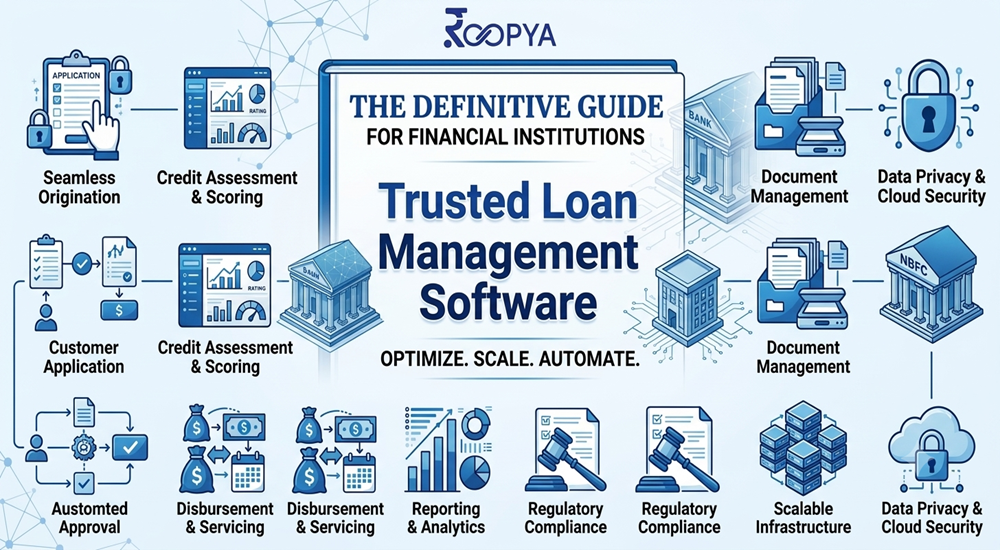
This guide explores what trusted loan management software really means, what it should do, and why Roopya has emerged as the platform of choice for forward-thinking financial institutions across India.
1. What Is Loan Management Software?
Loan management software (LMS) is a comprehensive digital platform that automates, manages, and monitors every stage of the loan lifecycle for a financial institution. Unlike point solutions that address only one aspect — say, a standalone application portal or a basic EMI calculator — a true loan management system is an end-to-end operational layer connecting origination, underwriting, disbursement, repayment, collections, and reporting in a single, unified environment.
The term ‘trusted’ in this context is deliberate. A trusted loan management platform is one that financial institutions, regulators, and borrowers alike can rely on — one where every calculation is transparent and reproducible, every decision is traceable, every compliance requirement is met by design, and every stakeholder interaction is handled with accuracy and integrity.
At Roopya, we define trusted loan management software as a platform that does three things consistently: it never loses a rupee to processing errors, it never misses a regulatory obligation, and it never creates a customer experience that undermines institutional credibility. That is the standard against which we build.
2. Why Financial Institutions Need Purpose-Built Loan Management Software
2.1 The Cost of Legacy Systems
Many financial institutions — particularly mid-tier NBFCs and co-operative banks — are running loan portfolios on a patchwork of legacy systems, custom-built databases, and manual processes. The immediate costs are obvious: slow processing times, error-prone calculations, and high headcount requirements. But the hidden costs are even more damaging. Manual reconciliation errors lead to incorrect outstanding balances. Missed regulatory filings attract RBI penalties. Inconsistent credit policy application creates portfolio risk that materialises only when the economy turns.
A study of NBFC operations in India found that institutions still relying on manual or semi-digital loan management processes spent up to three times more per loan on operational costs compared to fully digitised peers — and carried significantly higher NPAs as a result.
2.2 Regulatory Pressure Is Intensifying
The Reserve Bank of India has progressively tightened its oversight of the lending sector. From the Digital Lending Guidelines of 2022 to the increasing scrutiny of FLDG arrangements, co-lending frameworks, and data localisation requirements, the compliance burden on financial institutions has grown substantially. Manual compliance management is no longer viable at any meaningful scale. Purpose-built loan management software that encodes regulatory requirements directly into its workflows is the only reliable path to sustainable compliance.
2.3 Borrower Expectations Have Transformed
India’s credit consumers — particularly the young, mobile-first demographic driving the retail lending boom — expect the same digital experience from their lender that they get from their food delivery app or e-commerce platform. Real-time loan status updates, digital repayment, instant NOC on closure, WhatsApp-based communication — these are not premium features but baseline expectations. Loan management software that delivers this experience builds genuine institutional trust with borrowers.
2.4 Competition Has Gone Digital
Fintechs and digital lenders with modern technology stacks are competing directly with traditional NBFCs and banks for the same borrower pool. These competitors approve loans in minutes, not days. Their operational costs are a fraction of traditional players. The only sustainable competitive response for established financial institutions is to modernise their loan management infrastructure — and do so with a trusted platform that preserves their institutional advantages (regulatory standing, capital access, relationship networks) while eliminating their operational disadvantages.
3. The Full Loan Lifecycle: What Trusted Loan Management Software Must Cover
A genuinely comprehensive loan management platform covers every stage of the loan journey, not just origination or repayment in isolation. Here is what each stage demands:
Stage 1: Digital Loan Application and Origination
The loan lifecycle begins when a borrower expresses interest. A trusted LMS captures this through a digital, mobile-responsive application interface that guides the borrower through information collection, document upload, and consent management. Smart validation catches errors in real time. The platform stores every piece of application data with a complete audit trail from the first touchpoint.
Roopya supports 20+ pre-configured loan product journeys — covering personal loans, business loans, MSME credit, gold loans, home loans, vehicle loans, and microfinance — meaning institutions can launch any product without building application flows from scratch.
Stage 2: Automated KYC and Identity Verification
Know Your Customer compliance is the gateway to every lending relationship. Modern loan management software integrates directly with Aadhaar eKYC, PAN verification, Digilocker, and video KYC providers to deliver fully digital, RBI-compliant identity verification in under two minutes. Roopya’s platform comes pre-integrated with all major KYC providers through its library of 300+ plug-and-play APIs, eliminating the need for custom integration development.
Stage 3: Credit Bureau Integration and Underwriting
A trusted loan management system automatically pulls credit bureau reports — from CIBIL, Experian, CRIF, or Equifax — parses the output, and feeds it into the credit decisioning engine alongside application data, bank statement analysis, GST data, and other underwriting inputs. The Business Rule Engine (BRE) applies your institution’s credit policy consistently across every application, with no human variability or unconscious bias.
Roopya’s no-code BRE allows credit and risk teams to configure multi-variable decisioning rules through an intuitive visual interface, with no developer involvement required. Rules can be updated in minutes as credit policy evolves — not weeks.
Stage 4: Sanction and Loan Offer Generation
For approved applications, the LMS generates a personalised loan offer — sanctioned amount, tenure, applicable interest rate, fee structure, and detailed EMI schedule — and delivers it to the borrower through their preferred channel: in-app, WhatsApp, SMS, or email. Digital acceptance triggers the documentation workflow automatically.
Stage 5: Digital Documentation and eSign
Loan agreement execution is one of the most friction-heavy stages in traditional lending. Trusted loan management software integrates with eSign providers to enable legally valid, Aadhaar OTP-based or Digilocker-based digital signing. Borrowers sign from their device. The executed agreement is stored securely in the platform with a tamper-proof audit trail. No physical paper, no courier, no branch visit, no delay.
Stage 6: Disbursement Management
Post-sanction, the LMS orchestrates the disbursement workflow — integrating with banking APIs, payment gateways, and NACH mandates to ensure funds reach the borrower’s account accurately and on the agreed timeline. For complex products like home loans or project finance, tranche-based disbursement workflows are fully supported, with each tranche gated by configurable conditions.
Stage 7: Repayment Tracking and EMI Management
This is where many legacy systems fail most visibly. Trusted loan management software maintains a precise, always-current repayment schedule for every loan in the portfolio. It tracks every payment received, matches it to the correct loan and EMI, calculates outstanding principal and accrued interest accurately, and updates each borrower’s account in real time. Automated NACH/ECS mandate management ensures repayment collections happen without manual intervention.
Stage 8: Collections and NPA Management
When EMIs are missed, the LMS activates intelligent collections workflows. Automated escalation sequences — SMS, WhatsApp, IVR, field agent assignment — are triggered by configurable DPD (days past due) thresholds. The platform tracks every collections touchpoint, records promises to pay, and manages legal escalation workflows for chronic defaulters. Portfolio-level NPA monitoring dashboards give credit and collections leadership real-time visibility into portfolio health.
Stage 9: Prepayment, Part-Payment, and Loan Restructuring
Borrowers prepay, make part-payments, or request restructuring at various points in the loan lifecycle. A trusted LMS handles all of these scenarios with accurate interest recalculation, automatic schedule regeneration, and complete audit trails. Regulatory requirements around prepayment charges (RBI guidelines prohibit foreclosure penalties on floating-rate loans) are enforced automatically.
Stage 10: Loan Closure and NOC Generation
At the end of the loan lifecycle, the LMS manages the closure workflow — final balance calculation, security release (hypothecation cancellation, property document return, gold release), and automatic NOC (No Objection Certificate) generation. Digital NOC delivery — via email or WhatsApp — completes the borrower journey on a high note, reinforcing institutional trust.
4. Core Features of Trusted Loan Management Software
4.1 No-Code Configuration Engine
One of the most important capabilities of a trusted loan management platform is the ability for business users — credit managers, operations heads, product teams — to configure products, workflows, and rules without IT dependency. Roopya’s no-code configuration engine lets institutions define loan products, set interest calculation methodologies, configure fee structures, build credit policy rules, and design customer communication workflows entirely through a visual interface. Changes that would take weeks with a development-dependent system happen in hours on Roopya.
4.2 AI-Powered Document Processing
Every loan application generates a substantial document workload: identity documents, address proof, income documents, bank statements, GST returns, property papers. Manually reviewing these is slow, inconsistent, and fraud-prone. Roopya’s AI-powered document processing engine uses OCR and NLP to extract data fields, compute income figures, detect anomalies, and flag potential fraud indicators across all document types — with accuracy exceeding 99%. The platform catches document manipulation that even experienced human reviewers miss.
4.3 Real-Time Analytics and Portfolio Dashboards
Institutional leadership needs real-time visibility into portfolio performance — disbursement volumes, collection efficiency, DPD distribution, NPA ratios, product-level profitability, and channel performance. Trusted loan management software provides configurable dashboards that surface these insights in real time, without waiting for month-end MIS reports. Roopya’s analytics layer allows drill-down from portfolio level to individual loan level in seconds, enabling faster and better-informed decisions.
4.4 Multi-Branch and Multi-Product Architecture
Financial institutions operating across multiple branches, geographies, and product lines need a loan management system that handles this complexity natively. Roopya’s multi-branch architecture allows centralised policy governance with decentralised operations — each branch manages its own portfolio, but credit policy, reporting, and compliance are managed centrally. Multiple loan products coexist on the same platform with product-specific workflows, pricing structures, and decisioning rules.
4.5 Regulatory Compliance by Design
Compliance should be an output of good operations, not a separate overhead. Roopya’s platform encodes RBI requirements directly into its workflows: PMLA-compliant KYC, Digital Lending Guideline adherence, Fair Practice Code enforcement, credit bureau reporting (CIBIL, Experian, CRIF, Equifax), CERSAI registration for secured loans, and GST calculation on fees and charges. Regulatory reports are generated automatically — not assembled manually at month-end.
4.6 Embedded Communication Workflows
Borrower communication throughout the loan lifecycle — application confirmation, sanction letter, disbursement advice, EMI reminders, payment receipts, overdue notices, NOC — is managed within the LMS through configurable, multi-channel communication workflows. WhatsApp Business API, SMS, email, and IVR are all supported. Communication content and timing are fully configurable without developer involvement.
4.7 Co-Lending and Partnership Management
Co-lending arrangements between banks and NBFCs, and FLDG-backed lending partnerships, are increasingly central to the Indian lending landscape. Roopya’s LMS is built to support these models natively — managing split disbursements, proportional repayment allocation, partner-level reporting, and regulatory compliance for co-lending arrangements under the RBI’s Master Direction on Co-Lending.
4.8 Accounting and ERP Integration
Loan management does not exist in isolation from the broader financial operations of an institution. Roopya integrates directly with popular accounting software and ERP systems — Tally, Zoho Books, SAP, and others — ensuring that every loan transaction is automatically reflected in the general ledger without manual data entry. This eliminates reconciliation errors and dramatically reduces the workload on finance teams.
5. Loan Management Software Across Different Financial Institution Types
5.1 NBFCs
NBFCs face a unique combination of competitive pressure and regulatory scrutiny. They compete with banks and fintechs for the same borrowers, while operating under an increasingly demanding regulatory framework. Roopya’s LMS is the platform of choice for NBFCs because it delivers enterprise-grade functionality at a pay-as-you-use price point, with a no-code configuration model that keeps IT costs minimal and product agility maximal. From newly licensed NBFCs launching their first product to established players managing multi-thousand-crore portfolios, Roopya scales seamlessly.
5.2 Microfinance Institutions (MFIs)
Microfinance lending has unique operational requirements: group lending models, Joint Liability Group (JLG) workflows, weekly or fortnightly repayment cycles, and the operational challenge of serving borrowers in low-connectivity rural environments. Roopya’s LMS supports all of these natively — including offline-capable field agent apps, group loan management, and integration with the MFIN and Sa-Dhan reporting frameworks. Customer-facing interfaces are available in multiple regional languages to serve diverse borrower populations.
5.3 Housing Finance Companies (HFCs)
Home loans are among the most operationally complex lending products: long tenors, property valuation and legal verification workflows, tranche-based disbursements, PMAY subsidy management, CERSAI registration, and NHB reporting requirements. Roopya’s LMS handles all of these workflows within a unified platform — eliminating the need for multiple specialist systems that must be manually reconciled.
5.4 Banks — Urban Cooperative and Small Finance
Urban cooperative banks and small finance banks operate under RBI’s direct supervision with mandatory reporting requirements to multiple regulators. Roopya’s LMS delivers the compliance infrastructure these institutions need — automated regulatory reporting, comprehensive audit trails, and real-time portfolio monitoring — while providing the operational efficiency that allows them to compete on service speed and cost.
5.5 Fintech Lenders
Digital-native fintech lenders demand the highest levels of automation, API-first architecture, and scalability. Roopya’s open API layer allows fintech lenders to embed loan management functionality directly into their own product interfaces, orchestrate complex multi-product lending workflows, and scale to high transaction volumes without infrastructure constraints.
6. The Roopya Advantage: Why Financial Institutions Trust Our Platform
1-Day Go-Live — Not 6 Months
Traditional loan management software implementations require months of scoping, development, testing, and deployment — often six to twelve months or more. Roopya eliminates this entirely. Pre-built product journeys, 300+ pre-integrated APIs, and a no-code configuration interface mean most institutions are processing live loans within 24 hours of onboarding. This is not a marketing claim; it is the documented experience of every institution that has gone live on Roopya.
300+ Pre-Integrated APIs — No Development Required
Credit bureaus, KYC providers, eSign platforms, payment gateways, NACH providers, GST data sources, accounting software, banking APIs — all pre-integrated and available out of the box. The average NBFC building these integrations in-house would spend six to twelve months and several crore rupees. On Roopya, they are available from day one.
Truly No-Code — Business Teams in Control
The most powerful feature of Roopya’s platform is that business users — not developers — control it. Credit policy changes, new product launches, workflow modifications, communication template updates — all configurable through Roopya’s visual interface without a single line of code. This gives institutions the agility to respond to market opportunities and regulatory changes immediately, rather than queuing requests with a development team.
Pay-As-You-Use — Aligned With Your Growth
Roopya’s pricing model has no large upfront licence fees. Institutions pay based on what they actually process. A newly licensed NBFC with 50 loans a month pays only for those 50 loans. When they scale to 50,000 loans a month, the platform scales with them and pricing scales proportionally. There is no capital expenditure, no infrastructure provisioning, and no sudden price shock as you grow.
AI and Machine Learning Throughout
AI is not an add-on feature on Roopya — it is embedded throughout the platform. Document processing (99%+ accuracy OCR), ML-based credit scoring models, intelligent collections prioritisation, fraud detection, a self-learning BRE that improves with portfolio data — all standard. These capabilities would cost most institutions years of development and tens of crore in data science investment to build independently.
RBI-Compliant, Always
Roopya’s compliance team tracks every regulatory development from the RBI, NHB, SEBI, and IRDAI that affects the lending sector. Platform updates reflecting new guidelines are shipped proactively, before the compliance deadline. Institutions on Roopya never face a regulatory change that they need to scramble to address — the platform has already adapted.
Trusted by India’s Modern Lenders
IndiaKaLoan, QuickFinShop, Recapita, Findoc, EazyCredit, and a growing cohort of India’s most progressive financial institutions run their loan management operations on Roopya. These are not pilot deployments or proof-of-concepts — they are live, production systems managing real loan portfolios at scale.
7. Selecting Trusted Loan Management Software: Evaluation Criteria
Choosing a loan management system is one of the most consequential technology decisions a financial institution will make. Here is a framework for evaluation:
▸ Breadth of lifecycle coverage: Does the platform manage the entire loan lifecycle from origination to closure, or only selected stages?
▸ Depth of compliance capability: Is RBI compliance built into the platform’s workflows, or does it rely on manual processes layered on top?
▸ Integration ecosystem: How many third-party integrations are pre-built and maintained? Custom integration development is expensive and creates ongoing maintenance risk.
▸ No-code configurability: Can business users manage the platform independently, or is every change a development ticket?
▸ Scalability: Can the platform handle your current volume and your projected volume in three years without re-platforming?
▸ AI and automation depth: Is automation superficial, or does AI genuinely remove manual work from document processing, underwriting, and collections?
▸ Implementation timeline: Will you go live in days or months? Time-to-value is a real cost.
▸ Pricing model: Does the pricing model align with your growth stage and scalability ambitions?
▸ Track record: Who else is running on this platform? Can you speak with reference customers?
8. The Future of Loan Management for Financial Institutions
The evolution of loan management software over the next five years will be driven by four major forces: the Account Aggregator (AA) ecosystem, embedded finance, AI-powered underwriting, and regulatory technology (RegTech).
The Account Aggregator framework — now live with major banks and NBFCs as Financial Information Providers (FIPs) — transforms the underwriting capability of loan management systems. Borrowers can share consented, real-time financial data with their lender directly through the AA layer, enabling lenders to underwrite faster, more accurately, and for thinner-file borrower segments that were previously unserved. Roopya is AA-ready, enabling institutions to leverage this data directly within their decisioning workflows.
Embedded finance — the integration of lending products directly into non-financial platforms — is expanding the origination surface area for every lender. E-commerce platforms offering purchase financing, payroll apps offering salary advances, B2B marketplaces offering working capital — all of these require lenders to deliver their loan management infrastructure as a flexible, API-native service. Roopya’s API-first architecture is built for exactly this model.
AI-powered underwriting will increasingly differentiate lenders not on the basis of their credit policy documents, but on the quality of their data and models. Institutions running on a platform with strong AI foundations — like Roopya — will compound this advantage over time as their models improve with portfolio data.
RegTech is becoming a distinct capability domain. The volume and complexity of regulatory requirements facing Indian financial institutions will continue to grow. Lenders who embed compliance into their operational software — rather than managing it as a manual overlay — will spend less on compliance and face lower regulatory risk.
9. Getting Started With Roopya’s Trusted Loan Management Software
Moving to a new loan management platform is a significant decision, and we understand that trust must be earned through demonstration, not just claimed in marketing material.
Roopya’s onboarding process is designed to earn that trust quickly:
▸ Day 1 — Discovery Call: We understand your institution’s product portfolio, current technology landscape, compliance requirements, and growth objectives.
▸ Day 2 — Platform Demo: A live demonstration of Roopya’s full loan management workflow configured for your specific product types and operational context.
▸ Day 3 to 7 — Configuration and Integration: Your loan products, credit policies, and workflows are configured in Roopya’s no-code environment. Pre-built API integrations are activated.
▸ Day 8 — Go-Live: Your first live loans are processed on the platform, with Roopya’s implementation team available in real time for support.
From discovery to live operations in under two weeks. For institutions running on manual processes or legacy systems, this is a transformation that typically takes a year. Roopya delivers it in days.
If you are ready to give your institution a loan management foundation it can truly trust — and give your borrowers the experience they expect — we invite you to schedule your free demonstration today.

