Loan Management Software for Small NBFCs: Everything You Need to Know Before You Choose

Running a small non-banking financial company in India is equal parts ambition and complexity. You are navigating strict RBI regulations, managing a growing loan portfolio, chasing EMI collections, filing credit bureau reports, and trying to serve borrowers in underserved markets—often with a lean team and limited technology resources. The right loan management software can be the single biggest operational lever you pull in the first five years of your NBFC’s life.
Yet the loan management software market was not built with small NBFCs in mind. Most legacy platforms were designed for large banks and established financial institutions—expensive to license, slow to implement, difficult to configure, and laden with features that a small lender will never use. At the other end of the spectrum, generic accounting tools and spreadsheets break down the moment your portfolio crosses a few hundred accounts.
Start Free Trial
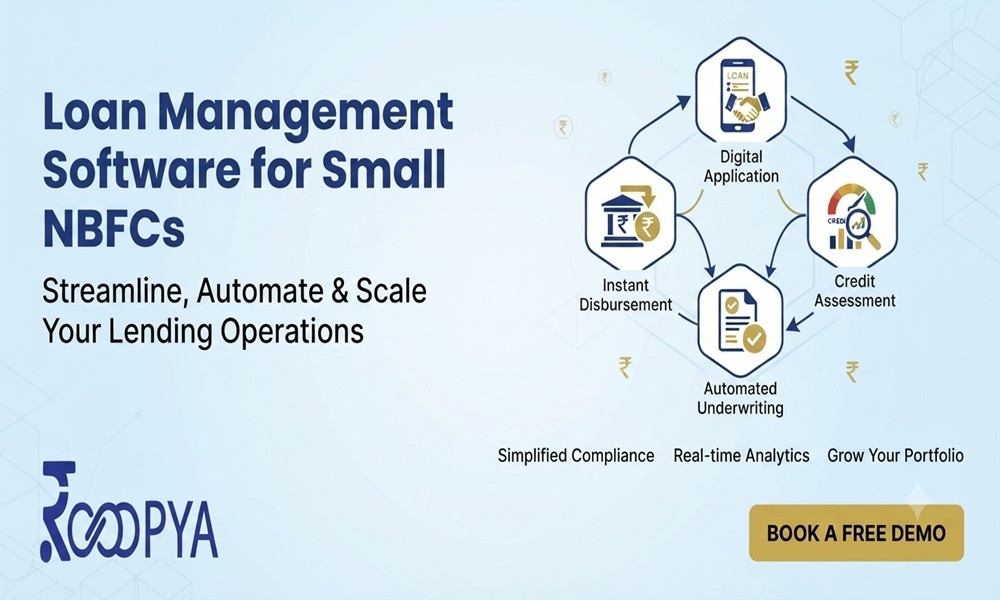
This guide is written specifically for small NBFCs—whether you are newly licensed, scaling from ₹25 crore to ₹200 crore AUM, or transitioning from a manual workflow to a digital-first operation. We will cover what loan management software actually does, the features that matter most for your stage of growth, the common mistakes lenders make when choosing a platform, and how Roopya’s purpose-built solution helps small NBFCs go live in a single day and grow without limits.
1. What Is Loan Management Software—and Why Small NBFCs Need It
Loan management software (LMS) is a digital platform that manages the complete post-disbursement lifecycle of a loan. From the moment a borrower’s account is created and funds are released, an LMS tracks every EMI schedule, records every repayment, manages overdue accounts, generates regulatory reports, and provides real-time visibility into your entire loan portfolio.
For a small NBFC, this matters enormously. Consider what happens without a dedicated loan management system:
- EMI schedules are maintained in spreadsheets that break when a borrower requests a restructuring or foreclosure.
- Collections teams work from manually updated lists, with no real-time visibility into which accounts are overdue.
- Credit bureau reporting—mandatory for every NBFC—requires hours of manual data extraction and formatting each month.
- Interest calculations for irregular repayments, part-payments, and penalty charges are done manually, leading to errors and borrower disputes.
- Audit and inspection readiness requires frantic document retrieval because nothing is systematically logged.
Good loan management software eliminates all of these pain points—systematically, automatically, and at a cost that makes sense for a small NBFC’s economics.
2. The Unique Challenges Small NBFCs Face That Generic Software Cannot Solve
The problems small NBFCs face are distinct from those of large banks. Understanding these distinctions is critical to choosing the right software.
2.1 Regulatory Complexity at Every Stage
Small NBFCs are regulated by the Reserve Bank of India and must comply with a growing body of rules—from the Scale-Based Regulation (SBR) framework to Fair Practice Code requirements, CERSAI registration mandates, credit bureau reporting obligations, and increasingly, data localization and cybersecurity directives. An LMS that does not automate regulatory compliance is not a management tool; it is a liability.
2.2 Lean Teams with Multiple Responsibilities
A small NBFC often has the same person managing collections, customer service, and compliance reporting. Software that requires specialized training or dedicated IT resources is a poor fit. The ideal loan management software for a small NBFC should be intuitive enough for a non-technical team member to operate on day one, powerful enough to handle complex loan structures, and automated enough to reduce repetitive manual work to near zero.
2.3 Diverse Loan Products and Borrower Profiles
Small NBFCs frequently serve borrowers who do not fit the standard credit profile—informal sector workers, micro-entrepreneurs, rural households, and first-time borrowers. Their loan products may include microfinance, gold loans, agricultural credit, small business loans, and personal loans. Each product has distinct EMI structures, interest methodologies, prepayment rules, and regulatory treatment. A one-size-fits-all LMS will not handle this diversity.
2.4 Cost Sensitivity and Capital Constraints
A small NBFC cannot afford a ₹50 lakh implementation with a 12-month go-live timeline. Technology investment must deliver ROI quickly, with pricing that scales proportionally with business volume. Pay-as-you-use models are far better suited to small NBFCs than large upfront licenses.
2.5 Growth Aspirations
A small NBFC today may be a mid-size NBFC in three years. The loan management software chosen now must be capable of scaling—handling ten times the loan accounts, supporting new product lines, integrating with co-lending partners, and accommodating regulatory changes—without requiring a platform migration.
3. Core Features Your Loan Management Software Must Have
3.1 Automated EMI Scheduling and Repayment Tracking
The most fundamental function of any LMS is accurate EMI computation and repayment tracking. This means support for reducing balance and flat-rate interest methods, flexible repayment frequencies (monthly, weekly, fortnightly, and daily), automatic generation of repayment schedules at disbursement, real-time recording of repayments with date, amount, and mode, and automatic recalculation of schedules on prepayment, restructuring, or moratorium. Roopya’s loan management module handles all of these automatically, with no manual calculation required.
3.2 Collections Workflow and Overdue Management
Collections is where small NBFCs lose the most money—not because borrowers do not want to pay, but because follow-up is manual, inconsistent, and poorly timed. A good LMS automates the entire collections workflow: identifying overdue accounts automatically, triggering WhatsApp, SMS, and email reminders at configurable intervals, generating field collection lists sorted by geography and overdue amount, tracking collection agent activities and outcomes, and computing penal interest and late payment charges automatically. Roopya’s collections module includes a mobile app for field agents, allowing real-time payment recording and GPS-tagged collection visits.
3.3 Credit Bureau Reporting
Every NBFC is required to submit credit bureau data to at least one of CIBIL, Experian, CRIF, or Equifax on a monthly basis. Manual bureau reporting is one of the most time-consuming and error-prone activities in a small NBFC’s compliance calendar. Good loan management software generates bureau-ready data files automatically—in the correct format for each bureau—directly from your live portfolio data, with zero manual extraction. Roopya’s bureau reporting module supports all four major bureaus and generates submission-ready files with a single click.
3.4 Loan Accounting and GL Integration
Every loan transaction—disbursement, repayment, interest accrual, penalty charge, write-off—must be reflected in your accounting system accurately. Many small NBFCs manage this manually, creating a persistent reconciliation headache. A good LMS either includes a built-in loan accounting engine or integrates cleanly with your existing accounting software (Tally, SAP, Zoho Books). Roopya offers native Tally integration, automatically posting all loan transactions to the correct GL heads without manual journal entries.
3.5 Regulatory Compliance and Audit Trail
RBI inspections, internal audits, and statutory audits all require comprehensive documentation of every action taken on every loan account. A good LMS maintains a complete, immutable audit log—who did what, when, and why—for every loan event. It also automates key compliance outputs: CERSAI registration and satisfaction filings, NOC generation, foreclosure statements, and interest certificates. Roopya’s compliance module keeps your NBFC audit-ready at all times, without any special preparation.
3.6 No-Code Configuration for Loan Products
Your loan products will evolve. Interest rates change. New product variants are launched. Regulatory requirements modify eligible tenures or LTV ratios. Every time your product configuration changes, you should not need to raise a ticket with a software vendor and wait weeks for implementation. A no-code product configuration interface—where your team can define and modify loan product parameters, EMI structures, fees, and charges—is not a luxury for a small NBFC; it is a necessity. Roopya’s no-code product engine lets you launch or modify any loan product in hours, not weeks.
3.7 Real-Time Portfolio Dashboard and MIS Reporting
Management information is the lifeblood of a small NBFC. Founders and senior managers need instant visibility into AUM, disbursement volumes, collection efficiency, NPA trends, product-wise performance, and geography-wise portfolio quality. A good LMS provides real-time dashboards and configurable MIS reports—eliminating the hours of manual data extraction and Excel-based reporting that consume team bandwidth every week. Roopya’s analytics module delivers 50+ pre-built MIS reports accessible on mobile and desktop, with custom report creation requiring no technical skills.
3.8 Foreclosure, Restructuring, and Part-Payment Handling
Loan portfolio management is rarely as clean as the original schedule. Borrowers foreclose early, request EMI deferrals, make partial payments, or need their loans restructured after financial distress. Every one of these events requires accurate recalculation of outstanding principal, accrued interest, pending penalties, and updated schedules. A good LMS handles all of these scenarios automatically, generating accurate statements and updated schedules in seconds. Roopya processes foreclosures, restructurings, and part-payments with full audit trails and automatic document generation.
3.9 Multi-Branch and Multi-Product Support
Even a small NBFC may operate across multiple branches or geographies. Your LMS should provide branch-level portfolio visibility, centralized management controls, and consistent policy application across all locations—without requiring separate instances or complex configurations. Roopya’s multi-branch architecture lets you manage 1 branch or 100 from a single platform.
3.10 Secure, Cloud-Based Architecture
A cloud-based LMS eliminates the need for on-premise server infrastructure, dramatically reduces the IT maintenance burden, and ensures your data is protected with enterprise-grade security—encryption at rest and in transit, role-based access controls, multi-factor authentication, and regular security audits. For a small NBFC without a dedicated IT team, cloud infrastructure is the only sensible choice. Roopya operates on a secure cloud architecture that meets RBI’s data localization requirements, with all data stored on Indian servers.
4. What Good Loan Management Software Looks Like in Practice: A Day in the Life
To understand the real value of a good LMS, it helps to see what a typical working day looks like for a small NBFC team running on Roopya’s platform.
- Morning: The collections manager opens the Roopya dashboard and sees an automatically generated list of accounts due today and overdue accounts from the past 7 days. Automated WhatsApp reminders have already gone out to borrowers with EMIs due today. The field collection team has received their route-optimized collection lists on their mobile app.
- Late Morning: A borrower calls to request foreclosure of their loan. The operations staff opens the account in Roopya, generates an instant foreclosure statement with outstanding principal, accrued interest, and applicable charges, collects payment, and closes the account. The system automatically updates the portfolio, posts the accounting entry, and schedules the bureau update. Total time: 4 minutes.
- Afternoon: The compliance officer runs the monthly credit bureau report. Roopya generates the bureau submission file for CIBIL and Experian in the correct format, directly from live portfolio data. The officer reviews and submits. Total time: 15 minutes. Previously this took 2 days of manual work.
- End of Day: The founder reviews the real-time portfolio dashboard—total AUM, today’s disbursements, collection efficiency for the month, and branch-level NPA trends. No data extraction required. The dashboard is live and current.
This is not an aspirational scenario. This is what Roopya customers experience every day.
5. Common Mistakes Small NBFCs Make When Choosing Loan Management Software
Mistake 1: Choosing on Price Alone
The cheapest loan management software is rarely the most economical. Hidden implementation costs, expensive customization requirements, poor support, and the operational cost of working around software limitations consistently exceed the savings on the license fee. Evaluate the total cost of ownership over three years, not just the monthly subscription.
Mistake 2: Choosing a Platform Built for Banks
Enterprise banking software is built for institutions with dedicated IT departments, months-long implementation budgets, and highly standardized loan products. A small NBFC has none of these. Choosing a bank-grade platform means paying for features you will never use, waiting months for go-live, and depending on the vendor for every configuration change.
Mistake 3: Underestimating the Importance of Bureau Reporting
Many small NBFCs discover the importance of automated bureau reporting only after they have received a regulatory notice or discovered errors in their historical submissions. Bureau reporting should be a core evaluation criterion, not an afterthought.
Mistake 4: Ignoring Scalability
A platform that meets your needs at ₹30 crore AUM may buckle at ₹300 crore. Before signing any contract, understand exactly how the platform scales—in terms of loan accounts, users, product complexity, and integration depth. Ask for customer references at the scale you expect to reach in three years.
Mistake 5: Treating Implementation as a Technology Project
The best loan management software implementations are led by the business team, not an IT team. If the vendor cannot onboard your operations staff in days without deep technical training, that is a warning sign. Roopya’s onboarding process is designed to have your team fully operational in 24 hours, with ongoing support that does not require technical expertise to access.
6. How Roopya’s Loan Management Software Is Built for Small NBFCs
Roopya is not a generic lending platform that has been adapted for NBFCs. It was designed from the ground up for Indian lenders—understanding India’s regulatory environment, the product diversity of NBFC portfolios, the team structures of small lending businesses, and the cost sensitivities of lenders at early stages of growth.
Built for Indian Regulations
Roopya’s compliance module is maintained and updated continuously by a team that monitors RBI circulars and regulatory changes in real time. Whether it is a new bureau reporting format, a change in the Fair Practice Code, or updated CERSAI filing requirements, Roopya handles the compliance update—your team does not need to know it happened.
20+ Pre-Configured Loan Products
Roopya ships with pre-configured product templates for the most common NBFC loan products—personal loans, gold loans, MSME loans, microfinance (JLG), vehicle loans, home loans, and salary advance products. Your team can launch any of these products the same day you onboard, with full EMI computation, collections automation, and bureau reporting configured out of the box.
300+ Pre-Integrated APIs
Collections payment modes, KYC providers, bureau connections, eSign platforms, accounting software, and banking APIs are all pre-integrated. You do not need a technology team or an integration project to connect Roopya to the tools your NBFC already uses. Everything works out of the box.
Pay-As-You-Use Pricing
Roopya’s pricing model is designed for small NBFCs. There are no large upfront license fees, no implementation cost surprises, and no charges for features you are not using. You pay based on what you process, which means the platform becomes more cost-effective as your business grows—not more expensive.
1-Day Go-Live
Roopya’s no-code configuration and pre-built product templates mean that most small NBFCs are processing live loans within 24 hours of signing up. There is no multi-month implementation project, no expensive consulting engagement, and no lengthy UAT cycle. Your team is operational the next day.
Dedicated Support for Small NBFCs
Roopya provides dedicated onboarding support, ongoing operational assistance, and regulatory update notifications as standard. When you have a question about bureau reporting or need to configure a new loan product, you are talking to a team that understands NBFC operations—not a generic helpdesk.
7. Loan Management Software vs. Loan Origination System: What Small NBFCs Need First
Many small NBFCs ask whether they should prioritize a Loan Origination System (LOS) or a Loan Management System (LMS). The honest answer is you need both, ideally on the same platform.
A loan origination system manages the pre-disbursement process—application capture, KYC, credit assessment, approval, and documentation. A loan management system takes over post-disbursement—EMI scheduling, repayment tracking, collections, and reporting.
Running separate systems for origination and management creates data silos, reconciliation problems, and operational complexity. Roopya provides a unified platform covering the complete loan lifecycle—from the first touch with a borrower’s application all the way through to loan closure—eliminating the integration headaches that come with patchwork technology stacks.
8. The ROI of Loan Management Software for a Small NBFC
The business case for investing in a good LMS is straightforward. Consider a small NBFC with 500 active loan accounts:
- Without LMS: 2 staff members spend approximately 60 hours per month on manual EMI reconciliation, bureau data extraction, and MIS reporting. That is ₹60,000–90,000 per month in labor costs, plus errors that create NPA under-reporting and regulatory risk.
- With Roopya LMS: The same tasks are automated. Staff time on these activities drops to approximately 5 hours per month. The saved capacity is redirected to collections and business development. Bureau reporting errors go to zero.
- Collections improvement: Automated EMI reminders via WhatsApp and SMS consistently improve collection efficiency by 8–15%. On a ₹50 crore portfolio, even a 5% improvement in collection efficiency translates to ₹25 lakh in reduced NPA exposure annually.
- Compliance cost reduction: Avoiding even one regulatory notice—which carries financial penalties and reputational consequences—more than pays for an annual LMS subscription.
The ROI of the right loan management software for a small NBFC is not marginal. It is transformative.
9. What to Look for When Evaluating Loan Management Software: A Checklist for Small NBFCs
- Does it support all the loan products in my current and planned portfolio?
- Can it handle all repayment frequencies and interest methodologies I use?
- Does it automate credit bureau reporting for CIBIL, Experian, CRIF, and Equifax?
- Is bureau reporting accurate and submission-ready without manual data manipulation?
- Does it integrate with my accounting software (Tally, Zoho, SAP)?
- Is there a mobile app for field collection agents?
- Can I configure and launch new loan products without vendor involvement?
- Does it provide real-time portfolio dashboards and MIS reports out of the box?
- What is the implementation timeline, and what does onboarding look like?
- Is pricing usage-based, or am I paying a large upfront licence fee?
- Is the vendor actively maintaining compliance with the latest RBI requirements?
- Can I speak to reference customers at a similar scale and product profile to mine?
10. Trusted by Small NBFCs Across India—Roopya in Action
Roopya’s loan management platform is trusted by a growing number of NBFCs, MFIs, and fintech lenders across India—including IndiaKaLoan, QuickFinShop, Recapita, Findoc, and EazyCredit. These are lenders who chose Roopya because it delivered what their previous solutions could not: fast implementation, automated compliance, and a platform that actually fits how a small NBFC operates.
If you are a small NBFC looking for loan management software that goes live in a day, automates your bureau reporting, handles your collections workflows, and scales as you grow—Roopya is built for you. Book a free demo and see the platform live, with your loan products configured, in under 30 minutes.

